Jump to Content
Hybrid Smart Parking Platform Market - Size, Share, Industry Trends, and Forecasts (2024 - 2031)
Hybrid Smart Parking Platform Market Size:
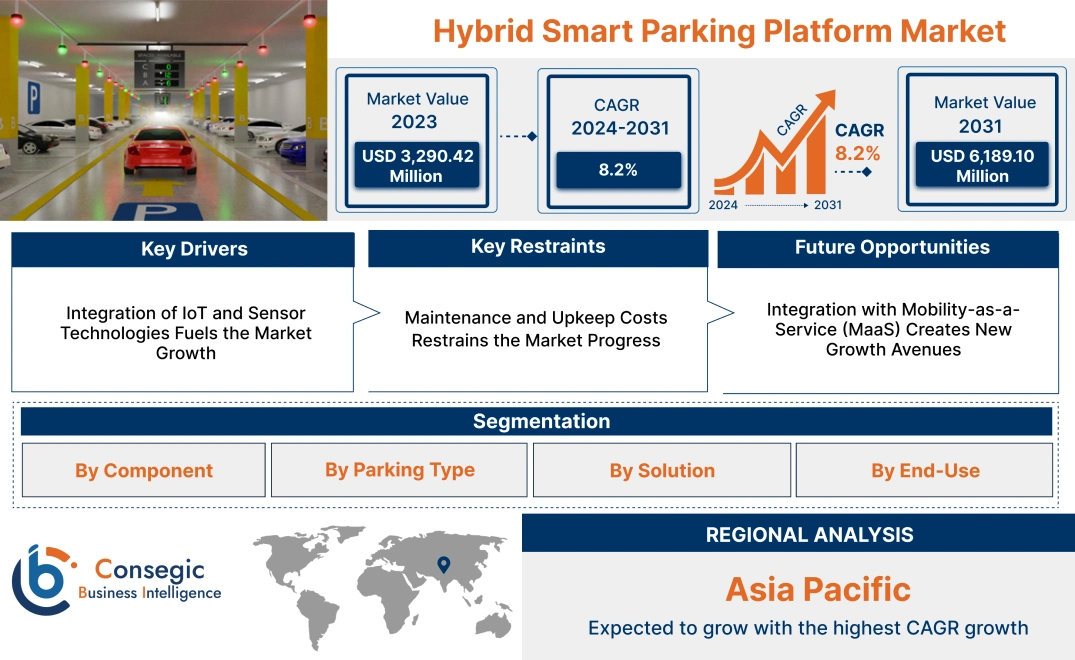
Hybrid Smart Parking Platform Market size is estimated to reach over USD 6,189.10 Million by 2031 from a value of USD 3,290.42 Million in 2023 and is projected to grow by USD 3,502.19 Million in 2024, growing at a CAGR of 8.2% from 2024 to 2031.
Hybrid Smart Parking Platform Market Scope & Overview:
A hybrid smart parking platform is a system that combines on-premises and cloud-based technologies to manage and optimize parking operations. It integrates IoT sensors, automated payment systems, and real-time data analytics to provide efficient and scalable parking management solutions. This dual architecture ensures flexibility, reliability, and enhanced functionality by maintaining essential processes locally while utilizing cloud resources for advanced analytics and remote management.
These platforms are equipped with features like real-time parking availability updates, mobile app integration, and predictive analytics to enhance user convenience and operational efficiency. The hybrid setup ensures data security and uninterrupted services, supporting multiple payment options and improving accessibility for users.
End-users of hybrid smart parking platforms include municipalities, commercial parking operators, and corporate facilities, where efficient parking management is essential for reducing congestion and streamlining operations. These platforms play a pivotal role in modernizing parking infrastructure and ensuring seamless parking experiences.
Hybrid Smart Parking Platform Market Dynamics - (DRO) :
Key Drivers:
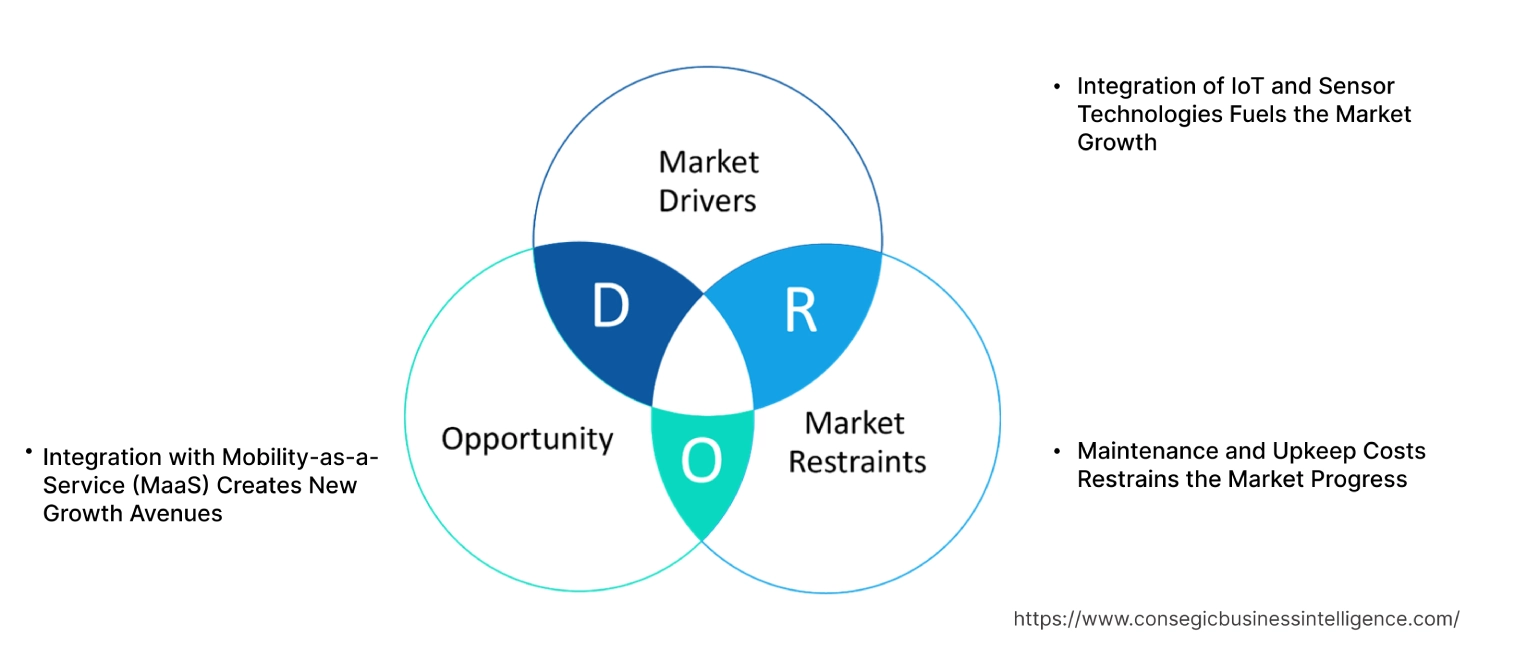
Integration of IoT and Sensor Technologies Fuels the Market Growth
The integration of IoT and sensor technologies is transforming the parking landscape by enabling real-time monitoring, automated operations, and improved user experiences. IoT-powered systems allow continuous communication between parking sensors, gateways, and centralized platforms, facilitating real-time data collection and analysis. Advanced sensors help detect vehicle presence, guide drivers to vacant spots, and automate ticketing processes, reducing waiting times and enhancing efficiency. Hybrid parking platforms benefit significantly from IoT integration, as they enable seamless scalability and adaptability for both urban and commercial facilities. These technologies also allow predictive analytics to optimize parking space utilization and reduce operational costs. With growing urbanization and demand for smart infrastructure, the adoption of IoT-driven parking solutions aligns with trends in automation and connected mobility, offering operators and users a seamless and technology-enhanced experience. Thus, the aforementioned factors fuels the hybrid smart parking platform market growth.
Key Restraints :
Maintenance and Upkeep Costs Restrains the Market Progress
Hybrid parking systems rely heavily on advanced hardware components such as sensors, cameras, and IoT gateways to ensure efficient operation. However, these components require routine maintenance to maintain functionality and accuracy, adding to operational costs. Regular upkeep involves cleaning, calibrating, and replacing faulty parts, which are both time-consuming and expensive.
Additionally, servicing these systems often leads to temporary downtime, disrupting parking operations and impacting user experience. For smaller operators with limited budgets, the cumulative costs of maintenance, coupled with potential revenue losses during system downtime, pose significant financial constraints. The need for skilled technicians to handle complex hardware further escalates expenses, deterring widespread adoption in cost-sensitive regions. These factors highlight the operational hurdles associated with maintaining hybrid parking platforms, particularly in environments with heavy usage or harsh weather conditions that accelerate wear and tear, limiting the hybrid smart parking platform market demand.
Future Opportunities :
Integration with Mobility-as-a-Service (MaaS) Creates New Growth Avenues
The integration of hybrid parking platforms with Mobility-as-a-Service (MaaS) solutions is unlocking significant opportunities in urban mobility ecosystems. By providing a unified interface, these platforms enable users to seamlessly plan their journeys, locate parking spaces, and make payments within a single application. This integration enhances user convenience, streamlining transitions between different modes of transportation, such as cars, public transit, and shared mobility services.
Additionally, hybrid platforms leveraging MaaS solutions will offer real-time updates on parking availability, pricing, and alternative transportation options, reducing congestion and improving urban mobility. Cities prioritizing smart transportation systems and integrated mobility ecosystems benefit from this approach, as it supports sustainability goals by encouraging efficient parking and transit usage. This alignment with trends in urban innovation and digital mobility fosters opportunities for operators to expand services and collaborate with other transportation stakeholders, enhancing the overall value proposition of hybrid parking solutions. Thus, the aforementioned factors are boosting hybrid smart parking platform market opportunities.
Hybrid Smart Parking Platform Market Segmental Analysis :
By Component:
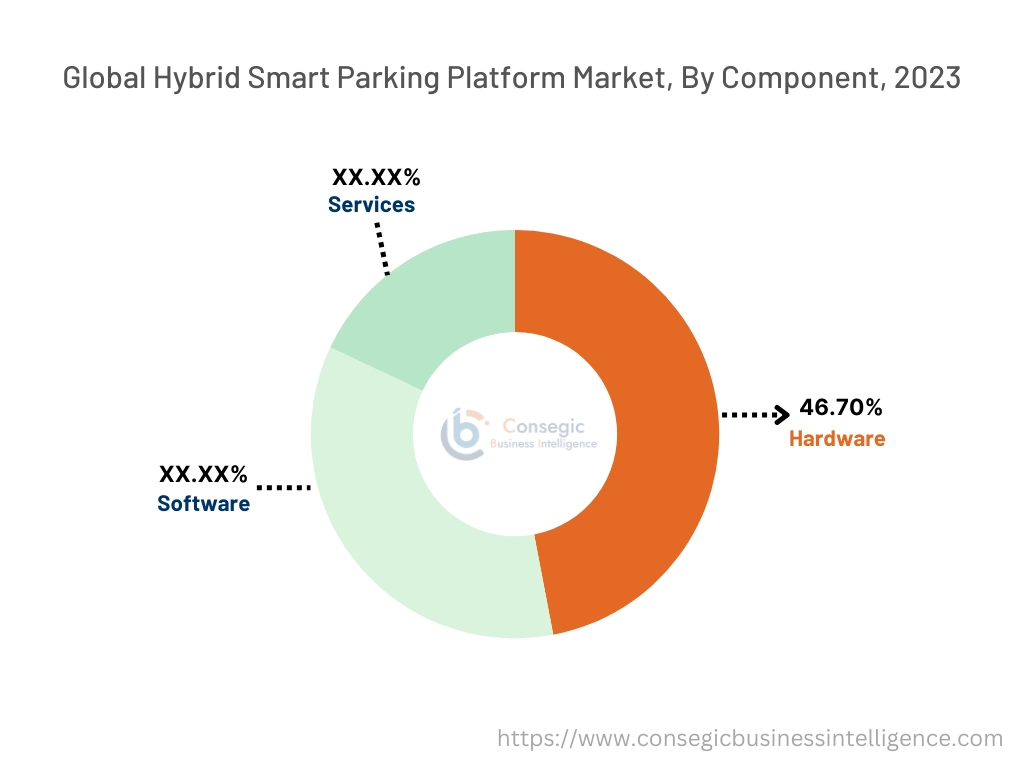
Based on component, the market is segmented into hardware, software, and services.
The hardware segment held the largest revenue of 46.70% of the total hybrid smart parking platform market share in 2023.
- Hardware components such as sensors, cameras, and gateways play a critical role in enabling real-time parking space monitoring and vehicle tracking.
- The rising adoption of advanced devices like license plate recognition systems and automated barriers enhances the efficiency of parking operations.
- Continuous advancements in IoT-enabled hardware components contribute to the operational reliability and scalability of hybrid smart parking platforms.
- The dominance of hardware reflects its essential role in creating the infrastructure required for automated and hybrid parking solutions, fueling the hybrid smart parking platform market expansion.
The services segment is expected to grow at the fastest CAGR during the forecast period.
- Consulting services help clients implement customized parking solutions tailored to their specific needs and operational challenges.
- Integration services ensure seamless connectivity between parking hardware, software, and existing IT ecosystems.
- Maintenance and support services ensure uninterrupted operations by addressing hardware malfunctions and software upgrades efficiently.
- As per hybrid smart parking platform market analysis, the growth of this segment is fueled by the increasing complexity of smart parking platforms, necessitating expert assistance for installation and ongoing management.
By Parking Type:
Based on parking type, the market is segmented into off-street parking and on-street parking.
The off-street parking segment held the largest revenue of the total hybrid smart parking platform market share in 2023.
- Off-street parking facilities, such as multi-level garages and parking lots, are highly suitable for implementing advanced parking systems.
- These facilities enable the use of sophisticated technology like valet management and automated entry systems, enhancing user convenience.
- The growing number of commercial establishments and urban infrastructure projects boosts the adoption of off-street parking solutions.
- As per hybrid smart parking platform market trends, the dominance of this segment reflects the increasing preference for controlled environments for parking operations.
The on-street parking segment is expected to grow at the fastest CAGR during the forecast period.
- On-street parking solutions are widely adopted by municipalities to manage urban traffic congestion and optimize space utilization.
- Mobile app integration for locating and reserving on-street parking spaces contributes to its growing adoption.
- The segment’s growth is supported by government initiatives to digitize parking spaces in urban areas for improved efficiency.
- The rapid adoption of on-street parking reflects its role in addressing the increasing challenges of urban parking, which further drives the hybrid smart parking platform market demand.
By Solution:
Based on the solution, the market is segmented into license plate recognition, security and surveillance, parking reservation management, and valet parking management.
The license plate recognition segment held the largest revenue share in 2023.
- License plate recognition systems are critical for enabling automated entry and exit, reducing wait times and manual intervention.
- These systems enhance security by verifying vehicle information in real time and preventing unauthorized access.
- The growing deployment of smart parking systems in commercial and government facilities supports the adoption of license plate recognition solutions.
- The dominance of this segment reflects its effectiveness in streamlining parking operations and enhancing user convenience, contributing the hybrid smart parking platform market growth.
The parking reservation management segment is expected to grow at the fastest CAGR during the forecast period.
- Parking reservation solutions enable users to book parking spots in advance, reducing search times and traffic congestion.
- Integration with mobile apps and online platforms facilitates seamless user experiences and operational efficiency.
- The segment’s growth is driven by the increasing adoption of real-time booking solutions across commercial and residential spaces.
- The rapid adoption of this segment reflects its role in improving user satisfaction and optimizing parking resource utilization, boosting the hybrid smart parking platform market expansion.
By End-Use:
Based on end-use, the market is segmented into commercial, residential, and government facilities.
The commercial segment held the largest revenue share in 2023.
- Commercial establishments such as shopping malls, office complexes, and entertainment hubs are increasingly adopting hybrid parking platforms to enhance customer experiences.
- The integration of parking solutions with loyalty programs and payment systems adds value for end-users.
- The dominance of this segment reflects its significant contribution to revenue generation in urban and suburban areas.
- As per hybrid smart parking platform market analysis, the segment’s leadership is supported by the growing adoption of automated parking solutions in high-traffic commercial spaces.
The residential segment is expected to grow at the fastest CAGR during the forecast period.
- Residential complexes and gated communities are integrating smart parking solutions to enhance security and optimize parking space allocation.
- The increasing focus on sustainability drives the adoption of parking solutions that minimize energy consumption and traffic disruptions.
- The rapid growth of this segment reflects its relevance in improving parking experiences for residential users.
- As per the market analysis, the segment’s expansion is supported by the rising demand for smart home solutions and integrated residential infrastructure, which creates new hybrid smart parking platform market opportunities.
Regional Analysis:
The regions covered are North America, Europe, Asia Pacific, the Middle East and Africa, and Latin America.
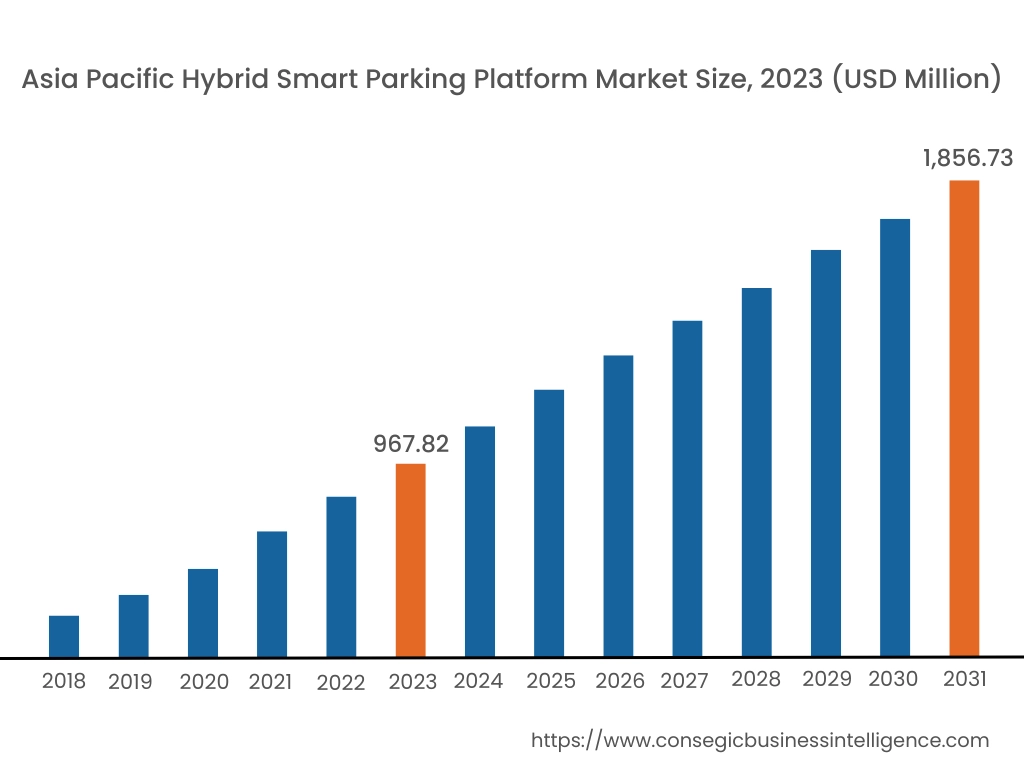
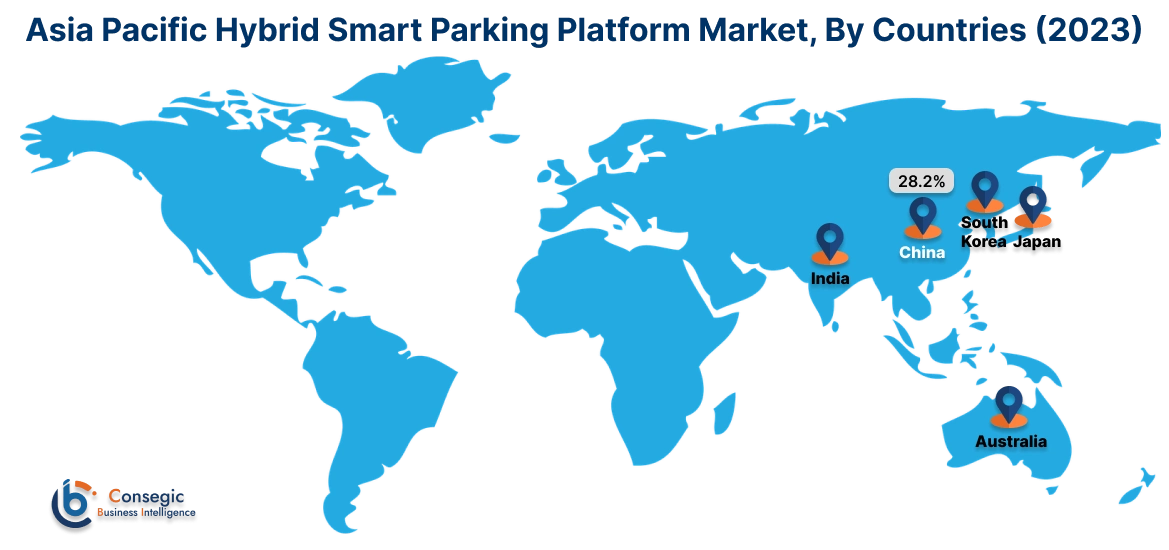
Asia Pacific region was valued at USD 967.82 Million in 2023. Moreover, it is projected to grow by USD 1,031.82 Million in 2024 and reach over USD 1,856.73 Million by 2031. Out of which, China accounted for the largest share of 28.2% in 2023. The Asia-Pacific region is experiencing rapid development in the hybrid smart parking platform market, driven by industrialization and technological advancements in countries such as China, Japan, and India. The proliferation of vehicles and the expansion of urban areas have intensified the demand for efficient parking management systems. As per hybrid smart parking platform market trends, government initiatives promoting digital transformation and smart city projects further influence market trends.
North America is estimated to reach over USD 2,036.21 Million by 2031 from a value of USD 1,093.71 Million in 2023 and is projected to grow by USD 1,163.11 Million in 2024. This region commands a significant portion of the hybrid smart parking platform market, driven by rapid urbanization and the adoption of smart city initiatives. The United States, in particular, has seen extensive implementation of these platforms to address urban parking challenges and reduce traffic congestion. The trend towards integrating Internet of Things (IoT) devices and data analytics into parking systems is notable, enhancing real-time monitoring and management capabilities.
Europe represents a substantial portion of the global hybrid smart parking platform market, with countries like Germany, France, and the United Kingdom leading in adoption and innovation. The region's strong emphasis on environmental sustainability and efficient urban mobility has propelled the utilization of smart parking solutions. Analysis indicates a growing trend towards the deployment of parking platforms that integrate electric vehicle (EV) charging stations, aligning with the region's green initiatives.
The Middle East & Africa region shows a growing interest in hybrid smart parking platforms, particularly in the telecommunications and government sectors. Countries like the United Arab Emirates and South Africa are investing in advanced parking technologies to support urbanization and improve traffic management. Analysis suggests an increasing trend towards adopting platforms that offer real-time parking availability and reservation systems, enhancing user convenience.
Latin America is an emerging market for hybrid smart parking platforms, with Brazil and Mexico being key contributors. The region's growing urban population and initiatives to promote technological innovation have spurred the adoption of smart parking solutions. Government policies aimed at modernizing infrastructure and enhancing urban mobility influence market trends.
Top Key Players and Market Share Insights:
The Hybrid Smart Parking Platform market is highly competitive with major players providing products and services to the national and international markets. Key players are adopting several strategies in research and development (R&D), product innovation, and end-user launches to hold a strong position in the global Hybrid Smart Parking Platform market. Key players in the Hybrid Smart Parking Platform industry include -
- Streetline (USA)
- Libelium (Spain)
- Huawei Technologies (China)
- Acer Inc. (Taiwan)
- Robert Bosch GmbH (Germany)
- Tata Elxsi (India)
- IPS Group (USA)
- Kapsch TrafficCom (Austria)
- NuPark (USA)
- Siemens (Germany)
Recent Industry Developments :
Partnerships & Collaborations:
- In October 2024, Comcast Smart Solutions announced partnerships with Umojo and eleven-x to enhance parking management technologies. This collaboration aims to reduce congestion, optimize curb space, and improve the driver experience by integrating Umojo's Parking Management System and eleven-x's eXactpark platform. These solutions provide real-time data analytics, streamlined operations, and actionable insights for property managers and city planners.
- In June 2024, ABM partnered with Rezcomm to upgrade the ABM Vantage platform, integrating advanced parking reservations, analytics, and customer engagement tools. The enhanced platform offers over 50 interconnected modules, supporting real-time management, personalized experiences, and sustainability initiatives like EV charging. Targeting industries like aviation and real estate, the scalable solution simplifies parking operations and improves user experiences.
Hybrid Smart Parking Platform Market Report Insights :
| Report Attributes | Report Details |
| Study Timeline | 2018-2031 |
| Market Size in 2031 | USD 6,189.10 Million |
| CAGR (2024-2031) | 8.2% |
| By Component |
|
| By Parking Type |
|
| By Solution |
|
| By End-Use |
|
| By Region |
|
| Key Players |
|
| North America | U.S. Canada Mexico |
| Europe | U.K. Germany France Spain Italy Russia Benelux Rest of Europe |
| APAC | China South Korea Japan India Australia ASEAN Rest of Asia-Pacific |
| Middle East and Africa | GCC Turkey South Africa Rest of MEA |
| LATAM | Brazil Argentina Chile Rest of LATAM |
| Report Coverage |
|
Key Questions Answered in the Report
How big is the Hybrid Smart Parking Platform Market? −
Hybrid Smart Parking Platform Market size is estimated to reach over USD 6,189.10 Million by 2031 from a value of USD 3,290.42 Million in 2023 and is projected to grow by USD 3,502.19 Million in 2024, growing at a CAGR of 8.2% from 2024 to 2031.
What specific segmentation details are covered in the Hybrid Smart Parking Platform Market report? +
The Hybrid Smart Parking Platform Market report covers segmentation based on Component, which includes hardware, software, and services. It also covers Parking Type, including off-street and on-street parking. Additionally, the report segments solutions into license plate recognition, security and surveillance, parking reservation management, and valet parking management. The market is further segmented by End-Use, such as commercial, residential, and government facilities, and by Region, covering Asia-Pacific, Europe, North America, Latin America, and the Middle East & Africa.
Which is the fastest-growing segment in the Hybrid Smart Parking Platform Market? +
The Parking Reservation Management segment is expected to grow at the fastest CAGR during the forecast period. This growth is driven by the increasing adoption of real-time booking solutions across both commercial and residential spaces, which enhances user convenience and optimizes parking resource utilization.
Who are the major players in the Hybrid Smart Parking Platform Market? +
Key players in the Hybrid Smart Parking Platform Market include Streetline (USA), Libelium (Spain), Tata Elxsi (India), IPS Group (USA), Kapsch TrafficCom (Austria), NuPark (USA), Siemens (Germany), Huawei Technologies (China), Acer Inc. (Taiwan), and Robert Bosch GmbH (Germany).
Overview
Reputation & Certifications


Our Services
- Market Intelligence & Forecasting
- Custom Research Solutions
- Market Entry Strategy
- Competitive Intelligence
- Customer Insights
- Industry Innovation Analysis
- Investment Advisory