Jump to Content
Smart Learning Market - Size, Share, Industry Trends, and Forecasts (2025-2032)
Smart Learning Market Size:
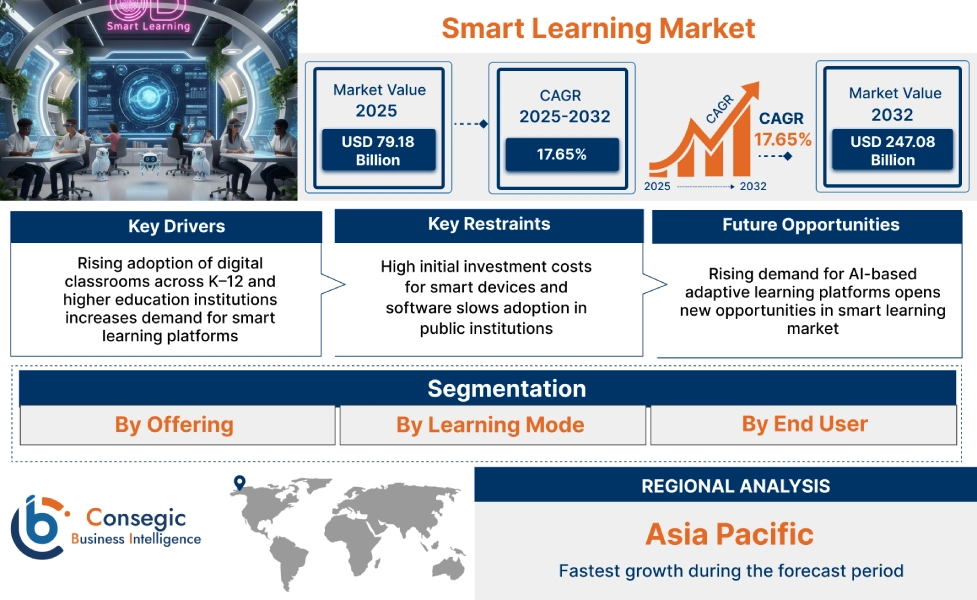
Smart Learning Market size is estimated to reach over USD 247.08 Billion by 2032 from a value of USD 66.15 Billion in 2024 and is projected to grow by USD 79.18 Billion in 2025, growing at a CAGR of 17.65% from 2025 to 2032
Smart Learning Market Scope & Overview:
Smart learning is a learning delivery process that uses digital technologies, connected devices, and data-driven platforms to deliver interactive and flexible learning experiences in educational and corporate settings. The smart learning system works by facilitating virtual classrooms, learning management systems, adaptive content delivery, performance measurement, and real-time collaboration between teachers and learners. The smart learning system uses cloud-based software, artificial intelligence engines, analytics engines, and connected devices that facilitate personalized learning paths, content management, and continuous assessment in educational institutions and corporate learning centers.
Further, the key factors contributing to the growth of the smart learning market include the rising demand for distance learning models, the increasing digital infrastructure in educational institutions, and the adoption of data-driven learning solutions. In addition, smart learning platforms offer several benefits, such as flexible access to content, improved learner engagement, measurable performance insights, and streamlined course management. The smart learning market is growing steadily due to the continuous digital transformation in the global education and corporate training environment.
How is the Smart Learning Market Affected by AI?
AI uses machine learning algorithms and analytics to process learning data with higher accuracy and speed, thus enhancing content personalization and performance analysis in smart learning systems. AI-based systems use past academic performance, current engagement levels, and test results, which helps in adaptive learning and content suggestions. Moreover, AI-based systems provide automated grading, intelligent tutoring, and chat support, which helps in improving learner support and minimizing the burden of educators.
Further, AI enables continuous performance tracking by identifying learning gaps and predicting academic outcomes, which strengthens early intervention strategies. It also supports natural language processing in virtual classrooms to generate transcripts, summarize sessions, and extract performance insights. This shift toward data-driven and adaptive education models improves learning effectiveness, operational efficiency, and scalability of digital education systems, which supports the steady expansion of the smart learning market.
Smart Learning Market Dynamics - (DRO):
Key Drivers:
Rising adoption of digital classrooms across K–12 and higher education institutions increases demand for smart learning platforms
The development of digital classroom infrastructure is also fueling the dependence on connected learning platforms and virtual content delivery systems. Educational institutions are adopting learning management systems, interactive displays, and cloud-based collaboration solutions to facilitate hybrid and online learning. Moreover, digital classrooms also facilitate centralized content management and real-time performance tracking, which enhances teaching planning. The smart learning market is expanding due to the institutional shift toward technology-enabled education delivery models.
- For instance, in January 2026, Mentenna introduced an AI-assisted interactive reading feature that uses artificial intelligence to help readers engage more deeply with digital books by offering explanations, summaries and support as they read.
Therefore, the smart learning market is experiencing growth due to the rising adoption of digital classrooms across K–12 and higher education institutions.
Key Restraints:
High initial investment costs for smart devices and software slows adoption in public institutions
The implementation of smart learning solutions also involves investment in hardware, software licenses, network infrastructure, and teacher training. Public institutions with budget constraints face difficulties in upgrading legacy systems and purchasing connected devices in bulk. Moreover, maintenance and subscription fees of platforms also add to the financial burden. These financial constraints are also delaying implementation schedules in budget-conscious regions.
Thus, the smart learning market is hampered by the high initial investment cost of smart devices and digital learning platforms.
Future Opportunities:
Rising demand for AI-based adaptive learning platforms opens new opportunities in smart learning market
The growing trend of personalized learning is driving the demand for AI-powered adaptive learning solutions in both academic and corporate settings. Adaptive learning solutions use AI to assess the performance data of learners and dynamically change the level of difficulty of the content to fill knowledge gaps. The use of AI-powered assessment solutions helps in measuring the effectiveness of learning. This trend is allowing vendors to adopt a new business model of subscription services.
- For Instance, in February 2025, Impelsys launched the mon’k Adaptive Learning solution, an AI-powered solution that offers personalized learning experiences to enhance training effectiveness in the corporate and professional learning space.
Hence, the rising demand for AI-based adaptive learning platforms is expected to create new revenue opportunities for the smart learning market during the forecast period.
Smart Learning Market Segmental Analysis:
By Offering:
On the basis of offering, the smart learning market is segmented into hardware (interactive displays, interactive whiteboards, smartboards, smart table, and other hardware), software (integrated solution and standalone solution), and services (consulting, implementation, and support & maintenance).
Trends in the Offering:
- Increasing deployment of interactive displays and connected devices is strengthening demand for integrated learning hardware.
- Rising institutional focus on centralized content management is accelerating adoption of cloud-based learning software.
The software offering was responsible for the highest revenue share in 2024.
- Software includes learning management systems, virtual classroom platforms, content authoring tools, and analytics dashboards.
- Additionally, educational institutions are prioritizing scalable digital platforms to manage curriculum delivery and learner performance tracking.
- Furthermore, demand for subscription-based and cloud-enabled solutions is increasing platform penetration across K–12 and higher education institutions.
- For example, in January 2026, Microsoft Corporation initiated the Elevate for Educators program to offer teachers AI-enabling tools, training, and support to enhance learning in the classroom and adoption of AI.
- Therefore, widespread implementation of digital learning platforms is supporting segment dominance.
It is anticipated that the services offering will exhibit the highest compound annual growth rate (CAGR) during the forecast period.
- Services include system integration, training, technical support, and platform customization.
- Additionally, institutions require ongoing assistance for deployment, upgrades, and user training.
- Furthermore, the rising complexity of AI-enabled and analytics-driven platforms is fueling dependence on managed support services.
- Therefore, the growth of technology-intensive learning environments is accelerating the services segment.
By Learning Mode:
On the basis of learning mode, the market is divided into asynchronous learning and synchronous learning.
Trends in the Learning Mode:
- The adoption of self-paced online courses is propelling the growth of asynchronous learning models.
- Expansion of real-time virtual classrooms is strengthening synchronous learning adoption across institutions.
Asynchronous Learning represented the highest revenue share in 2024.
- Asynchronous platforms provide recorded lectures, digital course materials, discussion boards, and automated assessments.
- Additionally, learners prefer on-demand access to content that supports individual learning speed and revision cycles.
- Further, institutions are developing digital content libraries to serve remote and geographically dispersed students.
- Moreover, this reduces dependency on fixed classroom schedules, thus improving accessibility for working professionals and adult learners.
- Furthermore, scalable content replication across multiple campuses supports cost-efficient program delivery.
- Thus, the demand for flexible and scalable learning delivery models is driving the dominance of the segment.
Synchronous Learning is anticipated to exhibit the most rapid compound annual growth rate (CAGR) throughout the forecast period.
- Synchronous platforms enable live video classes, real-time discussions, instant feedback, and collaborative group activities.
- Additionally, educational institutions are investing more in structured virtual classrooms to ensure continuity in instruction.
- Further, enterprises are implementing real-time training sessions for compliance and leadership training.
- Furthermore, technological improvements in low-latency communication infrastructure are enhancing the user experience in real-time sessions.
- Moreover, integration of interactive features such as polls and breakout sessions is enhancing engagement in virtual settings.
- Therefore, the growing demand for real-time digital engagement is driving the synchronous learning market.
By End User:
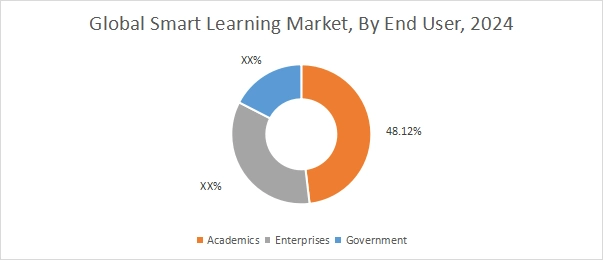
On the basis of end user, the smart learning market is divided into academics, enterprises, and government.
Trends in the End User:
- Ongoing modernization of education systems is strengthening demand across academic institutions.
- Rising focus on workforce skill enhancement is supporting enterprise investment in digital learning platforms.
Academics accounted for the largest revenue share of 48.12% in the year 2024.
- Schools and universities are integrating digital curricula, assessment systems, and performance tracking tools.
- Moreover, government initiatives in the education sector are promoting technology-enabled teaching infrastructure in government institutions.
- Additionally, the growing adoption of blended learning models is increasing dependence on structured digital platforms.
- Further, the need for scalable content distribution and academic monitoring systems in institutions with large student bases is increasing.
- Furthermore, the emphasis on learning outcomes in institutions is promoting the adoption of analytics-driven platforms.
- Therefore, broad adoption across K–12 and higher education institutions is supporting segment dominance.
Enterprise is anticipated to register the fastest CAGR during the forecast period.
- Companies are using digital learning platforms to handle employee onboarding and compliance training certification processes.
- Moreover, the adoption of remote and hybrid work environments is fueling the need for formal virtual learning platforms.
- Additionally, companies are using AI-powered skill mapping solutions to map employee skills to business goals.
- Further, the need for continuous reskilling is driving the demand for subscription-based learning platforms.
- Furthermore, the integration of performance analytics is enabling companies to measure the return on investment in training.
- Hence, expansion of digital workforce development strategies is driving rapid growth of the enterprise segment.
Regional Analysis:
North America, Europe, Asia Pacific, the Middle East and Africa, and Latin America are the regions of coverage.
North America region held largest market share in 2024. Furthermore, it is expected to increase by USD 26.61 billion in 2025 and exceed USD 82.47 billion by 2032. Market expansion is supported by early adoption of digital learning technologies and strong investment in education technology infrastructure across K–12 and higher education institutions. In addition, the presence of established EdTech providers and cloud service companies is strengthening platform deployment across academic and enterprise users. Canada and Mexico are also contributing to the regional demand because of the digital curriculum reforms and the integration of virtual learning models.
- For example, in April 2025, SMART Technologies introduced an AI Assist function in its Lumio platform, which applies generative AI to rapidly develop interactive quizzes and activities to help teachers save time and increase engagement.
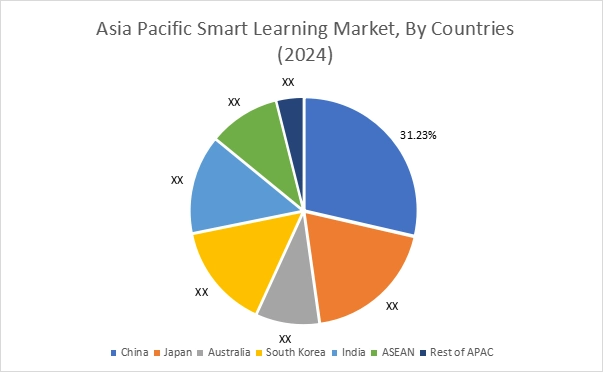
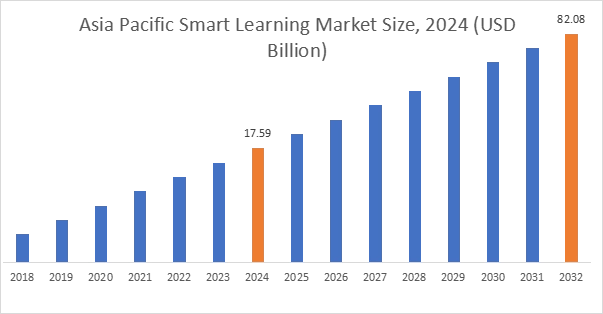
Asia Pacific is the fastest growing region and was valued at USD 17.59 Billion in 2024. Moreover, it is projected to grow by USD 22.17 Billion in 2025 and reach over USD 82.08 Billion by 2032. Out of this, China accounted for the maximum revenue share of 31.23%. The regional market is growing owing to the increasing internet penetration and government spending on digital education programs in China, India, Japan, and Southeast Asian nations. Public sector programs related to smart classrooms and distant access to education are also boosting the adoption of the platform in the region.
- In January 2026, the Chinese Director of the Department of Science, Technology, and Informatization said that the country’s smart education platform provides more than 1,000 AI courses and has trained close to 500,000 teachers and students from 2,000 universities, with 1.31 million undergraduates completing AI application programs.
Europe smart learning market growth is primarily driven by structured digital education policies, cross-border e-learning initiatives, and strong public funding for education modernization. Furthermore, the integration of blended learning models and digital curriculum delivery across higher education institutions is projected to drive the market progress during the forecast period.
Latin America smart learning market growth is mainly driven by expanding digital inclusion programs, rising smartphone penetration, and government-led education reforms. Furthermore, increasing adoption of cloud-based learning management systems and cross-border digital course access is projected to drive the market progress during the forecast period.
Middle East & Africa smart learning market growth is primarily driven by national digital transformation strategies, expansion of e-learning infrastructure, and increasing demand for remote education solutions. Furthermore, investments in smart classrooms and digital curriculum platforms are projected to drive the market progress during the forecast period.
Top Key Players & Market Share Insights:
The global smart learning market is moderately competitive, with existing players in the education technology industry, software companies, hardware suppliers, and new digital learning startups. In addition, the existing players in the market are using approaches such as platform development, content integration, cloud integration, AI capability development, and long-term contracts to gain a competitive advantage in the smart learning market. Key participants in the market for smart learning include:
- Pearson plc– UK
- McGraw Hill– US
- Anthology Inc.– US
- Instructure, Inc. – US
- Coursera, Inc. – US
- Udemy, Inc. – US
- SAP SE – Germany
- Oracle Corporation – US
- Microsoft Corporation – US
- Alphabet Inc. – US
Recent Industry Developments:
Product Launches
- In January 2026, McGraw Hill broadened its literacy offerings by launching a new core English Language Arts program for students in grades 6-12.
- In July 2025, Anthology enhanced its AI capabilities and immersive learning solutions to improve the functionality and user experience of its Blackboard platform.
- In April 2025, Pearson introduced an AI-driven Smart Lesson Generator to improve digital content development and transform the learning experience in the classroom.
Smart Learning Market Report Insights:
| Report Attributes | Report Details |
|---|---|
| Study Timeline | 2019-2032 |
| Market Size in 2032 (USD Trillion) | USD 247.08 Billion |
| CAGR (2025-2032) | 17.65% |
| By Offering |
|
| By Learning Mode |
|
| By End User |
|
| By Region |
|
| Key Players |
|
| Report Coverage |
|
Key Questions Answered in the Report
How big is the smart learning market? −
The smart learning market size is estimated to reach over USD 247.08 Billion by 2032 from a value of USD 66.15 Billion in 2024 and is projected to grow by USD 79.18 Billion in 2025, growing at a CAGR of 17.65% from 2025 to 2032.
Which segmentation details are covered in the smart learning report? +
The smart learning report includes specific segmentation details for offering, learning mode, end user, and region.
Which is the fastest segment anticipated to impact the market growth? +
In the smart learning market, the services segment is projected to register the fastest growth during the forecast period, driven by rising demand for system integration, educator training, and ongoing platform support across academic and enterprise institutions.
Who are the major players in the smart learning market? +
The key participants in the smart learning market are Pearson plc (UK), McGraw Hill (US), Anthology Inc. (US), Instructure, Inc. (US), Coursera, Inc. (US), Udemy, Inc. (US), SAP SE (Germany), Oracle Corporation (US), Microsoft Corporation (US), Alphabet Inc. (US), and others.
What are the key trends in the smart learning market? +
The smart learning market is shaped by key trends including expansion of hybrid learning models, integration of AI-based adaptive learning platforms, and increasing deployment of cloud-based learning management systems across K–12, higher education, and corporate training environments.
Overview
Reputation & Certifications


Our Services
- Market Intelligence & Forecasting
- Custom Research Solutions
- Market Entry Strategy
- Competitive Intelligence
- Customer Insights
- Industry Innovation Analysis
- Investment Advisory