Jump to Content
Nano Metrology Market - Size, Share, Industry Trends, and Forecasts (2025 - 2032)
Nano Metrology Market Size:
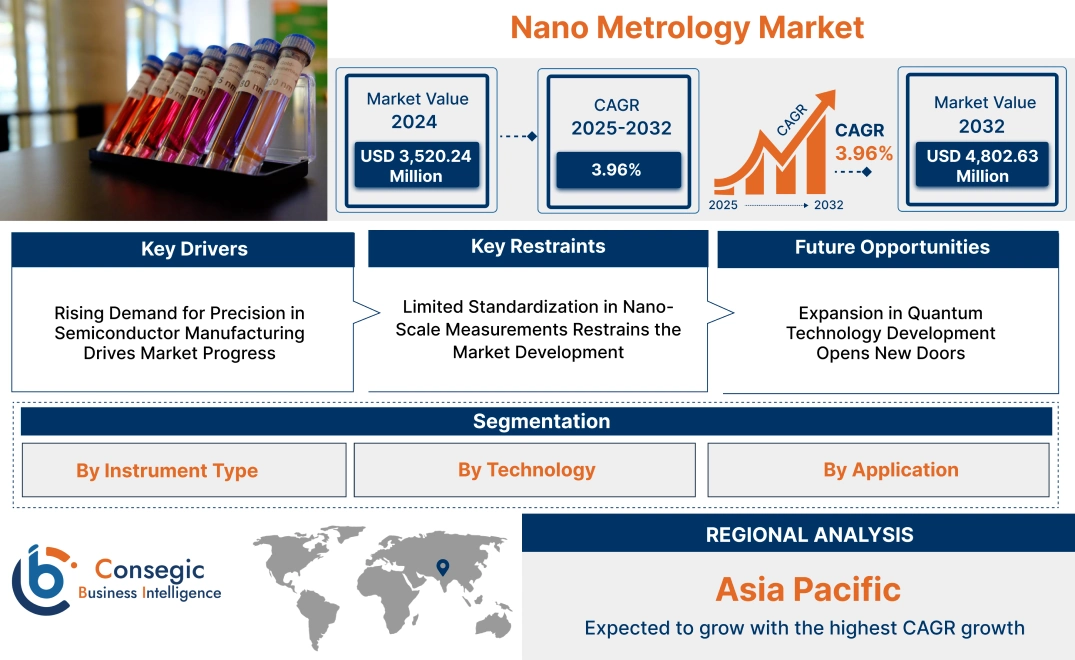
Nano Metrology Market size is estimated to reach over USD 4,802.63 Million by 2032 from a value of USD 3,520.24 Million in 2024 and is projected to grow by USD 3,596.92 Million in 2025, growing at a CAGR of 3.96% from 2025 to 2032.
Nano Metrology Market Scope & Overview:
Nano metrology refers to the science of measurement at the nanoscale, focusing on the precise quantification of dimensions, properties, and performance of materials and devices. It plays a critical role in ensuring accuracy and consistency in nanoscale manufacturing, research, and quality control processes. It encompasses techniques such as scanning probe microscopy, electron microscopy, and spectroscopy, enabling detailed analysis of structures at the atomic and molecular levels.
These systems are designed to measure nanoscale features with high precision, reliability, and repeatability, making them essential in fields such as semiconductor manufacturing, material science, and biotechnology. Nano metrology tools analyze surface roughness, thickness, and mechanical properties, providing valuable insights for product development and quality assurance.
End-users of these solutions include research laboratories, semiconductor manufacturers, pharmaceutical companies, and nanotechnology developers, where precise measurement is crucial for innovation and operational accuracy. It further enables advancements in the development and application of nanoscale technologies across a wide range of industries.
Nano Metrology Market Dynamics - (DRO) :
Key Drivers:
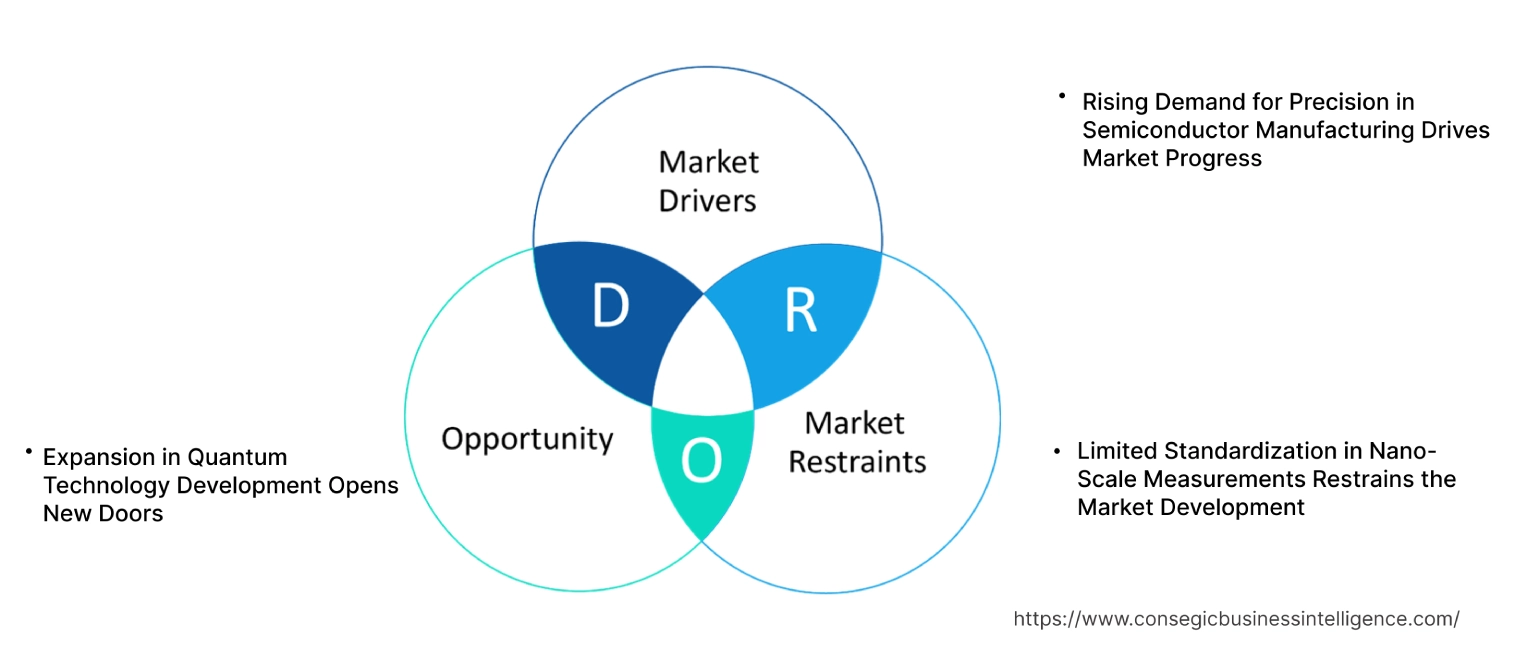
Rising Demand for Precision in Semiconductor Manufacturing Drives Market Progress
The growing complexity of semiconductor manufacturing, particularly in integrated circuits (ICs) and microchips, is driving the need for ultra-precise measurement tools. As transistors continue to shrink to sub-10nm dimensions, driven by Moore’s Law, even minor deviations in wafer thickness, surface roughness, or alignment critically impact device performance and yield. Nano metrology systems play a crucial role in ensuring accuracy at these scales, enabling manufacturers to achieve the tight tolerances required for advanced node technologies. Tools such as atomic force microscopy (AFM) and electron beam techniques facilitate the detailed characterization of nano structures, ensuring consistency and quality in production. The push toward smaller, faster, and more energy-efficient semiconductor devices, especially for applications in 5G, AI, and high-performance computing, is further fueling the adoption of nano-scale metrology solutions. This rising demand highlights the critical importance of precise measurement systems in advancing next-generation semiconductor manufacturing. Thus, the aforementioned factors are contributing to the nano metrology market growth.
Key Restraints:
Limited Standardization in Nano-Scale Measurements Restrains the Market Development
The lack of universally accepted standards for nano-scale measurements poses significant issues for industries relying on precise characterization. Different measurement techniques, such as atomic force microscopy (AFM), scanning electron microscopy (SEM), and interferometry, often produce inconsistent results due to variations in calibration methods and tool configurations. This inconsistency complicates the comparability of measurement data across laboratories, manufacturers, and industries. Sectors like pharmaceuticals, electronics, and semiconductors, which require stringent regulatory compliance, face difficulties in adopting nano metrology tools without standardized measurement frameworks.
Additionally, the absence of uniform benchmarks increases uncertainty, limiting trust in measurement accuracy and reliability. Companies are often forced to develop proprietary calibration procedures, raising costs and slowing adoption. Addressing this standardization gap is crucial for facilitating interoperability, ensuring repeatable results, and driving broader acceptance of nano-scale measurement systems across diverse industries. Therefore, the above-mentioned factors limit the nano metrology market demand.
Future Opportunities :
Expansion in Quantum Technology Development Opens New Doors
The rapid advancement of quantum technology, including quantum computing, quantum communication, and quantum sensing, is driving the need for ultra-precise measurement tools. Nano metrology plays a crucial role in enabling accurate characterization and control of quantum particles, such as qubits, which operate at nano-scale dimensions. Tools like atomic force microscopy (AFM) and scanning tunneling microscopy (STM) are essential for measuring surface properties, particle behavior, and structural stability in quantum devices. Quantum systems are highly sensitive to even minor inaccuracies, requiring metrology solutions with unprecedented precision. Industries developing quantum processors, sensors, and cryptographic systems rely on nano metrology to ensure performance and reliability.
As quantum technology gains momentum in sectors such as healthcare, defense, and computing, the demand for advanced measurement systems will rise significantly. This intersection of quantum innovation and metrology creates substantial nano metrology market opportunities for growth in this industry.
Nano Metrology Market Segmental Analysis :
By Instrument Type:
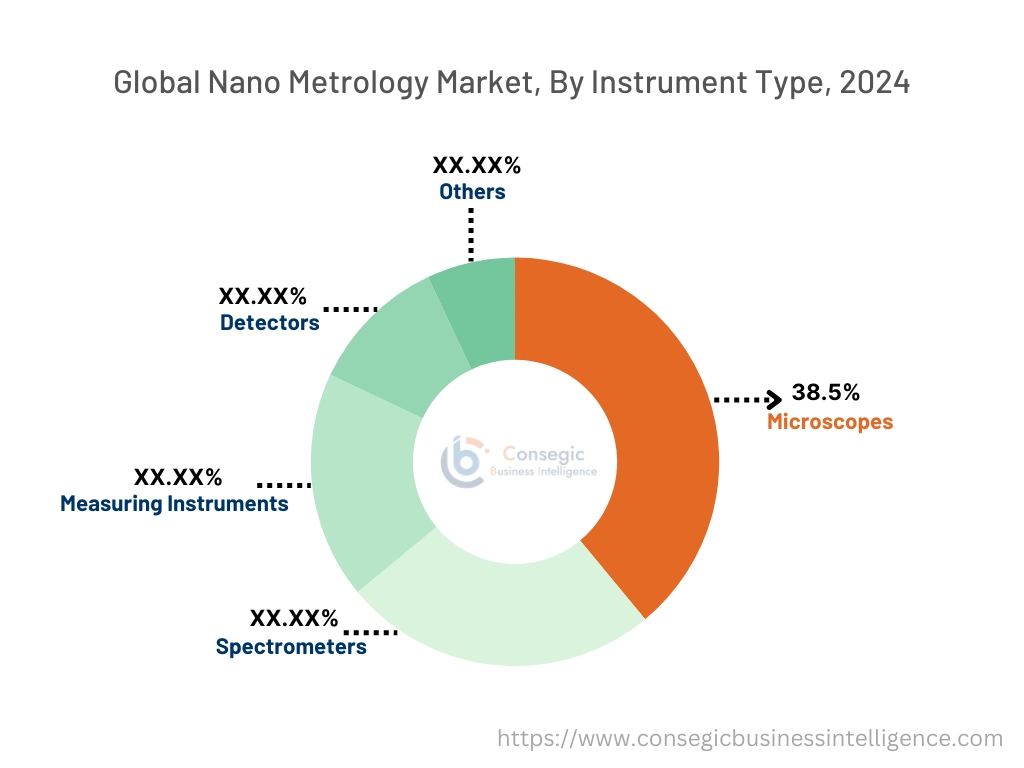
Based on instrument type, the market is segmented into microscopes, spectrometers, measuring instruments, detectors, and others.
The microscopes segment accounted for the largest revenue of 38.5% of the total nano metrology market share in 2024.
- Microscopes, including scanning electron microscopy (SEM) and atomic force microscopy (AFM), are widely used for high-resolution imaging of nanostructures.
- The increasing adoption of microscopes in semiconductor manufacturing and materials science contributes significantly to the segment's dominance.
- Technological advancements, such as automated imaging systems and improved resolution capabilities, enhance their usability across industries.
- Thus, as per market trends, the need for precise nano-measurements in research and industrial applications supports the widespread adoption of microscopes, fueling the nano metrology market expansion.
The spectrometers segment is projected to grow at the fastest CAGR during the forecast period.
- Spectrometers play a critical role in analyzing light, molecular composition, and chemical properties at the nanoscale level.
- Industries like healthcare and energy are increasingly leveraging spectrometers for accurate analysis in medical imaging and fuel production.
- Advancements in spectrometer technologies, including integration with AI-powered analytics, further drive the segment's growth.
- As per nano metrology market analysis, the ability to deliver real-time data analysis for quality control and research applications boosts the adoption of spectrometers globally.
By Technology:
Based on technology, the market is segmented into scanning electron microscopy (SEM), atomic force microscopy (AFM), transmission electron microscopy (TEM), X-ray diffraction (XRD), and others.
The scanning electron microscopy (SEM) segment accounted for the largest revenue of the total nano metrology market share in 2024.
- SEM is widely adopted for its ability to provide detailed surface morphology and topographical analysis at nanoscale levels.
- The technology is essential for quality control and defect analysis in semiconductor manufacturing and materials science.
- Its versatility and cost-effectiveness make it a preferred choice for research laboratories and industrial applications.
- As per the nano metrology market trends, SEM’s integration with advanced spectroscopy tools further enhances its analytical capabilities across various industries.
The atomic force microscopy (AFM) segment is anticipated to grow at the fastest CAGR during the forecast period.
- AFM provides precise three-dimensional imaging of surfaces, making it invaluable for nanoscale material characterization and biological research.
- The segment’s growth is fueled by its increasing application in medical imaging, semiconductor fabrication, and materials science.
- Non-destructive measurement capabilities and high precision make AFM systems ideal for critical quality control processes.
- Therefore, advancements in AFM technology, including enhanced imaging speed and automation, support it's expanding adoption further driving nano metrology market demand.
By Application:
Based on application, the market is segmented into materials science, semiconductor manufacturing, fuel production, medical imaging, and others.
The semiconductor manufacturing segment accounted for the largest revenue share in 2024.
- Nano metrology tools are integral to ensuring accuracy and precision in semiconductor fabrication processes.
- The increasing miniaturization of semiconductor components drives the demand for advanced metrology solutions in this industry.
- Technologies such as SEM and AFM enable defect detection, process optimization, and quality control for integrated circuits.
- As per market trends, leading manufacturers rely on nano metrology to meet evolving production standards and enhance product performance, contributing to the nano metrology market growth.
The medical imaging segment is projected to grow at the fastest CAGR during the forecast period.
- Nano metrology technologies are transforming medical imaging by providing high-resolution imaging of biological samples and structures.
- AFM and TEM are extensively used for diagnostics, disease research, and drug development applications.
- The integration of nano metrology tools with AI-based evaluation enhances their use in clinical studies and healthcare research.
- Therefore, as per nano metrology market analysis, rising investments in advanced imaging systems for biomedical research further propel the segment’s growth.
Regional Analysis:
The regions covered are North America, Europe, Asia Pacific, the Middle East and Africa, and Latin America.
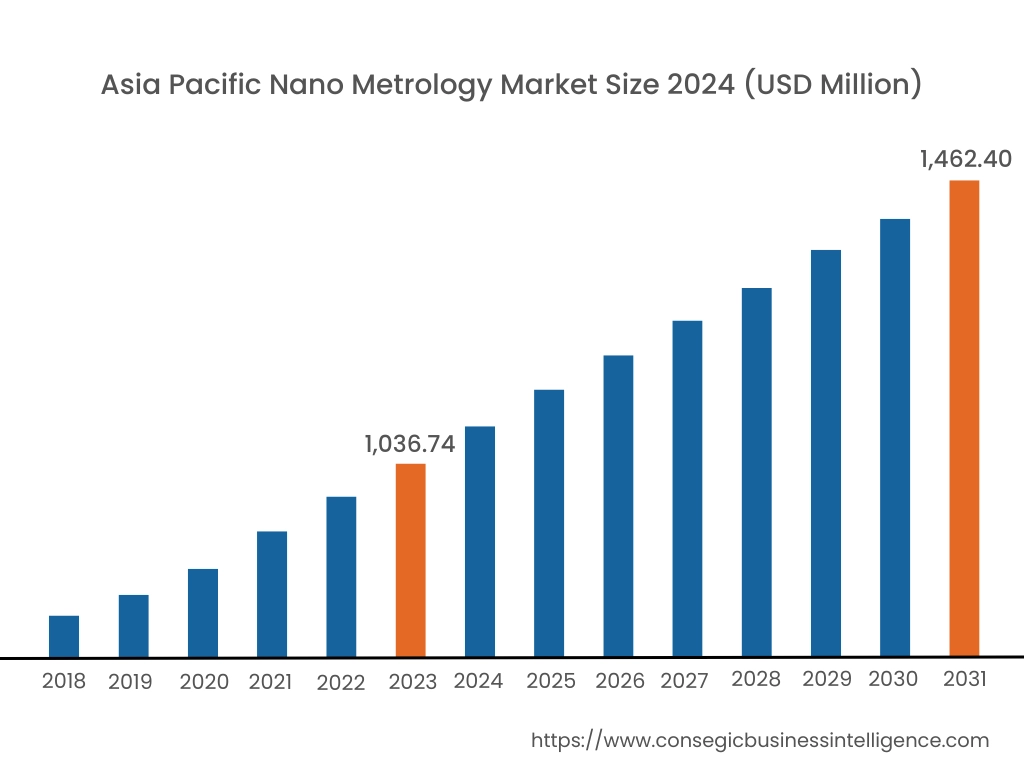
Asia Pacific region was valued at USD 1,036.74 Million in 2024. Moreover, it is projected to grow by USD 1,062.32 Million in 2025 and reach over USD 1,462.40 Million by 2032. Out of this, China accounted for the maximum revenue share of 31.2%. The Asia-Pacific region is experiencing rapid development in the nano metrology market, driven by industrialization and technological advancements in countries such as China, Japan, and India. The expansion of the manufacturing sector and the rising demand for high-precision measurement have intensified the need for advanced metrology systems. As per the market trends, government initiatives promoting industrial efficiency further influence nano metrology market opportunities.

North America is estimated to reach over USD 1,556.53 Million by 2032 from a value of USD 1,167.69 Million in 2024 and is projected to grow by USD 1,190.85 Million in 2025. This region leads in nano metrology adoption, driven by substantial investments in nanotechnology research and development. The United States, in particular, has seen extensive utilization of metrology tools in the electronics and healthcare sectors. A notable trend is the integration of advanced sensor technologies that provide greater accuracy, sensitivity, and resolution, enhancing measurement precision. The nano metrology market trends indicate the increasing need for nanometrology in these sectors is driving market growth in North America.
Europe represents a substantial share of the global nano metrology market, with countries like Germany, France, and the United Kingdom leading in adoption and innovation. The region's emphasis on industrial automation and precision engineering has propelled the utilization of advanced nano metrology solutions. The survey indicates a growing trend towards the deployment of intelligent measurement systems equipped with sensors for real-time data analysis, enhancing precision and reducing downtime.
The Middle East & Africa region shows a growing interest in advanced measurement solutions, particularly in the construction and industrial sectors. Countries like Saudi Arabia and South Africa are investing in modern manufacturing technologies to enhance production efficiency. Research suggests an increasing trend toward adopting high-precision nanometrology tools to meet international quality standards.
Latin America is an emerging market with Brazil and Mexico being key contributors. The region's growing focus on industrial modernization and the automotive sector has spurred the adoption of advanced measurement solutions. Government policies aimed at enhancing manufacturing capabilities influence nano metrology market expansion.
Top Key Players and Market Share Insights:
The Nano Metrology market is highly competitive with major players providing products and services to the national and international markets. Key players are adopting several strategies in research and development (R&D), product innovation, and end-user launches to hold a strong position in the global Nano Metrology market. Key players in the Nano Metrology industry include -
- Thermo Fisher Scientific (USA)
- Bruker Corporation (USA)
- Hitachi High-Tech Corporation (Japan)
- Nikon Corporation (Japan)
- Park Systems (South Korea)
- Oxford Instruments (UK)
- Carl Zeiss AG (Germany)
- Horiba, Ltd. (Japan)
- JEOL Ltd. (Japan)
- Keysight Technologies (USA)
Nano Metrology Market Report Insights :
| Report Attributes | Report Details |
| Study Timeline | 2019-2032 |
| Market Size in 2032 | USD 4,802.63 Million |
| CAGR (2025-2032) | 3.96% |
| By Instrument Type |
|
| By Technology |
|
| By Application |
|
| By Region |
|
| Key Players |
|
| North America | U.S. Canada Mexico |
| Europe | U.K. Germany France Spain Italy Russia Benelux Rest of Europe |
| APAC | China South Korea Japan India Australia ASEAN Rest of Asia-Pacific |
| Middle East and Africa | GCC Turkey South Africa Rest of MEA |
| LATAM | Brazil Argentina Chile Rest of LATAM |
| Report Coverage |
|
Key Questions Answered in the Report
What is the size of the Nano Metrology Market? −
Nano Metrology Market size is estimated to reach over USD 4,802.63 Million by 2032 from a value of USD 3,520.24 Million in 2024 and is projected to grow by USD 3,596.92 Million in 2025, growing at a CAGR of 3.96% from 2025 to 2032.
What are the segments and subsegments covered in the Nano Metrology Market report? +
The market is segmented into instrument types (Microscopes, Spectrometers, Measuring Instruments, Detectors, Others), technologies (Scanning Electron Microscopy (SEM), Atomic Force Microscopy (AFM), Transmission Electron Microscopy (TEM), X-Ray Diffraction (XRD), Others), and applications (Materials Science, Semiconductor Manufacturing, Fuel Production, Medical Imaging, Others).
Which segment is expected to grow the fastest in the Nano Metrology Market? +
The atomic force microscopy (AFM) segment is anticipated to grow at the fastest CAGR during the forecast period, driven by its increasing application in medical imaging, semiconductor fabrication, and materials science.
Who are the key players in the Nano Metrology Market? +
Key players in the Nano Metrology Market include Thermo Fisher Scientific (USA), Bruker Corporation (USA), Oxford Instruments (UK), Carl Zeiss AG (Germany), Horiba, Ltd. (Japan), JEOL Ltd. (Japan), Keysight Technologies (USA), Hitachi High-Tech Corporation (Japan), Nikon Corporation (Japan), and Park Systems (South Korea).
Overview
Reputation & Certifications


Our Services
- Market Intelligence & Forecasting
- Custom Research Solutions
- Market Entry Strategy
- Competitive Intelligence
- Customer Insights
- Industry Innovation Analysis
- Investment Advisory