Jump to Content
Renewable Energy Market - Size, Share, Industry Trends, and Forecasts (2025-2032)
Renewable Energy Market Size:
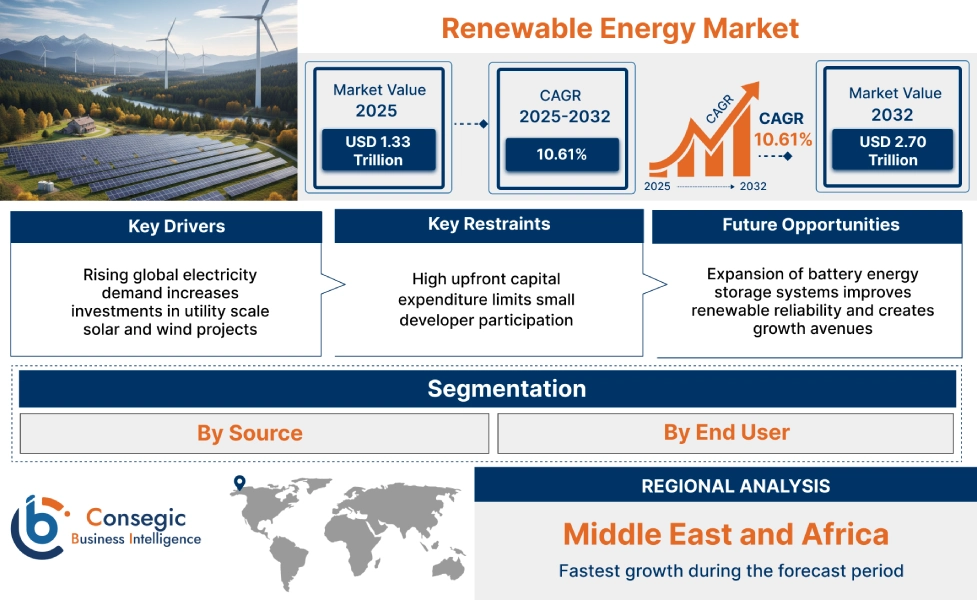
Renewable Energy Market size is estimated to reach over USD 2.70 Trillion by 2032 from a value of USD 1.20 Trillion in 2024 and is projected to grow by USD 1.33 Trillion in 2025, growing at a CAGR of 10.61% from 2025 to 2032
Renewable Energy Market Scope & Overview:
Renewable energy can be described as the production of power using naturally replenishable resources such as solar, wind, hydro, biomass, and geothermal. The renewable energy industry involves the deployment of solar photovoltaic modules, wind turbines, hydropower systems, bioenergy plants, inverters, energy storage systems, grid infrastructure, and digital monitoring platforms. The objective is to generate low carbon electricity while reducing dependence on fossil fuels and lowering greenhouse gas emissions. The infrastructure supports the large-scale production of power, decentralized power production, real-time grid connection, and efficient transmission of power on a national and regional level.
The renewable energy sector is growing as a result of the increasing global demand for electricity and the government policies aimed at reducing carbon emissions. The government and the corporate sector are investing in utility-scale solar farms, offshore wind farms, and battery storage projects. The corporate purchase of renewable energy in the form of power purchase agreements is also increasing the pace of project development.
How is the Renewable Energy Market Affected by AI?
Artificial intelligence improves renewable energy resources by processing massive amounts of weather information, grid load patterns, and equipment performance with a high degree of accuracy. Machine learning algorithms detect variability in power generation, equipment malfunctions, and efficiency losses in solar farms, wind farms, and energy storage plants. AI systems are also used for demand forecasting, smart inverter management, and automatic grid balancing in distributed energy resources.
AI-enabled platforms allow for the continuous monitoring of renewable energy resources and real-time decision-making in the transmission and distribution of energy. Predictive models assess turbine degradation, panel deterioration, battery performance, and power generation optimization before any system failure.
Renewable Energy Market Dynamics - (DRO):
Key Drivers:
Rising global electricity demand increases investments in utility scale solar and wind projects
Growing industrialization, urban expansion, and electrification of transport are increasing global power consumption. The traditional power production plants are experiencing fuel availability challenges and carbon dioxide compliance. Solar parks and large onshore and offshore wind farms are being developed to satisfy the growing base load and peak growth. Governments and private power utilities are allocating more capital expenditure to the addition of renewable energy resources to enhance grid security.
- According to the International Energy Agency, the global electricity demand is expected to increase by 3.3% in 2025 and 3.7% in 2026, which is lower than the 4.4% increase in 2024, and the total electricity consumption is expected to surpass 29,000 terawatt-hours by 2026.
Thus, the increasing global electricity demand is fueling the growth of large-scale renewable energy projects.
Key Restraints:
High upfront capital expenditure limits small developer participation
The renewable energy sector involves substantial capital expenditure in terms of land purchase, installation of equipment, and grid connection. Solar panels, wind energy turbines, and transmission networks require substantial capital expenditure before the generation of revenue. Small-scale developers experience difficulties in accessing low-cost capital. Long payback periods and exposure to policy fluctuations increase financial risk.
Thus, high upfront capital expenditure is restricting the entry and expansion of small and mid-sized developers in the renewable energy market.
Future Opportunities:
Expansion of battery energy storage systems improves renewable reliability and creates growth avenues
Solar and wind generation depends on weather conditions, which creates variability in power output. Battery energy storage systems facilitate load balancing, peak shaving, and frequency regulation in a grid with a high penetration of renewable energy. Utilities are integrating large-scale lithium-ion and advanced energy storage systems to stabilize the supply and improve dispatchability. Hybrid projects involving renewable energy and energy storage systems are on the increase.
- In February 2026, Hitachi and KS Energy agreed to jointly develop and operate an extra-high voltage grid battery energy storage system (BESS) in Kumamoto Prefecture to stabilize renewable power supply and support regional carbon neutrality, including collaboration on power trading systems and AI-driven optimization tools.
Thus, the expansion of battery energy storage systems is strengthening renewable power reliability and creating new long term growth opportunities in the renewable energy market.
Renewable Energy Market Segmental Analysis:
By Source:
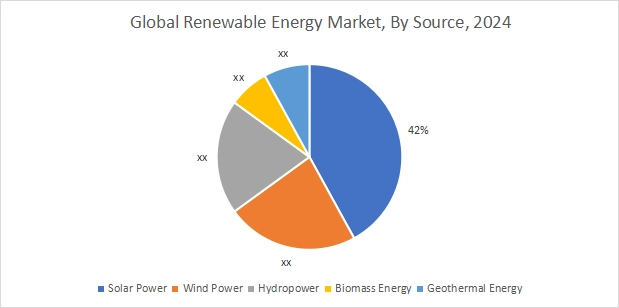
On the basis of source, the renewable energy market is segmented into solar power, wind power, hydropower, biomass energy, and geothermal energy.
Trends in the Source:
- Rising decarbonization targets are accelerating installation of utility scale renewable capacity.
- Grid modernization initiatives are strengthening integration of variable renewable sources.
The solar power segment accounted for the highest revenue share of 42% in 2024.
- The reducing costs of photovoltaic modules are making projects more feasible.
- Large-scale solar parks are being set up to cater to the increasing demand for electricity during the daytime.
- Additionally, supportive policy incentives and net metering regulations are encouraging the adoption of rooftop solar.
- Further, the reduced time taken for project development is accelerating the addition of capacity.
- Furthermore, corporate power purchase agreements are increasing procurement from solar assets.
- Therefore, expanding solar installations are supporting dominance of the solar power segment.
It is anticipated that the wind power will exhibit the highest compound annual growth rate (CAGR) during the forecast period.
- Offshore wind investments are expanding high-capacity generation zones.
- Additionally, technological advancements are increasing turbine efficiency and output per installation.
- Moreover, hybrid wind plus storage projects is improving dispatch reliability.
- Further, government auctions are increasing allocation of new wind capacity.
- Furthermore, rising electricity demand in coastal and industrial regions is supporting wind deployment.
- For instance, In July 2025, The HiPoTeSis project was approved under the Interreg Atlantic Area programme to strengthen Europe’s floating offshore wind test infrastructure and accelerate industrialization by creating coordinated high-power test capabilities for next-generation turbines.
- Hence, expansion of offshore and high-capacity wind projects is accelerating growth of the wind power segment.
By End User:
On the basis of end user, the renewable energy market is divided into industrial, commercial, and residential.
Trends in the End User:
- Electrification of manufacturing and mobility is increasing renewable procurement across industries.
- Distributed energy systems are expanding adoption among commercial and residential consumers.
Industrial accounted for the largest revenue share in the year 2024.
- Energy intensive industries are procuring renewable power to meet carbon compliance targets.
- Long-term power purchase agreements are enhancing cost predictability for manufacturers.
- Additionally, on-site captive solar and wind projects are reducing dependence on the grid.
- Further, export-oriented sectors are aligning with international sustainability norms.
- Furthermore, large industrial groups are incorporating renewable energy to stabilize costs.
- Therefore, rising industrial clean energy procurement is supporting dominance of the industrial segment.
Commercial is anticipated to register the fastest CAGR during the forecast period.
- Commercial buildings are installing rooftop solar systems to reduce electricity costs.
- Retail chains and data centers are committing to renewable sourcing targets.
- Additionally, green building certifications are encouraging adoption of clean energy systems.
- Further, energy management platforms are optimizing renewable utilization in commercial facilities.
- Furthermore, urban infrastructure development is increasing distributed renewable deployment.
- For Instance, CBRE’s latest report on decarbonizing office buildings in Asia Pacific states that 51% of office space in the region has obtained green building certification, reflecting a 6.5% year-on-year increase.
- Hence, increasing renewable integration across commercial establishments is driving growth of the commercial segment.
Regional Analysis:
North America, Europe, Asia Pacific, the Middle East and Africa, and Latin America are the regions of coverage.
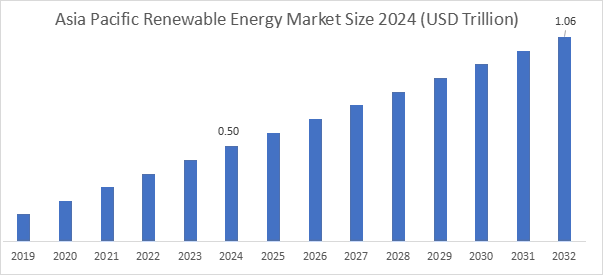
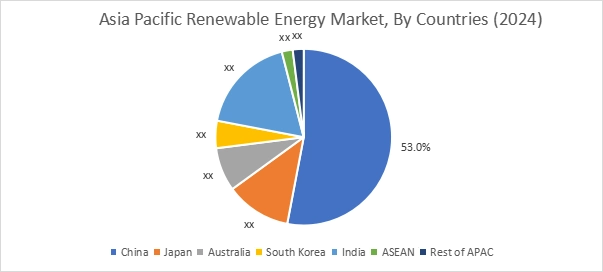
Asia Pacific region was valued at USD 0.50 trillion in 2024. Furthermore, it is expected to increase steadily during the forecast period. China accounted for the highest revenue share (53%). Market expansion is fueled by the installation of large-scale solar and wind energy capacity, backed by the energy transition plans of the respective nations. India is developing utility-scale solar energy parks and wind energy corridors to support the growing demand for electricity. Japan is developing offshore wind energy and rooftop solar energy to enhance energy security.
- For example, in February 2025, Ørsted started the offshore construction of the 920 MW Greater Changhua 2b and 4 offshore wind farms in Taiwan. This is a significant milestone in the development of large-scale renewable energy capacity in the Asia-Pacific region.
Middle East and Africa is expected to witness the fastest growth during the forecast period. The market is growing due to the large-scale solar energy projects being developed in Saudi Arabia and the UAE to diversify energy resources. Government-supported renewable energy goals and green hydrogen projects are boosting clean energy investments in the MEA region. South Africa is enhancing the grid-connected renewable energy procurement schemes to meet the country’s energy deficit. The growing foreign direct investment in large-scale projects is propelling the addition of renewable energy capacity in the MEA region.
- In February 2026, Saudi Arabia’s Al-Gihaz Holding will construct a 210 MW solar energy facility and an 827 MWh battery energy storage system in Syria to enhance the country’s energy grid and support the country’s growth in clean energy.
The market in North America is driven by the region’s growing focus on energy independence, grid reliability, and emission reduction. Additionally, the expansion of solar, onshore wind, and battery storage projects across the US and Canada is supporting capacity growth.
Europe is mainly driven by climate neutrality targets, regulatory support under the EU Green Deal, and ongoing wind and offshore project developments. Furthermore, increasing investments in grid interconnections and storage infrastructure are projected to drive the market progress in the region during the forecast period.
Latin America renewable energy market growth is driven by strong solar and wind resource availability and increasing cross-border energy investments. Furthermore, rising corporate power purchase agreements and expansion of utility-scale projects are projected to drive the market progress in the region during the forecast period.
Top Key Players & Market Share Insights:
The renewable energy market is moderately fragmented at the global level. Major independent power producers, major utilities, equipment suppliers, and new entrants in the clean energy space are actively taking part in the market. Market participants are concentrating on long-term power contracts, developing project pipelines, entering into joint ventures, and integrating vertically in the generation and storage sectors to improve market competitiveness. Market players are also concentrating on developing high-efficiency solar panels, advanced wind turbine technology, battery energy storage solutions, and digital energy management solutions to increase their presence in the market. Key participants in the market for renewable energy include:
- NextEra Energy, Inc.(US)
- Iberdrola, S.A.(Spain)
- Ørsted A/S(Denmark)
- Enel S.p.A. (Italy)
- EDP Renováveis, S.A. (Spain)
- Vestas Wind Systems A/S (Denmark)
- Siemens Gamesa Renewable Energy (Spain)
- Canadian Solar Inc. (Canada)
- First Solar, Inc. (US)
- Adani Green Energy Limited (India)
Recent Industry Developments:
Product Launches
- In December 2025, Iberdrola has begun assembling wind turbines for Portugal’s largest wind farm, a 274 MW project that will generate renewable energy for around 128,000 households and strengthen the country’s clean power infrastructure.
- In October 2025, Google signed a new 54 MW power purchase agreement with utility Eneco to supply wind-generated electricity from three Belgian wind farms to its data centres, supporting its local infrastructure expansion and carbon-free energy goals.
Renewable Energy Market Report Insights:
| Report Attributes | Report Details |
|---|---|
| Study Timeline | 2019-2032 |
| Market Size in 2032 (USD Trillion) | USD 2.70 Trillion |
| CAGR (2025-2032) | 10.61% |
| By Source |
|
| By End User |
|
| By Region |
|
| Key Players |
|
| Report Coverage |
|
Key Questions Answered in the Report
Which is the fastest segment anticipated to impact the market growth? −
Wind power is the fastest growing segment, driven by increasing offshore wind installations and higher turbine capacity additions across major economies.
Which segmentation details are covered in the renewable energy report? +
The renewable energy report includes specific segmentation details for source, end user, and regions.
How big is the renewable energy market? +
The renewable energy market sizeis estimated to reach over USD 2.70 Trillion by 2032 from a value of USD 1.20 Trillion in 2024 and is projected to grow by USD 1.33 Trillion in 2025, growing at a CAGR of 10.61% from 2025 to 2032.
Who are the major players in the renewable energy market? +
The key participants in the renewable energy marketare NextEra Energy, Inc. (US), Iberdrola, S.A. (Spain), Ørsted A/S (Denmark), Enel S.p.A. (Italy), EDP Renováveis, S.A. (Spain), Vestas Wind Systems A/S (Denmark), Siemens Gamesa Renewable Energy (Spain), Canadian Solar Inc. (Canada), First Solar, Inc. (US), Adani Green Energy Limited (India), and others.
What are the key trends in the renewable energy market? +
The renewable energy market is shaped by key trends including large scale solar capacity expansion, rising offshore wind investments, integration of battery energy storage systems, and growing corporate renewable power purchase agreements.
Overview
Reputation & Certifications


Our Services
- Market Intelligence & Forecasting
- Custom Research Solutions
- Market Entry Strategy
- Competitive Intelligence
- Customer Insights
- Industry Innovation Analysis
- Investment Advisory