Jump to Content
Augmented Reality (AR) Market - Size, Share, Industry Trends, and Forecasts (2025-2032)
Augmented Reality (AR) Market Size:
Augmented Reality (AR) Market size is estimated to reach over USD 643.58 Billion by 2032 from a value of USD 79.94 Billion in 2024 and is projected to grow by USD 102.36 Billion in 2025, growing at a CAGR of 35.1% from 2025 to 2032.
Augmented Reality (AR) Market Scope & Overview:
Augmented reality (AR) enhances the real world by overlaying digital information, images, or objects, which offers interactive and immersive experiences that blend the physical and digital worlds together. AR devices including tablets, smartphones, or specialized headsets, use cameras and sensors to capture the user's surroundings and then overlay digital content. AR provides interactive virtual environments including maps, product locaters, and contextual information overlaid onto the user's real-world view. AR is used for gaming, product visualization, and marketing campaigns, in turn, enhancing entertainment experiences. .
How is AI Impacting the Augmented Reality Market?
AI is a foundational driver of innovation in the augmented reality (AR) market, moving it beyond simple overlays to truly intelligent and interactive experiences. Machine learning algorithms, particularly in computer vision, allow AR systems to understand the physical world by recognizing and tracking objects, surfaces, and even human gestures with unparalleled accuracy. This enables more realistic and stable placement of virtual objects, enhancing user immersion. AI also personalizes AR content in real-time, adapting to a user's environment and preferences. Furthermore, it streamlines content creation and optimizes system performance, ensuring a smoother, more responsive, and efficient AR experience across diverse applications from gaming and retail to industrial maintenance.

Augmented Reality (AR) Market Dynamics - (DRO):
Key Drivers:
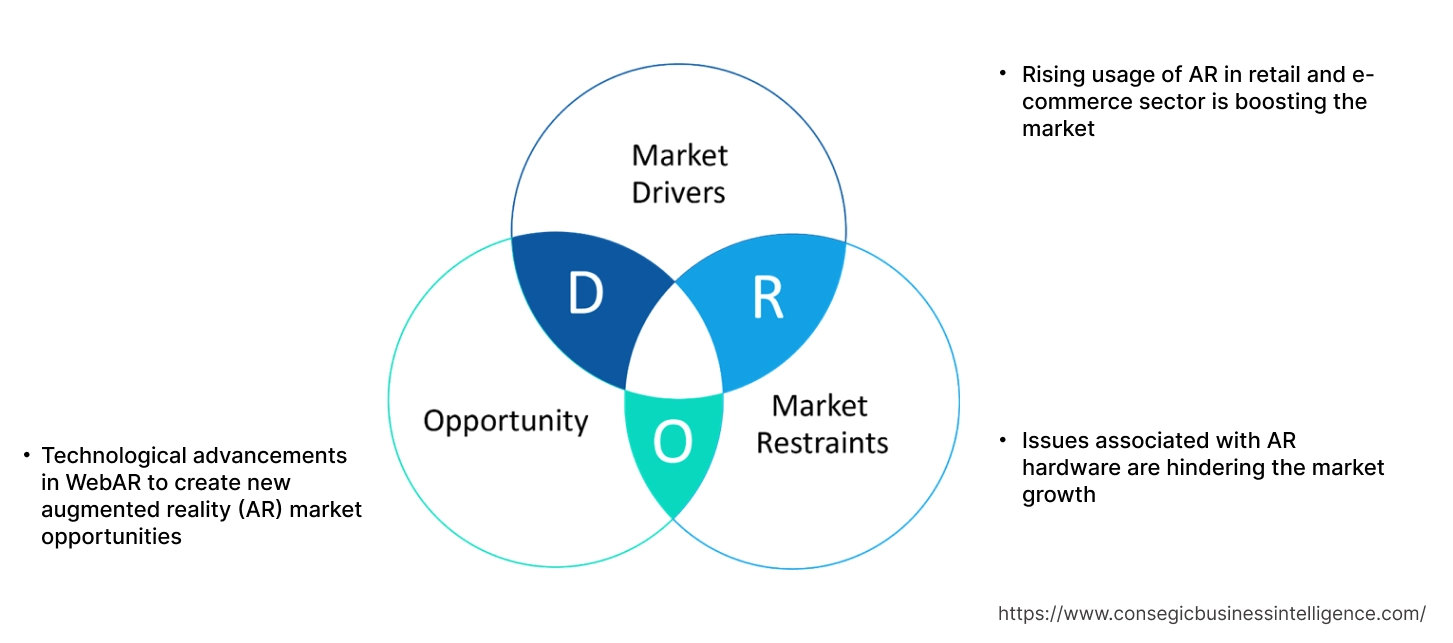
Rising usage of AR in retail and e-commerce sector is boosting the market
AR is used in retail due to benefits including enhanced the shopping experience through personalized, interactive, and immersive digital overlays that allows customers to visualize products in their environment. Customers are able to virtually-try-on makeup, clothes, or accessories using AR apps, reducing returns and enhancing the experience. Moreover, customers are able to access product specifications, customer reviews, and related recommendations through AR overlays on physical products.
- For instance, in October 2024, Snapchat launched an AR pop up in London. The product enhances the street shopping experience of the user.
Thus, the aforementioned factors are boosting the usage of AR technology, in turn, driving the augmented reality (AR) market growth.
Key Restraints:
Issues associated with AR hardware are hindering the market growth
AR devices require powerful processing and display capabilities, which leads to bulky and expensive hardware. AR hardware are dependent on high-speed and stable network connection for seamless and immersive user experience. Delays in processing and rendering AR content leads to a poor user experience and motion sickness. Moreover, developing and implementing AR solutions is expensive, requiring significant investment in hardware.
Additionally, the AR devices have a limited battery backup, leading to constrained usage that hampers the user experience. Thus, the market analysis shows that the aforementioned factors are restraining the augmented reality (AR) market demand.
Future Opportunities:
Technological advancements in WebAR to create new augmented reality (AR) market opportunities
Web-based augmented reality (WebAR) provides AR experiences accessible through a web browser, eliminating the need for app downloads. WebAR experiences are easy to deploy and update, unlike traditional AR apps. Moreover, webAR is accessible on various devices, including smartphones, tablets, and computers, as long as they have a web browser.
- For instance, in September 2023, La-Z-Boy introduced next-gen 3D product configuration with WebAR on-demand. The platform offers easier large scale personalization of shopping experiences for several customers at the same time.
Thus, the ongoing advancements in WebAR are projected to drive augmented reality (AR) market opportunities during the forecast period.
Augmented Reality (AR) Market Segmental Analysis :
By Component:
Based on the component, the market is segmented into hardware and software.
Trends in the Component:
- Rising adoption of AR due to understand the device's position, orientation, and movement is boosting the augmented reality (AR) market size.
- Increasing trend in AR software to enhance customer experiences, streamline workflows, improve training and education, and increase productivity.
The hardware segment accounted for the largest revenue share in the augmented reality (AR) market share in 2024.
- The AR hardware consists devices including tablets, smartphones, smart glasses, and headsets that use cameras, sensors, and processors to overlay digital information onto the real world.
- For instance, in September 2024, Meta launched Orion, a true AR glasses. These glasses offer digital experiences that are unconstrained by the limits of a smartphone screen.
- Therefore, the wide applications of the AR hardware are boosting the augmented reality (AR) market growth.
The software segment is expected to register the fastest CAGR during the forecast period.
- AR software leverages computer vision and other technologies to overlay digital content onto the real world, creating an interactive and immersive experience. This technology allows users to see digital elements like 3D models, animations, or text superimposed on their view of the physical environment.
- For instance, in February 2025, VerveAR launched VerveAR Studio solution. The solution offers view-in-my-room functionality, 360º shopping, and virtual try-on.
- Thus, the market analysis shows that the ongoing advancements in software are expected to drive the augmented reality (AR) market trends during the forecast period.
By Display:
Based on the display, the market is segmented into HMD (head-mounted display), smart glass, head-up display (HUD), and handheld devices.
Trends in the Display:
- Rising trend in adoption of HUD for enhanced safety and reduced distractions is boosting the augmented reality (AR) market size.
- Increasing demand in adoption of handheld devices for personalized shopping, social sharing, and others.
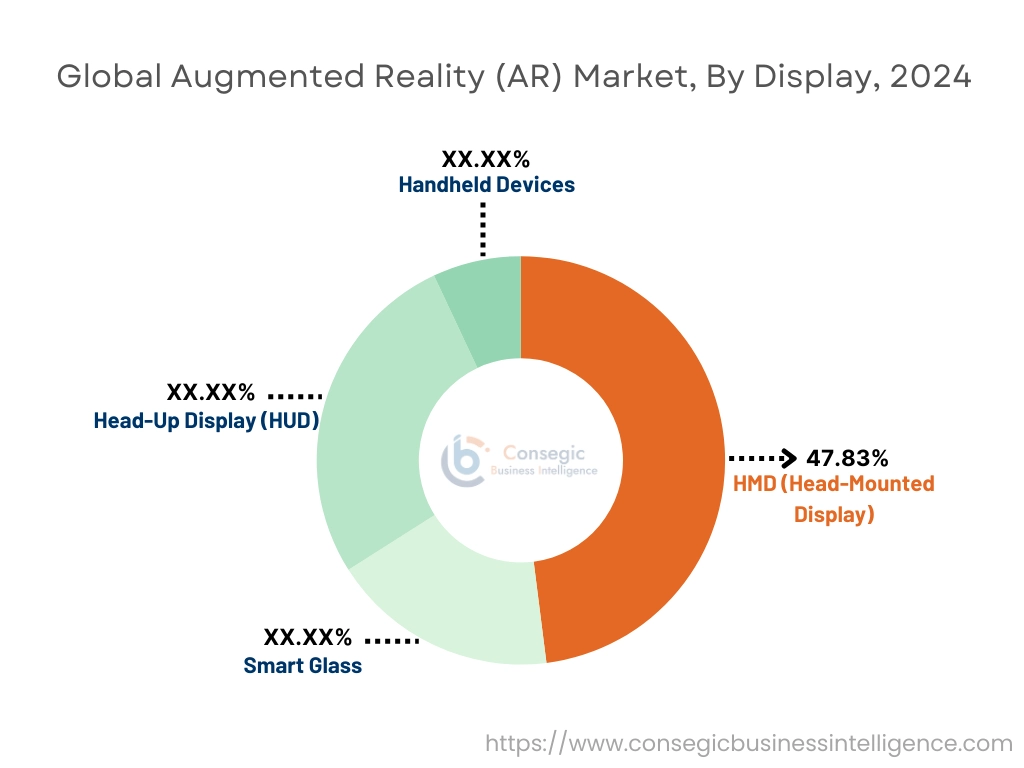
The HMD (head-mounted display) segment accounted for the largest revenue share of 47.83% in the market in 2024.
- An HMD is a device worn on the head that displays images or information directly in front of the user's eyes.
- HMDs enable hands-free interaction with AR content, allowing users to see and manipulate virtual objects without holding a device.
- For instance, Virtual Realities LLC offers HMDs in its product offerings. The products are available in VR Pro 3D Video, VR2000 Pro Dual, Z800 Pro Dual, VR Pro 1080P, and other models.
- Therefore, the benefits offered by HMD are driving the augmented reality (AR) market demand.
The head-up display (HUD) segment is expected to register the fastest CAGR during the forecast period.
- HUD projects information directly into the user’s line of sight, enhancing situational awareness and safety by overlaying virtual data onto the real world, like navigation directions and alerts.
- For instance, in April 2023, Raythink launched smart car AR head-up display. The product offers projection of important driving information including navigation, speed, and advanced driving assistance features.
- Thus, the market analysis shows that rising advancements related to HUD are projected to drive the augmented reality (AR) market trends during the forecast period.
By End-User:
Based on the end user, the market is segmented into aerospace & defense, gaming & entertainment, education, e-commerce & retail, industrial & manufacturing, and others.
Trends in the End User:
- Rising trend in adoption of AR in manufacturing to access real-time data, improve training, and enhance various processes like assembly, inspection, and maintenance.
- Increasing demand in AR for step-by-step instructions and visual cues to technicians during maintenance and repair tasks, reducing errors and improving turnaround times.
The gaming & entertainment segment accounted for the largest revenue share in the augmented reality (AR) market share in 2024.
- AR in gaming enhances the player experience by overlaying digital elements onto the real world, offering immersive and interactive gameplay through devices like smartphones and AR glasses, without requiring full virtual reality immersion.
- For instance, DevDen Creative Solutions offers AR headsets. The headsets can be used in theme parks, live events, sports broadcasting, and interactive movies.
- Therefore, the augmented reality (AR) market analysis depicts that the wide applications of AR technology in gaming and entertainment are boosting the market growth.
The education segment is expected to register the fastest CAGR during the forecast period.
- AR transforms learning, making it more interactive and visually stimulating. AR help students visualize complex concepts and processes, leading to a deeper understanding of the material.
- For instance, in December 2024, Avantis Education launched Eduverse+ AR library. The solutions allow schools to create immersive, dynamic, and AI-powered experiences.
- Thus, the market analysis depicts that the benefits offered by AR technology in education sector is expected to boost the augmented reality (AR) market expansion during the forecast period.
Regional Analysis:
The regions covered are North America, Europe, Asia Pacific, the Middle East and Africa, and Latin America.
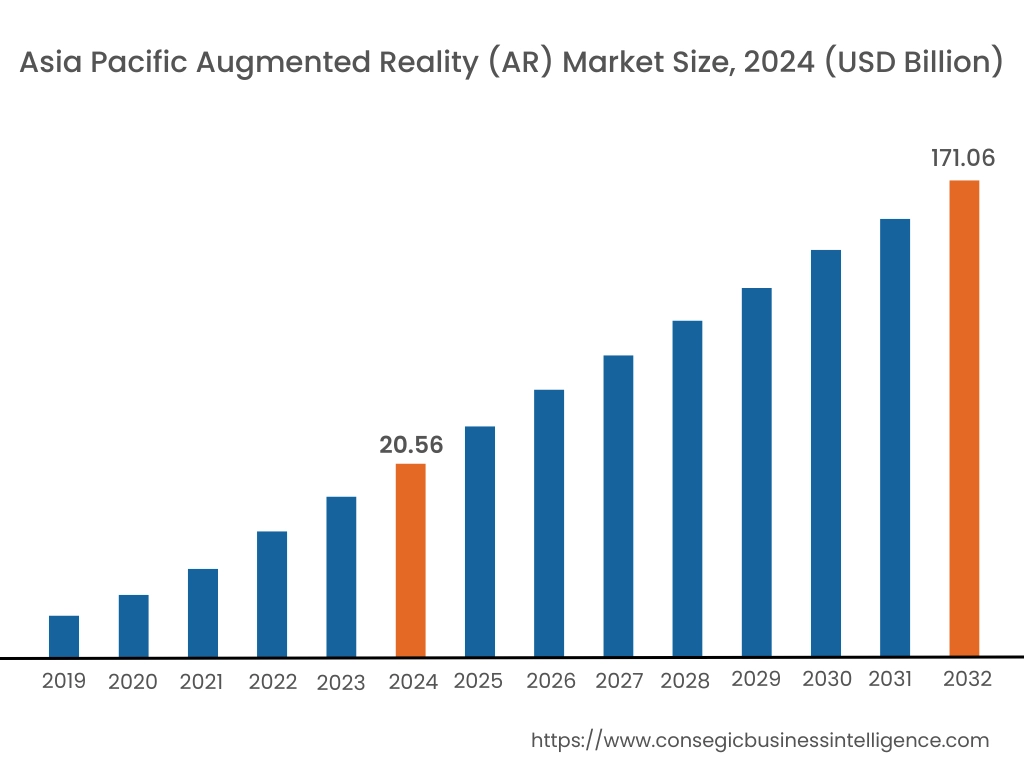
Asia Pacific region was valued at USD 20.56 Billion in 2024. Moreover, it is projected to grow by USD 26.40 Billion in 2025 and reach over USD 171.06 Billion by 2032. Out of this, China accounted for the maximum revenue share of 38.01%. The market growth in the region is driven due to rising demand of AR in manufacturing, retail, education, healthcare, and tourism industry. Moreover, strong economic growth, increasing consumer spending, and technological advancements, particularly in mobile AR and immersive experiences are further boosting the augmented reality (AR) market expansion.
- For instance, Fusion VR, an India-based company, offers AR solutions in its portfolio for various industries in chemicals, oil and gas, nuclear, power, mining, automotive, life science, pharma, and healthcare.

North America is estimated to reach over USD 232.27 Billion by 2032 from a value of USD 28.99 Billion in 2024 and is projected to grow by USD 37.11 Billion in 2025. The market growth is driven by high internet and smart device penetration, advanced technology infrastructure, and increasing AR integration with smartphones.
- For instance, in June 2024, Vuzix Corporation was selected by AFWERX for a Smart Business Innovative Research (SBIR) Phase I. The HMDs from the company will be used by Department of the Air Force, USA.
In Europe, the market is driven due to strong research institutions, government support and incentives, and the potential for AR to create new business models and improve various industries. The augmented reality (AR) market analysis shows that in Latin America and Middle East and Africa, the market is driven by increasing investments in AR, rise of AR smartphone applications, and the growing demand for remote collaboration and technological advancements in various industries including healthcare, retail, education, gaming, and others.
Top Key Players & Market Share Insights:
The augmented reality (AR) industry is highly competitive with major players providing solutions to the national and international markets. Key players are adopting several strategies in research and development (R&D), product innovation, and end-user launches to hold a strong position in the global augmented reality (AR) market. Key players in the augmented reality (AR) industry include -
- Apple Inc. (USA)
- Atheer, Inc. (USA)
- RealWear, Inc. (USA)
- Samsung Electronics Co., Ltd. (South Korea)
- Scope AR (USA)
- Seiko Epson Corporation (Japan)
- Snap Inc. (USA)
- Sony Corporation (Japan)
- Unity Technologies (USA)
- Avegant Corporation (USA)
- Google LLC (USA)
- Magic Leap, Inc. (USA)
- Maxst Co., Ltd. (South Korea)
- Meta Platforms, Inc. (USA)
- Microsoft Corporation (USA)
- Niantic, Inc. (USA)
- Vuzix Corporation (USA)
- PTC Inc. (USA)
Recent Industry Developments :
Product Launches:
- In March 2025, Vuzix launched an AR smart glasses-powered hearing assistance solution. The solution allows users with auditory disorders to leverage real-time informatory AR captions to support everyday tasks.
Augmented Reality (AR) Market Report Insights:
| Report Attributes | Report Details |
| Study Timeline | 2019-2032 |
| Market Size in 2032 | USD 643.58 Billion |
| CAGR (2025-2032) | 35.1% |
| By Component |
|
| By Display |
|
| By End-User |
|
| By Region |
|
| Key Players |
|
| North America | U.S. Canada Mexico |
| Europe | U.K. Germany France Spain Italy Russia Benelux Rest of Europe |
| APAC | China South Korea Japan India Australia ASEAN Rest of Asia-Pacific |
| Middle East and Africa | GCC Turkey South Africa Rest of MEA |
| LATAM | Brazil Argentina Chile Rest of LATAM |
| Report Coverage |
|
Key Questions Answered in the Report
How big is the augmented reality (AR) market? −
Augmented Reality (AR) Market size is estimated to reach over USD 643.58 Billion by 2032 from a value of USD 79.94 Billion in 2024 and is projected to grow by USD 102.36 Billion in 2025, growing at a CAGR of 35.1% from 2025 to 2032.
What are the major segments covered in the augmented reality (AR) market report? +
The segments covered in the report are component, display, end user, and region.
Which region holds the largest revenue share in 2024 in the augmented reality (AR) market? +
North America holds the largest revenue share in the augmented reality (AR) market in 2024.
Who are the major key players in the augmented reality (AR) market? +
The major key players in the market are Apple Inc. (USA), Atheer, Inc. (USA), Avegant Corporaton (USA), Google LLC (USA), Magic Leap, Inc. (USA), Maxst Co., Ltd. (South Korea), Meta Platforms, Inc. (USA), Microsoft Corporation (USA), Niantic, Inc. (USA), PTC Inc. (USA), RealWear, Inc. (USA), Samsung Electronics Co., Ltd. (South Korea), Scope AR (USA), Seiko Epson Corporation (Japan), Snap Inc. (USA), Sony Corporation (Japan), Unity Technologies (USA), and Vuzix Corporation (USA).
Overview
Reputation & Certifications


Our Services
- Market Intelligence & Forecasting
- Custom Research Solutions
- Market Entry Strategy
- Competitive Intelligence
- Customer Insights
- Industry Innovation Analysis
- Investment Advisory