Jump to Content
Next Generation Non-Volatile Memory Market - Size, Share, Industry Trends, and Forecasts (2025-2032)
Next Generation Non-Volatile Memory Market Size:
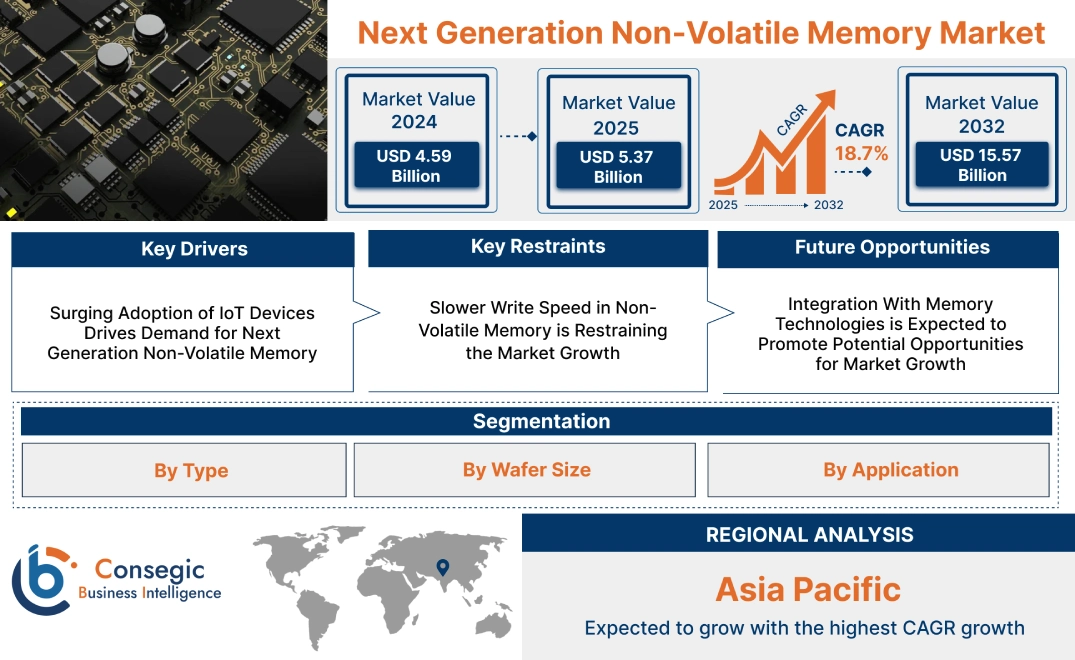
Next Generation Non-Volatile Memory Market is estimated to reach over USD 15.57 Billion by 2032 from a value of USD 4.59 Billion in 2024 and is projected to grow by USD 5.37 Billion in 2025, growing at a CAGR of 18.7% from 2025 to 2032.
Next Generation Non-Volatile Memory Market Scope & Overview:
Next generation non-volatile memory is widely used storage technology which retains data even when the power is cut off. The memory technology is essential for storing important information such as firmware, configuration settings, and others, enabling efficient data retrieval and storage. Additionally, the rising demand for embedded systems and IoT devices is fueling the next generation non-volatile memory market growth. Further, the key factors driving the memory technology include enhanced access speed, increased performance, and reduced boost time among others which, in turn, propels the next generation non-volatile memory market demand.
Next Generation Non-Volatile Memory Market Dynamics - (DRO) :
Key Drivers:
Surging Adoption of IoT Devices Drives Demand for Next Generation Non-Volatile Memory
The rapid development of IoT technologies and 5G networks has exponentially increased the volume of data generated, which, in turn, is driving the next generation non-volatile memory market demand. Additionally, the memory technology is utilized to ensure that the memory data is not lost in unexpected events. Also, the memory technology is essential to ensure the accuracy and protect the integrity of the data before malicious intrusions.
- For instance, in February 2023, GlobalFoundries acquired Renesas’ non-volatile resistive RAM technology. The aim of the acquisition is to enable a range of applications in home, industrial IoT and wearable devices to smartphones devices.
Therefore, the rising adoption of IoT devices is paving the way for demand of non-volatile memory to ensure memory data is not lost, in turn, proliferating the next generation non-volatile memory market growth.

Key Restraints:
Slower Write Speed in Non-Volatile Memory is Restraining the Market Growth
The non-volatile memory has slower read and write operations, and the CPU is unable to directly access the memory which, in turn, hinders the next generation non-volatile memory market expansion. Additionally, the reduced performance and efficiency due to lower read and write speed of the memory restrains the market progress.
Therefore, the slower read and write sped of the memory technology is restraining the next generation non-volatile memory market expansion.
Future Opportunities :
Integration With Memory Technologies is Expected to Promote Potential Opportunities for Market Growth
The proliferation of data centers is driving the integration of memory technology due to application of non-volatile memory into data centers to offer a flexible approach to expanding memory capacity which, in turn, is propelling the next generation non-volatile memory market opportunities. Additionally, the integration provides improved performance and scalability driving the market progress.
- For instance, in January 2025, Weebit Nano Limited have partnered with onsemi for the license agreement of integrating resistive random access memory into innovative non-volatile memory technology. The integration aims to provide a low-power, cost-effective NVM with excellent retention at high temperatures.
Hence, the integration of memory technology with non-volatile memory is anticipated to promote prospect for next generation non-volatile memory market opportunities during the forecast period.
Next Generation Non-Volatile Memory Market Segmental Analysis :
By Type:
Based on the type, the market is bifurcated into Hybrid Memory Cube (HMC) and High-bandwidth Memory (HBM).
Trends in the Type:
- The performance of Edge-AI workloads is optimized by high bandwidth memory which, in turn, drives the next generation non-volatile memory market trend.
- The increasing focus towards enhancing memory bandwidth is driving the adoption of high-bandwidth memory type which, in turn, drives the market trend.
High-bandwidth memory (HBM) accounted for the largest revenue share in the year 2024.
- High bandwidth memory (HBM) is a state-of-the-art computer memory technology which provides higher memory rate for driving applications such as artificial intelligence (AI) and supercomputers which, in turn, is driving the next generation non-volatile memory market share.
- Additionally, the continuous progression in domains such as AI applications, high end servers, and graphics is driving the need for high-bandwidth memory which, in turn, propels the next generation non-volatile memory market share.
- For instance, in February 2021, Samsung Electronics Co., Ltd., developed high bandwidth memory with embedded AI capability. The launch enables application into data centers, high performance computing (HPC) systems and AI-enabled mobile applications.
- Thus, according to the next generation non-volatile memory market analysis, continuous progression in domains is driving the adoption of high-bandwidth memory.
Hybrid memory cube (HMC) is anticipated to register the fastest CAGR during the forecast period.
- The hybrid memory cube is the next generation of high-speed external memory technology driving their adoption in tablets and graphics cards which, in turn, is propelling the market development.
- The rising adoption of supercomputers and high-speed servers is paving the way for hybrid memory cube segment, which, in turn, fuels the next generation non-volatile memory market size.
- Therefore, as per the market analysis, the rising adoption of supercomputers and high-speed servers is anticipated to boost the market during the forecast period.
By Wafer Size:
Based on the wafer size, the market is bifurcated into 200 mm and 300 mm.
Trends in the Wafer Size:
- The rising productivity and improved efficiency are driving the adoption of 300 mm wafer size which, in turn, fuels the next generation non-volatile memory market trend.
300 mm accounted for the largest revenue share in the year 2024.
- The increasing production of processors, memory chips, and advanced logic devices is driving the 300 mm wafers size. Also, the 300 mm wafer size significantly increases productivity and efficiency, in turn, driving the segment progress.
- Further, the rising adoption in semiconductors and electronics industry is driving the 300 mm wafer size segment progress which, in turn, fuels the next generation non-volatile memory market size.
- For instance, according to STMicroelectronics, the company is focusing on strengthening 300 mm wafer digital manufacturing capacity in France as well as 9,000 wafers per week in Italy facility.
- Thus, according to the next generation non-volatile memory market analysis, rising adoption in semiconductors and electronics industry is driving the 300 mm wafers size segment.
200 mm is anticipated to register the fastest CAGR during the forecast period.
- The 200 mm wafer size is utilized in applications such as microprocessors, logic, RF, and power chips. Also, the rising adoption in high volume production of consumer devices is driving the adoption of 200 mm wafer size.
- For instance, in July 2021, STMicroelectronics developed first 200 mm Silicon-Carbide wafer at facility in Sweden. Additionally, the development aims to cater the rising adoption in automotive and industrial sectors.
- Therefore, as per the market analysis, the rising adoption in consumer electronics is anticipated to boost the market during the forecast period.
By Application:
Based on the application, the market is segmented into BFSI, consumer electronics, government, telecommunications, information technology, and others.
Trends in the Application:
- The trend towards more efficient and compact memory solutions is driving the adoption of market in consumer electronics sector.
- The trend towards rising adoption of non-volatile memory solutions in modern automotive systems is driving the market growth.
Consumer electronics accounted for the largest revenue share of 41.08% in the year 2024.
- The rising utilization of non-volatile memory for data storage in solid-state drives (SSDs), USB drives and memory cards in digital cameras, smartphones and other devices is propelling the market adoption in consumer electronics sector.
- Additionally, characteristics of non-volatile memory make it suitable for applications such as smartphones and others where persistent storage is essential which, in turn, is driving the next generation non-volatile memory industry.
- For instance, in December 2020, TDK Corporation launched flash storage solution for applications in IoT devices, factory automation, industrial computers and others.
- Thus, as per the market analysis, the rising utilization for data storage is driving the adoption of market in consumer electronics sector.
BFSI is anticipated to register the fastest CAGR during the forecast period.
- The rapid digitalization as well as changing stringent rules and regulations in BFSI sector is driving the demand for net generation non-volatile memory.
- Additionally, the proliferation of IoT connected devices is driving the market adoption in BFSI sector due to improved data security and operational efficiencies.
- Therefore, as per the market analysis, rapid digitalization is anticipated to boost the market during the forecast period.

Regional Analysis:
The regions covered are North America, Europe, Asia Pacific, the Middle East and Africa, and Latin America.

Asia Pacific region was valued at USD 1.22 Billion in 2024. Moreover, it is projected to grow by USD 1.43 Billion in 2025 and reach over USD 4.29 Billion by 2032. Out of this, China accounted for the maximum revenue share of 33.6%. The rising adoption of vehicles with advanced driver assistance systems (ADAS) is driving the market growth. Furthermore, AI integration into non-volatile memory is projected to drive the market adoption in Asia Pacific region during the forecast period.
- For instance, in May 2022, Toshiba electronic devices & storage corporation partnered with Japan semiconductor corporation for development of analog platform embedded with NVM for application in automotive sector.

North America is estimated to reach over USD 5.36 Billion by 2032 from a value of USD 1.60 Billion in 2024 and is projected to grow by USD 1.86 Billion in 2025. In the North American region, the growing automotive and consumer electronics sector offer lucrative growth prospects for the market. Additionally, technological advancements and rising number of global memory technology manufacturers in North America is driving the market evolution. Also, the ring adoption to secure the crucial data even during power loss is fueling the market growth.
- For instance, in April 2024, Everspin Technologies, Inc. deployed MRAM to IBM for utilization in IBM FlashCore Module 4 for ensuring critical data integrity even during power loss.
The regional evaluation depicts that rising adoption in applications such as consumer electronics and data centers are driving the market in Europe. Additionally, the key factor driving the market is the rising adoption of IoT connected devices in the Middle East and African region. Further, the increasing focus towards digital transformation is paving the way for the progress of market in Latin America region.
Top Key Players and Market Share Insights:
The global next generation non-volatile memory market is highly competitive with major players providing next generation non-volatile memory to the national and international markets. Key players are adopting several strategies in research and development (R&D), product innovation, and end-user launches to hold a strong position in the next generation non-volatile memory industry. Key players in the next generation non-volatile memory market include-
- Renesas Electronics Corporation (Japan)
- Avalanche Technology, Inc. (USA)
- Crossbar Inc. (USA)
- Cypress Semiconductor Corporation (USA)
- Everspin Technologies Inc. (USA)
- Honeywell International Inc. (USA)
- IBM Corporation (USA)
- Intel Corporation (USA)
- Microchip Technology Inc. (USA)
- Micron Technology, Inc. (USA)

Recent Industry Developments :
Product Launch:
- In March 2025, VDURA launched All-Flash NVMe V5000 for applications in AI pipelines and generative AI models. The launch offers scalability and reliability to AI powered infrastructure.
- In November 2024, Infineon Technologies AG launched flash memory for application in space and extreme environment. Additionally, the device is capable of handling high density and radiation.
Collaborations and Partnerships:
- In February 2025, Everspin Technologies, Inc partnered with Lattice Semiconductor for integration of MRAM into Lattice Semiconductor field programmable gate arrays for application in industrial, aerospace, military, and automotive.
Next Generation Non-Volatile Memory Market Report Insights :
| Report Attributes | Report Details |
| Study Timeline | 2019-2032 |
| Market Size in 2032 | USD 15.57 Billion |
| CAGR (2025-2032) | 18.7% |
| By Type |
|
| By Wafer Size |
|
| By Application |
|
| By Region |
|
| Key Players |
|
| North America | U.S. Canada Mexico |
| Europe | U.K. Germany France Spain Italy Russia Benelux Rest of Europe |
| APAC | China South Korea Japan India Australia ASEAN Rest of Asia-Pacific |
| Middle East and Africa | GCC Turkey South Africa Rest of MEA |
| LATAM | Brazil Argentina Chile Rest of LATAM |
| Report Coverage |
|
Key Questions Answered in the Report
How big is the next generation non-volatile memory market? −
The next generation non-volatile memory market is estimated to reach over USD 15.57 Billion by 2032 from a value of USD 4.59 Billion in 2024 and is projected to grow by USD 5.37 Billion in 2025, growing at a CAGR of 18.7% from 2025 to 2032.
What specific segmentation details are covered in the next generation non-volatile memory report? +
The next generation non-volatile memory report includes specific segmentation details for type, wafer size, application, and regions.
Which is the fastest segment anticipated to impact the market growth? +
In the next generation non-volatile memory market, the BFSI is the fastest-growing segment during the forecast period due to rapid digitalization as well as proliferation of IoT connected devices.
Who are the major players in the next generation non-volatile memory market? +
The key participants in the next generation non-volatile memory market are Renesas Electronics Corporation (Japan), Avalanche Technology, Inc. (USA), Crossbar Inc. (USA), Cypress Semiconductor Corporation (USA), Everspin Technologies Inc. (USA), Honeywell International Inc. (USA), IBM Corporation (USA), Intel Corporation (USA), Microchip Technology Inc. (USA), Micron Technology, Inc. (USA) and others.
What are the key trends in the next generation non-volatile memory market? +
The next generation non-volatile memory market is shaped by several key trends including trend towards more efficient and compact memory solutions as well as rising adoption of non-volatile memory solutions in modern automotive systems and other are the key trends driving the market.
Overview
Reputation & Certifications


Our Services
- Market Intelligence & Forecasting
- Custom Research Solutions
- Market Entry Strategy
- Competitive Intelligence
- Customer Insights
- Industry Innovation Analysis
- Investment Advisory