Jump to Content
Smart Transportation Market - Size, Share, Industry Trends, and Forecasts (2025-2032)
Smart Transportation Market Size:
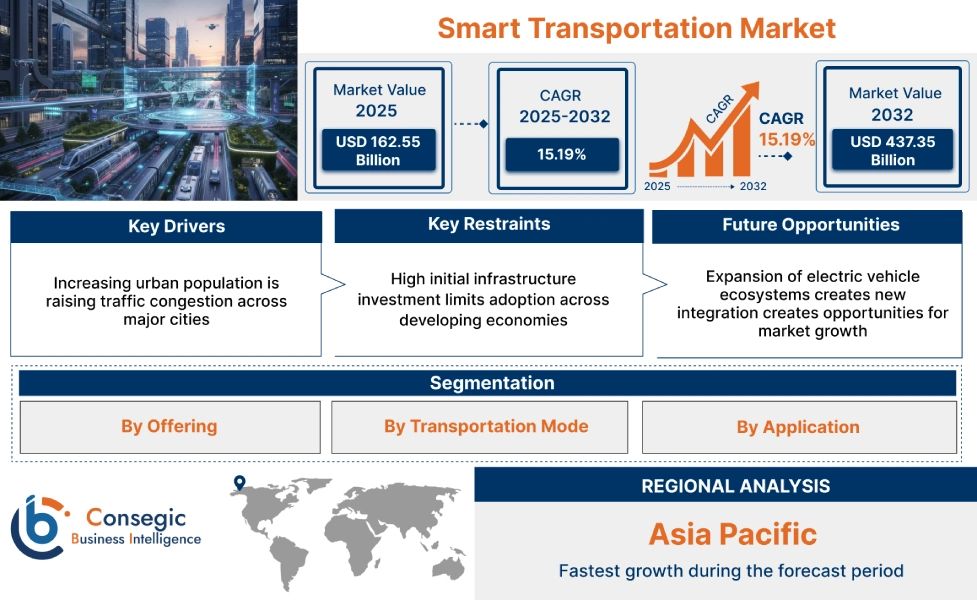
Smart Transportation Market size is estimated to reach over USD 437.35 Billion by 2032 from a value of USD 141.41 Billion in 2024 and is projected to grow by USD 162.55 Billion in 2025, growing at a CAGR of 15.19% from 2025 to 2032
Smart Transportation Market Scope & Overview:
Smart transportation refers to integrated mobility systems that use digital technologies to improve traffic management, public transport operations, road safety, and urban mobility efficiency. These solutions integrate intelligent transportation systems, connected vehicle solutions, traffic sensors, data analytics software, and communication infrastructure. The aim is to optimize traffic flow, alleviate congestion, improve passenger safety, and optimize the performance of the overall transport network. The infrastructure enables real-time data transfer between vehicles, traffic control centers, and roadside infrastructure.
The smart transportation market is fueled by the increasing pace of urbanization and the strain on current transport infrastructure. Governments and urban planners are investing in intelligent traffic management and connected mobility solutions to counter congestion and passenger safety issues. The expansion of connected vehicles and 5G-enabled communication networks has increased system integration across transport ecosystems. Regulatory focus on emission reduction and sustainable mobility is further supporting market expansion.
How is the Smart Transportation Market Affected by AI?
AI enhances smart transport systems by analyzing large amounts of traffic data, vehicle movements, and commuter behavior at a faster speed and with greater accuracy. Machine learning models detect congestion build-up, accident risks, and abnormal traffic conditions across road networks. This approach reduces response time and improves traffic flow management. AI also helps in adaptive traffic signal control and route optimization for interlinked transport systems.
AI-based platforms allow for the continuous observation of transportation infrastructure and dynamic decision-making based on real-time conditions. Predictive models forecast traffic demand, vehicle performance, and maintenance needs before the occurrence of events. This shift from static traffic planning to data-driven mobility management improves operational efficiency. As urban mobility networks expand, AI integration is strengthening long-term transport planning and system coordination across cities.
Smart Transportation Market Dynamics - (DRO):
Key Drivers:
Increasing urban population is raising traffic congestion across major cities
The rising urban population is increasing vehicle density and daily commute volumes across metropolitan regions. Higher traffic congestion is reducing road efficiency and increasing travel time. City authorities are deploying intelligent traffic management systems to improve signal coordination and real-time traffic monitoring. The platforms facilitate data-driven decision-making and minimize inefficiencies in the transportation network.
- For instance, in September 2024, Cubic Transportation Systems launched umo scanRide, a new contactless fare payment system that aims to make payments easier and more convenient for public transport users.
Thus, the smart transportation market is growing as a result of increasing traffic congestion and the need for smart traffic optimization solutions.
Key Restraints:
High initial infrastructure investment limits adoption across developing economies
Smart transportation systems with advanced technology involve the installation of sensors, communication infrastructure, control rooms, and software platforms. The total investment involves the integration of the system, testing, and maintenance. Developing countries face challenges in allocating funds. This slows large-scale deployment of intelligent transport frameworks.
Therefore, high initial infrastructure investment is restricting broader penetration of smart transportation solutions in cost-sensitive markets.
Future Opportunities:
Expansion of electric vehicle ecosystems creates new integration creates opportunities for market growth
The growing demand for the use of electric vehicles is also leading to an increased need for coordinated charging infrastructure and traffic management systems. Electric vehicle charging stations need to be connected to the grid, have location intelligence, and traffic flow analysis for optimal use. The transport sector is incorporating charging infrastructure into smart traffic management systems.
- International Energy Agency stated that global sales of electric cars in 2024 exceeded 17 million units, registering a growth of over 25%, and the additional 3.5 million units sold compared to 2023 were higher than the total sales recorded in 2020.
Hence, the growth of electric vehicle ecosystems is creating new system integration requirements and long-term opportunities for the smart transportation market.
Smart Transportation Market Segmental Analysis:
By Offering:
On the basis of offering, the smart transportation market is segmented into solution (ticketing management system, parking management & guidance system, integrated supervision system, traffic management system), and services (business, professional and cloud services).
Trends in the Offering:
- Increasing traffic congestion across urban centers is strengthening demand for integrated traffic management solutions.
- Growing deployment of connected mobility platforms is supporting system-level solution integration.
The solution offering was responsible for the highest revenue share in 2024.
- Solutions include traffic control platforms, smart signaling systems, surveillance networks, and analytics software.
- Moreover, municipal authorities are investing in centralized traffic command centers to improve operational control.
- Additionally, rising need for real-time data processing is increasing adoption of intelligent transport software.
- Further, integration of IoT sensors across highways and intersections is strengthening solution deployment.
- Furthermore, expansion of connected vehicle ecosystems is increasing demand for end-to-end traffic management platforms.
- Therefore, higher capital allocation toward digital traffic infrastructure is supporting segment dominance.
It is anticipated that the services offering will exhibit the highest compound annual growth rate (CAGR) during the forecast period.
- Services include consulting, system integration, technical support, and managed mobility operations.
- Moreover, increasing complexity of multi-vendor transport systems is raising demand for integration services.
- Additionally, ongoing software upgrades and cybersecurity management are strengthening recurring service contracts.
- Further, public private partnership projects are increasing outsourced operational support requirements.
- Furthermore, growing need for data analytics optimization is expanding advisory and managed service adoption.
- Hence, rising system complexity and long-term maintenance requirements are accelerating growth of the services segment.
By Transportation Mode:
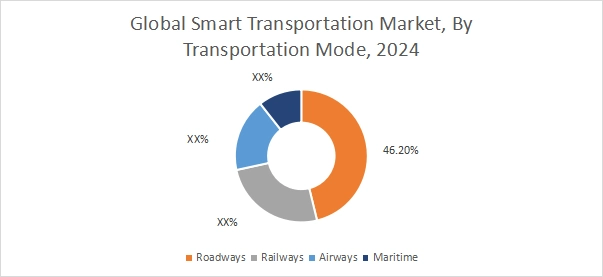
On the basis of transportation mode, the market is divided into roadways, railways, airways and maritime.
Trends in the Transportation Mode:
- The increasing rate of urban traffic growth is also propelling the installation of digital infrastructure in road networks.
- Infrastructure modernization programs are strengthening intelligent system adoption in rail and air transport.
Roadways represented the highest revenue share of 46.20% in 2024.
- Road transport manages the majority of passenger and freight movement globally.
- Moreover, the government is installing adaptive traffic signal control systems to alleviate congestion.
- Additionally, the use of electronic toll collection systems is also on the rise along national highway routes.
- Further, the integration of connected vehicles is also increasing the need for vehicle-to-infrastructure communication systems.
- Furthermore, rising accident rates are supporting installation of real-time monitoring and enforcement systems.
- For example, in February 2026, Iveda Solutions launched an AI Traffic Management Module that uses existing intersection cameras to provide real-time traffic intelligence to improve traffic flow, safety, and new revenue streams for smart transportation systems.
- Therefore, high vehicle density and continuous infrastructure upgrades are supporting segment dominance.
Railways is anticipated to exhibit the most rapid compound annual growth rate (CAGR) throughout the forecast period.
- Urban metro expansion projects are incorporating automated train control systems.
- Rail operators are deploying predictive maintenance platforms to reduce downtime.
- Integration of smart ticketing and passenger information systems is enhancing service coordination.
- Government investment in high-speed rail corridors is strengthening digital signaling adoption.
- Focus on low-emission transport alternatives is increasing preference for rail modernization.
- Hence, increasing rail infrastructure investments are accelerating segment growth.
By Application:
On the basis of application, the smart transportation market is divided into mobility as a service, route information and route guidance, public transport, transit hubs, connected cars, video management and others.
Trends in the Application:
- Rising smartphone usage is increasing demand for app-based mobility platforms.
- Growing requirement for real-time traffic updates is strengthening route guidance solutions.
Public Transport accounted for the largest revenue share in the year 2024.
- Transit agencies are implementing automated fare collection and fleet tracking systems.
- Real-time passenger information displays are improving service visibility.
- Increasing urban commuting volumes are raising demand for centralized transport management.
- Integration of bus and metro data systems is improving operational coordination.
- Government emphasis on minimizing the use of private vehicles is enhancing investment in the digitization of public transport.
- Therefore, strong policy focus on mass transit efficiency is supporting segment dominance.
Mobility as a service is anticipated to register the fastest CAGR during the forecast period.
- Integrated platforms combine ride-hailing, car-sharing, and public transit services.
- Consumers are shifting toward subscription-based and on-demand mobility access models.
- Digital payment integration is improving user convenience and service accessibility.
- Data analytics platforms are facilitating the smooth coordination of various transport operators.
- Urban governments are encouraging multimodal transport ecosystems through regulatory support.
- Hence, rising preference for integrated mobility solutions is accelerating segment growth.
Regional Analysis:
North America, Europe, Asia Pacific, the Middle East and Africa, and Latin America are the regions of coverage.
North America region was valued at USD 45.55 billion in 2024. Furthermore, it is expected to increase steadily during the forecast period. Market expansion is fueled by the adoption of intelligent transportation systems and smart city investments. Federal and state government initiatives are encouraging the implementation of connected traffic management systems in large cities. Canada and Mexico are also increasing the scope of digital transport modernization initiatives, which is boosting the market in the region during the forecast period.
- For example, in June 2024, the General Services Administration launched an investment of USD 80 million under the Inflation Reduction Act to implement smart technologies that enhance energy efficiency, lower emissions and expenses, and upgrade federal facilities.
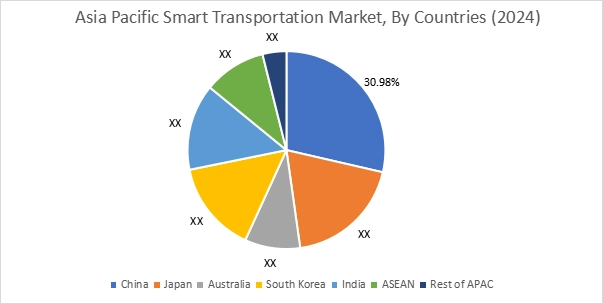
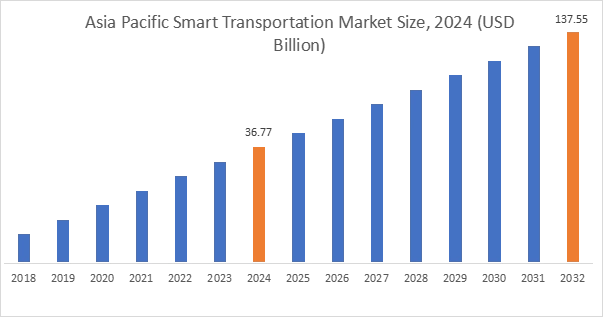
Asia Pacific region is the fastest growing and was valued at USD 36.77 Billion in 2024. Moreover, it is projected to grow by USD 43.28 Billion in 2025 and reach over USD 137.55 Billion by 2032. Out of this, China accounted for the maximum revenue share of 30.98%. The Asia Pacific market is growing due to the increasing urbanization in China, India, and Southeast Asia. The increasing investment by the government in metro rail systems, smart highways, and mobility solutions is fueling the adoption of intelligent transport systems in the Asia Pacific region.
- UN-Habitat reported that over 50% of ASEAN’s population has lived in urban areas since 2020, and this share is projected to reach nearly 56% by 2030, increasing the urban population from 335 million to 405 million, which reflects growth of around 70 million people.
The market in Europe is mainly driven by regulatory support for sustainable mobility, expansion of intelligent traffic systems, and increasing investment in connected public transport networks. Furthermore, integration of real-time data platforms and cross-border mobility frameworks are projected to drive the market progress during the forecast period.
The Latin America smart transportation market is primally driven by urban congestion management initiatives, expansion of electronic toll collection systems, and modernization of public transport networks. Furthermore, investments in integrated mobility platforms and digital ticketing systems are projected to drive the market growth during the forecast period.
The Middle East & Africa smart transportation market growth is mainly driven by smart city initiatives, metro rail expansion projects, and investments in digital traffic monitoring systems. Furthermore, government-led transport modernization strategies and centralized mobility command centers are expected to support regional market development during the forecast period.
Top Key Players & Market Share Insights:
The global smart transportation market has a moderate level of competition, with key players in the market being technology companies, infrastructure companies, and mobility platform companies. Additionally, the companies in the smart transportation market are using strategies such as partnerships with city governments, development of platforms, enhancement of digital traffic management capabilities, and public infrastructure contracts to position themselves in the market. Key participants in the smart transportation market include:
- Siemens AG– Germany
- Cisco Systems, Inc.– US
- IBM Corporation– US
- Thales Group – France
- Kapsch TrafficCom AG – Austria
- Cubic Corporation – US
- Indra Sistemas, S.A. – Spain
- Hitachi, Ltd. – Japan
- Huawei Technologies Co., Ltd. – China
- TomTom N.V. – Netherlands
Recent Industry Developments:
Product Launches
- In January 2026, Kapsch TrafficCom introduced its next-generation EcoTrafiX mobility platform to unify and modernize urban traffic operations with connected vehicle integration and advanced analytics for smarter, sustainable transportation management.
- In January 2026, TomTom enhanced its mapping and navigation services by integrating with Microsoft Corporation’s Azure platform to support smarter routing and real-time traffic insights for connected mobility and smart transportation systems.
- In February 2025, Thales Group partnered with Cubic Corporation to introduce next-generation eSIM solutions that enhance secure connectivity for connected vehicles and smart transportation networks.
Smart Transportation Market Report Insights:
| Report Attributes | Report Details |
|---|---|
| Study Timeline | 2019-2032 |
| Market Size in 2032 (USD Trillion) | USD 437.35 Billion |
| CAGR (2025-2032) | 15.19% |
| By Offering |
|
| By Transportation Mode |
|
| By Application |
|
| By Region |
|
| Key Players |
|
| Report Coverage |
|
Key Questions Answered in the Report
How big is the smart transportation market? −
The smart transportation market sizeis estimated to reach over USD 437.35 Billion by 2032 from a value of USD 141.41 Billion in 2024 and is projected to grow by USD 162.55 Billion in 2025, growing at a CAGR of 15.19% from 2025 to 2032.
Which segmentation details are covered in the smart transportation report? +
The smart transportation report includes specific segmentation details for offering, transportation mode, application, and regions.
Which is the fastest segment anticipated to impact the market growth? +
The mobility as a service segment is the fastest growing, driven by rising adoption of app-based transport platforms and integration of multimodal mobility services across urban regions.
Who are the major players in the smart transportation market? +
The key participants in the smart transportation marketare Siemens AG (Germany), Cisco Systems, Inc. (US), IBM Corporation (US), Thales Group (France), Kapsch TrafficCom AG (Austria), Cubic Corporation (US), Indra Sistemas, S.A. (Spain), Hitachi, Ltd. (Japan), Huawei Technologies Co., Ltd. (China), TomTom N.V. (Netherlands), and others.
What are the key trends in the smart transportation market? +
The smart transportation market is shaped by key trends including increasing urban congestion, deployment of AI-based traffic management systems, expansion of connected vehicle infrastructure, and stronger regulatory focus on sustainable urban mobility.
Overview
Reputation & Certifications


Our Services
- Market Intelligence & Forecasting
- Custom Research Solutions
- Market Entry Strategy
- Competitive Intelligence
- Customer Insights
- Industry Innovation Analysis
- Investment Advisory