Jump to Content
Vacuum Insulated Glass Market - Size, Share, Industry Trends, and Forecasts (2025-2032)
Vacuum Insulated Glass Market Size:
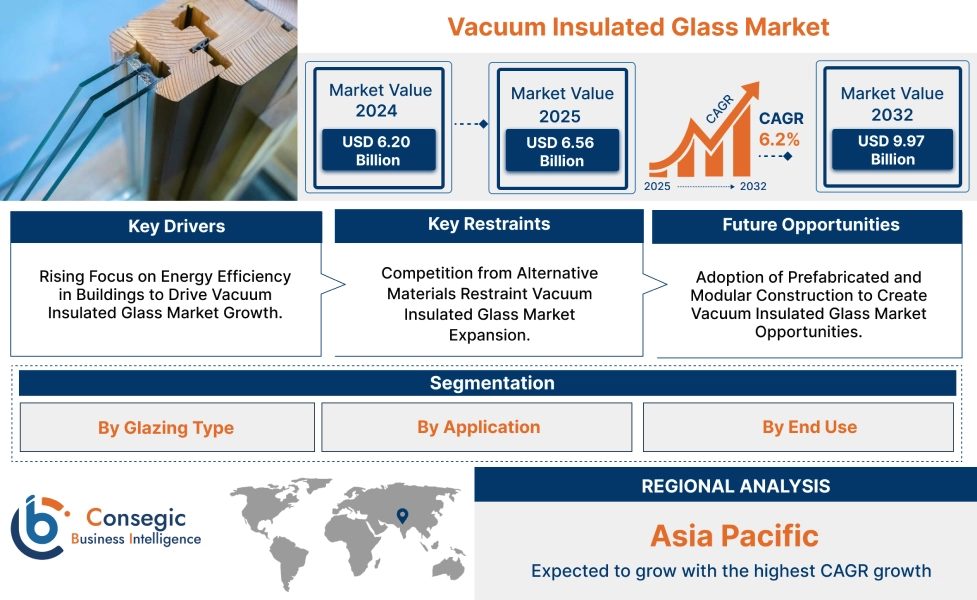
The Vacuum Insulated Glass Market size is growing with a CAGR of 6.2% during the forecast period (2025-2032), and the market is projected to be valued at USD 9.97 Billion by 2032 from USD 6.20 Billion in 2024. Additionally, the market value for 2025 is attributed to USD 6.56 Billion.
Vacuum Insulated Glass Market Scope & Overview:
Vacuum insulated glass (VIG) is a type of architectural glass that consists of two glass panes which are separated by a narrow gap. Microscopic pillars are present inside the gap. These pillars make even spacing to maintain the structural integrity of the glass. The pillars are designed so that they do not compromise the transparency or aesthetic of the glass. Removal of air from the glass panes creates a vacuum that further reduces the transfer of heat. As a result, these glasses presenting vacuum insulation provide superior thermal insulation. This results in lower U-values and higher R-values compared to traditional double-paned glass. These glasses serve crucial role in reducing energy consumption for heating and cooling in modern buildings. Predominantly utilized in windows and doors, building facades and curtain walls, skylights and roof glazing, interior partitions, and more, these glasses cater to various end-use sectors including residential, commercial, and industrial.
How is AI Impacting the Vacuum Insulated Glass Market?
Artificial Intelligence is revolutionizing the vacuum insulated glass (VIG) market by enhancing manufacturing precision, energy efficiency, and product innovation. In production, AI-driven monitoring systems analyze temperature, pressure, and sealing parameters in real time to ensure uniform vacuum levels and defect-free glass panels. Machine learning models optimize material selection and thermal performance, helping manufacturers design glass with superior insulation and durability. AI-powered simulations also accelerate R&D, allowing rapid testing of new coatings and structural designs. Additionally, predictive analytics improve maintenance scheduling and energy efficiency in smart buildings using VIG. As demand for sustainable and high-performance glazing grows, AI is driving greater quality, efficiency, and innovation across the global VIG market.
Vacuum Insulated Glass Market Dynamics - (DRO) :
Key Drivers:
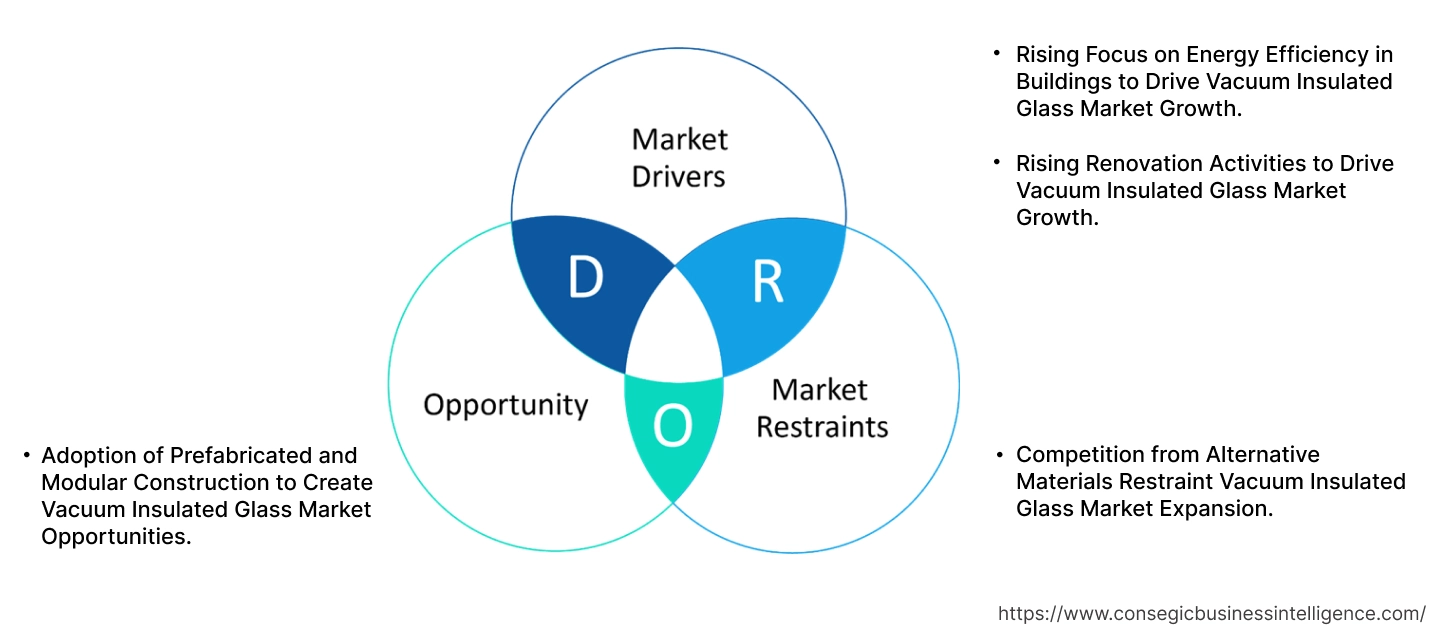
Rising Focus on Energy Efficiency in Buildings to Drive Vacuum Insulated Glass Market Growth.
The construction sector is increasingly prioritizing energy efficiency due to the stricter building energy codes. In addition to this, adoption of green building certifications such as LEED is growing across several countries which further mandates the use of high-performance glass solutions such as vacuum insulated glass to minimize energy consumption in buildings. Reduction in consumption of energy decreases energy costs in turn providing economic benefits. Also, rising global awareness of environmental concerns in addition to regulations is making these glasses suitable investment for building owners and occupants.
- For instance, in May 2024, the updated Energy Performance of Buildings Directive (EU/2024/1275) came into effect. The directive supports commitment to enhancing energy efficiency and reducing greenhouse gas emissions from buildings.
Hence, as per market analysis, preference for energy efficiency, benefits the vacuum insulated glass market demand.
Rising Renovation Activities to Drive Vacuum Insulated Glass Market Growth.
Renovation or retrofitting of the property enhances functionality, increases property value, and updates aesthetics. Homeowners are increasingly investing in renovation to increase the value of their properties. This is creating a growing demand for vacuum insulated glass to improve aesthetics and functions in older historical buildings.
- For instance, according to the data published by Verana, in 2021, over half of homeowners, specifically 53%, undertook renovations, representing a 4% increase from the 49% who renovated in 2020.
Thus, VIGs being slim and lightweight in nature are widely used for home renovation, benefiting the market revenue
Key Restraints :
Competition from Alternative Materials Restraint Vacuum Insulated Glass Market Expansion.
The upward trajectory of the market faces limitations due to the widespread availability and established use of substitute materials. Traditional high-performing insulated glass units such as triple glazing with advanced coatings and gas fills, offer a more established and often less expensive alternative. Apart from this, materials such as acrylics used for acrylic sheets and polycarbonates offer superior impact resistance and lighter weight which makes them suitable for safety glazing and skylights. Aluminum also offers strength and corrosion resistance in facade and window frame construction, further reducing the need for extensive glass areas. Opaque cladding materials including stone are preferred for cost, insulation, and aesthetic reasons in facades. This abundance of readily available and competitively priced substitutes creates a competitive landscape. As a result, the above-mentioned factors are hindering the vacuum insulated glass market expansion.
Future Opportunities :
Adoption of Prefabricated and Modular Construction to Create Vacuum Insulated Glass Market Opportunities.
Prefabrication and modular construction involve building components or entire modules off-site and then transporting them to the construction site for assembly. These approaches allow precise installation, efficiency, cost-effectiveness, and sustainability benefits. This type of construction prioritizes energy efficiency to reduce operational costs. Hence, it becomes useful to adopt VIGs in such energy conscious construction. Thus, growing support for prefabricated and modular construction will create adoption of these glasses to improve energy efficiency.
- For instance, in March 2025, Australian federal government announced commitment of investing USD 54 million to support modular and prefab construction.
As a result, as per analysis, the increasing acceptance and adoption of prefabricated building across various building types signifies a consistent and expanding opportunities for the VIGs.
Vacuum Insulated Glass Market Segmental Analysis :
By Glazing Type:
Based on glazing type, the market is categorized into dual glazing, triple glazing, and others
Trends in Glazing Type:
- Combining dual glazing with specialized coatings for enhanced solar control and low-E properties improve energy efficiency and occupant comfort.
- Adoption of triple and quadruple glazing is rising to enhance both thermal and acoustic insulation performance.
The dual glazing segment accounted for the largest market share in 2024.
- Dual glazing glass presents two glasses separated by vacuum. The presence of two glasses makes their thickness and weight manageable compared to triple glazing.
- As a result, dual glaze offers a less expensive and established performance. In addition to this, its thickness and weight of these glasses make them suitable for utilization in both the new construction and retrofitting.
- Moreover, these glasses reduce the heat significantly which supports energy savings with high affordability.
- As per the analysis, owing to the cost effectives, the dual glazing segment dominates the vacuum insulated glass market demand.
The triple glazing segment is expected to grow at the fastest CAGR over the forecast period.
- Triple glazed vacuum insulated glasses contain three panes of insulated glass units.
- These glasses offer increased thermal and sound insulation for windows, facades, and doors, hence significantly reducing energy consumption.
- There's a growing global consciousness regarding the environmental impact of buildings.
- For instance, according to the European Commission, buildings account for approximately 40% of the European Union's total energy consumption, over half of the EU's gas consumption, and 35% of its energy-related greenhouse gas emissions.
- Triple glaze glasses contribute to more sustainable construction by lowering carbon emissions associated with energy use, which further creates potential for the segment.
- Hence, owing to the above-mentioned factors, the triple glaze segment is expected to grow at the fastest rate over the future years.
By Application:
Based on applications, the market is categorized into windows & doors, building facades & curtain walls, skylights & roof glazing, partitions & interior walls, and others.
Trends in the Application:
- The trend of larger windows for increased natural light is fueling the demand for bigger glass panes.
- Adoption of prefabricated systems in building facades and curtain walls is rising as it offers faster installation, better quality control, and improved energy performance.
The windows & doors segment accounted for the largest Vacuum Insulated Glass market share in 2024.
- Vacuum insulated glass plays a vital role in windows and doors. These glasses serve several functions from allowing daylight and views to providing thermal and sound insulation, security, and safety.
- Windows & doors are extensively used across residential, commercial, and industrial buildings. Energy efficiency of these glasses is a critical factor driving their use in windows & doors in new construction and retrofitting.
- A growing focus on adoption of energy efficient windows & doors in sustainable construction is the factor fueling the segment revenue.
- For instance, in 2024, Kolbe Windows & Doors announced partnership with LuxWall, Inc. to offer vacuum insulating glass as a new, high-efficiency glass option.
- Consequently, the windows & doors segment functions as the principal determinant of dynamics within the broader market.
The building facades & curtain walls segment is expected to grow at the fastest CAGR over the forecast period.
- Vacuum insulating glass is used in building facades & curtain walls as the exterior skin of commercial and high-rise building.
- Curtain walls are non-structural external walls that contain large expanses of glass along with glazing systems for energy efficiency, structural integrity, and aesthetic appeal.
- Facades also incorporate various types of vacuum insulted glass for cladding and visual impact.
- Moreover, adoption of unitized and prefabricated facade systems is also accelerating growth in this segment.
- Hence, owing to the above-mentioned analysis, the building facades & curtain walls segment is expected to grow at the fastest rate over the future years, creating vacuum insulated glass market opportunities.
By End Use:
The end use segment is categorized into residential, commercial, and industrial.
Trends in the End Use:
- Using advanced glazing systems such as structural glazing with solar control coatings to meet green building standards and reduce energy costs.
- Noise pollution mitigation is a trend positively impacting the use of specialized acoustic glass in transportation hubs and buildings near high-traffic areas.
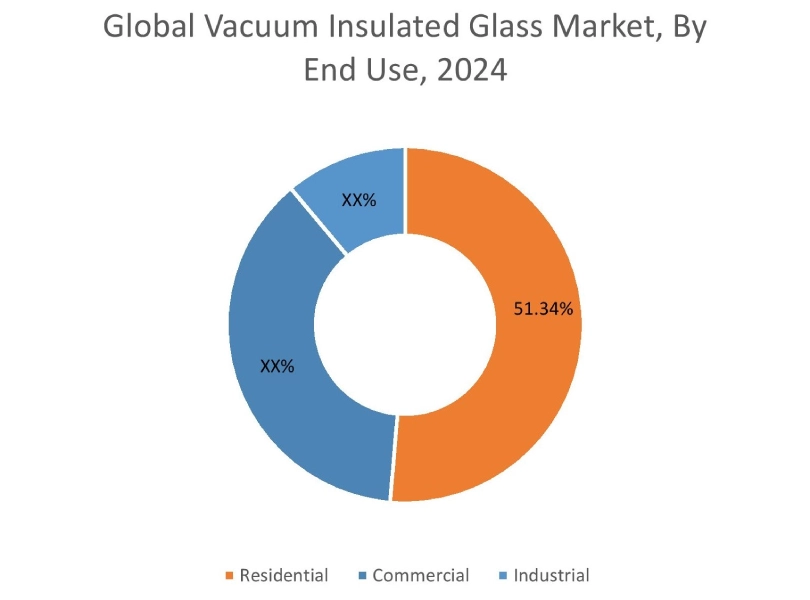
The residential segment accounted for the market share of 51.34% in 2024.
- In the residential sector, VIG is used in single-family homes, apartments, and other housing units.
- In residential construction, key applications of VIGs include windows, doors, interior partitions, facades, cladding, internal partitions and walls.
- Several factors including new housing construction, home renovation and remodeling activities, and growing preference and energy-efficient solutions are the factors supporting the sector growth.
- For instance, according to the data published by the National Association of Realtors, in 2024, it is estimated that Americans spent approximately USD 603 billion on home remodeling projects.
- Thus, as per the vacuum insulated glass market analysis, the residential segment is dominating the vacuum insulated glass market trends.
The commercial segment is expected to grow at the fastest CAGR over the forecast period.
- Commercial end use includes the use of insulated glass in commercial buildings such as offices, retail spaces, and hotels among others.
- Commercial buildings which increasingly demand energy-efficient construction materials.
- The high thermal insulation offered by these architectural glasses are valued for their potential to reduce energy consumption costs in turn improving the comfort of occupants.
- These glasses also help meet the growing number of stringent sustainability standards mandated for commercial properties. This makes VIG a suitable choice for architects and developers in the commercial building sector.
- Hence, the aforementioned factors are expected to drive growth in the infrastructure end use consumption during the forecast period.
Regional Analysis:
The regional segment includes North America, Europe, Asia Pacific, the Middle East and Africa, and Latin America.
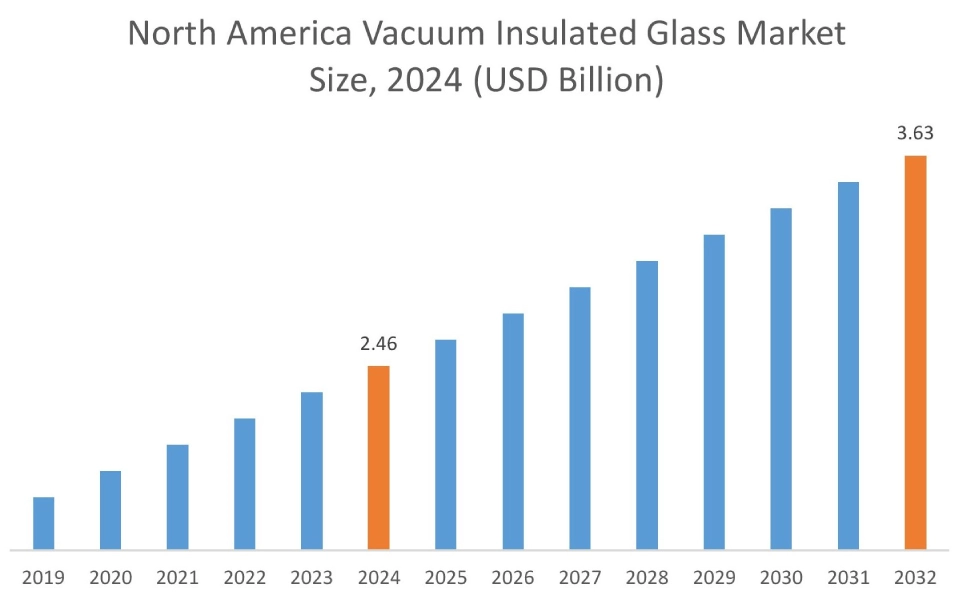
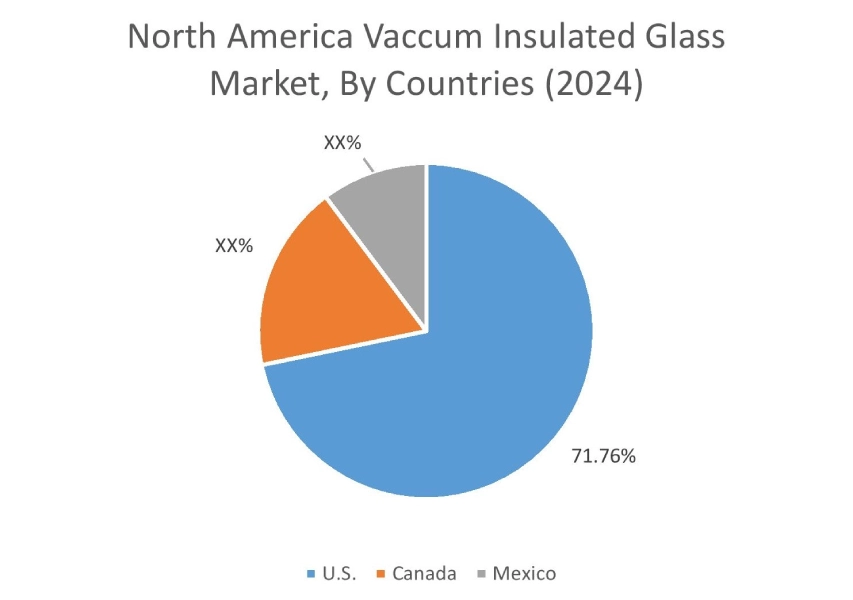
In 2024, North America accounted for the highest market share at 39.67% and was valued at USD 2.46 Billion and is expected to reach USD 3.63 Billion in 2032. In North America, the U.S. accounted for a market share of 71.76% during the base year of 2024. The North American market trend significantly defined by stringent energy efficiency regulations and the increasing adoption of green building certifications pushing the need for high-performance glass to reduce energy consumption in both residential and commercial buildings. Furthermore, renovation and remodeling of existing buildings is also supporting the market revenue across the region. The United States and Canada have a well-established prefabricated housing market. This also contributes significantly to the adoption of glass.
- For instance, EPA's new Energy Star NextGen certification, funded by the Inflation Reduction Act, sets stricter energy efficiency and emission reduction standards for new homes and apartments, achieving 20% greater efficiency and 40-80% lower emissions than code-built homes.
Hence, as per analysis, aforementioned factors are supporting the vacuum insulated glass market share across North America.
In Asia Pacific, the vacuum insulated glass industry is experiencing the fastest growth with a CAGR of 8.2% over the forecast period. Asia Pacific's influence on the market is significant due to the large-scale infrastructure development, and a growing construction sector, especially in China and India. The growing construction sector generates significant demand for building materials including glass for various applications such as windows, facades, doors, and interior partitions. Governments are actively investing in infrastructure development. These initiatives often prioritize modern and energy-efficient building materials, including advanced vacuum insulated glass solutions. These factors create a strong upward trajectory for the Asia Pacific market, positioning it as the fastest growing region for players.
One of the key factors contributing to Europe’s market revenue is the stringent energy efficiency regulations, ambitious sustainability targets like the European Green Deal, and increasing adoption of aesthetically appealing and functional glazing solutions. The region's commitment to reducing carbon emissions from buildings, which account for a significant portion of its energy consumption, necessitates the adoption of high-performance glass such as low-E coatings. Furthermore, the renovation of existing buildings and the rising popularity of green building certifications are creating a strong market for advanced glazing technologies. These factors collectively present a positive impact on the European market.
The Latin American vacuum insulated glass market trend is driven by the region's focus on infrastructure development. The growing investments in infrastructure, particularly in countries such as Brazil, contribute significantly to this demand for various glass applications in residential, commercial, and industrial buildings. Furthermore, the increasing disposable incomes and a growing preference for energy efficient construction are boosting the need for advanced glass options in the region. As per analysis, these aforementioned factors are contributing to the upward trajectory of the market.
The Middle East and African vacuum insulated glass market analysis is currently characterized by growing focus on industrial development. This has led to significant growth potential for the market in the upcoming years. Increasing investments in the construction sector, particularly large-scale institutional and commercial construction projects in countries like the UAE, Saudi Arabia, and Qatar are expected to positively influence the adoption of this glass type used in architecture.
Top Key Players & Market Share Insights:
The Global Vacuum Insulated Glass Market is highly competitive with major players providing products to the national and international markets. Key players are adopting several strategies in research and development (R&D) and product innovation to hold a strong position in the global Vacuum Insulated Glass market. Key players in the Vacuum Insulated Glass industry include
- Guardian Industries Holdings (U.S.)
- LuxWall, Inc. (U.S.)
- Panasonic Housing Solutions Co., Ltd. (Japan)
- LandGlass Technology Co., Ltd. (China)
- Shandong Haanglas Co.,Ltd (China)
- Vitro (U.S.)
- Saint-Gobain (France)
- AGC Inc. (Japan)
- Guardian Industries Holdings (U.S.)
- Nippon Sheet Glass Co., Ltd. (Japan)
Recent Industry Developments :
Product Launch
- In October 2024, Saint-Gobain Glass introduced INSIO, a new VIG range with ECLAZ coatings for balanced aesthetics and high insulation (Ug < 0.4 W/(m²K) hybrid). Available with low-carbon ORAÉ glass, it launches mid-2025.
- In February 2024, Kolbe Windows & Doors announced partnership with LuxWall, Inc. to offer vacuum insulating glass as a new, high-efficiency glass option.
Vacuum Insulated Glass Market Report Insights :
| Report Attributes | Report Details |
| Study Timeline | 2019-2032 |
| Market Size in 2032 | USD 9.97 Billion |
| CAGR (2025-2032) | 6.2% |
| By Glazing Type |
|
| By Application |
|
| By End Use |
|
| By Region |
|
| Key Players |
|
| North America | U.S. Canada Mexico |
| Europe | U.K. Germany France Spain Italy Russia Benelux Rest of Europe |
| APAC | China South Korea Japan India Australia ASEAN Rest of Asia-Pacific |
| Middle East and Africa | GCC Turkey South Africa Rest of MEA |
| LATAM | Brazil Argentina Chile Rest of LATAM |
| Report Coverage |
|
Key Questions Answered in the Report
How big is the Vacuum Insulated Glass market? −
In 2024, the Vacuum Insulated Glass market is USD 6.20 Billion.
Which is the fastest-growing region in the Vacuum Insulated Glass market? +
Asia Pacific is the fastest-growing region in the Vacuum Insulated Glass market.
What specific segmentation details are covered in the Vacuum Insulated Glass market? +
By Glazing Type, By Application and End Use segmentation details are covered in the Vacuum Insulated Glass market.
Who are the major players in the Vacuum Insulated Glass market? +
Guardian Industries Holdings (U.S.), Vitro (U.S.), Saint-Gobain (France), AGC Inc. (Japan) are some of the major players in the market.
Overview
Reputation & Certifications


Our Services
- Market Intelligence & Forecasting
- Custom Research Solutions
- Market Entry Strategy
- Competitive Intelligence
- Customer Insights
- Industry Innovation Analysis
- Investment Advisory