Jump to Content
Private 5G As A Service Market Size & Industry Share - Growth Trends & Forecasts (2026 - 2034)
Private 5G as a Service Market Size:
Private 5G as a Service Market size is estimated to reach over 1,27,632.08 (US$M) by 2034 from a value of 7,077.53 (US$M) in 2025 and is projected to grow by 9,759.91 (US$M) in 2026, growing at a CAGR of 37.9% from 2026 to 2034, according to a recent report from Consegic Business Intelligence.
Private 5G as a Service Market Scope & Overview:
Private 5G as a Service is a wireless technology that provides with fifth-generation (5G) cellular network tailored to specific needs. The 5G network infrastructure includes antennas, base stations, and core network components, deployed on the organization's premises. Additionally, the private 5G network is managed by a third-party service provider, which is responsible for deploying, maintaining, and upgrading the network infrastructure. Moreover, it offers a wide range of benefits including reliability, scalability, cost-efficiency, and rapid deployment. The aforementioned benefits of private 5G as a Service are major determinants for increasing their deployment in commercial, healthcare, financial, and other industries.
Private 5G as a Service Market Insights:

Private 5G as a Service Market Dynamics - (DRO) :
Key Drivers:
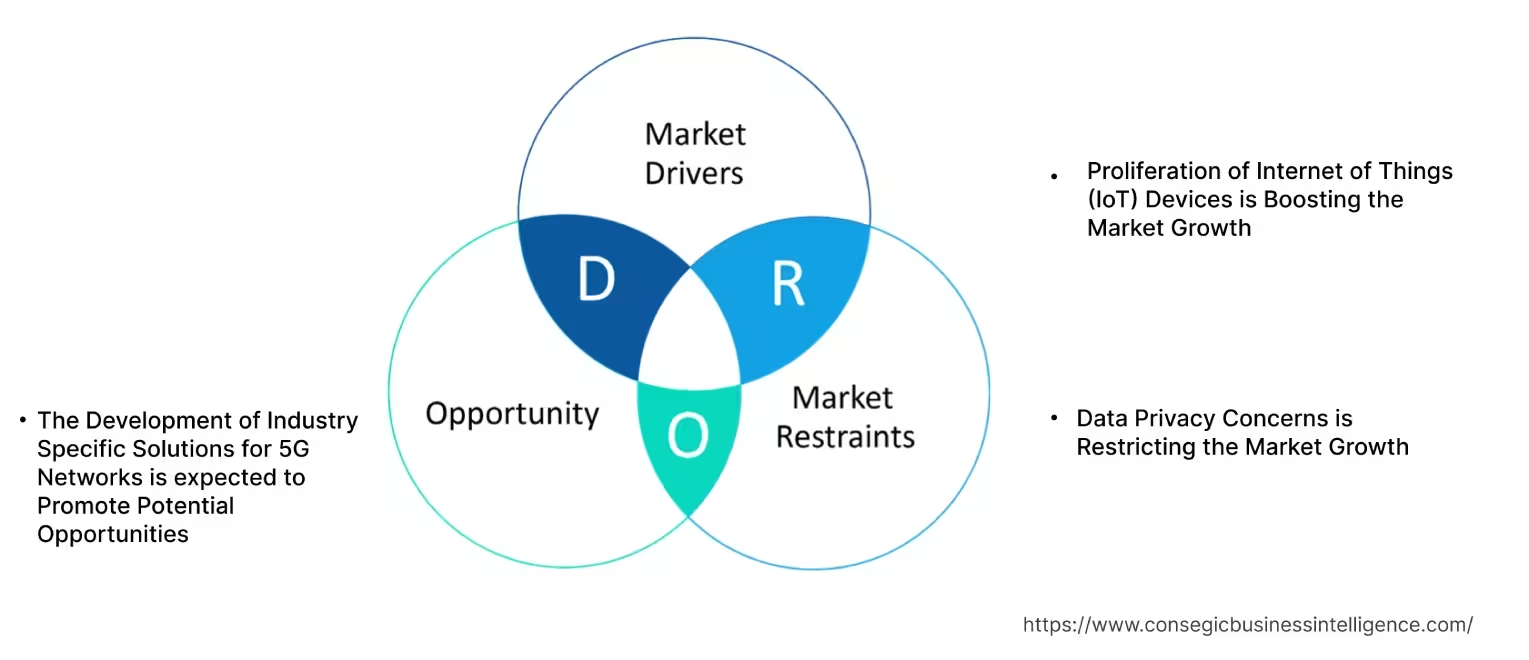
Proliferation of Internet of Things (IoT) Devices is Boosting the Market Growth
The Growth of IoT devices across various sectors necessitates a robust network of handling massive connections. Private 5G networks provide the scalability and reliability needed to manage and secure connected devices. A private 5G as a service is designed to handle this high device density, offering the scalability needed to support a large number of simultaneous connections without compromising performance. Additionally, IoT devices drive the development of smart infrastructure, smart manufacturing, and industrial automation systems with private 5G as a service, which ensures that these devices communicate seamlessly, supporting complex and dynamic needs.
- In February 2023, Kyndryl and Nokia collaborated to launch private 5G as a service solution for industrial IoT applications, focusing on smart manufacturing and logistics, ensuring enhanced connectivity and automation.
Therefore, the proliferation of IoT devices across various sectors is transforming how organizations operate, propelling the private 5G as a service market growth.
Key Restraints :
Data Privacy Concerns is Restricting the Market Growth
Concerns over data privacy are a significant restraint in the adoption of private 5G networks, particularly in sectors including healthcare, finance, and government, where the handling of sensitive information is paramount. The devices from smart home appliances to industrial sensors, connected to these networks collect and transmit personal data. Additionally, the increased complexity of 5G networks introduces security challenges. The use of virtualization, software-defined networking, and network slicing creates potential vulnerabilities that malicious actors can exploit.
- For instance, as per the analysis of the forum released in September 2023, by the Telecom Regulatory Authority of India. 5G enabled IoT and edge computing devices are vulnerable to cyberattacks and data breaches that compromise their functionality, data integrity, and privacy. These devices collect and process large amounts of personal and sensitive data that reveal user behavior, preferences, location, and identity.
Hence, data privacy concerns in connected devices are vulnerable to cyberattacks and data breaches, hindering the private 5G as a service market.
Future Opportunities :
The Development of Industry Specific Solutions for 5G Networks is expected to Promote Potential Opportunities
As businesses increasingly seek specialized solutions to address their unique operational challenges, private 5G networks can be customized to meet these demands. These networks can provide the high-speed, low-latency connectivity essential for telemedicine, remote patient monitoring, and emergency response systems. Additionally, private 5G networks can transform production processes through enhanced connectivity and automation. Tailored solutions can support smart factories with IoT-enabled machinery, real-time data analytics, and predictive maintenance systems. The low latency and high reliability of private 5G networks facilitate efficient communication between interconnected devices, optimize production lines, and enhance overall operational efficiency.
- In February 2023, Siemens launched private industrial 5G routers for the manufacturing sector. Siemens implemented this network to enhance its Industry 4.0 initiatives, enabling real-time data analytics, improved automation, and seamless communication between interconnected devices within the infrastructure.
Thus, the development of market-specific private 5G solutions for tailored connectivity in various sectors represents significant opportunities in private 5G as a service market demand.
Private 5G as a Service Market Segmental Analysis :
By Type:
Based on type the market is segmented into standalone (SA) and non-standalone (NSA).
Trends in the type:
- There is a growing trend towards deploying 5G cores specifically designed for Standalone networks. These cores are essential for unlocking the full potential of 5G, including network slicing and ultra-reliable low-latency communication (URLLC), which are critical for advanced use cases like autonomous vehicles.
- Non-Standalone networks offer a cost-effective way for operators to introduce 5G services, as they do not require immediate investment in a 5G core. This growth has made NSA networks the preferred choice for initial 5G rollouts in many regions, especially in developing markets.
The standalone type component accounted for the largest revenue share in the year 2024 and is anticipated to register the fastest CAGR during the forecast period.
- SA networks provide the complete range of 5G features, including ultra-low latency and network slicing, which are crucial for advanced industrial applications and enterprise needs.
- Additionally, Industries with complex use cases, such as autonomous vehicles, smart manufacturing, and remote operations, are increasingly adopting SA networks to fully leverage 5G's capabilities.
- In September 2022, Telstra, in collaboration with Ericsson, announced a suite of innovative 5G Standalone (SA) services designed for enterprises. This partnership highlights several groundbreaking advancements in 5G technology, including the deployment of fully automated 5G network slicing and the introduction of a Local Packet Gateway within Telstra's commercial network.
- Thus, the standalone enhances the industrial operations, fueling the private 5G as a service market demand.
By Component:
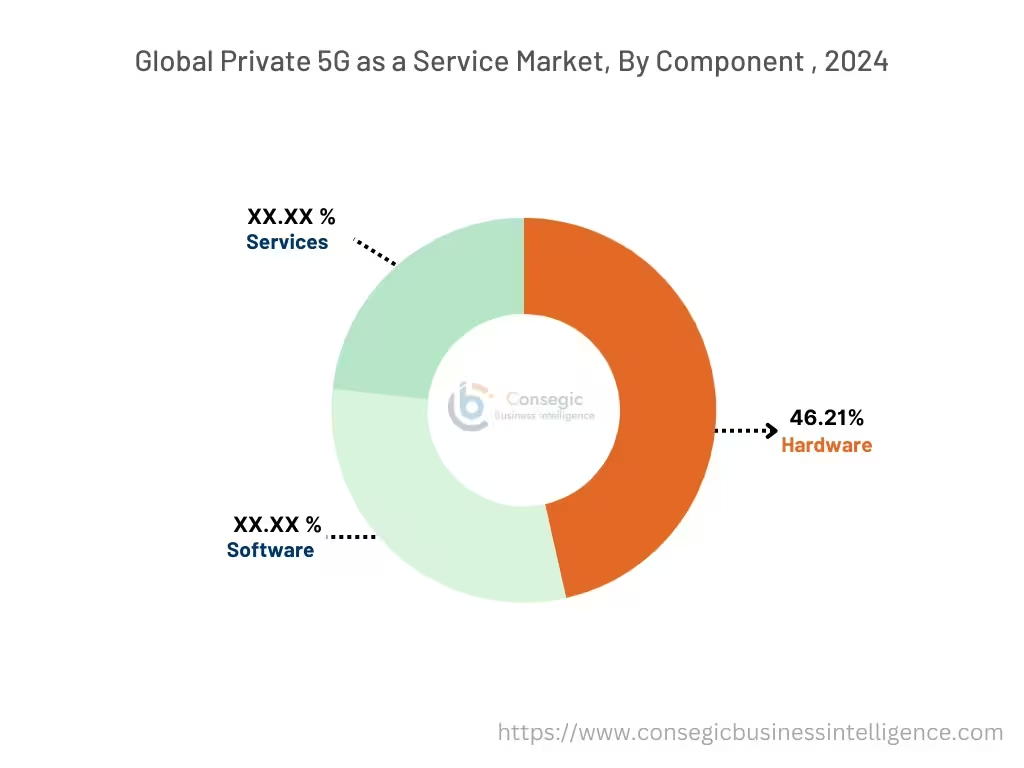
Based on components the market is segmented into hardware, software, and services.
Trends in the component:
- The opportunities for managed services are increasing as enterprises seek to offload the complexities of deploying and managing private 5G networks. Managed service providers offer end-to-end solutions, including network design, deployment, monitoring, and maintenance, allowing organizations to focus on their core business.
- The adoption of Network Function Virtualization (NFV) and Software-Defined Networking (SDN) is transforming private 5G networks by enabling more flexible and scalable network management. These technologies allow for virtualized network functions and centralized control, which simplify deployment and reduce operational costs.
The hardware component accounted for the largest revenue share of 46.21% in the year 2024.
- The private 5G network infrastructure encompasses hardware including base stations, antennas, modems, and edge computing devices.
- These components are essential for establishing the foundational infrastructure needed to support 5G connectivity and performance.
- In February 2021, Qualcomm released Snapdragon X65 5G Modem-RF System, fourth-generation 5G modem-to-antenna solution. These modems facilitated high-speed, reliable connectivity for various private 5G deployments, including smart logistics and healthcare.
- Therefore, the hardware segment is propelling the private 5G as a service market trend.
The software segment is anticipated to register the fastest CAGR during the forecast period.
- Software segment enables more flexible, scalable, and cost-effective management of private 5G networks.
- It allows for centralized control, automation, and dynamic resource allocation, essential for managing the complexity and scale of future 5G deployment.
- In November 2023, Ericsson launched 5G RAN Software to boost automation and network capacity. The software includes automation and orchestration capabilities, enabling efficient management and optimization of private 5G networks in manufacturing environments.
- Thus, as per the analysis, enhanced control and automation offered by the software segment is fueling the private 5G as a service market opportunities.
By Frequency band:
Based on frequency band the market is segmented into Sub-1 GHz, 1 GHz to 6 GHz, 24 GHz, and above.
Trends in the frequency band:
- Advancements in network management software and radio technologies are enhancing the efficiency of mid-band (1 GHz to 6 GHz) spectrum usage. Techniques such as dynamic spectrum sharing, and advanced beamforming are optimizing network performance and resource allocation.
- The high-band spectrum (24 GHz and above) is increasingly used for applications requiring ultra-high-speed data transfer and low latency. This trend includes immersive technologies such as virtual reality (VR) and augmented reality (AR), as well as advanced manufacturing and autonomous vehicles.
The 1 GHz to 6 GHz frequency band accounted for the largest revenue share in the year 2024.
- 1 GHz to 6 GHz frequency band is also known as Mid-band spectrum. It offers a favorable balance between coverage and capacity, making it well-suited for high-density urban environments and enterprise applications.
- Many private 5G networks being deployed today use mid-band frequencies. This growth is driven by its ability to provide a good mix of coverage and performance.
- In September 2021, Ericsson and Qualcomm collaborated to deploy a 5G New Radio (NR) call on CBRS (Citizen Broadband Radio Service) with mid-band spectrum. This combination enables support for high-speed data transfer and enables various IoT applications within industrial and commercial environments, fueling the Industry 4.0 evolution.
- Hence, due to widespread deployments and diverse applications, the mid-band spectrum is boosting the private 5G as a service market trend.
The 24 GHz and above frequency band segment is anticipated to register the fastest CAGR during the forecast period.
- 24 GHz above is called a high-band spectrum including mmWave, and offers extremely high data rates and bandwidth, making it ideal for applications that require massive amounts of data transfer.
- It provides very low latency, which is crucial for applications demanding real-time responses.
- In October 2023, Huawei introduced a series of 5.5G solutions enabling mmWave tailored for individuals and home users, focusing on delivering high-speed connectivity and low latency to enhance immersive user experience and connectivity.
- Therefore, according to the analysis, the ability of the 24 GHz and above frequency band particularly mmWave provide high-data rates and low latency, is poised to dominate the global private 5G as a Service market share.
By Application :
Based on application the market is segmented into industrial, commercial, healthcare, residential, entertainment, BFSI, and others.
Trends in the Application :
- The 5G network is increasingly being used in healthcare, as it provides surgical guidance to primary hospitals and makes robotic surgery widespread and accessible to the masses.
The Industrial application segment accounted for the largest revenue share in the year 2024 and is anticipated to register the fastest CAGR during the forecast period.
- The demand for automating industrial processes to enhance productivity, reduce costs, and improve operational efficiency is propelling the segment.
- Additionally, 5G networks provide the high-speed, low-latency connectivity needed to support advanced robotics, real-time monitoring, and automated control systems.
- In September 2023, Siemens launched private infrastructure with 5G communications standards. This solution enables industrial companies to build their customized 5G networks catering to industrial needs, which will provide optimal support for automation applications.
- Thus, as per the analysis, private 5G as a service market is driven by the need for high-speed and low-latency connectivity to support industrial automation systems.
Regional Analysis:
The regions covered are North America, Europe, Asia Pacific, the Middle East and Africa, and Latin America.
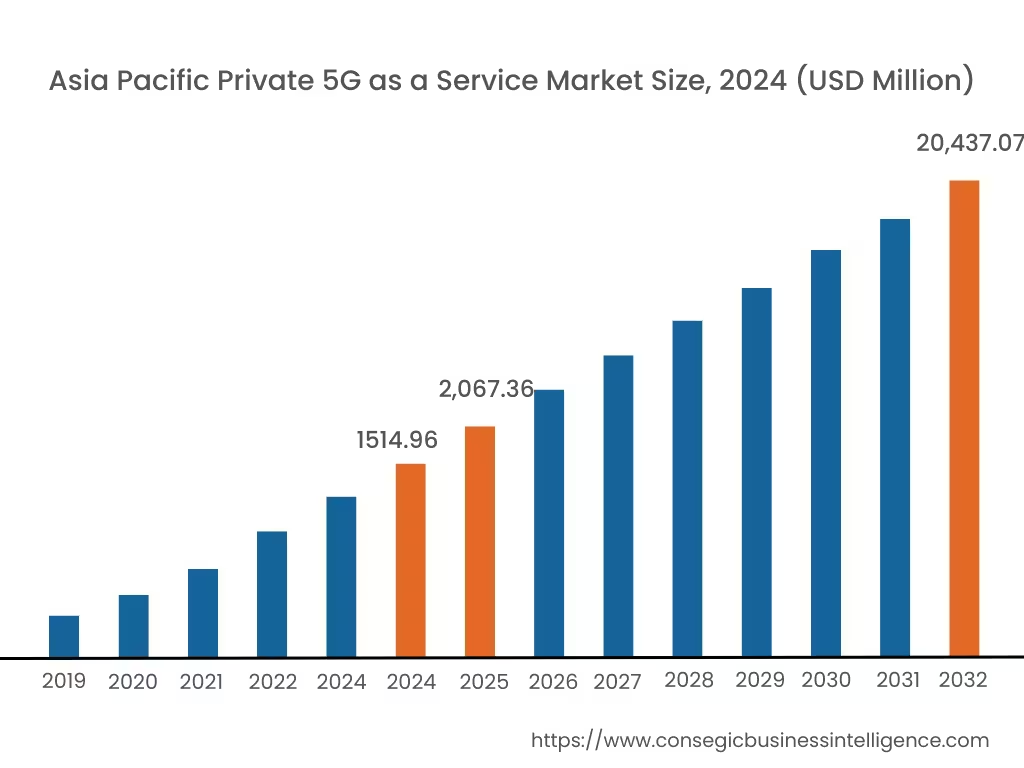
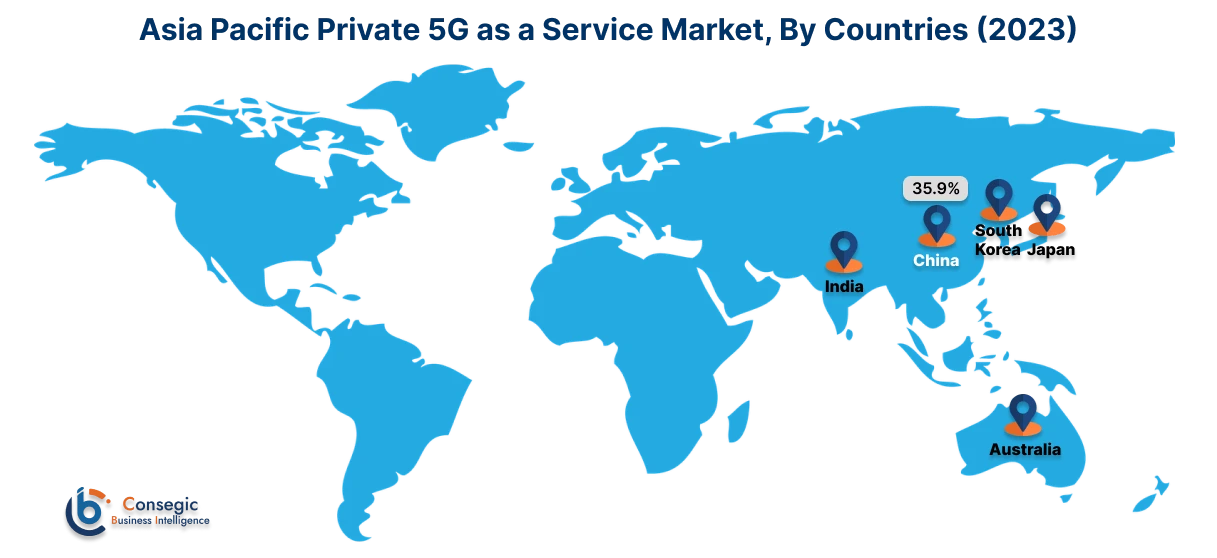
Asia Pacific region was valued at USD 1,514.96 Million in 2024. Moreover, it is projected to grow by USD 2,067.36 Million in 2025 and reach over USD 20,437.07 Million by 2032. Out of this, China accounted for the maximum revenue share of 35.9%. As per the private 5G as a service market analysis, In the Asia-Pacific region, the adoption of private 5G networks is rapidly gaining momentum, driven by the region's strong focus on technological innovation and industrial advancement. Countries including China, India, Japan, and South Korea are at the forefront of this development, with extensive investments in private 5G networks across various sectors.
In June 2022, Samsung Electronics partnered with Naver Cloud to launch a private 5G network solution, aiming to cater to businesses and industries seeking secure and high-performance connectivity. This partnership combined Samsung's advanced 5G network technology with Naver Cloud's cloud services to provide a comprehensive private 5G offering.
North America is estimated to reach over USD 21,752.56 Million by 2032 from a value of USD 1,706.32 Million in 2024 and is projected to grow by USD 2,317.49 Million in 2025. In North America, the deployment and adoption of private 5G networks are notably advanced, driven primarily by the United States and Canada. These deployments focus on Industry 4.0 solutions, leveraging high-speed, low-latency connectivity to improve automation, real-time data analytics, and overall operational efficiency. Consequently, the integration of private 5G across various sectors, including manufacturing, healthcare, and smart cities propels the private 5G as a service industry.
- In November 2021, according to the analysis of IBM (US), the IoT and Edge devices with 5G connectivity use AI analytics to detect faults across industrial sites. These devices are compelling business use cases and favorable regulatory changes on spectrum, availability for enterprises. TBR estimates private 5G networks market will reach USD 7.5 billion in 2025 up from USD 200 million in 2020.
Europe is emerging as a key region in the adoption of private 5G networks driven by robust investment and security. The region is particularly focused on enhancing its industrial and manufacturing sectors with countries including Germany, France, and the UK.
Latin America is gradually embracing private 5G as a service as countries in this region are experiencing economic expansion and innovation in technology. The Middle East and Africa region is experiencing steady private 5G as a service market expansion. It is boosted by the need for advanced connectivity in sectors including oil and gas, smart cities, and logistics.
Top Key Players & Market Share Insights:
The private 5G as a service market is highly competitive with major players providing enhanced network connectivity to the national and international markets. Key players are adopting several strategies in research and development (R&D), product innovation, and end-user launches to hold a strong position in the private 5G as a service market. Key players in the private 5G as a service market include-
- Nokia Corporation (Finland)
- Ericsson AB (Sweden)
- Qualcomm Technologies, Inc. (US)
- Cisco Systems, Inc. (US)
- Verizon Communications Inc. (US)
- AT&T Inc. (US)
- VMware, Inc. (US)
- Mavenir Systems, Inc. (US)
- Huawei Technologies Co., Ltd. (China)
- Samsung Electronics Co., Ltd. (South Korea)
- Deutsche Telekom AG (Germany)
- Intel Corporation (US)
- ZTE Corporation (China)
- T-Mobile US, Inc. (US)
- Microsoft Corporation (US)
- IBM Corporation (US)
Recent Industry Developments :
Product Launches:
- In February 2024, ZTE released Full-Scenario Ecosystem 3.0 with AI 5G FWA (Fixed Wireless Access), which provides a faster and smoother network experience with a 20% increase in bandwidth utilization and a 30% decrease in network congestion. Additionally, it achieves network strategy control and bandwidth optimization across various applications of AI algorithms.
- In February 2024, Nokia launched a 5G outdoor fixed wireless access receiver designed to support high-capacity connectivity in stadiums and other large venues, addressing the need for high-speed internet access and improved user experiences. The outdoor receiver enables operators to use low-cost mmWave spectrum to provide consistent, reliable, ultra-fast wireless broadband services.
- In May 2023, Honeywell launched VersaWave, a satcom system with a 5G network, it is a hardware and software solution combining multiple connectivity options. The cellular capability includes high-speed 5G connectivity supporting low latency and high data transfers at a low cost whether on public or private networks.
Business Expansion:
- In May 2024, Ericsson expanded 5G for Smart Factory across the USA. This 5G smart factory ensures secure fast and agile deliveries to meet US customer requirements. This Growth will enable Ericsson to deliver existing new radios and basebands for customers from the factory including Open RAN-ready products.
Product Enhancements:
- In February 2024, Qualcomm modified its Snapdragon X80 5G Modem-RF System the seventh generation of its 5G modem-to-antenna solution, integrated with 5G AI Processor and 5G-Advanced-ready architecture. It features an AI tensor accelerator, which enhances data speed, latency, quality of service (QoS), coverage, location accuracy, spectrum efficiency, power efficiency, and multi-antenna management.
Private 5G as a Service Market Report Insights :
| Report Attributes | Report Details |
| Study Timeline | 2021-2034 |
| Market Size in 2034 | USD 127,632.08 Million |
| CAGR (2026-2034) | 37.90% |
| Base Year | 2025 |
| By Type |
|
| By Component |
|
| By Frequency band |
|
| By Application |
|
| By Region |
|
| Key Players |
|
| North America | U.S. Canada Mexico |
| Europe | U.K. Germany France Spain Italy Russia Benelux Rest of Europe |
| APAC | China South Korea Japan India Australia ASEAN Rest of Asia-Pacific |
| Middle East and Africa | GCC Turkey South Africa Rest of MEA |
| LATAM | Brazil Argentina Chile Rest of LATAM |
| Report Coverage |
|
Key Questions Answered in the Report
How big is the Private 5G as a Service Market? −
Private 5G as a Service Market size is estimated to reach over USD 67,116.81 Million by 2032 from a value of USD 5,144.03 Million in 2024 and is projected to grow by USD 6,999.90 Million in 2025, growing at a CAGR of 37.9% from 2025 to 2032.
What is the key market trend? +
The adoption of Network Function Virtualization (NFV) and Software-Defined Networking (SDN) is transforming private 5G networks by enabling more flexible and scalable network management. These technologies allow for virtualized network functions and centralized control, which simplify deployment and reduce operational costs.
Who are the major players in the Private 5G as a Service Market? +
The key players in Private 5G as a Service Market are Nokia Corporation (Finland), Ericsson AB (Sweden), Huawei Technologies Co., Ltd. (China), Qualcomm Technologies, Inc. (US), Samsung Electronics Co., Ltd. (South Korea), Cisco Systems, Inc. (US), Verizon Communications Inc. (US), AT&T Inc. (US), Deutsche Telekom AG (Germany), Intel Corporation (US), ZTE Corporation (China), T-Mobile US, Inc. (US), VMware, Inc. (US) and others.
Which region/country is anticipated to witness the highest CAGR during the forecast period, 2025-2032? +
Asia-Pacific is anticipated to register the fastest CAGR growth during the forecast period. In the Asia-Pacific region, the adoption of private 5G networks is rapidly gaining momentum, driven by the region's strong focus on technological innovation and industrial advancement. Countries including China, India, Japan, and South Korea are at the forefront of this development, with extensive investments in private 5G networks across various sectors.
Overview
Reputation & Certifications


Our Services
- Market Intelligence & Forecasting
- Custom Research Solutions
- Market Entry Strategy
- Competitive Intelligence
- Customer Insights
- Industry Innovation Analysis
- Investment Advisory