Jump to Content
Refurbished Electronics Market - Size, Share, Industry Trends, and Forecasts (2025 - 2032)
Refurbished Electronics Market Size:
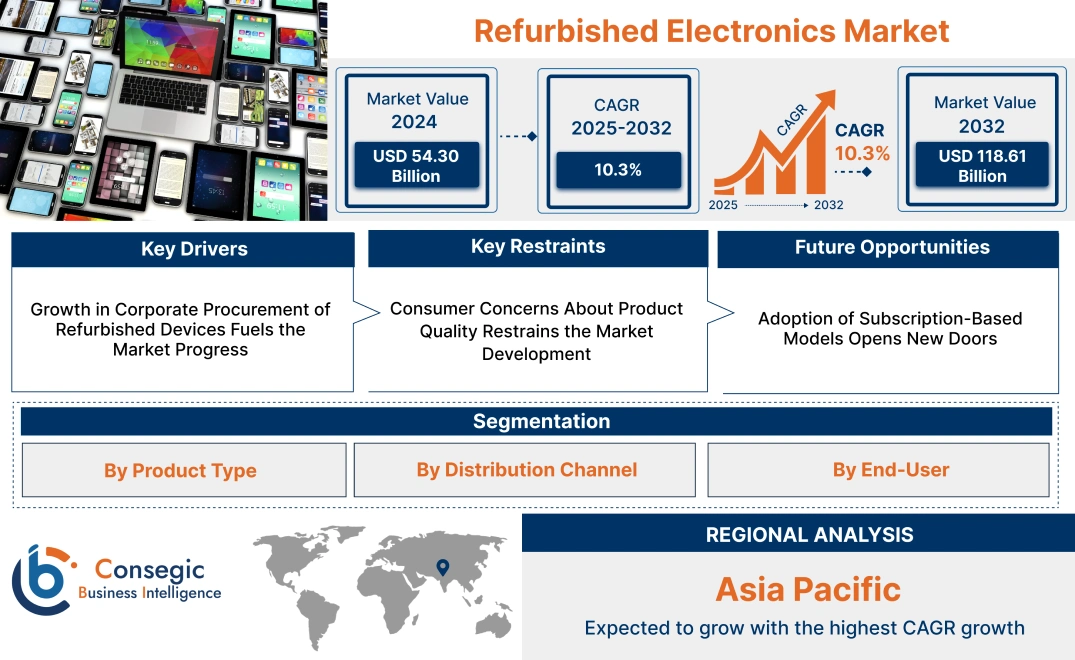
Refurbished Electronics Market size is estimated to reach over USD 118.61 Billion by 2032 from a value of USD 54.30 Billion in 2024 and is projected to grow by USD 58.90 Billion in 2025, growing at a CAGR of 10.3% from 2025 to 2032.
Refurbished Electronics Market Scope & Overview:
Refurbished electronics refer to pre-owned electronic devices that have been repaired, tested, and restored to full functionality before being resold. These products undergo rigorous inspection and quality checks to ensure they meet performance and safety standards, providing a cost-effective alternative to new electronics. The range of these electronics includes smartphones, laptops, tablets, televisions, and other consumer or industrial electronic devices.
They are available through certified programs, third-party refurbishers, and retail channels, offering a variety of options for consumers and businesses. These products often come with warranties and support services to ensure reliability and customer satisfaction. Advanced refurbishment processes include cleaning, component replacement, software updates, and final testing, ensuring that the products deliver optimal performance.
End-users of refurbished electronics include individual consumers, educational institutions, and small businesses looking for affordable yet reliable electronic solutions. The market for refurbished products plays a significant role in promoting sustainability and extending the lifecycle of electronic devices while meeting diverse customer needs.
Refurbished Electronics Market Dynamics - (DRO) :
Key Drivers:
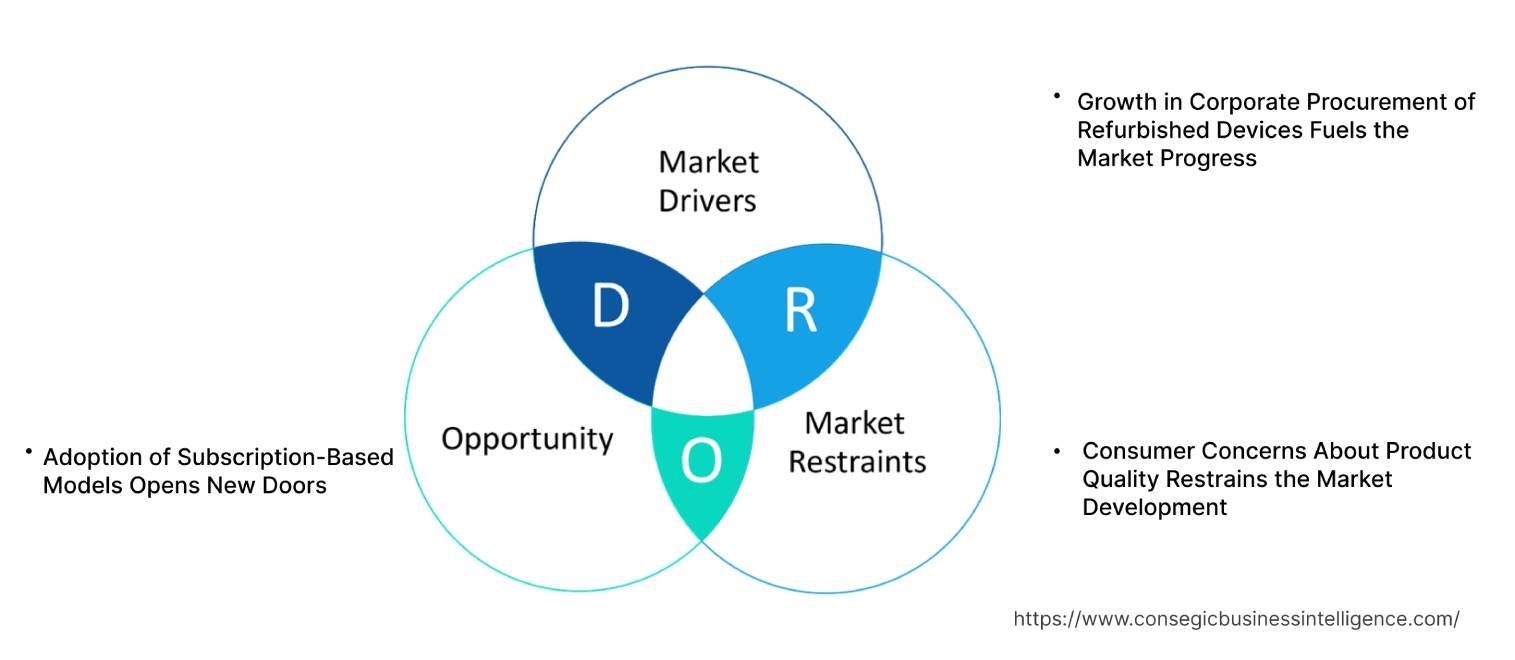
Growth in Corporate Procurement of Refurbished Devices Fuels the Market Progress
Small and medium enterprises (SMEs) are increasingly adopting refurbished electronics to minimize operational costs while maintaining performance standards. Refurbished laptops, desktops, and peripherals offer cost-effective solutions, enabling businesses to equip their workforce without exceeding budget constraints. Bulk procurement programs and corporate partnerships are further accelerating this trend, as organizations seek reliable and affordable alternatives for technology upgrades. The rising demand for refurbished devices in the corporate industry highlights their value in meeting operational needs efficiently, driving significant refurbished electronics market growth.
Key Restraints:
Consumer Concerns About Product Quality Restrains the Market Development
A significant restraint in the refurbished electronics market is the widespread perception that these products are of inferior quality compared to new devices. Even with certifications, warranties, and rigorous testing processes, many consumers remain skeptical about the durability and performance of refurbished products. This skepticism is particularly pronounced in markets with limited awareness of refurbishing standards and quality assurance practices. The perception that refurbished products are more prone to malfunction or have a shorter lifespan discourages potential buyers, especially in segments where reliability is paramount. Addressing these concerns is critical to boosting consumer confidence and driving broader adoption of refurbished devices. Thus, the aforementioned factors are limiting the refurbished electronics market demand.
Future Opportunities :
Adoption of Subscription-Based Models Opens New Doors
Subscription-based models are revolutionizing the refurbished electronics market by offering flexible and affordable payment options for consumers and businesses. These models allow access to upgraded technology without the burden of significant upfront costs, making high-quality devices more accessible. For businesses, especially small and medium enterprises (SMEs), subscription plans provide an efficient way to manage operational expenses while ensuring access to reliable technology. Consumers, on the other hand, benefit from affordable pricing and the ability to switch to newer models periodically. This recurring revenue model is also advantageous for refurbishing companies, enabling them to maintain customer retention, expand their product offerings, and explore new market segments. By addressing affordability and flexibility, subscription-based models are fostering increased interest and adoption, creating significant refurbished electronics market opportunities.
Refurbished Electronics Market Segmental Analysis :
By Product Type:
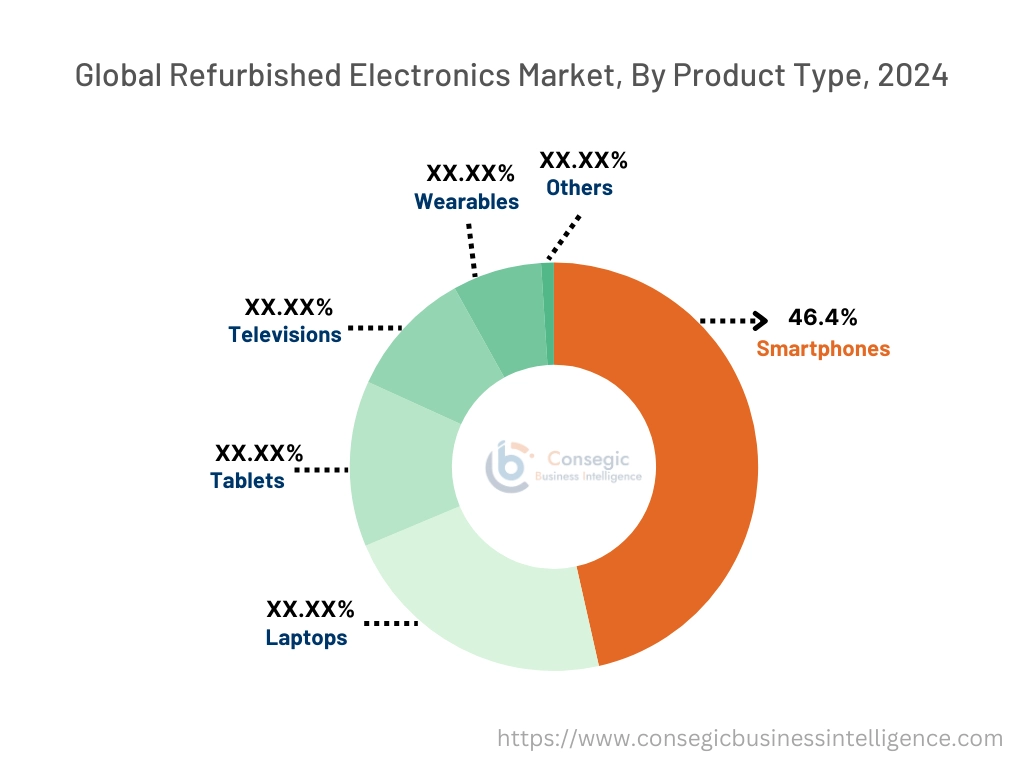
Based on product type, the market is segmented into smartphones, laptops, tablets, televisions, wearables, and others.
The smartphones segment held the largest revenue of 46.4% of the total refurbished electronics market share in 2024.
- Refurbished smartphones are widely accepted due to their affordability and accessibility, making them popular among budget-conscious consumers.
- Leading smartphone manufacturers and third-party retailers are focusing on offering certified refurbished devices with warranties, enhancing consumer confidence.
- The rise in e-commerce platforms has significantly boosted the sale of refurbished smartphones, providing easy access and competitive pricing.
- The dominance of this segment reflects its ability to cater to a broad customer base, including students, young professionals, and low-income groups, fueling the refurbished electronics market expansion.
The laptops segment is expected to grow at the fastest CAGR during the forecast period.
- Refurbished laptops are gaining traction in the education and corporate sectors due to cost-effectiveness and functional reliability.
- Companies are increasingly adopting refurbished laptops to meet sustainability goals and reduce e-waste, driving adoption in commercial settings.
- Government initiatives promoting digital education and affordable technology access are further supporting the extension of the refurbished laptops segment.
- As per the refurbished electronics market analysis, the growth of this segment is attributed to advancements in refurbishment techniques that ensure high-quality performance comparable to new devices.
By Distribution Channel:
Based on distribution channel, the market is segmented into online retail and offline retail.
The online retail segment accounted for the largest revenue of the total refurbished electronics market share in 2024.
- Online platforms offer an extensive variety of refurbished electronics, enabling consumers to compare prices and access certified products easily.
- Partnerships between e-commerce platforms and certified refurbishers ensure quality assurance and enhanced customer experience.
- Digital promotions and exclusive online discounts have increased the attractiveness of online retail channels among tech-savvy buyers.
- As per the refurbished electronics market trends, the segment’s dominance is driven by its convenience, competitive pricing, and global reach, making it a preferred channel for refurbished products.
The offline retail segment is expected to register the fastest CAGR during the forecast period.
- Specialty stores and independent retailers provide hands-on inspection opportunities, ensuring consumer confidence in refurbished products.
- Local retailers cater to regions with limited internet penetration, playing a vital role in bridging the accessibility gap.
- Offline retail channels are preferred for high-value purchases like televisions and laptops, where physical inspection is prioritized.
- Thus, growth in this segment is supported by customer loyalty, personal interaction, and immediate product availability, which drives the refurbished electronics market growth.
By End-User Industry:
Based on end-user, the market is segmented into residential, commercial, and government.
The residential segment held the largest revenue share in 2024.
- Increasing consumer awareness regarding cost-effective alternatives to new electronics drives the adoption of refurbished products in households.
- Refurbished smartphones and laptops are extensively used for personal use, remote working, and online education.
- The residential segment benefits from the availability of affordable, high-quality refurbished electronics with warranties and post-purchase support.
- Thus, as per refurbished electronics market analysis, the dominance of this segment reflects its alignment with growing sustainability concerns among individual consumers.
The commercial segment is expected to register the fastest CAGR during the forecast period.
- Businesses increasingly rely on refurbished IT equipment, including laptops and servers, to manage costs and reduce e-waste.
- The rising adoption of refurbished electronics in small and medium enterprises supports operational efficiency without significant capital expenditure.
- Commercial users often opt for bulk purchases, benefiting from cost reductions and warranties offered by certified refurbishers.
- Therefore, the rapid growth of this segment is driven by the need for cost-efficient technology upgrades in corporate environments, facilitating the refurbished electronics market demand.
Regional Analysis:
The regions covered are North America, Europe, Asia Pacific, the Middle East and Africa, and Latin America.
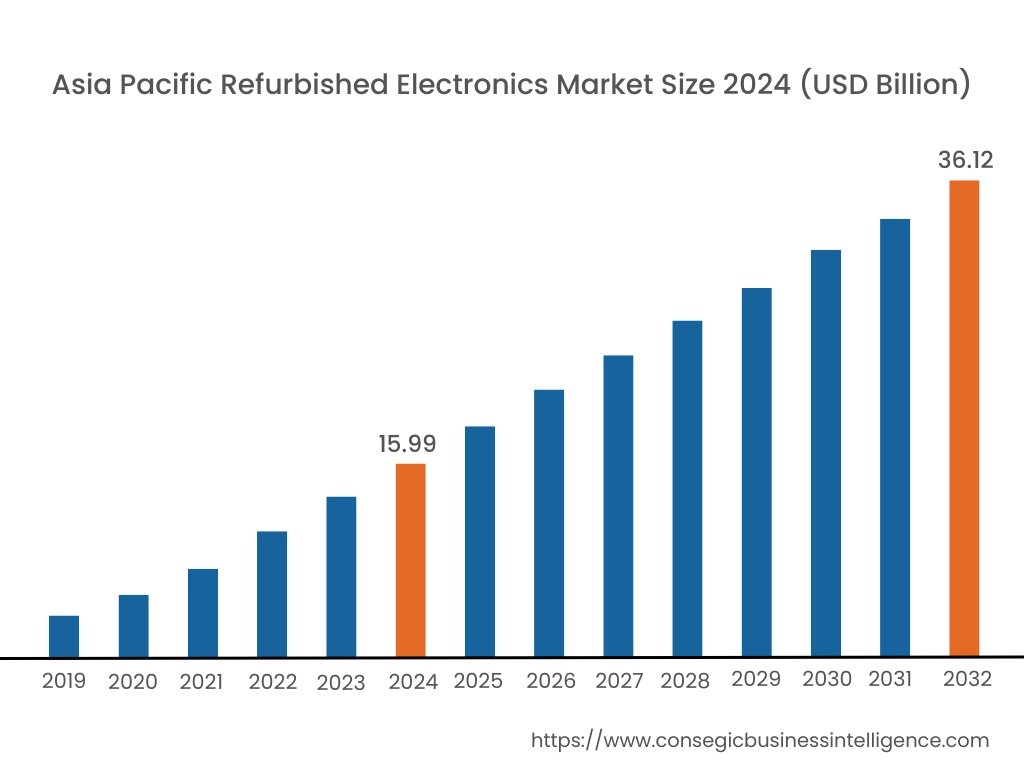
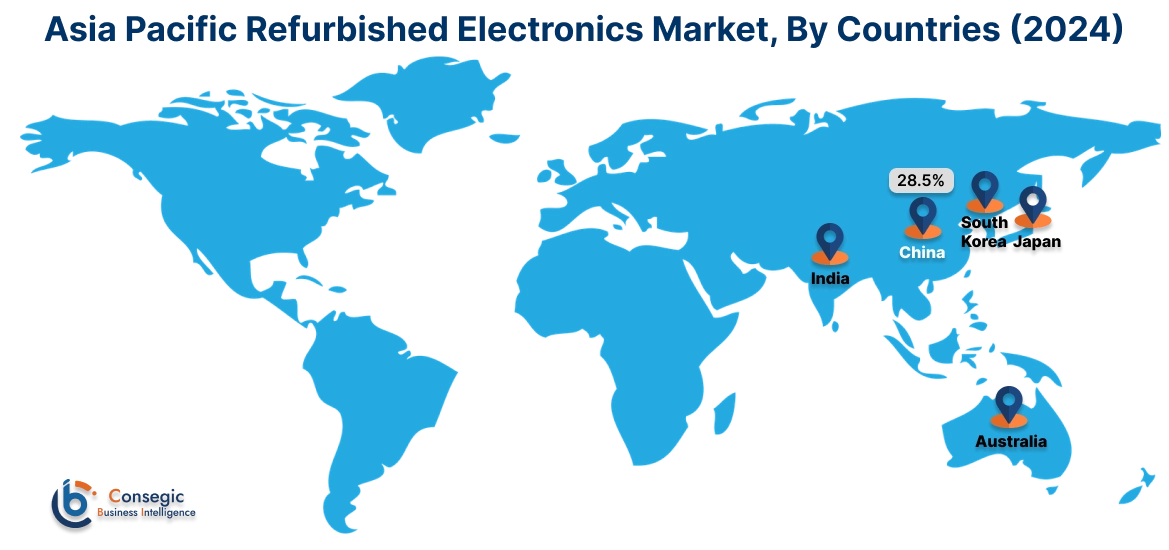
Asia Pacific region was valued at USD 15.99 Billion in 2024. Moreover, it is projected to grow by USD 17.40 Billion in 2025 and reach over USD 36.12 Billion by 2032. Out of this, China accounted for the maximum revenue share of XX%. The Asia-Pacific region is experiencing rapid development in the market, driven by industrialization and technological advancements in countries such as China, Japan, and India. The enlargement of the consumer electronics industry and the rising demand for affordable devices have intensified the need for refurbished products. As per the refurbished electronics market trends, government initiatives promoting industrial efficiency further influence market trends.
North America is estimated to reach over USD 38.44 Billion by 2032 from a value of USD 18.01 Billion in 2024 and is projected to grow by USD 19.50 Billion in 2025. In this region, the market is characterized by a strong consumer shift towards affordable electronics and environmental consciousness. The United States and Canada have witnessed a surge in the adoption of refurbished smartphones and computers, facilitated by major technology companies and third-party refurbishers offering certified and extensively tested products. A notable trend is the increasing availability of refurbished devices through online platforms, providing consumers with access to high-quality electronics at competitive prices.
Europe represents a substantial share of the global refurbished electronics market, with countries like Germany, France, and the United Kingdom leading in adoption and innovation. The region's emphasis on sustainability and energy efficiency has propelled the utilization of eco-friendly electronics solutions. Analysis indicates a growing trend towards the deployment of refurbished devices in both consumer and enterprise sectors, offering flexibility across various applications which creates new refurbished electronics market opportunities.
The Middle East & Africa region shows a growing interest in refurbished electronics, particularly in the construction and industrial sectors. Countries like Saudi Arabia and South Africa are investing in modern technologies to enhance production efficiency. Analysis suggests an increasing trend towards adopting refurbished devices to meet international quality standards.
Latin America is an emerging market with Brazil and Mexico being key contributors. The region's growing focus on industrial modernization and the automotive industry has spurred the adoption of advanced electronics solutions. Government policies aimed at enhancing manufacturing capabilities influence refurbished electronics market expansion.
Top Key Players and Market Share Insights:
The Refurbished Electronics market is highly competitive with major players providing products and services to the national and international markets. Key players are adopting several strategies in research and development (R&D), product innovation, and end-user launches to hold a strong position in the global Refurbished Electronics market. Key players in the Refurbished Electronics industry include –
- Apple Inc. (USA)
- Samsung Electronics (South Korea)
- ASUSTeK Computer Inc. (Taiwan)
- Acer Inc. (Taiwan)
- ReBoot IT (Australia)
- Amazon (USA)
- Lenovo Group Limited (China)
- Dell Technologies (USA)
- HP Inc. (USA)
- Microsoft Corporation (USA)
Recent Industry Developments :
Investments & Funding:
- In November 2023, Refurbed, a leading European marketplace for refurbished products, secured Billion in a Series C funding round led by Evli Growth Partners and C4 Ventures, alongside All Iron Venture and Speedinvest. The funds will accelerate its mission to expand Europe’s circular economy, enhance user experience, and grow its product offerings. Refurbed, which achieved profitability in the DACH region, has earned over $1 billion in GMV and plans further expansion in core markets like Ireland.
Partnerships & Collaborations:
- In July 2024, Quick Heal partnered with NewJaisa Technologies to enhance cybersecurity in refurbished electronics. This collaboration integrates Quick Heal's Total Security software into NewJaisa’s refurbished laptops and desktops, ensuring better protection for consumers.
Product Launch:
- In October 2024, TikTok Shop officially introduced refurbished electronics, including tablets, mobile phones, and laptops, to its platform in the U.S., catering to the growing demand for cost-effective and environmentally conscious shopping options. Trusted brands like Apple, Samsung, Google, and Lenovo are part of the offering, providing a wide selection of high-quality products.
Refurbished Electronics Market Report Insights :
| Report Attributes | Report Details |
| Study Timeline | 2019-2032 |
| Market Size in 2032 | USD 118.61 Billion |
| CAGR (2025-2032) | 10.3% |
| By Product Type |
|
| By Distribution Channel |
|
| By End-User |
|
| By Region |
|
| Key Players |
|
| North America | U.S. Canada Mexico |
| Europe | U.K. Germany France Spain Italy Russia Benelux Rest of Europe |
| APAC | China South Korea Japan India Australia ASEAN Rest of Asia-Pacific |
| Middle East and Africa | GCC Turkey South Africa Rest of MEA |
| LATAM | Brazil Argentina Chile Rest of LATAM |
| Report Coverage |
|
Key Questions Answered in the Report
What is the size of the Refurbished Electronics Market? −
Refurbished Electronics Market size is estimated to reach over USD 118.61 Billion by 2032 from a value of USD 54.30 Billion in 2024 and is projected to grow by USD 58.90 Billion in 2025, growing at a CAGR of 10.3% from 2025 to 2032.
What are the segments and subsegments covered in the Refurbished Electronics Market report? +
The market is segmented by product type, distribution channel, and end-user. Product types include smartphones, laptops, tablets, televisions, wearables, and other electronics. The distribution channels are categorized into online retail and offline retail. End-users are divided into residential, commercial, and government sectors.
Which segment is expected to grow the fastest in the Refurbished Electronics Market? +
The commercial segment is expected to register the fastest CAGR during the forecast period. This growth is driven by businesses increasingly adopting refurbished electronics, such as laptops and servers, to manage costs and reduce e-waste.
Who are the key players in the Refurbished Electronics Market? +
Key players in the Refurbished Electronics Market include Apple Inc. (USA), Samsung Electronics (South Korea), Amazon (USA), Lenovo Group Limited (China), Dell Technologies (USA), HP Inc. (USA), Microsoft Corporation (USA), ASUSTeK Computer Inc. (Taiwan), Acer Inc. (Taiwan), and ReBoot IT (Australia).
Overview
Reputation & Certifications


Our Services
- Market Intelligence & Forecasting
- Custom Research Solutions
- Market Entry Strategy
- Competitive Intelligence
- Customer Insights
- Industry Innovation Analysis
- Investment Advisory