Jump to Content
Rhenium Market - Size, Share, Industry Trends, and Forecasts (2025-2032)
Rhenium Market Size:
Rhenium Market size is growing with a CAGR of 6.6% during the forecast period (2025-2032), and the market is projected to be valued at USD 492.05 Million by 2032 from USD 296.07 Million in 2024. Additionally, the market value for the 2025 attributes to USD 314.57 Million.
Rhenium Market Scope & Overview:
Rhenium is a rare metal. It is known for its high melting point. It has excellent strength and resistance to wear. It also provides excellent protection against corrosion. It is obtained as a byproduct of molybdenum and copper mining. Because of its unique properties, it is widely used in aerospace, electronics, chemical processing, healthcare, and automotive industries. It is sold through multiple sales channels. In direct sales, manufacturers supply it directly to industries. In indirect sales, distributors and traders handle indirect sales. The market is growing especially in high-performance applications such as jet engines and catalysts.
How is AI Transforming the Rhenium Market?
AI transforms the rhenium market by automating and optimizing its scrap recovery and refining processes, improving real-time quality control through machine vision and predictive maintenance, and others. Additionally, AI systems, including computer vision and machine learning, perform intelligent, real-time inspection of production lines to detect defects and inconsistencies with greater speed and accuracy than manual methods. Thus, AI helps in enhancing supply chain responsiveness with AI-driven demand forecasting and inventory management as well as manage material loss, operational downtime, while enabling the production of high-purity rhenium for critical applications in aerospace and electronics.

Rhenium Market Dynamics - (DRO) :
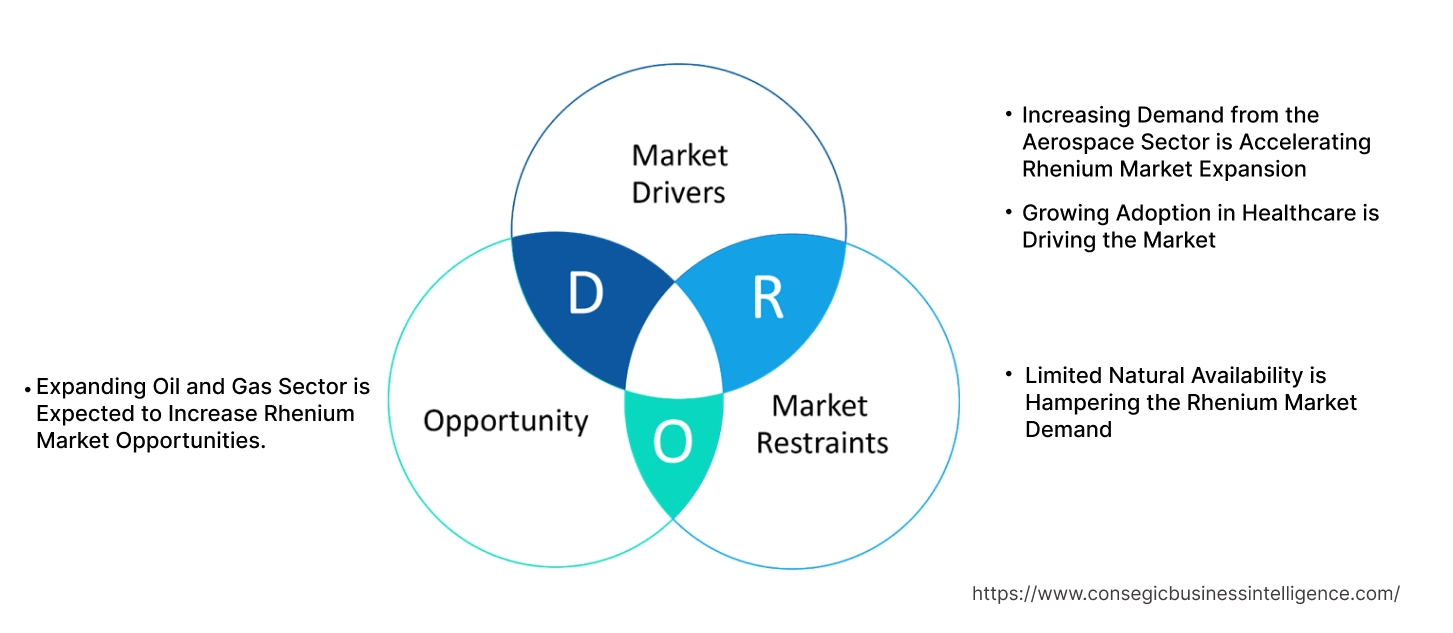
Key Drivers:
Increasing Demand from the Aerospace Sector is Accelerating Rhenium Market Expansion
Rhenium is important in aerospace because it makes jet engines stronger and more heat-resistant. It is added to the superalloys used in turbine blades. This helps them work at very high temperatures without melting out. This improves fuel efficiency and engine lifespan. It is also used in space exploration for rocket thrusters and high-temperature coatings. Increasing air travel has led to sector growth.
For instance,
- According to Avionics International, Boeing delivered 340 commercial aircraft in 2021, which was more than twice the 157 delivered in 2020. This is driving the market share.
Overall, the increasing need from the aerospace sector is significantly boosting the rhenium market expansion.
Growing Adoption in Healthcare is Driving the Market.
Rhenium plays an important role in healthcare. Its isotopes, such as rhenium-188 and rhenium-186, are used in radiopharmaceuticals for targeted radiation therapy. This is helpful in destroying cancer cells. It also minimizes damage to healthy tissues. Moreover, manufacturers are increasingly using them for X-ray tubes and medical implants. It is due to its strength and heat resistance.
For instance,
- In 2023, MiRus launched of a new line of medical implants made from a molybdenum-rhenium alloy for foot and ankle plating system. This is driving the market.
Thus, growing adoption in healthcare is accelerating the global rhenium market growth.
Key Restraints:
Limited Natural Availability is Hampering the Rhenium Market Demand
Rhenium is one of the rarest metals on Earth. This makes its supply highly limited. It is mainly obtained as a byproduct of molybdenum and copper mining. This leads to production dependence on the availability of these ores. Since rhenium is not mined directly, its supply is unpredictable. This leads to shortages and high prices. Moreover, recycling rhenium from used superalloys and catalysts is possible. However, the process is complex and expensive. Extracting pure rhenium from scrap materials requires advanced technology. This makes large-scale recycling difficult. Many industries still rely on primary sources. It increases supply chain risks. All these factors make it a costly and difficult material to source, limiting its widespread use. Hence, the limited natural availability is hampering the rhenium market demand.
Future Opportunities :
Expanding Oil and Gas Sector is Expected to Increase Rhenium Market Opportunities.
Rhenium plays a key role in the oil and gas sector. It is mainly used as a catalyst for petroleum refining. These catalysts help convert low-quality feedstock into cleaner and more efficient fuels. This reduces operational costs. Its ability to withstand high temperatures makes it ideal for hydrocracking and hydrogenation reactions. Global energy demand is rising, leading to sector growth.
- For instance, according to Enerdata, Eight members of OPEC+ have committed to a plan that will begin raising crude oil production in April 2025. This creates potential for the market.
Overall, expanding oil and gas sector is expected to increase rhenium market opportunities.
Rhenium Market Segmental Analysis :
By Form:
Based on form, the market is categorized into powder, bars, pellets, sheets, wires, and others.
Trends in Form:
- Powder remains the most prevalent form. It is due to its versatility in powder metallurgy, catalyst production, and superalloy manufacturing.
- Pellets are gaining importance in the oil and gas industry. This is due to their ease of handling and controlled surface area.
The powder segment accounted for the largest market share in 2024.
- Powder segment dominated the rhenium market trends. This form allows for homogeneous mixing with other materials.
- It ensures uniform composition in alloys and catalysts. The high surface area of powder enhances its reactivity.
- Moreover, powders enhance the sintering process, resulting in stronger and denser materials.
- There are new equipment advancements in powder production. This enables higher purity and more consistent quality.
- For instance, in 2024, Molymet, launched a new atomizer platform to produce rhenium spherical This is increasing applications of powder form.
- Overall, as per the market analysis, technological advancements are driving a segment in rhenium market growth.
The pellets segment is expected to grow at the fastest CAGR over the forecast period.
- The pallet segment is emerging in market trends. They offer advantages such as consistent weight. This offers precise dosing in alloying and melting processes.
- It minimizes dust generation compared to powder. This reduces material loss and improves workplace safety.
- They are used as feedstock in vacuum induction melting (VIM) and electron beam melting (EBM) processes, ensuring uniform alloy formation.
- Pellets find primary usage in the sectors where high-temperature superalloys are critical, such as engine components.
- According to market analysis, the growing automotive sector will drive segmental growth for the upcoming years.
By End Use:
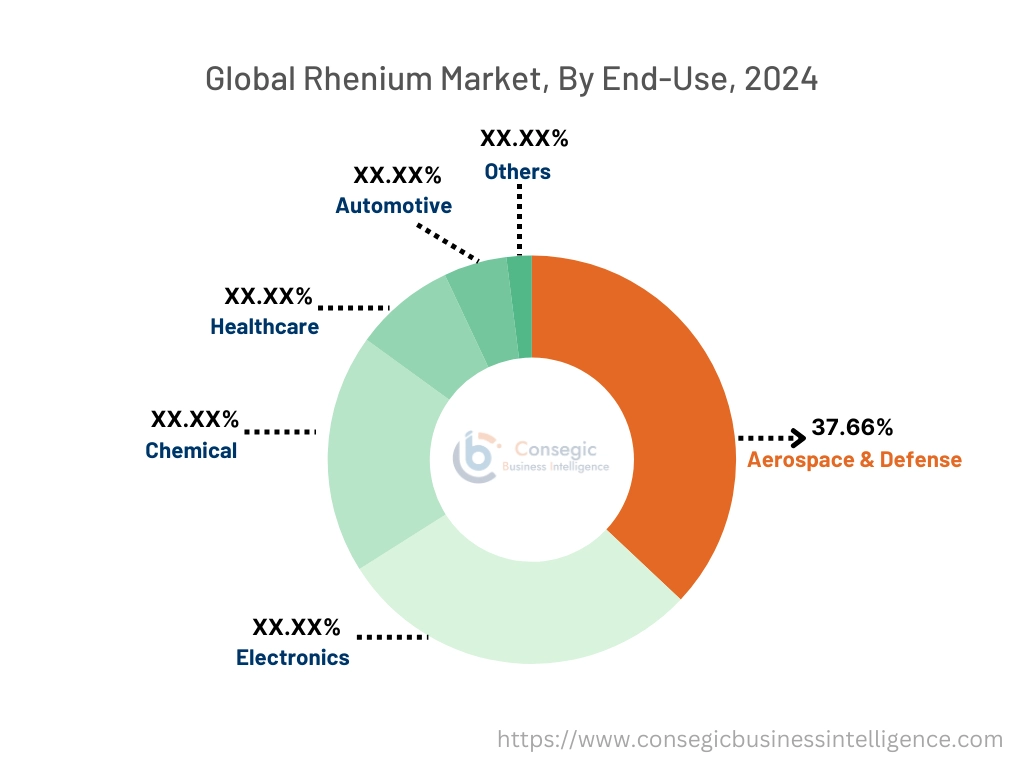
Based on end-use, the market is categorized into aerospace & defense, electronics, chemical, healthcare, automotive, and others.
Trends in the End-Use:
- Growing use of rhenium in high-temperature superconductors and advanced electronic components.
- Rhenium-based catalysts continue to be essential in petroleum refining and various chemical synthesis processes, ensuring stable demand.
The aerospace & defense segment accounted for the largest market share of 37.66% in 2024.
- The aerospace and defense segment dominated the rhenium market trends. It is used as an alloying element in superalloys.
- It is used for critical jet engine components such as turbine blades and combustion chambers.
- This has been due to its exceptional ability to withstand extreme temperatures and high stress.
- Its high melting point and resistance to heat are also advantageous in aircraft and rocket engines.
- Overall, as per the market analysis, increased military spending and advancements in space exploration are driving segmental growth in the rhenium industry. Moreover, growing air travel and technological innovations, such as artificial intelligence, further support the segment.
The electronics segment is expected to grow at the fastest CAGR over the forecast period.
- The electronics segment is emerging in market trends. It is a key component in electronics due to its high temperature resistance.
- It provides electronics with greater stability and reliability as well. It is used in specialized electrical contacts and superconductors.
- It is becoming emerging material in valleytronics as well.Increasing consumer demand for connected devices is leading to sector development.
- For instance, according to the Time of India, the Indian electronics production is expected to grow at a CAGR of 26% from 2023-2030. This creates potential for segment in the market.
- Thus, as per the market analysis, the expanding electronics sector will drive segmental growth for the forecasted years.
Regional Analysis:
The regional segment includes North America, Europe, Asia Pacific, the Middle East and Africa, and Latin America.
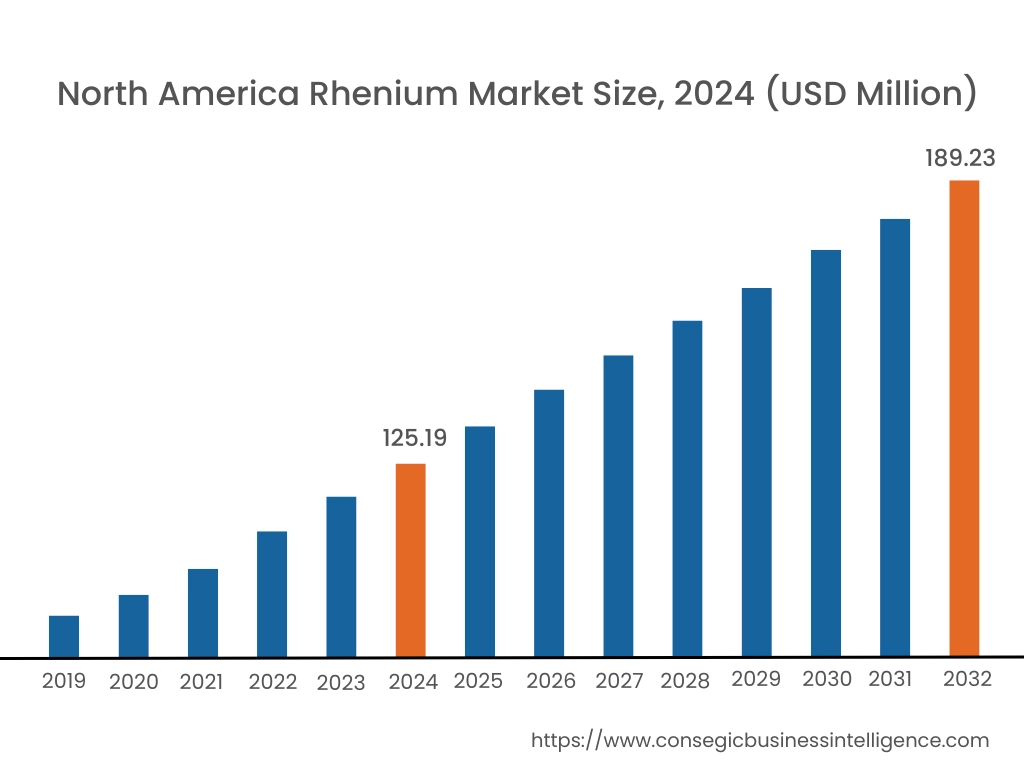
In 2024, North America accounted for the highest rhenium market share at 42.29% and was valued at USD 125.19 Million and is expected to reach USD 189.23 Million in 2032. In North America, the U.S. accounted for the rhenium market share of 73.48% during the base year of 2024. The region is home to major aircraft manufacturers. They rely on rhenium-based superalloys for jet engines. These alloys improve engine efficiency, heat resistance, and durability. Moreover, there is an expansion of wind turbines in North America.
- For instance, according to Energy Information Administration (EIA), the U.S. wind power generation capacity has increased by 46% when compared to 2019. Rhenium is used in wind turbine blades and other components to improve their strength and stability.
Overall, rising energy and aerospace industry are driving the market in the region.

In Asia Pacific, the rhenium market is experiencing the fastest growth with a CAGR of 9.1% over the forecast period. Many countries in the region are expanding their oil refining capacity. Rhenium is used as reforming catalysts to improve fuel production efficiency and quality. Moreover, the increasing electronics sector in Asia-Pacific is also supporting the market. Countries like China, South Korea, and Japan are major producers of semiconductors and electronic components. Rhenium is used in electrical contacts, filaments, and high-temperature circuits.
Europe's rhenium market analysis states that several trends are responsible for the progress of the market in the region. Isotopes such as rhenium-188 and rhenium-186, are used in cancer treatment and radiopharmaceuticals. These isotopes help in targeted radiation therapy. This improves treatment effectiveness with fewer side effects. Moreover, the increasing recycling of superalloys in Europe is also supporting the market. Recycling reduces costs, ensures a stable supply, and lowers environmental impact. Strict European regulations on resource sustainability is leading to more recovery.
The Middle East and Africa (MEA) rhenium market analysis states that the region is also witnessing several trends for a notable surge. The region is seeing growing requirements for high-performance coatings. Rhenium-based coatings are used in automotive and industrial machinery to protect equipment from extreme heat and wear. However, rhenium is not widely mined in the region. This leads to low local production making it harder for local businesses to access it. It increases import prices as well.
Latin America's rhenium market is also emerging. Many countries in the region are investing in military equipment and advanced defense systems. Rhenium-based superalloys are used in it as they improve heat resistance and durability. However, rhenium is rare and extracted as a byproduct of molybdenum mining. This makes its production difficult and expensive. Prices fluctuate due to limited supply and changing global requirements. This creates uncertainty for buyers.
Top Key Players & Market Share Insights:
The Rhenium market is highly competitive with major players providing products to the national and international markets. Key players are adopting several strategies in research and development (R&D) and product innovation to hold a strong position in the global Rhenium market. Key players in The Rhenium industry include-
- Hoganas AB (Sweden)
- Merck KGaA (Germany)
- Cross Company (U.S.)
- Shanghai Truer technology Co., Ltd (China)
- CDH Fine Chemical (India)
- American Elements (U.S.)
- Ultramet (U.S.)
- ATT Advanced Elemental Materials Co., Ltd. (U.S.)
- Advanced Engineering Materials Limited (China)
- Stanford Advanced Materials (U.S.)
Rhenium Market Report Insights:
| Report Attributes | Report Details |
| Study Timeline | 2019-2032 |
| Market Size in 2032 | USD 492.05 Million |
| CAGR (2025-2032) | 6.6% |
| By Form |
|
| By End-Use |
|
| By Region |
|
| Key Players |
|
| North America | U.S. Canada Mexico |
| Europe | U.K. Germany France Spain Italy Russia Benelux Rest of Europe |
| APAC | China South Korea Japan India Australia ASEAN Rest of Asia-Pacific |
| Middle East and Africa | GCC Turkey South Africa Rest of MEA |
| LATAM | Brazil Argentina Chile Rest of LATAM |
| Report Coverage |
|
Key Questions Answered in the Report
How big is the Rhenium market? −
In 2024, the Rhenium market is USD 296.07 Million.
Which is the fastest-growing region in the Rhenium market? +
Asia Pacific is the fastest-growing region in the Rhenium market.
What specific segmentation details are covered in the Rhenium market? +
Form and End-Use segmentation details are covered in the Rhenium market
Who are the major players in the Rhenium market? +
Hoganas AB (Sweden), Merck KGaA (Germany), American Elements (U.S.), Ultramet (U.S.), ATT Advanced Elemental Materials Co., Ltd. (U.S.), and Advanced Engineering Materials Limited (China) are some major players in the market.
Overview
Reputation & Certifications


Our Services
- Market Intelligence & Forecasting
- Custom Research Solutions
- Market Entry Strategy
- Competitive Intelligence
- Customer Insights
- Industry Innovation Analysis
- Investment Advisory