Jump to Content
Screenless Display Market - Size, Share, Industry Trends, and Forecasts (2025-2032)
Screenless Display Market Size:
Screenless Display Market Size is estimated to reach over USD 22.97 Billion by 2032 from a value of USD 4.97 Billion in 2024 and is projected to grow by USD 5.93 Billion in 2025, growing at a CAGR of 24.3% from 2025 to 2032.
Screenless Display Market Scope & Overview:
A screenless display projects visual information without requiring a traditional flat panel and uses technologies such as holography or retinal projection. These systems aim to create images that appear in space or directly on the viewer's retina, offering more immersive and potentially space-saving alternatives to conventional screens. The benefits of screenless displays include enhanced immersion & interactivity, increased space efficiency, targeted information delivery, and others which in turn drive the market.Further, the screenless displays are used for a wide range of applications in consumer electronics, aerospace & defense, healthcare, automotive, retail, and other sectors which in turn drive the market. Further, key trends driving screenless displays include the increasing demand for immersive AR/VR experiences and the rapid advancement of holographic and retinal projection technologies.
How is AI Impacting the Screenless Display Market?
AI is revolutionizing the screenless display market by enabling more intuitive and immersive user experiences. AI-powered algorithms are crucial for holographic and retinal displays, allowing for the real-time generation of complex 3D visuals that can be projected into open space or directly onto the user's retina. This technology also enables gesture and voice recognition, allowing users to interact with screenless displays naturally and without the need for physical controls. Furthermore, AI helps personalize content and adapts the display based on user behavior and context, which is essential for applications like heads-up displays in cars and augmented reality glasses.
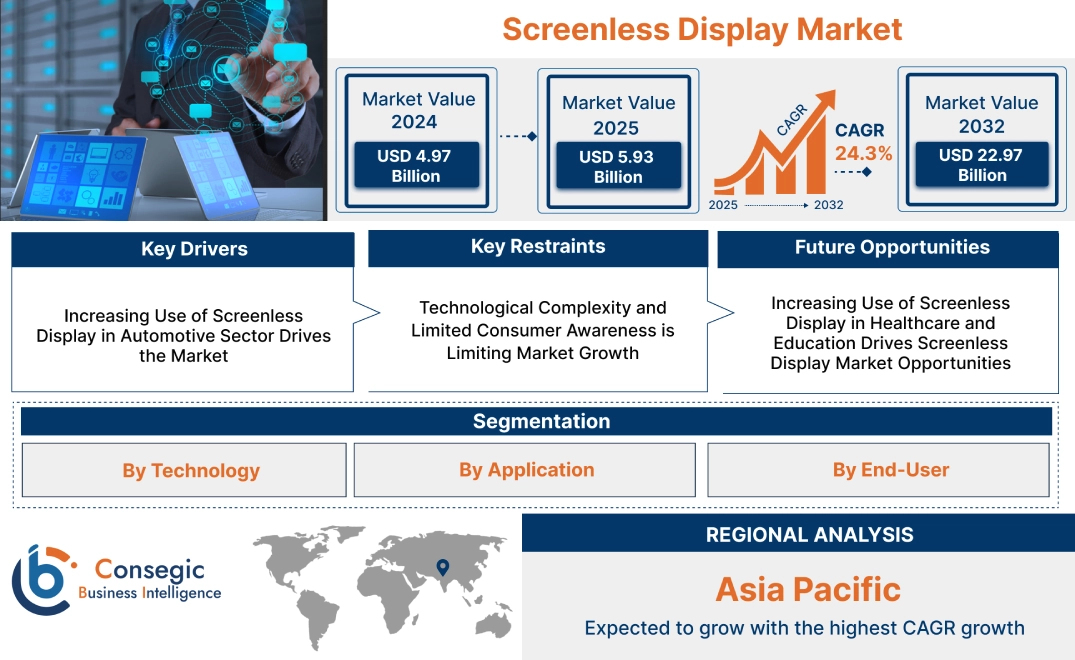
Screenless Display Market Dynamics - (DRO) :
Key Drivers:
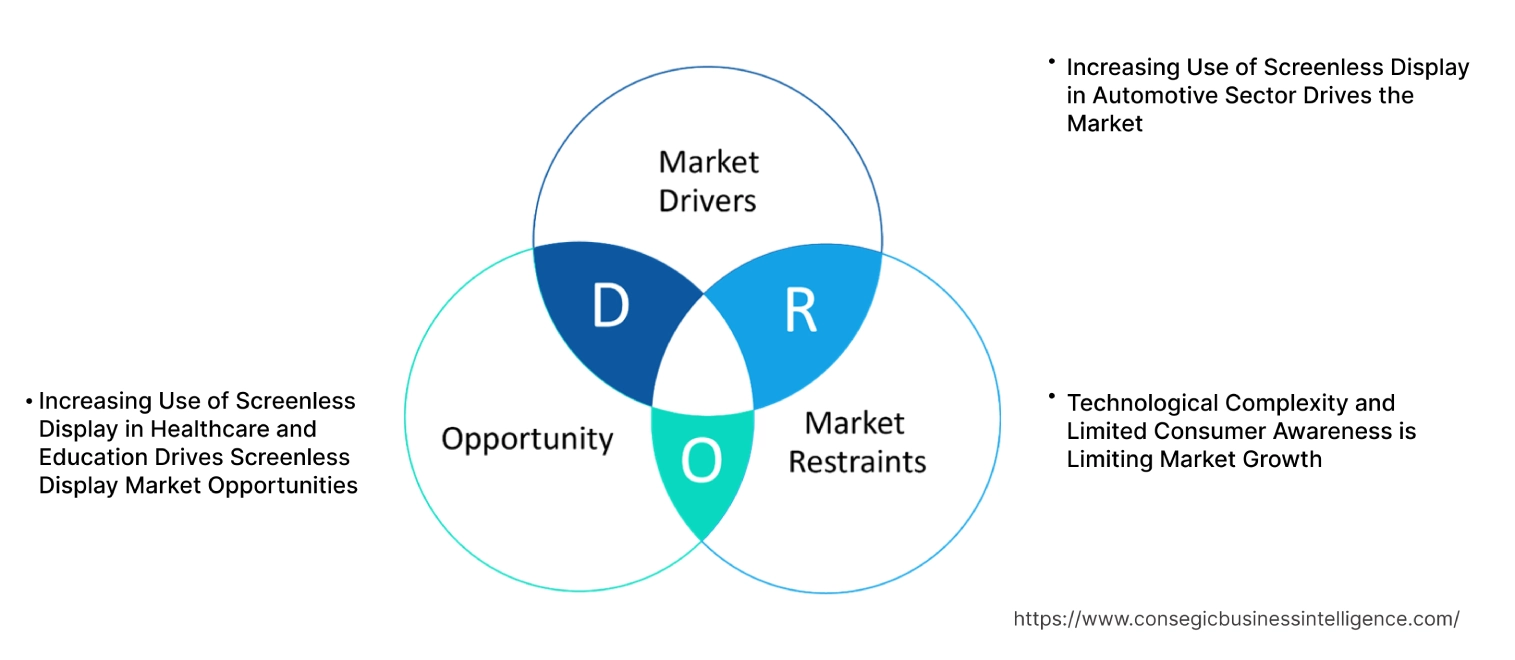
Increasing Use of Screenless Display in Automotive Sector Drives the Market
The increasing adoption of screenless display technology in automotive sector is a significant catalyst for market growth. Head-up displays (HUDs) are used for projecting critical driving information onto the windshield and are becoming standard features, enhancing driver safety and situational awareness. Further, advanced holographic displays and augmented reality (AR) overlays are also emerging, offering interactive dashboards and immersive in-car entertainment. Furthermore, as vehicles become more autonomous, screenless displays will play a crucial role in providing seamless and intuitive information to both drivers and passengers.
- For instance, according to IEA electric car sales in Europe rose from 2.7 million units in 2022 to 3.2 million units in 2023. The increased sales are driving the demand for screenless displays.
Thus, increased automobile sales and integration of advanced visual interfaces within automotive systems is driving the screenless display market.
Key Restraints:
Technological Complexity and Limited Consumer Awareness is Limiting Market Growth
Technological complexity and limited consumer awareness are significant hurdles restricting the widespread adoption of screenless displays. The intricate nature of technologies like holographic projections and retinal displays poses challenges in manufacturing and integration, leading to higher production costs and slower market penetration. Furthermore, many potential users are unaware of the benefits and applications, leading to hesitation in adopting these technologies. This lack of understanding necessitates extensive consumer education and marketing efforts. Thus, technological complexities and consumer awareness are potential factors restraining the market.
Future Opportunities :
Increasing Use of Screenless Display in Healthcare and Education Drives Screenless Display Market Opportunities
The expanding use of screenless displays in healthcare and education is creating substantial market opportunities. In healthcare, holographic imaging and retinal displays are revolutionizing surgical planning, medical training, and patient visualization, enabling more precise and less invasive procedures. Further, in education sector interactive holographic projections and augmented reality are transforming traditional learning into immersive experiences. These technologies facilitate complex concept visualization and enhance student engagement. Furthermore, as healthcare and education prioritize innovative, engaging, and efficient methods, screenless display technologies are poised to become integral tools, significantly expanding market potential.Thus, growing use of screenless display in healthcare and education drives screenless display market opportunities.
Screenless Display Market Segmental Analysis :
By Technology:
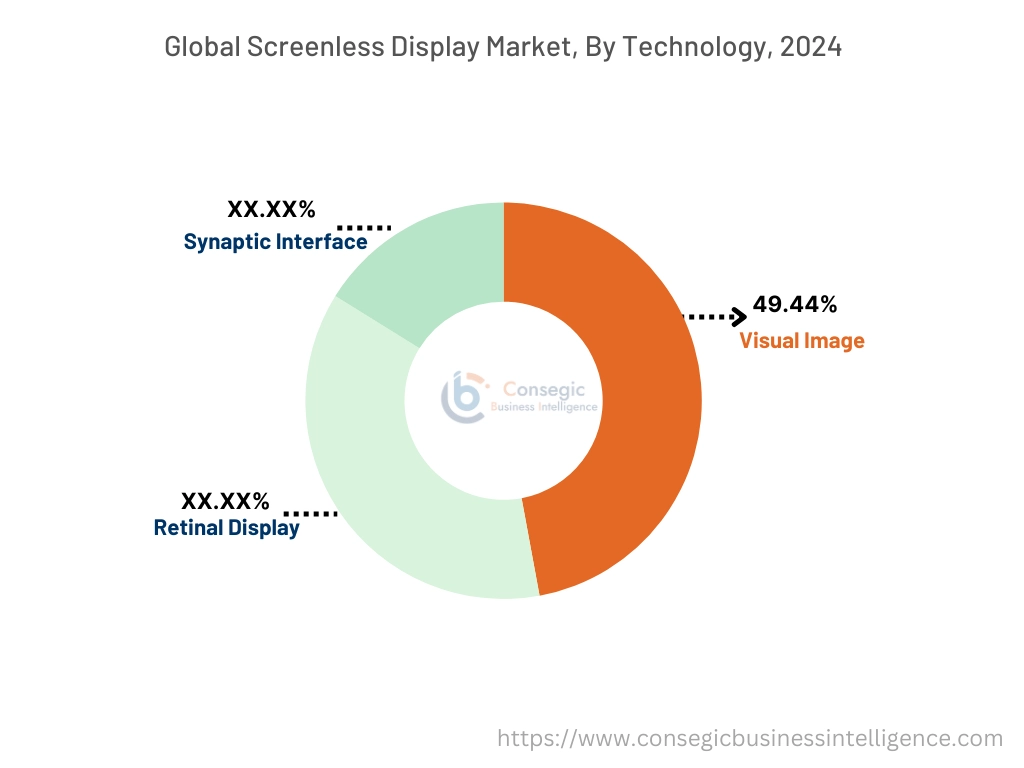
Based on the technology, the market is segmented into visual image, retinal display, and synaptic interface.
Trends in the Technology:
- Decreasing size of the projection systems and development of more portable devices is driving the screenless display market trends.
- Growing improvements in image stability and clarity are expected to drive screenless display market size.
Visual image accounted for the largest revenue share of 49.44% in the year 2024.
- Expanding HUD applications beyond automotive to aviation, military, and industrial sector is driving the screenless display market share.
- Further, enhanced holographic projection and integration of AI for dynamic holographic content generation drives the screenless display market trends.
- Furthermore, integration of augmented reality (AR) into HUDs for real-time information is driving the screenless display market size.
- Thus, as per screenless display market analysis, expanding HUD applications, enhanced holographic projection, and integration of augmented reality driving the market.
Retinal display is anticipated to register the fastest CAGR during the forecast period.
- Growing development of compact and lightweight retinal displays for AR/VR headsets drives the screenless display market share.
- Further, growing use of the retinal display in vision correction and prosthetic devices in turn drives the screenless display market demand.
- Therefore, based on analysis, medical applications and AR/VR integration are anticipated to boost the market during the forecast period.
By Application:
Based on the application, the market is segmented into augmented reality, virtual reality, automotive displays, portable devices, home entertainment devices, and others.
Trends in the Application:
- Advancements in VR streaming and cloud based VR experience drive the screenless display market demand.
- Development of holographic displays for immersive home entertainment experiences drives the market.
Virtual reality accounted for the largest revenue share in the year 2024.
- Growing development of more immersive and realistic VR gaming experiences drives market.
- Further, VR simulations for surgical training and medical education are driving the screenless display industry.
- Furthermore, interactive VR learning environments for science and engineering drive the market.
- Thus, as per screenless display market analysis, adoption of VR in gaming, surgical training, medical education, and others are driving the market.
Augmented reality is anticipated to register the fastest CAGR during the forecast period.
- Increased use in manufacturing and logistics for real-time information and guidance drives the screenless display market growth.
- Further, interactive AR displays for product information and visualization in retail sector propels the screenless display market expansion.
- Furthermore, AR visualization of patient data for diagnosis and treatment planning drives the market.
- For instance, in January 2024, Avegant announced Spotlight display technology for AR. This innovation brings the power-saving benefits of APL (average pixel level) to LCoS, making it a more efficient and higher-contrast solution for augmented reality displays.
- Therefore, based on analysis, growing adoption in manufacturing, retail, and healthcare sectors is anticipated to boost the growth of the market during the forecast period.
By End User:
Based on the end user, the market is segmented into consumer electronics, aerospace & defense, healthcare, automotive, retail, others.
Trends in the End User:
- Increased use of AR-enhanced HUDs in aerospace sector for improved situational awareness which in turn drives the screenless display market expansion.
- Growing use of VR for surgical training propels the screenless display market.
Consumer Electronics accounted for the largest revenue share in the year 2024.
- The growing use of AR displays in smart glasses and watches is driving the market.
- Further, increased development of social VR platforms is driving the market during the forecast period.
- Furthermore, development of interactive AR entertainment experiences drives screenless display market growth.
- For instance, in February 2024, Avegant, Qualcomm, and Applied Materials collaborated to develop a blueprint for lightweight, wireless AI smart glasses powered by the Snapdragon AR1 platform.
- Thus, based on analysis, growing use of AR displays and rising trends of interactive AR entertainment are driving the market.
Automotive is anticipated to register the fastest CAGR during the forecast period.
- Integration of AR into head-up displays for enhanced navigation and safety is driving the market.
- Technological advancement, rising disposable income, and growing trends of electric vehicle is driving the automotive sector which in turn drives the screenless display market.
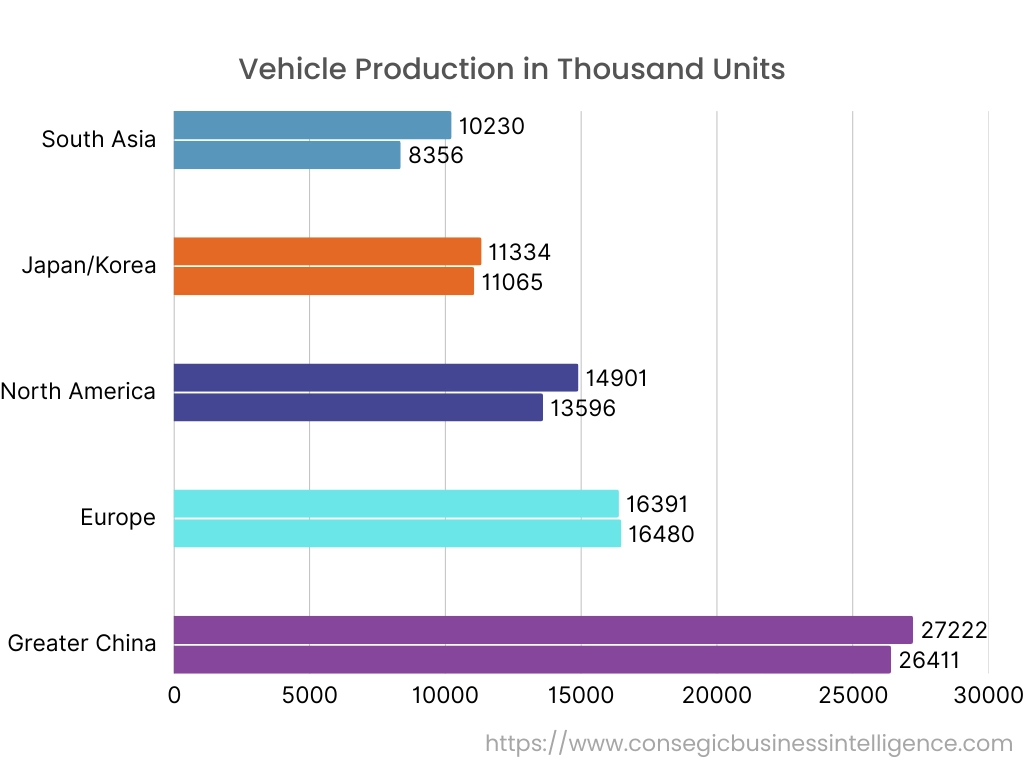
- For instance, as per the European Automobile Manufacturers' Association (ACEA), vehicle production worldwide reached 85.4 million units in 2022, observing a 5.7% rise from 2021. The increasing vehicle production in turn drives the adoption of screenless displays.
- Therefore, based on analysis, aforementioned factors are anticipated to boost the growth of the market during the forecast period.
Regional Analysis:
The regions covered are North America, Europe, Asia Pacific, the Middle East and Africa, and Latin America.
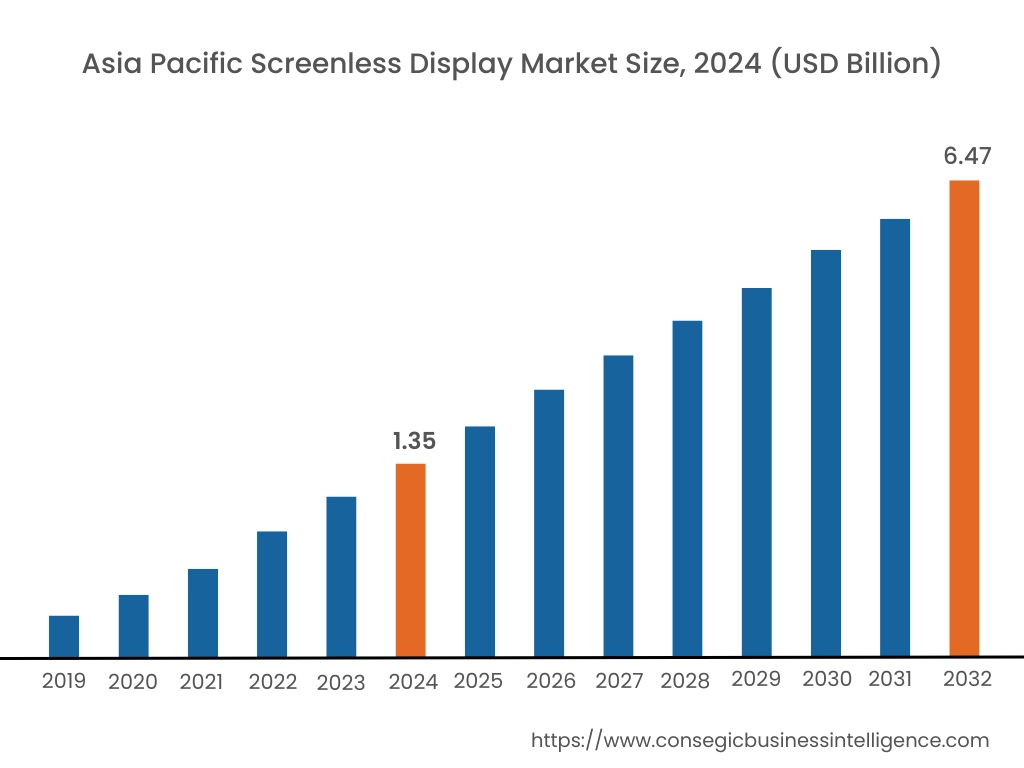
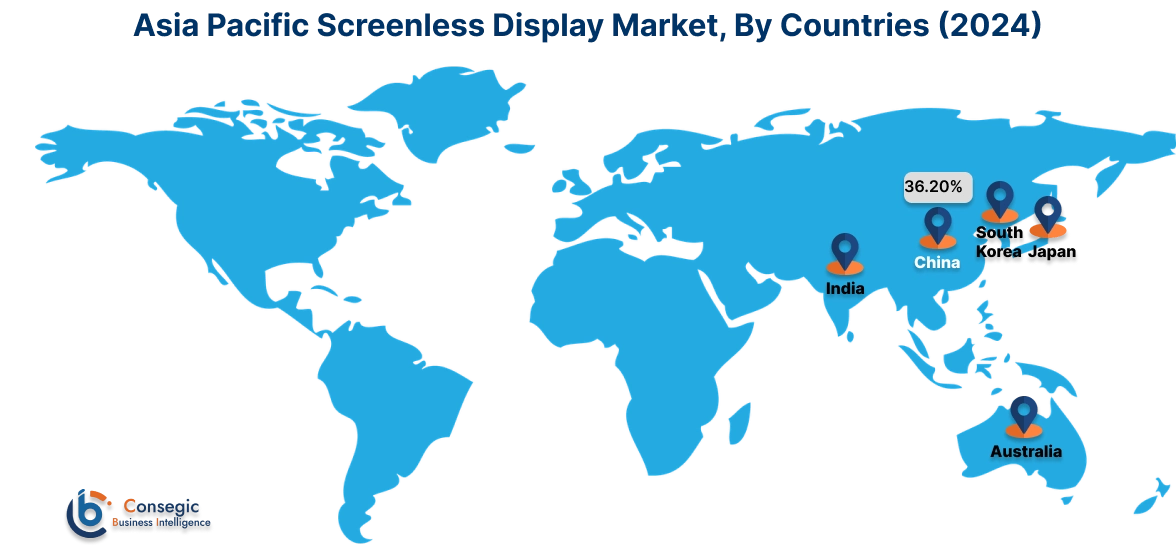
Asia Pacific region was valued at USD 1.35 Billion in 2024. Moreover, it is projected to grow by USD 1.62 Billion in 2025 and reach over USD 6.47 Billion by 2032. Out of this, China accounted for the maximum revenue share of 36.20%. The market growth for screenless display is mainly driven by rapid adoption of AR/VR technologies across various sectors, coupled with the expanding consumer electronics market and increasing demand for innovative display solutions.
- For instance, according to Global EV Outlook 2024 by IEA, the sale of electric cars in China grew to 8.2 million units in 2023 from 5.9 million units in 2022. The increased sales of electric vehicle is resulting in the growing need for screenless systems.
North America is estimated to reach over USD 8.01 Billion by 2032 from a value of USD 1.74 Billion in 2024 and is projected to grow by USD 2.08 Billion in 2025. The North American market is primarily driven by technological innovation and the high adoption rate of advanced technologies in sectors like aerospace and defense, healthcare, and consumer electronics.
- For instance, in September 2024, DigiLens Inc. and Avegant partnered to create compact, affordable, and high-performance transparent displays for AI-enabled smart glasses.
The regional trends analysis depicts strong research and development initiatives, particularly in healthcare and automotive sectors, and focus on integrating advanced technologies for enhanced industrial and consumer applications in Europe is driving the market. Additionally, the factors driving the market in the Middle East and African region are growing demand for advanced display solutions in sectors like entertainment, automotive, and defense and rising disposable incomes. Further, increasing adoption of consumer electronics and entertainment technologies is paving the way for the progress of market trends in Latin America region.
Top Key Players and Market Share Insights:
The global screenless display market is highly competitive with major players providing solutions to the national and international markets. Key players are adopting several strategies in research and development (R&D), product innovation, and end-user launches to hold a strong position in the screenless display industry. Key players in the global screenless display market include-
- EON Reality (US)
- Holoxica (UK)
- Leia Inc. (US)
- Magic Leap, Inc. (US)
- Microsoft (US)
- Realview Imaging Ltd. (Israel)
- Sightful (Israel)
- Sony Corporation (Japan)
- Synaptics Incorporated (US)
- Vuzix Corporation (US)
Recent Industry Developments :
Collaborations and Partnerships:
- In June 2024, Vuzix and Avegant collaborated to develop optimized waveguide optical modules for AI-enabled consumer smart glasses, combining Avegant's light engine with Vuzix's waveguide.
Screenless Display Market Report Insights :
| Report Attributes | Report Details |
| Study Timeline | 2019-2032 |
| Market Size in 2032 | USD 22.97 Billion |
| CAGR (2025-2032) | 24.3% |
| By Technology |
|
| By Application |
|
| By End User |
|
| By Region |
|
| Key Players |
|
| North America | U.S. Canada Mexico |
| Europe | U.K. Germany France Spain Italy Russia Benelux Rest of Europe |
| APAC | China South Korea Japan India Australia ASEAN Rest of Asia-Pacific |
| Middle East and Africa | GCC Turkey South Africa Rest of MEA |
| LATAM | Brazil Argentina Chile Rest of LATAM |
| Report Coverage |
|
Key Questions Answered in the Report
How big is the screenless display market? −
The screenless display market is estimated to reach over USD 22.97 Billion by 2032 from a value of USD 4.97 Billion in 2024 and is projected to grow by USD 5.93 Billion in 2025, growing at a CAGR of 24.3% from 2025 to 2032.
What specific segmentation details are covered in the Screenless Display report? +
The screenless display report includes specific segmentation details for technology, application, end user, and regions.
Which is the fastest segment anticipated to impact the market growth? +
In the screenless display market, passenger Augmented Reality is the fastest-growing segment during the forecast period.
Who are the major players in the screenless display market? +
The key participants in the screenless display market are EON Reality (US), Holoxica (UK), Leia Inc. (US), Magic Leap, Inc. (US), Microsoft (US), Realview Imaging Ltd. (Israel), Sightful (Israel), Sony Corporation (Japan), Synaptics Incorporated (US), Vuzix Corporation (US) and others.
What are the key trends in the Screenless Display market? +
The screenless display market is being shaped by several key trends including technological advancements in chassis design, growing electric vehicle market, and adoption of autonomous vehicles.
Overview
Reputation & Certifications


Our Services
- Market Intelligence & Forecasting
- Custom Research Solutions
- Market Entry Strategy
- Competitive Intelligence
- Customer Insights
- Industry Innovation Analysis
- Investment Advisory