Jump to Content
Space Robotics Market- Size, Share, Industry Trends, and Forecasts (2025-2032)
Space Robotics Market Size:
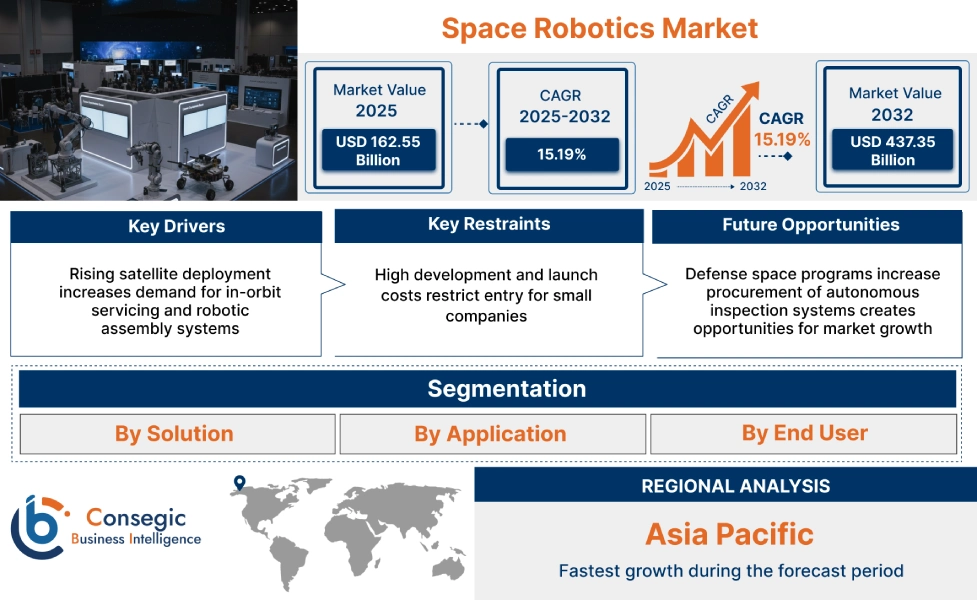
Space Robotics Market size is estimated to reach over USD 437.35 Billion by 2032 from a value of USD 141.41 Billion in 2024 and is projected to grow by USD 162.55 Billion in 2025, growing at a CAGR of 15.19% from 2025 to 2032
Space Robotics Market Scope & Overview:
Space robotics can be defined as the use of robotic technology in outer space for the purpose of satellite servicing, space station operation, and planetary exploration. Space robotics involves the use of robotic arms, autonomous navigation modules, vision sensors, artificial intelligence software, propulsion systems, and communication networks . The objective is to execute complex tasks in harsh space environments while reducing direct human intervention. The infrastructure enables remote operations, real-time telemetry exchange, and precise maneuvering between spacecraft, orbital platforms, and ground control centers.
The space robotics industry is growing due to the increasing number of satellites being launched into space for communication, earth observation, and military purposes. Space agencies and companies are investing in in-orbit satellite servicing and space debris removal. The development of commercial space programs and reusable rockets has driven the need for automated inspection and assembly. Regulatory focus on orbital sustainability and long-term space asset management is further supporting industry expansion.
How is the Space Robotics Market Affected by AI?
AI enhances space robotics systems by analyzing large amounts of mission data, space telemetry, orbital elements, and environmental factors with high accuracy. Machine learning algorithms detect anomalies, navigation hazards, and mechanical stress patterns in space robotics systems during orbital missions. AI systems are also used for autonomous docking, robotic arm control, and terrain navigation during planetary missions.
AI-based systems allow for the continuous monitoring of robotic system components and real-time decision-making during deep space and orbital missions. Predictive models assess component degradation, fuel optimization, and mission timelines before performance anomalies occur. This transition from ground-based control to autonomous mission control enhances system reliability. With the increasing number of commercial and government space missions, AI integration is improving long-term mission planning and coordination during multi-orbit space missions.
Space Robotics Market Dynamics - (DRO):ynamics - (DRO):
Key Drivers:
Rising satellite deployment increases demand for in-orbit servicing and robotic assembly systems
The increasing number of satellites being launched for communication, earth observation, and navigation purposes is leading to congestion in orbital paths. Satellites need robotic systems for inspection, refueling, repair, and life extension. In-orbit servicing helps in reducing the cost of mission replacement. Space agencies and satellite companies are combining robotic platforms to facilitate assembly and maintenance missions in orbit.
- For instance, in March 2025, Goldman Sachs forecasts a major increase in satellite launches, estimating up to 70,000 low-Earth orbit satellites projected to launch over the next five years as the global satellite market expands significantly by 2035.
Therefore, the space robotics industry is expanding due to rising satellite deployment and the need for automated in-orbit servicing capabilities.
Key Restraints:
High development and launch costs restrict entry for small companies
Space robotics systems need advanced engineering, radiation-hardened components, testing infrastructure, and validation of missions. The total investment involves research and development, launch costs, and insurance of missions. Small companies are limited by capital constraints and delayed returns. This limits the scope of participation to well-funded space agencies and established aerospace contractors.
Thus, the high development and launch costs are hindering the entry of more participants into the space robotics industry.
Future Opportunities:
Defense space programs increase procurement of autonomous inspection systems creates opportunities for market growth
The national defense organizations are increasing their space-based surveillance, communication, and security operations. To support these operations, there is a need for robotic systems that can inspect satellites, monitor threats, and protect space assets autonomously. Autonomous inspection robots enable faster response times and minimize the need for crewed missions. Governments are increasing their budgets for robust and self-sustaining space infrastructure.
- In January 2026, Novaspace stated that the space market for governments grew to USD 137.4 billion in 2025, indicating increased defense-related spending. Defense spending accounted for 54% of the total, at USD 73.5 billion, surpassing civil budgets of USD 63.7 billion, solidifying space as a defense priority.
Thus, the growing defense space programs are opening up future procurement avenues for autonomous robotic systems in the space robotics market.
Space Robotics Market Segmental Analysis:
By Solution:
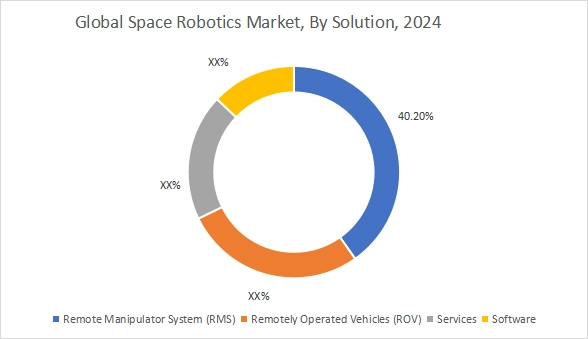
On the basis of solution, the space robotics market is segmented into Remotely Operated Vehicles (ROV) (rovers/spacecraft landers, space probes, and others), Remote Manipulator System (RMS) (robotic arms/manipulator systems, gripping & docking systems, and others), software, and services.
Trends in the Solution:
- Rising in-orbit satellite maintenance requirements are increasing deployment of robotic servicing platforms.
- Growth in autonomous mission planning is strengthening demand for advanced robotic software systems.
The Remote Manipulator System (RMS) was responsible for the highest revenue share of 40.20% in 2024.
- RMS platforms support satellite capture, docking, assembly, and maintenance operations.
- Also, space agencies are integrating robotic arms into orbital stations and servicing spacecraft.
- Moreover, growing demand for precision handling in zero-gravity environments is increasing RMS adoption.
- In addition, long mission durations require reliable manipulation systems for complex tasks.
- Furthermore, commercial satellite operators are investing in robotic extension capabilities to preserve asset value.
- Therefore, expanding in-orbit servicing missions are supporting dominance of the RMS segment.
It is anticipated that the software offering will exhibit the highest compound annual growth rate (CAGR) during the forecast period.
- Software platforms manage navigation, autonomous control, telemetry processing, and mission simulation.
- Moreover, increasing focus on autonomous operations is strengthening demand for AI-enabled robotic control systems.
- In addition, real-time anomaly detection and predictive maintenance functions are expanding software integration.
- Further, multi-satellite coordination requires advanced mission planning and data analytics platforms.
- Furthermore, rising private sector participation is increasing demand for scalable robotic operating systems.
- Hence, the transition toward autonomous mission management is accelerating growth of the software segment.
By Application:
On the basis of application, the market is divided into satellite servicing, planetary exploration, space construction, space debris removal, and autonomous operations.
Trends in the Application:
- Increasing orbital congestion is strengthening focus on servicing and debris mitigation missions.
- Expansion of deep space exploration programs is raising demand for robotic surface mobility systems.
Satellite represented the highest revenue share in 2024.
- Servicing missions include inspection, refueling, repair, and life extension activities.
- Also, the satellite operators are focusing on the preservation of assets to minimize replacement cycles.
- In addition, the orbital robotic platforms minimize reliance on crewed missions.
- Further, growing number of communication and observation satellites is increasing maintenance requirements.
- Furthermore, space agencies are developing servicing spacecraft equipped with robotic arms.
- Therefore, rising satellite asset protection requirements are supporting segment dominance.
The space debris is expected to have the highest compound annual growth rate (CAGR) during the forecast period.
- Debris mitigation missions require capture, relocation, and controlled deorbit operations.
- Moreover, governments are introducing orbital sustainability frameworks to manage space traffic.
- Additionally, autonomous robotic capture systems are improving operational precision.
- Further, increasing satellite launches are raising long-term debris management requirements.
- Furthermore, international collaboration initiatives are supporting technology development in debris mitigation.
- Hence, rising regulatory and sustainability focus is accelerating growth of the space debris removal segment.
By End User:
On the basis of end user, the space robotics market is divided into commercial, government, and defense.
Trends in the End User:
- Growth in private satellite operators is expanding commercial robotic mission demand.
- Increasing national security focus is strengthening defense space investments.
Government accounted for the largest revenue share in the year 2024.
- The space agencies of nations allocate budgets for exploration, research, and infrastructure initiatives.
- Also, the government-funded missions aid in the development of robotic systems for planetary and orbital missions
- In addition, the government-funded initiatives ensure long-term budget stability for the development of complex robotic systems.
- Further, the international space cooperation programs are witnessing an increase in the procurement of robotic platforms.
- Furthermore, scientific research missions rely on robotic systems for remote task execution.
- Therefore, sustained public investment in space programs is supporting government segment dominance.
Defense is anticipated to register the fastest CAGR during the forecast period.
- Defense agencies are expanding space-based surveillance and inspection capabilities.
- Moreover, autonomous robotic systems enhance satellite observation and protection of assets.
- Additionally, rising geopolitical competition is increasing procurement of resilient orbital infrastructure.
- Further, Military space programs require rapid inspection and threat assessment platforms.
- Furthermore, Governments are prioritizing self-operating systems to enhance mission security.
- For instance, according to the International Institute for Strategic Studies (IISS), the world’s military expenditure has risen to USD 2.46 trillion in 2024 from USD 2.24 trillion in 2023. The actual growth in military expenditure has been 7.4% in 2024, up from 6.5% in 2023.
- Hence, expanding defense space programs are accelerating growth of the defense segment.
Regional Analysis:
North America, Europe, Asia Pacific, the Middle East and Africa, and Latin America are the regions of coverage.
North America region was valued at USD 48.58 Billion in 2024. Furthermore, it is expected to increase steadily during the forecast period. Market growth is driven by strong presence of private space companies and established government space programs. Government budgetary allocations for satellite servicing, deep space exploration, and orbital security missions are boosting the demand for robotic systems. Canada is also developing robotic arm technology and space automation solutions, which is encouraging the growth of the industry in the region.
- For instance, according to NASA’s Fiscal Year 2025 mission fact sheets, the budget request allocates USD 7.61 billion to the Deep Space Exploration Systems account to support exploration initiatives including Moon-to-Mars programs.
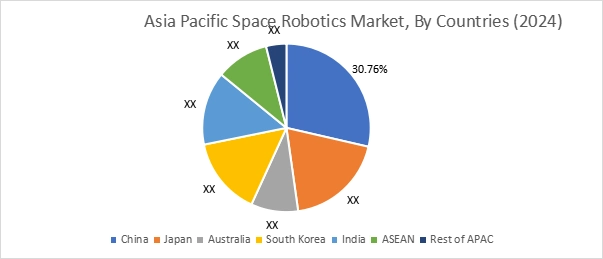
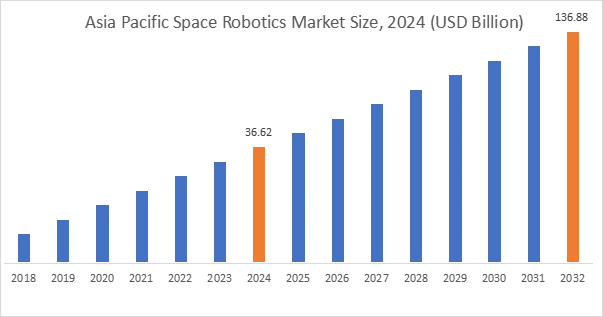
Asia Pacific region was valued at USD 36.62 Billion in 2024. Moreover, it is projected to grow by USD 43.21 Billion in 2025 and reach over USD 136.88 Billion by 2032. Out of this, China accounted for the maximum revenue share of 30.76%. Asia Pacific is expected to witness robust growth during the forecast period. The market is expanding due to the increasing satellite launches across China, India, and Japan. Government-supported missions for lunar and planetary exploration are propelling the demand for autonomous robotic solutions. Increasing commercial launch operations and the rise of regional space agencies are also contributing to the adoption of space robotics platforms in the region.
- As per Economic Survey 2025-26, India has launched 393 foreign satellites between 2015 and 2024, earning close to USD 143 million and USD 322 million in revenue, thus establishing itself in the global commercial launch market.
Europe space robotics market is driven by robotic exploration programs, satellite servicing research, and collaborative missions under ESA member states. Development of robotic arms for space stations and autonomous systems for planetary exploration is strengthening regional capability in orbital robotics.
Latin America space robotics market is fueled by satellite development programs and collaborative research initiatives in Brazil and Argentina. Academic institutions and national space agencies are supporting robotics research for remote sensing satellites and small satellite missions.
Emerging lunar exploration plans and satellite development strategies are fueling the Middle East & Africa space robotics market, particularly in the UAE and Saudi Arabia. National space programs are allocating funding toward autonomous systems and robotic mission support technologies to build domestic space capabilities.
Top Key Players & Market Share Insights:
The space robotics market is moderately concentrated globally. Established space companies, defense contractors, and new space companies are involved in the space robotics market. Market participants are focusing on long-term space agency contracts, joint development agreements, technology licensing, and vertical integration of robotic subsystems to strengthen competitive positioning. Companies are also investing in autonomous navigation software, in-orbit servicing capabilities, and mission simulation platforms to expand their operational footprint across orbital and deep space applications. Key participants in the market for space robotics include:
- Northrop Grumman Corporation– US
- Vantor Holdings, Inc. – US
- Airbus – France
- Thales S.A – France
- MDA Space Ltd. – Canada
- stroscale Holdings Inc. – Japan
- Intuitive Machines, Inc. – US
- Motiv Space Systems, Inc.– US
- Honeybee Robotics, LLC – US
- Altius Space Machines – US
Recent Industry Developments:
Product Launches
- In December 2025, vantor’s upgraded worldview 2d tasking system uses an automated platform with real-time feasibility validation, transparent pricing, and increased constellation capacity to guarantee imagery collection with 70–80 % fulfillment rates and immediate task confirmations, streamlining satellite imaging for a range of missions.
- In March 2025, Airbus was selected to design and build the landing platform for ESA’s ExoMars rover mission, supporting its planned Mars deployment.
Space Robotics Market Report Insights:
| Report Attributes | Report Details |
|---|---|
| Study Timeline | 2019-2032 |
| Market Size in 2032 (USD Billion)) | USD 437.35 Billion |
| CAGR (2025-2032) | 15.19% |
| By Solution |
|
| By Application |
|
| By End User |
|
| By Region |
|
| Key Players |
|
| Report Coverage |
|
Key Questions Answered in the Report
How big is the space robotics market? −
The space robotics market sizeis estimated to reach over USD 437.35 Billion by 2032 from a value of USD 141.41 Billion in 2024 and is projected to grow by USD 162.55 Billion in 2025, growing at a CAGR of 15.19% from 2025 to 2032.
Which segmentation details are covered in the space robotics report? +
The space robotics report includes specific segmentation details for solution, application, end user, and regions.
Which is the fastest segment anticipated to impact the market growth? +
Space debris removal is the fastest growing segment, driven by rising orbital congestion and sustainability regulations.
Who are the major players in the space robotics market? +
The key participants in the space robotics marketare Northrop Grumman Corporation (US), Vantor Holdings, Inc. (US), Airbus (France), Thales S.A. (France), MDA Space Ltd. (Canada), Astroscale Holdings Inc. (Japan), Intuitive Machines, Inc. (US), Motiv Space Systems, Inc. (US), Honeybee Robotics, LLC (US), Altius Space Machines, and others.
What are the key trends in the space robotics market? +
The space robotics market is shaped by key trends including rising satellite launches, growing in-orbit servicing demand, higher adoption of autonomous robotic systems, and expanding defense space programs.
Overview
Reputation & Certifications


Our Services
- Market Intelligence & Forecasting
- Custom Research Solutions
- Market Entry Strategy
- Competitive Intelligence
- Customer Insights
- Industry Innovation Analysis
- Investment Advisory