Jump to Content
Sustainable Manufacturing Market - Size, Share, Industry Trends, and Forecasts (2025 - 2032)
Sustainable Manufacturing Market:
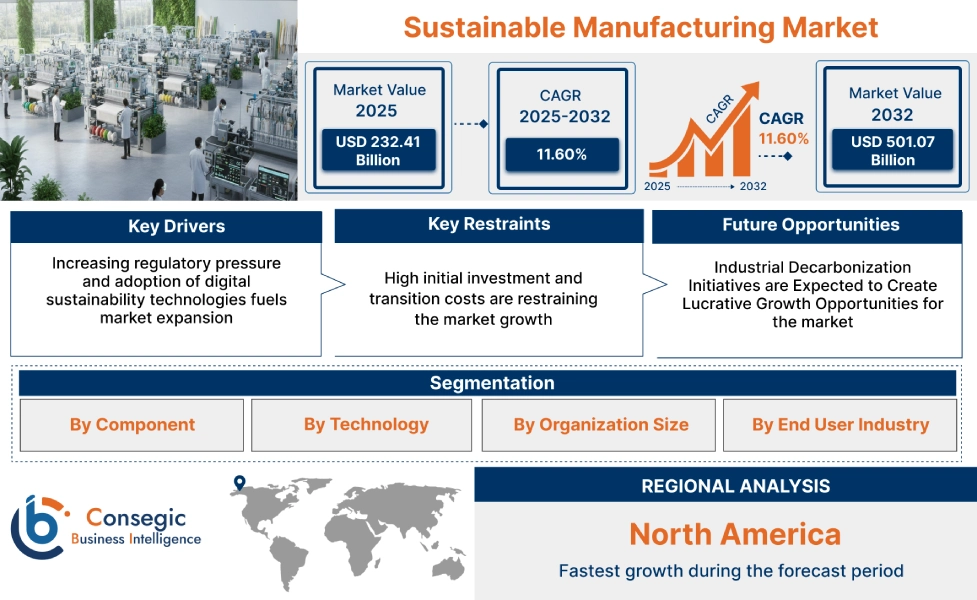
Sustainable Manufacturing Market size is estimated to reach over USD 501.07 Billion by 2032 from a value of USD 208.25 Billion in 2024 and is projected to grow by USD 232.41 Billion in 2025, growing at a CAGR of 11.60% from 2025 to 2032
Sustainable Manufacturing Market Scope & Overview:
Sustainable manufacturing can be described as the integration of environmentally responsible and resource-efficient practices into industrial production processes. It includes the use of energy-efficient technologies, renewable energy integration, waste reduction strategies, circular economy concepts, and sustainable sourcing of raw materials in different industries such as automotive, electronics, chemical, and consumer products. The strategy focuses on the reduction of emissions, conservation of water and energy, optimization of material use, and improvement of overall production efficiency without compromising the quality and performance of the product.
The sustainable manufacturing market is driven by the increasing regulatory pressure to cut carbon emissions, the growing corporate commitment to environmental, social, and governance goals, and the increasing consumer demand for eco-friendly products. In addition, the increasing capabilities in automation, digital monitoring systems, and smart manufacturing technologies are making it possible to track resources and optimize performance, which will drive the adoption of sustainable manufacturing practices.
How is AI Impacting the Sustainable Manufacturing Market?
AI employs machine learning to analyze production data and optimize inefficiencies in the use of energy and resources in sustainable manufacturing. In addition, AI enables the monitoring of emissions, waste, and energy use in real-time, and this enables companies to minimize their effects on the environment. Furthermore, AI enables predictive maintenance by detecting problems in equipment early, thus minimizing waste and unplanned downtime.
Sustainable Manufacturing Market Dynamics - (DRO):
Key Drivers:
Increasing regulatory pressure and adoption of digital sustainability technologies fuels market expansion
The market for sustainable manufacturing is increasing owing to the stringent environmental regulations in the major economies. The governments are setting targets for carbon reduction and enforcing energy efficiency standards. The regulations are forcing the manufacturers to reduce emissions, waste, and improve resource use.
In addition, organizations have set ESG and net-zero targets. Organizations are investing in renewable energy sources, energy-saving equipment, and waste reduction technologies to meet these targets. Consumers are also demanding environmentally friendly products, and this is encouraging organizations to adopt clean production methods.
- For example, in January 2025, Siemens AG unveiled its MACHINUM CNC digitalization solution portfolio at the IMTEX 2025 event, which aims to enhance the efficiency of machine tools and cut down energy consumption by as much as 18% while promoting sustainable digital transformation in manufacturing processes.
Therefore, the need for regulatory requirements and the use of digital sustainability technology is driving the market for sustainable manufacturing.
Key Restraints:
High initial investment and transition costs are restraining the market growth
The implementation of sustainable manufacturing practices requires high capital investment in terms of purchasing new equipment, energy-saving equipment, renewable energy sources, and waste management systems. Moreover, organizations are required to modify their existing manufacturing practices to align with environmental standards and sustainable practices, which is a cost implication for organizations. Moreover, the cost of certification and monitoring may be a burden, especially for small and medium-sized organizations.
Furthermore, the implementation of sustainable technologies in the existing system requires technical knowledge and training costs. Moreover, the volatility of the cost of raw materials for sustainable products may influence the production costs.
Therefore, high upfront investment and transition costs are restraining the sustainable manufacturing market expansion.
Future Opportunities:
Industrial Decarbonization Initiatives are Expected to Create Lucrative Growth Opportunities for the market
The rising global focus on carbon neutrality and regulatory pressure on industrial emissions is accelerating the adoption of sustainable manufacturing solutions. Governments and multinational corporations are investing in clean energy integration, low-carbon materials, and circular production models, which is creating strong opportunities for sustainable manufacturing technologies. Additionally, manufacturers are adopting energy-efficient machinery, renewable power sourcing, waste heat recovery systems, and advanced recycling technologies to reduce operational costs and meet ESG commitments.
Furthermore, digital technologies such as AI-driven energy management systems and real-time carbon monitoring platforms are improving production efficiency and reducing environmental impact, which is expanding long-term market prospects.
- For instance, Schneider Electric has introduced new solutions for industrial sustainability, which are aimed at lowering carbon emissions in manufacturing facilities. This move is expected to help manufacturing companies measure their Scope 1 and Scope 2 emissions effectively.
Hence, the increasing implementation of industrial decarbonization programs and digital sustainability platforms is anticipated to drive adoption, thereby promoting future opportunities in the sustainable manufacturing market during the forecast period.
Sustainable Manufacturing Market Segmental Analysis:
By Component:
Based on the component, the sustainable manufacturing market is segmented into solutions and services.
Trends in the Component:
- The increasing need to lower carbon emissions and improve energy efficiency in manufacturing facilities is driving the demand for sustainability solutions.
- The increasing need for regulatory compliance, sustainability consulting, and lifecycle assessment is fueling the demand for services in the market.
The solutions component accounted for the largest revenue share in the year 2024.
- The solutions component comprises energy management systems, waste management platforms, carbon footprint tracking software, and sustainable production monitoring solutions.
- These solutions assist manufacturers in tracking energy usage, minimizing material waste, and maximizing resource use on production lines.
- Moreover, the rising use of IoT, AI, and data analytics in manufacturing plants is fueling the demand for sophisticated sustainability solutions.
- In addition, the rise in smart factories and green manufacturing projects is accelerating the adoption of comprehensive sustainability solutions.
- Additionally, the capability of these solutions to offer real-time insights, enhance operational transparency, and address ESG reporting requirements is contributing to the growth of the market.
- Thus, as per the sustainable manufacturing market analysis, the rising emphasis on energy efficiency and carbon management is driving the adoption of solutions.
The services component is anticipated to register the fastest CAGR during the forecast period.
- The services component includes consulting, integration & deployment, auditing, and support & maintenance services.
- These services assist organizations in evaluating their environmental impact, pointing out areas of improvement, and designing a customized sustainability plan.
- In addition, the growing complexity of environmental laws is also fueling the demand for specialized consulting and compliance services.
- Further, there is an increasing trend among manufacturers to adopt lifecycle assessment and sustainability reporting services to align with global ESG norms.
- Therefore, as per the market analysis, the rising regulatory pressure and increasing focus on ESG compliance are anticipated to boost the services segment during the forecast period.
By Technology:
Based on the technology, the sustainable manufacturing market is segmented into advanced process controls, renewable energy integration, IoT & smart manufacturing platforms, 3D printing, AI & predictive analytics.
Trends in the Technology:
- The growing pressure to reduce greenhouse gas emissions and achieve net-zero targets is driving the adoption of carbon footprint management technologies.
- The rising focus on energy optimization and cost reduction in manufacturing facilities is accelerating the deployment of energy management systems.
IoT & Smart Manufacturing Platforms accounted for the largest revenue share in the year 2024.
- Connected sensors and monitoring systems improve real-time visibility across production lines.
- Also, manufacturers are deploying smart factory solutions to reduce energy consumption and material waste.
- Moreover, industrial automation initiatives are increasing demand for integrated IoT platforms.
- Furthermore, growing need for data-driven decision making is supporting wider smart manufacturing adoption.
- Therefore, expanding smart factory deployments are supporting dominance of the IoT & Smart Manufacturing Platforms segment.
AI & Predictive Analytics is anticipated to register the fastest CAGR during the forecast period.
- Increasing focus on proactive asset management is strengthening demand for advanced analytics solutions.
- Also, real-time anomaly detection is improving equipment uptime and production efficiency.
- In addition, manufacturers are adopting machine learning models to optimize energy and resource usage.
- Further, expansion of autonomous manufacturing initiatives is increasing deployment of AI platforms.
- Hence, the transition toward intelligent manufacturing ecosystems is accelerating growth of the AI & Predictive Analytics segment.
By Organization Size:
Based on the organization size, the sustainable manufacturing market is bifurcated into large enterprises and small & medium enterprises (SMEs).
Trends in the Organization Size:
- The increasing implementation of enterprise-wide sustainability frameworks and ESG reporting standards in large enterprises is driving market adoption.
- The growing availability of cloud-based and cost-effective sustainability solutions is encouraging SMEs to integrate sustainable manufacturing practices.
Large enterprises accounted for the largest revenue share in the year 2024.
- Large companies have large production networks and supply chains, thereby creating a greater need for a sustainable management system.
- Large companies make heavy investments in the use of advanced technologies such as energy management, carbon tracking, and sustainable supply chain solutions in order to meet their environmental goals.
- In addition, the need for strict regulatory compliance and mandatory sustainability reporting is also contributing to the adoption of sustainable manufacturing solutions by large companies.
- Moreover, large companies are increasingly pledging to achieve net-zero emissions and circular economy projects, thereby fueling the adoption of sustainable manufacturing solutions.
- In addition, large companies have access to higher capital budgets, thereby allowing them to adopt integrated sustainability solutions for multiple facilities.
- Therefore, based on the analysis of the sustainable manufacturing market, regulatory forces and corporate sustainability commitments are fueling the adoption of sustainable manufacturing solutions by large companies.
Small & Medium Enterprises is anticipated to register the fastest CAGR during the forecast period.
- The SMEs are increasingly adopting sustainable practices in order to enhance operational efficiency and reduce production costs.
- Moreover, the growing awareness regarding environmental impact and the rising demand for eco-friendly products from customers is encouraging SMEs to adopt sustainability solutions.
- Further, government incentives and financial support programs for green manufacturing are supporting adoption among small and medium enterprises.
- Furthermore, the flexibility, scalability, and lower upfront investment associated with cloud-based sustainability platforms are accelerating market penetration in SMEs.
- Therefore, as per the market analysis, increasing awareness, regulatory encouragement, and affordable technology options are anticipated to boost the adoption among SMEs during the forecast period.
By End User Industry:
Based on the end user industry, the sustainable manufacturing market is segmented into automotive, electronics & semiconductor, food & beverage, chemicals, and healthcare.
Trends in the End User Industry:
- The growing transition toward electric vehicles and low-emission production processes in the automotive sector is driving the adoption of sustainable manufacturing solutions.
- The increasing regulatory scrutiny on waste disposal, water usage, and emissions in the chemicals and food & beverage industries is accelerating market adoption.
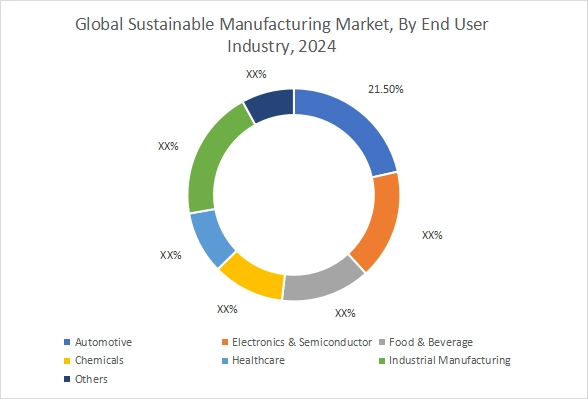
Automotive accounted for the largest revenue share of 21.50% in the year 2024.
- The automotive industry is increasingly working towards minimizing carbon emissions throughout the entire production and supply chain process.
- The industry is adopting energy-efficient production processes, sustainable material procurement, and closed-loop recycling processes to achieve environmental objectives.
- In addition, the increasing adoption of electric vehicle production is driving the need for sustainable battery production and resource optimization solutions.
- Furthermore, the automotive industry is adopting carbon footprint management and sustainable supply chain platforms to ensure alignment with global ESG norms.
- Furthermore, the implementation of circular economy practices such as remanufacturing and recycling is boosting the demand for sustainable manufacturing technologies.
- Thus, as per the sustainable manufacturing market analysis, the shift toward electric mobility and low-emission production is driving adoption in the automotive sector.
Electronics & semiconductor is anticipated to register the fastest CAGR during the forecast period.
- The electronics & semiconductor industry is adopting sustainable manufacturing practices to address high energy consumption and water usage in fabrication processes.
- Also, the rising demand for energy-efficient devices and environmentally responsible production is encouraging companies to implement green manufacturing strategies.
- Further, strict environmental regulations related to hazardous waste management and emissions are driving investments in sustainable technologies.
- Furthermore, increasing consumer and investor focus on sustainable sourcing of raw materials is accelerating adoption across semiconductor manufacturing facilities.
- Therefore, as per the market analysis, the growing need for energy efficiency and regulatory compliance is anticipated to boost adoption in the electronics & semiconductor sector during the forecast period.
Regional Analysis:
North America, Europe, Asia Pacific, the Middle East and Africa, and Latin America are the regions of coverage.
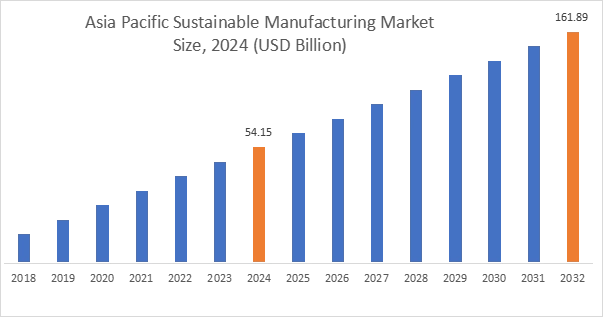
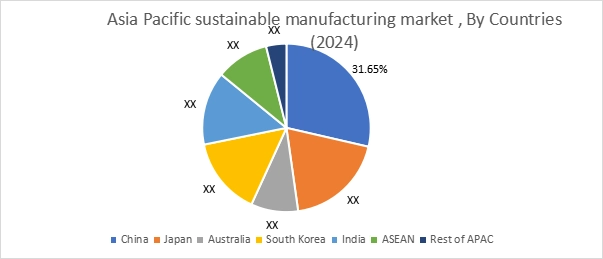
Asia Pacific region was valued at USD 54.15 billion in 2024. Moreover, it is projected to grow by USD 61.76 billion in 2025 and reach over USD 161.89 billion by 2032. Out of this, China accounted for the maximum revenue share of 31.65% in 2024 due to its strong industrial output and increasing investments in green production technologies. The market progress is mainly driven by rapid industrialization, expansion of renewable energy integration in manufacturing facilities, and increasing regulatory focus on carbon emission reduction. Furthermore, factors including rising investments in energy-efficient equipment, the adoption of smart factory technologies, and government-led sustainability mandates are projected to drive the market progress in the Asia Pacific region during the forecast period.
- For instance, according to the International Energy Agency (IEA), China currently dominates global solar PV manufacturing capacity and holds a significant share of global battery manufacturing capacity. In 2024, China accounted for over 80–90 % of new solar PV manufacturing capacity additions, indicating its strong manufacturing presence in clean technology components, and also maintained a large portion of global battery cell production capacity according to IEA data. This focus of manufacturing capacity on clean energy technologies is opening the way for sustainable manufacturing practices and energy-efficient industrial production in the Asia Pacific region.
North America is estimated to reach over USD 161.92 billion by 2032 from a value of USD 70.80 billion in 2024 and is projected to grow by USD 78.59 billion in 2025. The North American region’s increasing emphasis on decarbonization, efficiency, and circular economy principles provides highly favorable growth opportunities for the market. In addition, the swift adoption of clean energy technologies, automation, and ESG compliance frameworks in different industries is propelling the market forward.
- For example, under the Inflation Reduction Act (IRA) of the US, there are significant incentives for clean energy and sustainable manufacturing investments in the country, which is accelerating the development of low-carbon production facilities.
Europe is driven by the regions carbon reduction targets under the EU climate framework and mandatory industrial energy efficiency compliance. Adoption of circular production models and electrification of industrial processes is shaping manufacturing upgrades across Germany, France, and Italy.
Latin America is driven by the growing industrial modernization in this region, which is increasing the adoption of energy-efficient equipment and renewable-powered production systems. Foreign direct investment in automotive and electronics manufacturing is encouraging factories to align with international sustainability compliance standards.
Middle East & Africa is advancing economic diversification strategies through investment in renewable-powered industrial zones and green manufacturing clusters, particularly in Saudi Arabia and the UAE. Regional industrial reforms and ESG compliance requirements are influencing upgrades in manufacturing facilities. These factors are driving market growth in this region.
Top Key Players & Market Share Insights:
The global sustainable manufacturing market is quite competitive, with leading players in the industrial automation, software, and energy management sectors providing solutions to the global production chain. The key players are using a number of approaches in research and development, digital transformation, and partnerships to ensure that they continue to be a dominant force in the sustainable manufacturing industry. The players are focusing on industrial AI, smart factories, energy-efficient solutions, circular production, and resource optimization solutions to ensure that they have a competitive advantage and are able to support low-carbon industrial production. The key players operating in the sustainable manufacturing market are:
- Siemens AG– Germany
- Schneider Electric SE– France
- ABB Ltd.– Switzerland
- Honeywell International Inc. – US
- Rockwell Automation Inc. – US
- General Electric Company – US
- Emerson Electric Co. – US
- Dassault Systèmes SE – France
- SAP SE – Germany
- Johnson Controls International plc – Ireland
Recent Industry Developments:
Funding
- In October 2025, WinCup, Inc. further strengthened its sustainable manufacturing capabilities by acquiring ConverPack Inc., which has made significant progress in the company’s ability to manufacture eco-friendly, paper-based products. This acquisition is a step in the right direction for WinCup, Inc., as it will enable the company to support circular manufacturing and cater to the increasing demand for sustainable disposable products.
- In July 2025, Siemens has signed a memorandum of understanding with A*STAR to drive innovation in smart and sustainable manufacturing in the ASEAN region. This will enable the adoption of sustainable manufacturing practices by manufacturers in the region.
Sustainable Manufacturing Market Report Insights:
| Report Attributes | Report Details |
|---|---|
| Study Timeline | 2019-2032 |
| Market Size in 2032 (USD Billion) | USD 501.07 Billion |
| CAGR (2025-2032) | 11.60% |
| By Component |
|
| By Technology |
|
| By Organization Size |
|
| By End User Industry |
|
| By Region |
|
| Key Players |
|
| Report Coverage |
|
Key Questions Answered in the Report
How big is the sustainable manufacturing market? −
The sustainable manufacturing marketsize is estimated to reach over USD 501.07 Billion by 2032 from a value of USD 208.25 Billion in 2024 and is projected to grow by USD 232.41 Billion in 2025, growing at a CAGR of 11.60% from 2025 to 2032.
Which segmentation details are covered in the sustainable manufacturing report? +
The sustainable manufacturing report includes specific segmentation details for component, technology, organization size, end user industry, and regions.
Which is the fastest segment anticipated to impact the market growth? +
In the sustainable manufacturing market, the AI & predictive analytics segment is anticipated to be the fastest-growing segment during the forecast period due to rising industrial focus on data-driven efficiency and emissions optimization.
Who are the major players in the sustainable manufacturing market? +
The key participants in the sustainable manufacturing marketare Siemens AG (Germany), Schneider Electric SE (France), ABB Ltd. (Switzerland), Honeywell International Inc. (US), Rockwell Automation Inc. (US), General Electric Company (US), Emerson Electric Co. (US), Dassault Systèmes SE (France), SAP SE (Germany), Johnson Controls International plc (Ireland), and others.
What are the key trends in the sustainable manufacturing market? +
The sustainable manufacturing market is being shaped by several key trends including increasing adoption of smart energy monitoring solutions, integration of digital technologies for carbon tracking, and the rising demand for circular economy practices.
Overview
Reputation & Certifications


Our Services
- Market Intelligence & Forecasting
- Custom Research Solutions
- Market Entry Strategy
- Competitive Intelligence
- Customer Insights
- Industry Innovation Analysis
- Investment Advisory