Jump to Content
Next Generation Biometrics Market - Size, Share, Industry Trends, and Forecasts (2024 - 2031)
Next Generation Biometrics Market Size:
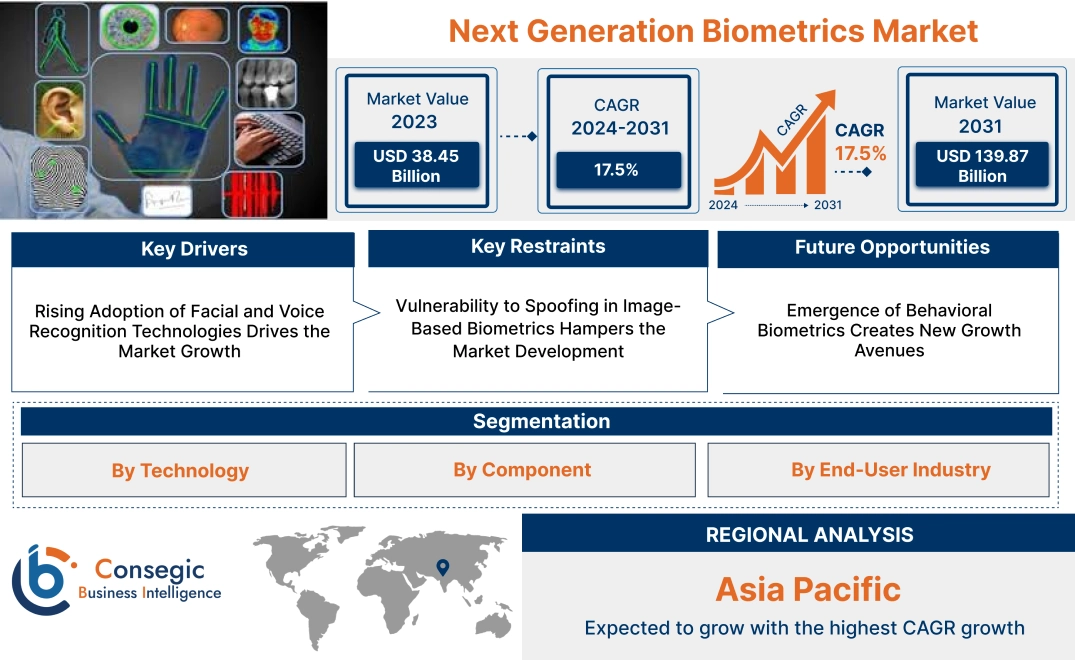
Next Generation Biometrics Market size is estimated to reach over USD 139.87 Billion by 2031 from a value of USD 38.45 Billion in 2023 and is projected to grow by USD 44.50 Billion in 2024, growing at a CAGR of 17.5% from 2024 to 2031.
Next Generation Biometrics Market Scope & Overview:
Next generation biometrics refers to advanced identification and authentication systems that utilize unique biological and behavioral characteristics such as fingerprints, facial recognition, iris scans, and voice patterns to verify an individual’s identity. These systems leverage cutting-edge technologies, including artificial intelligence and machine learning, to enhance accuracy, security, and efficiency in identity verification processes. They are widely deployed across various sectors, including banking, healthcare, government, and transportation.
These biometric solutions are designed to handle high volumes of data and integrate seamlessly with existing security systems, offering scalability and adaptability for diverse applications. They also provide multi-factor authentication capabilities, combining biometric data with other security measures to strengthen access control and prevent unauthorized access. Modern biometric systems are compact, user-friendly, and engineered for reliable performance under different environmental conditions.
End-users of next generation biometrics include enterprises, government agencies, and service providers that require robust identity verification solutions to enhance security, streamline operations, and ensure compliance with regulatory standards. These systems play a pivotal role in safeguarding sensitive information and facilitating secure and efficient identity management.
Next Generation Biometrics Market Dynamics - (DRO) :
Key Drivers:
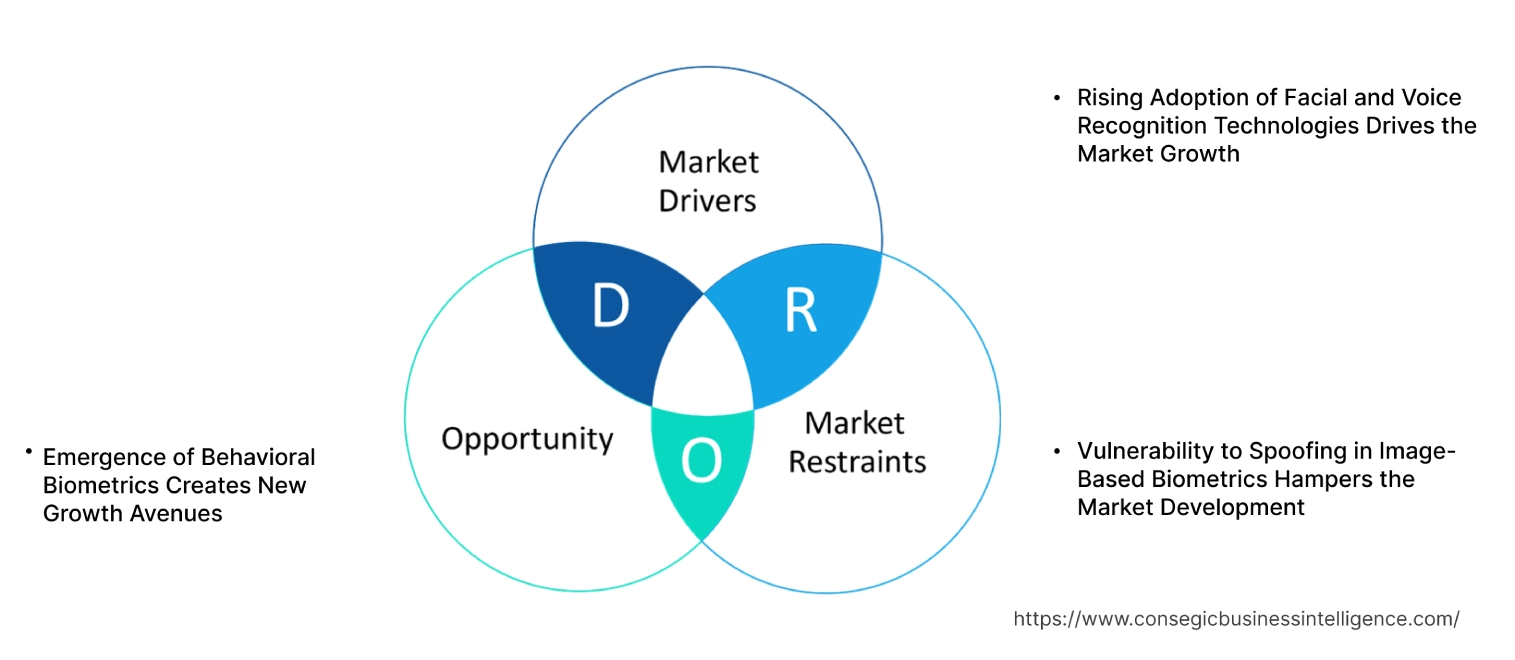
Rising Adoption of Facial and Voice Recognition Technologies Drives the Market Growth
The increasing deployment of facial and voice recognition technologies across industries is a significant driver for the next-generation biometrics market. Facial recognition systems are being widely adopted for security applications, including surveillance, access control, and identity verification, due to their ability to provide contactless and efficient authentication. Voice recognition technology is gaining traction in sectors like banking, retail, and consumer electronics, enabling secure voice-activated transactions and user authentication. These technologies are particularly valued for their convenience, high accuracy, and non-invasive nature, driving demand in smart devices, virtual assistants, and customer service applications. As industries prioritize seamless and secure authentication solutions, the growth of facial and voice recognition technologies is accelerating, supported by advancements in AI and machine learning algorithms. Thus, the aforementioned factors proliferate the next generation biometrics market growth.
Key Restraints :
Vulnerability to Spoofing in Image-Based Biometrics Hampers the Market Development
Image-based biometric systems, including facial recognition and iris scanning technologies, face significant issues due to their susceptibility to spoofing attacks. Malicious actors exploit these systems by using high-resolution images, videos, or synthetic replicas to mimic genuine credentials, undermining their reliability and security. Even with the integration of AI-driven countermeasures, vulnerabilities persist, particularly in high-stakes environments requiring robust authentication. Studies and controlled experiments have revealed that advanced iris recognition systems are deceived by carefully crafted patterns, highlighting critical weaknesses in these technologies. This raises concerns over their effectiveness in applications where trust and accuracy are vital, such as banking, national security, and high-level corporate access. These limitations not only reduce the appeal of image-based biometrics for sensitive use cases but also emphasize the need for continuous innovation to address spoofing risks and build confidence in their deployment. Therefore, the above-mentioned factors are hindering the next generation biometrics market demand.
Future Opportunities :
Emergence of Behavioral Biometrics Creates New Growth Avenues
Behavioral biometrics, focusing on unique user behavior patterns such as typing rhythm, mouse movements, and gait, are revolutionizing the field of authentication. Unlike traditional static biometrics, behavioral systems offer continuous verification, monitoring user behavior throughout a session to detect anomalies. This dynamic approach enhances security, making it particularly valuable for high-risk applications such as online banking, e-commerce, and enterprise cybersecurity. By analyzing real-time data and using advanced machine learning algorithms, these systems detect fraudulent activities more effectively, even if a user’s physical credentials are compromised. Behavioral biometrics also integrate seamlessly with existing multi-factor authentication solutions, providing an additional layer of protection. With growing threats in the digital landscape and increasing regulatory emphasis on secure financial transactions, behavioral biometrics are gaining traction as a critical tool for enhancing security and improving user trust across various industries, creating significant next generation biometrics market opportunities.
Next Generation Biometrics Market Segmental Analysis :
By Technology:
Based on technology, the market is segmented into fingerprint recognition, face recognition, iris recognition, voice recognition, palm recognition, signature recognition, and others.
The fingerprint recognition segment accounted for the largest revenue of the total next generation biometrics market share in 2023.
- Fingerprint recognition is widely used for secure access control and authentication due to its high accuracy and ease of integration into consumer devices such as smartphones and laptops.
- The adoption of fingerprint recognition technology is driven by its compatibility with biometric payment systems, offering secure and seamless transactions across BFSI and retail sectors.
- Its application in time and attendance systems across industries has enhanced workforce management, reducing fraud and errors in tracking employee hours.
- The segment’s dominance reflects its reliability, affordability, and growing use in personal identification systems worldwide, fueling the next generation biometrics market expansion.
The face recognition segment is expected to grow at the fastest CAGR during the forecast period.
- Face recognition technology is gaining traction in surveillance and security applications due to its contactless and non-intrusive nature.
- Government agencies leverage face recognition for border control and identity verification, ensuring enhanced security and operational efficiency.
- The integration of face recognition with AI-powered systems has enabled real-time monitoring and detection in crowded public spaces and critical infrastructures.
- As per the analysis of segmental trends, the growth of this segment is supported by advancements in AI and machine learning algorithms, improving accuracy and reducing false positives, contributing to the next generation biometrics market growth.
By Component:
Based on components, the market is segmented into hardware and software.
The hardware segment accounted for the largest revenue of the total next generation biometrics market share in 2023.
- Hardware components such as sensors, cameras, and scanners are critical for capturing biometric data accurately and ensuring high performance in identification systems.
- Sensors are extensively used across biometric devices, including fingerprint scanners and iris recognition systems, enhancing the precision of authentication processes.
- Cameras and advanced imaging technologies drive the adoption of face and palm recognition solutions in high-security environments like airports and government facilities.
- As per the next generation biometrics market analysis, the dominance of the hardware segment reflects its essential role in establishing a robust biometric infrastructure for various applications.
The software segment is expected to grow at the fastest CAGR during the forecast period.
- Biometric software solutions, including AI algorithms and matching engines, enable seamless data processing and real-time authentication.
- AI-powered software ensures higher accuracy in complex biometric systems, enhancing their reliability in BFSI and healthcare sectors.
- The increasing adoption of cloud-based biometric solutions supports scalability and remote access, making software a critical component in next-generation systems.
- As per the next generation biometrics market trends, the segment’s rapid extension is driven by the demand for advanced analytics and machine learning capabilities to handle vast biometric datasets.
By End-User:
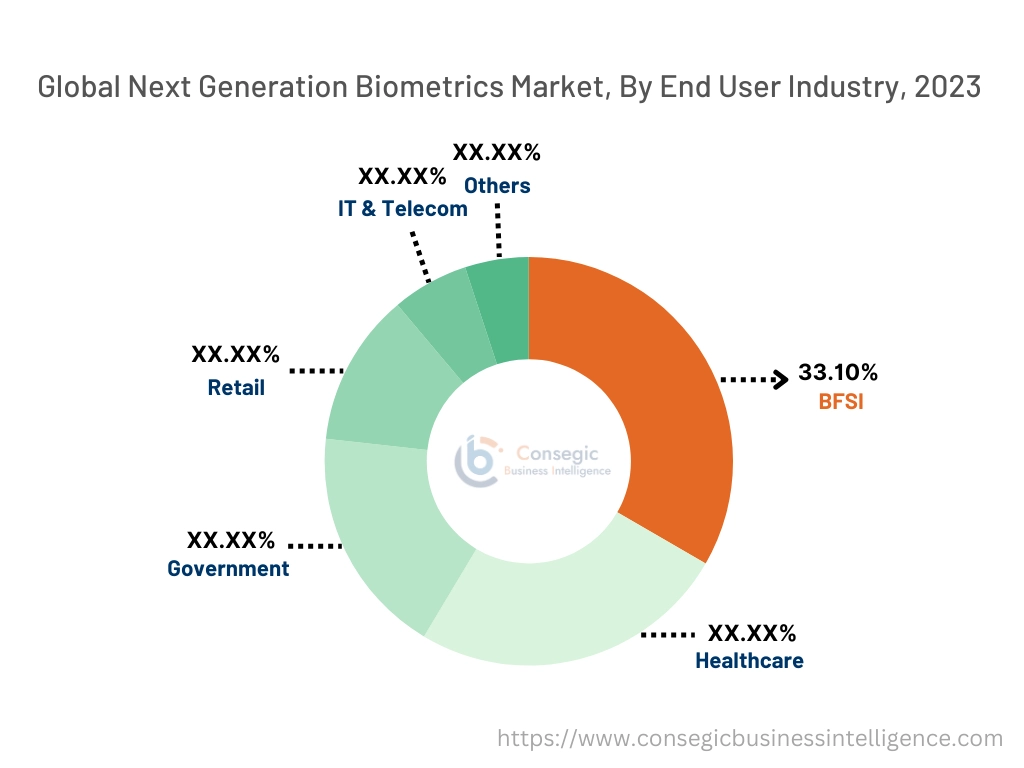
Based on the end-user industry, the market is segmented into BFSI, healthcare, government, retail, IT & telecom, and others.
The BFSI segment accounted for the largest revenue share of 33.10% in 2023.
- Biometric technologies are widely adopted in the BFSI sector for secure customer onboarding, fraud prevention, and digital payment authentication.
- Banks and financial institutions utilize multi-factor authentication, combining fingerprint or facial recognition with PINs, to enhance transaction security.
- The deployment of biometric ATMs ensures secure and seamless cash withdrawal processes, reducing the risk of unauthorized access.
- The analysis of segmental trends depicts that the dominance of the BFSI segment is attributed to the sector’s increasing reliance on advanced security solutions to address rising cyber threats, which boosts the next generation biometrics market demand.
The healthcare segment is expected to grow at the fastest CAGR during the forecast period.
- Biometric systems in healthcare enable secure access to electronic health records (EHR), ensuring patient data confidentiality and compliance with regulations.
- Hospitals and clinics use biometric time-tracking systems for efficient workforce management and reducing administrative errors.
- Iris and fingerprint recognition technologies enhance security in restricted areas, such as operating rooms and pharmaceutical storage units.
- As per the next generation biometrics market analysis, the growth of this segment is supported by the increasing adoption of biometric systems for patient identification and secure medical billing processes.
Regional Analysis:
The regions covered are North America, Europe, Asia Pacific, the Middle East and Africa, and Latin America.
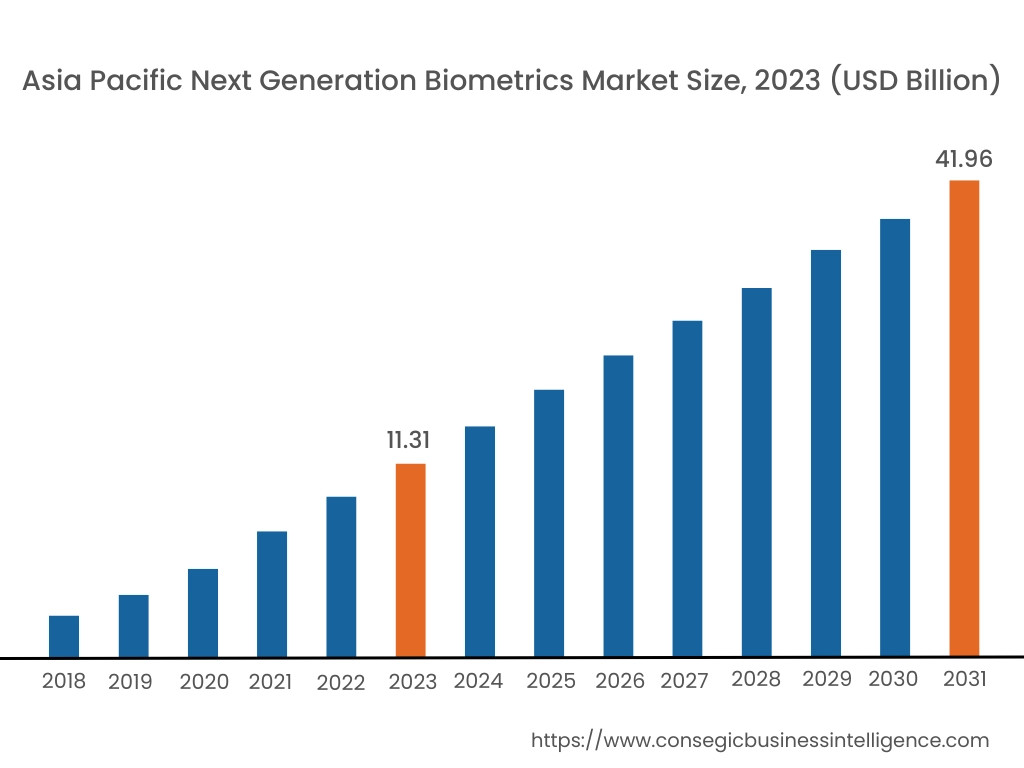
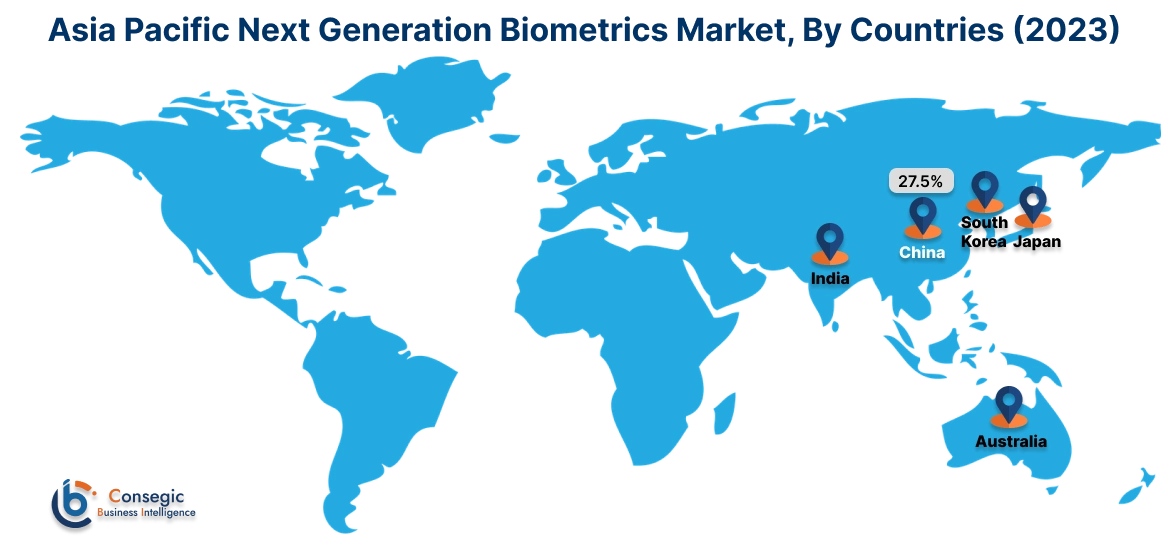
Asia Pacific region was valued at USD 11.31 Billion in 2023. Moreover, it is projected to grow by USD 13.11 Billion in 2024 and reach over USD 41.96 Billion by 2031. Out of these, China accounted for the largest share of 27.5% in 2023. The Asia-Pacific region is experiencing rapid growth in the next generation biometrics market, driven by industrialization and technological advancements in countries such as China, Japan, and India. The proliferation of smartphones and the enlargement of the e-commerce sector have intensified the demand for secure and efficient authentication methods. Government initiatives promoting digital identity programs further influence the next generation biometrics market opportunities.
North America is estimated to reach over USD 46.02 Billion by 2031 from a value of USD 12.78 Billion in 2023 and is projected to grow by USD 14.78 Billion in 2024. This region holds a substantial share of the next generation biometrics market, driven by the rapid adoption of advanced technologies and the presence of key industry players. The United States, in particular, has seen widespread implementation of biometric systems across sectors such as government, healthcare, and finance. A notable trend is the integration of biometrics with artificial intelligence to enhance security measures and user authentication processes is driving the next generation biometrics market expansion.
Europe represents a significant portion of the global next generation biometrics market, with countries like Germany, France, and the United Kingdom leading in adoption and innovation. The region's strong emphasis on data protection and privacy has propelled the utilization of biometric solutions, particularly in the banking and financial services sector. Analysis indicates a growing trend towards the deployment of multimodal biometric systems to enhance accuracy and security.
The Middle East & Africa region shows a growing interest in next generation biometrics solutions, particularly in the government and banking sectors. Countries like the United Arab Emirates and South Africa are investing in advanced biometric technologies to enhance security and streamline identification processes. Analysis suggests an increasing trend towards adopting biometric systems for border control and national identification programs.
Latin America is an emerging market for next generation biometrics, with Brazil and Mexico being key contributors. As per the next generation biometrics market trends, the region's growing focus on enhancing security measures and combating fraud has spurred the adoption of biometric solutions. Government policies aimed at modernizing identification systems and improving public safety influence market trends.
Top Key Players and Market Share Insights:
The next generation biometrics market is highly competitive with major players providing products and services to the national and international markets. Key players are adopting several strategies in research and development (R&D), product innovation, and end-user launches to hold a strong position in the global next generation biometrics market. Key players in the next generation biometrics industry include –
- Thales Group (France)
- NEC Corporation (Japan)
- Suprema Inc. (South Korea)
- RCG Holdings Limited (Hong Kong)
- Fujitsu Ltd (Japan)
- Siemens AG (Germany)
- IDEMIA (France)
- Fingerprint Cards AB (Sweden)
Recent Industry Developments :
Partnerships & Collaborations:
- In November 2024, authID Inc., a provider of biometric identity verification solutions, secured a $10 Billion, three-year agreement with a next-generation AI company to deliver advanced authentication services across various industries in India. This partnership aims to enhance security and user experience in sectors such as banking, financial services, emergency services, and transportation.
Product Launches:
- In October 2024, Fingerprint Cards AB (Fingerprints™) unveiled its 4th generation iris recognition platform, combining affordability and advanced Zero Trust security. With "just glance" functionality, it supports long-distance and large field-of-view operation on low-cost hardware, ensuring one-in-a-billion accuracy. The solution works seamlessly with masks, glasses, and beards, distinguishes twins, and protects against deepfakes. Ideal for access control, PCs, and POS systems, it delivers swift enrollment and authentication with enhanced AI-driven user convenience.
- In September 2024, Suprema introduced BioEntry W3, an AI-driven facial authentication device prioritizing data privacy and durability. With its display-free design and Template on Mobile (ToM) method, users securely store biometric data on personal devices. Featuring real-time edge processing, encrypted Secure Element (SE) chip protection, and compliance with GDPR and NIS2, it ensures high-speed authentication in 0.2 seconds. Its IK08 and IP67 certifications make it resilient for outdoor, high-security environments.
- In August 2024, Fingerprint Cards AB (Fingerprints) launched FPC AllKey, a comprehensive biometric system for logical and physical access control. Designed for seamless integration, it supports devices like smart locks, cryptocurrency wallets, and FIDO tokens. FPC AllKey eliminates the need for PINs and passwords, offering robust, user-friendly authentication. With all-in-one hardware, software, and algorithms, the system ensures top-tier security, ultra-low power consumption, and smooth performance without compromising host system efficiency.
- In February 2024, Suprema introduced Template on Mobile (ToM), an innovative biometric access solution enabling users to securely store facial authentication data on smartphones. ToM eliminates the need for physical keys or RFID cards, ensuring GDPR compliance, cost savings, and environmental benefits by reducing plastic use. It simplifies management for administrators, requiring no server expansion, and supports ESG goals.
Next Generation Biometrics Market Report Insights :
| Report Attributes | Report Details |
| Study Timeline | 2018-2031 |
| Market Size in 2031 | USD 139.87 Billion |
| CAGR (2024-2031) | 17.5% |
| By Technology |
|
| By Component |
|
| By End-User Industry |
|
| By Region |
|
| Key Players |
|
| North America | U.S. Canada Mexico |
| Europe | U.K. Germany France Spain Italy Russia Benelux Rest of Europe |
| APAC | China South Korea Japan India Australia ASEAN Rest of Asia-Pacific |
| Middle East and Africa | GCC Turkey South Africa Rest of MEA |
| LATAM | Brazil Argentina Chile Rest of LATAM |
| Report Coverage |
|
Key Questions Answered in the Report
How big is the Next Generation Biometrics Market? −
Next Generation Biometrics Market size is estimated to reach over USD 139.87 Billion by 2031 from a value of USD 38.45 Billion in 2023 and is projected to grow by USD 44.50 Billion in 2024, growing at a CAGR of 17.5% from 2024 to 2031.
What specific segmentation details are covered in the Next Generation Biometrics Market report? +
The market is segmented based on technology (fingerprint recognition, face recognition, iris recognition, voice recognition, palm recognition, signature recognition, and others), components (hardware including sensors, cameras, scanners, and software including data analytics, AI algorithms, and matching engines), and end-user industry (BFSI, healthcare, government, retail, IT & telecom, and others).
Which is the fastest-growing segment in the Next Generation Biometrics Market? +
The face recognition segment is expected to grow at the fastest CAGR during the forecast period, driven by its increasing adoption in surveillance and security applications, particularly due to advancements in AI and machine learning algorithms improving accuracy and reducing false positives.
Who are the major players in the Next Generation Biometrics Market? +
The major players in the Next Generation Biometrics Market include Thales Group (France), NEC Corporation (Japan), Fujitsu Ltd (Japan), Siemens AG (Germany), IDEMIA (France), Fingerprint Cards AB (Sweden), Suprema Inc. (South Korea), and RCG Holdings Limited (Hong Kong).
Overview
Reputation & Certifications


Our Services
- Market Intelligence & Forecasting
- Custom Research Solutions
- Market Entry Strategy
- Competitive Intelligence
- Customer Insights
- Industry Innovation Analysis
- Investment Advisory