Jump to Content
Telehealth Market- Size, Share, Industry Trends, and Forecasts (2025 - 2032)
Telehealth Market Size:
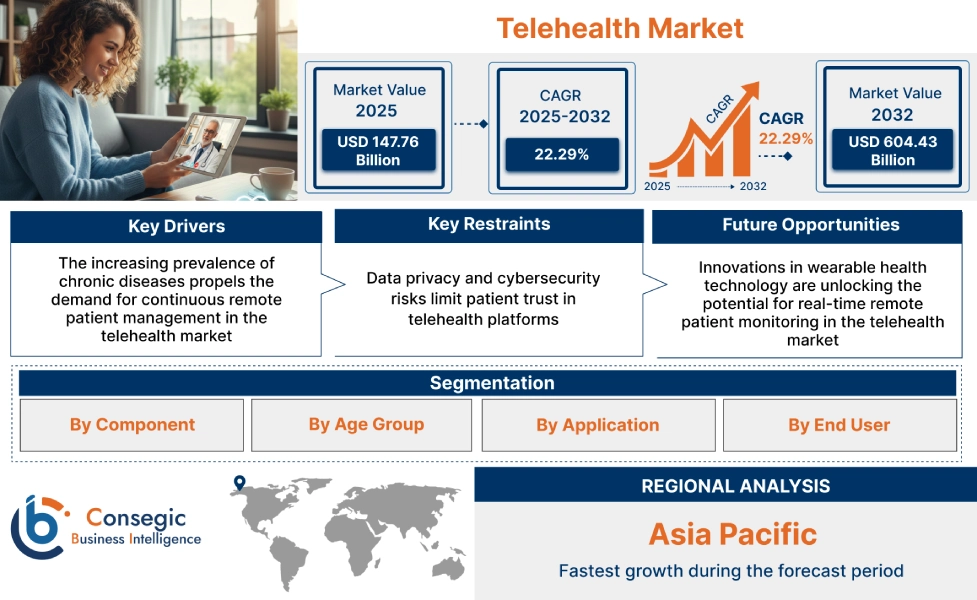
Telehealth Market size is estimated to reach over USD 604.43 Billion by 2032 from a value of USD 121.66 Billion in 2024 and is projected to grow by USD 147.76 Billion in 2025, growing at a CAGR of 22.29% from 2025 to 2032
Telehealth Market Scope & Overview:
Telehealth refers to a healthcare delivery system that offers clinical and non-clinical services using digital communication technology to ensure remote access to medical care and health management. The telehealth system works by facilitating remote consultations, patient monitoring, the integration of electronic health records, and the secure transfer of health information between healthcare providers and patients. The telehealth system integrates software solutions, medical devices that are connected, and communication technology that enables real-time consultations, data transfer, and continuous patient monitoring in hospitals, clinics, home care, and rural healthcare facilities.
Additionally, the key factors that contribute to the growth of the telehealth market include the rising demand for remote healthcare delivery, the increasing prevalence of chronic diseases, and the adoption of digital health solutions. Additionally, telehealth solutions provide several benefits, including fewer hospital visits, enhanced patient engagement, timely medical care, and the efficient use of healthcare resources. The telehealth market is witnessing steady expansion due to these structural healthcare and technology shifts.
How is the Telehealth Market Affected by AI?
AI applies machine learning algorithms and predictive analytics to process clinical data with greater accuracy and efficiency, thereby improving diagnosis support and patient risk assessment in telehealth platforms. AI-based systems analyze past health data, real-time health monitoring data, and patient-submitted data, which allows for personalized treatment plans and timely clinical interventions. Moreover, AI facilitates virtual triage, symptom analysis, and automated scheduling, which optimizes care coordination and reduces administrative burden for healthcare professionals.
Further, AI enables continuous remote patient monitoring by identifying abnormal health patterns and generating early alerts for potential complications, which strengthens preventive care management. It also facilitates natural language processing in virtual care to document conversations and offer key insights. This paradigm shift in intelligent and data-driven care delivery enhances clinical decision-making, efficiency, and scalability of digital healthcare services, thereby adding to the telehealth market growth.
Telehealth Market Dynamics - (DRO):
Key Drivers:
The increasing prevalence of chronic diseases propels the demand for continuous remote patient management in the telehealth market
The increasing prevalence of chronic diseases such as diabetes, cardiovascular diseases, and respiratory diseases is driving the demand for continuous patient monitoring and management. Healthcare professionals are increasingly using telehealth services to monitor patients’ health parameters and offer immediate medical care. In addition, remote consultation models support follow-up care and reduce frequent hospital visits, which improves treatment adherence. The telehealth market is expanding due to the increasing requirement for structured remote disease management solutions.
- World Health Organization latest estimates show that chronic diseases including cardiovascular disorders, cancer, diabetes, and respiratory conditions are projected to account for 86% of the estimated 90 million annual deaths worldwide by 2050.
Therefore, the telehealth market is experiencing growth due to the rising prevalence of chronic diseases and the demand for continuous remote patient monitoring.
Key Restraints:
Data privacy and cybersecurity risks limit patient trust in telehealth platforms
Issues pertaining to the security and privacy of patients’ data are influencing the adoption of telehealth solutions in the healthcare sector. Telehealth platforms handle sensitive medical information, which increases exposure to cyber threats and data breaches. In addition, regulatory compliance requirements for data protection are increasing operational complexity for service providers. These issues are slowing down the adoption of telehealth solutions for patient enrollment.
Thus, the telehealth market is thus being hindered by the risks of data privacy and cybersecurity breaches associated with telehealth solutions.
Future Opportunities:
Innovations in wearable health technology are unlocking the potential for real-time remote patient monitoring in the telehealth market
The increasing adoption of wearable health technology is unlocking new opportunities for real-time patient monitoring through telehealth services. Wearable health technology enables the continuous monitoring of patient health information such as heart rate, blood glucose, and activity levels. This enables proactive patient care. The convergence of wearable health technology and telehealth services enhances remote patient diagnosis and treatment.
- For example, in October 2023, the UK government has launched a fund of USD 40 million to support the NHS Integrated Care Systems in adopting innovative solutions such as virtual wards, wearable health technology, and advanced diagnostic solutions to reduce waiting times and improve patient outcomes.
Hence, the growth in wearable health devices is expected to create new remote monitoring opportunities for the telehealth market during the forecast period.
Telehealth Market Segmental Analysis:
By Component:
On the basis of component, the telehealth market is segmented into hardware, software, and services.
Trends in the Component:
- The increasing demand for integrated digital care platforms is accelerating investment in telehealth software solutions.
- The expansion of remote patient monitoring programs is supporting demand for connected medical hardware devices.
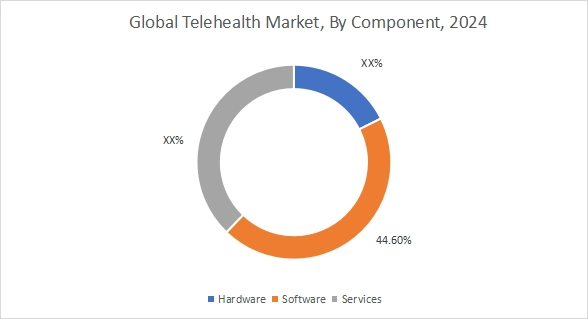
The software component was responsible for the highest revenue share of 44.60% in 2024.
- Software platforms are the operational core of telehealth systems and help in conducting virtual consultations, managing patient data, and integrating clinical workflows.
- Moreover, the increasing demand for secure video consultations and integration of electronic health records is driving the market.
- In addition, healthcare providers are using centralized telehealth solutions to efficiently handle a large number of patients.
- Furthermore, the adoption of AI-enabled triage and analytics modules is strengthening software utilization across care settings.
- For instance, in September 2024, Cigna Healthcare has launched a new E-Treatment service called MDLIVE, which allows eligible customers in the US to receive virtual diagnosis and treatment plans within one hour without a live phone or video consultation.
- Therefore, the dominance of the software segment is driven by the increasing reliance on digital infrastructure for remote healthcare delivery.
It is anticipated that the services component will exhibit the highest compound annual growth rate (CAGR) during the forecast period.
- Services include implementation, training, technical support, and system integration across healthcare networks.
- Moreover, the healthcare institutions must be supported in order to ensure that they are in compliance with the regulations and their data is protected.
- Additionally, the rise in telehealth services in the hospital systems is increasing the demand for managed services
- Furthermore, the providers are looking for customized deployment models to fit their IT infrastructure.
- Hence, the growing complexity of digital health ecosystems is accelerating the growth of the services segment.
By Age Group:
On the basis of age group, the market is divided into pediatrics, adults, and geriatrics.
Trends in the Age Group:
- The rise in the prevalence of chronic diseases within the adult population is fueling the demand for telehealth services.
- The aging population is driving the adoption of remote monitoring services among the geriatric population.
Adults represented the highest revenue share in 2024.
- Adults represent the largest patient pool utilizing telehealth for primary consultations and follow-up care.
- Moreover, working populations prefer remote healthcare services to reduce time constraints and travel requirements.
- In addition, rising awareness of preventive healthcare is encouraging virtual health assessments among adults.
- Furthermore, employers are incorporating telehealth services into corporate health programs.
- Therefore, the dominance of the adults segment is attributed to higher utilization rates across general healthcare needs.
Geriatrics is anticipated to exhibit the most rapid compound annual growth rate (CAGR) throughout the forecast period.
- The elderly population requires constant health monitoring and frequent consultations with healthcare professionals.
- Moreover, telehealth assists in the reduction of hospital readmissions and home-based care.
- Additionally, remote monitoring devices help in tracking vital health parameters of elderly patients in real-time.
- Furthermore, the healthcare industry is shifting towards cost-effective models of elderly care management.
- Hence, demographic shifts toward aging populations are accelerating the growth of the geriatrics segment.
By Application:
On the basis of application, the market is divided into primary care, specialty care, TeleICU, virtual sitting and nursing, and other applications.
Trends in the Application:
- Increasing demand for remote consultations is supporting telehealth adoption in primary care settings.
- Hospitals are integrating digital monitoring systems to strengthen critical care management through TeleICU.
Primary care represented the highest revenue share in 2024.
- Primary care consultations account for a substantial share of routine healthcare interactions.
- Also, telehealth platforms enable initial diagnosis, prescription management, and follow-up services.
- Moreover, the healthcare organizations are moving non-emergency visits to virtual platforms to optimize resource utilization.
- Furthermore, online appointment scheduling and e-prescription systems are used for effective patient management.
- Thus, the primary care segment occupies the leading position because of its large patient base and high consultation volumes.
TeleICU is expected to demonstrate the fastest compound annual growth rate (CAGR) during the forecast period.
- TeleICU solutions enable the remote monitoring of critically ill patients in various facilities.
- Moreover, hospitals are deploying centralized monitoring hubs to address specialist shortages.
- Additionally, continuous real-time data transmission improves clinical response times in intensive care units.
- Furthermore, health systems are focusing on improving ICU utilization efficiency.
- Hence, the increasing need for centralized critical care management is accelerating TeleICU adoption.
By End User:
On the basis of end user, the telehealth market is divided into healthcare providers, healthcare payers, patients.
Trends in the End User:
- Hospitals and clinics are integrating telehealth into routine care delivery models.
- Insurance companies are expanding coverage policies to include virtual consultations.
Healthcare providers accounted for the largest revenue share in the year 2024.
- Healthcare providers are the main adopters of telehealth solutions for patient consultation and monitoring.
- Moreover, hospitals are using telehealth to expand their reach of services beyond the boundaries of their physical infrastructure.
- Additionally, telehealth platforms are efficient for patient triage and workflow management.
- Furthermore, telehealth solutions are also helpful in clinical documentation and compliance management.
- Thus, the healthcare providers segment is the dominant one due to direct service delivery responsibilities.
Healthcare payers is anticipated to register the fastest CAGR during the forecast period.
- Payers are incorporating telehealth services into reimbursement frameworks to manage claim costs.
- Moreover, virtual consultations reduce inpatient admissions and emergency visits.
- In addition, insurance providers are investing in digital health partnerships to enhance member engagement.
- Furthermore, data analytics from telehealth platforms supports risk assessment and policy structuring.
- Hence, the focus on cost optimization and preventive care strategies is supporting growth of the healthcare payers segment.
Regional Analysis:
North America, Europe, Asia Pacific, the Middle East and Africa, and Latin America are the regions of coverage.
North America region held largest market share in 2024. Furthermore, it is expected to increase by USD 54.21 billion in 2025 and exceed USD 199.56 billion by 2032. Market growth is driven by established digital health infrastructure and favorable reimbursement coverage for virtual consultations. In addition, the robust integration of telehealth solutions within the hospital infrastructure is also propelling regional dominance. Canada and Mexico are expected to drive the demand in the region during the forecast period.
- For example, in June 2025, the Centers for Medicare & Medicaid Services (CMS) is encouraging the development of the national digital health infrastructure, including enhancements to Medicare.gov and Blue Button 2.0, to enhance the security of data transfer for Medicare and Medicaid beneficiaries.
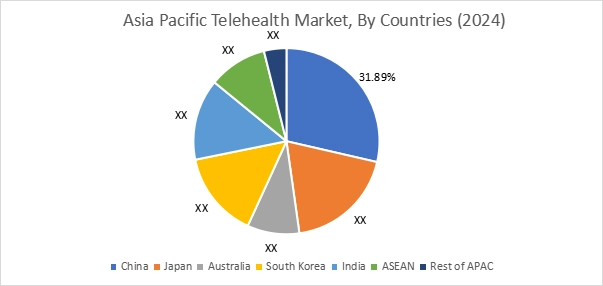
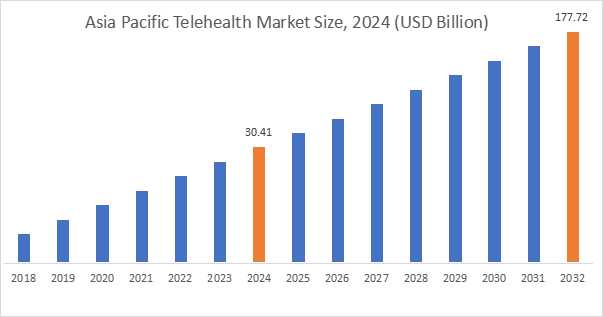
Asia Pacific is expected to exceed USD 177.72 billion by 2032, up from USD 30.41 billion in 2024, and to increase by USD 37.45 billion in 2025. Out of this, China accounted for the maximum revenue share of 31.89%. The regional market is expanding due to the rising smartphone penetration and internet connectivity in the urban and semi-urban areas. The government efforts to offer digital access to healthcare are also contributing to the adoption of telehealth solutions in the public healthcare infrastructure.
- In July 2024, according to the Mobile Economy APAC 2024 Report by GSMA and Singtel, the number of mobile internet users in the APAC region is projected to increase from 1.4 billion with a penetration rate of 51% to 1.8 billion with a penetration rate of 61% in 2030.
In Europe, telehealth adoption is shaped by aging demographics, cross-border digital health frameworks, and reimbursement integration within public healthcare systems. Hospitals and primary care networks are incorporating virtual consultations and remote patient monitoring into standard care pathways.
In Latin America, telehealth demand is emerging from healthcare access gaps and uneven provider distribution in the region. Governments and public hospitals are using virtual consultation platforms to extend primary and specialist care to remote communities.
The Middle East & Africa telehealth market is fueled by national digital health transformation programs and hospital modernization efforts in the UAE, Saudi Arabia, and South Africa. Healthcare authorities are integrating virtual care systems to manage chronic disease cases and reduce in-person hospital visits.
Top Key Players & Market Share Insights:
The telehealth market is moderately competitive in nature, with key technology companies and healthcare organizations providing end-to-end telehealth solutions. In addition, the key players in the telehealth market are using strategies such as development of telehealth platforms, partnerships, service offerings, and acquisitions to enhance their market position in the telehealth market. Key participants in the market for telehealth include:
- Teladoc Health, Inc.– US
- Amwell– US
- me Inc– US
- Included Health, Inc. (Doctor On Demand) – US
- MDLive – US
- HealthTap, Inc. – US
- Ping An Health – China
- Practo Technologies Pvt. Ltd. – India
- Koninklijke Philips N.V. – Netherlands
- GlobalMed – US
Recent Industry Developments:
Funding
- In January 2026, Teladoc Health has introduced an upgraded 24/7 care service to improve continuous virtual access to integrated and comprehensive healthcare support.
- In December 2025, Included Health has expanded its platform to provide an AI-driven clinician-in-the-loop experience that enhances coordinated and personalized virtual care delivery.
- In April 2025, DocNow has launched an integrated telehealth platform designed to simplify and optimize virtual care delivery for post-acute care providers.
Telehealth Market Report Insights:
| Report Attributes | Report Details |
|---|---|
| Study Timeline | 2019-2032 |
| Market Size in 2032 (USD Trillion) | USD 604.43 Billion |
| CAGR (2025-2032) | 22.29% |
| By Component |
|
| By Age Group |
|
| By Application |
|
| By End User |
|
| By Region |
|
| Key Players |
|
| Report Coverage |
|
Key Questions Answered in the Report
How big is the telehealth market? −
The telehealth market sizeis estimated to reach over USD 604.43 Billion by 2032 from a value of USD 121.66 Billion in 2024 and is projected to grow by USD 147.76 Billion in 2025, growing at a CAGR of 22.29% from 2025 to 2032.
Which segmentation details are covered in the telehealth report? +
The telehealth report includes specific segmentation details for component, age group, application, end user, and region.
Which is the fastest segment anticipated to impact the market growth? +
In the telehealth market, the TeleICU segment is projected to register the fastest growth during the forecast period, driven by rising demand for centralized critical care monitoring and specialist access across multi-location hospitals.
Who are the major players in the telehealth market? +
The key participants in the telehealth marketare Teladoc Health, Inc. (US), Amwell (US), Doxy.me Inc (US), Included Health, Inc. (US), MDLive (US), HealthTap, Inc. (US), Ping An Health (China), Practo Technologies Pvt. Ltd. (India), Koninklijke Philips N.V. (Netherlands), GlobalMed (US), and others.
What are the key trends in the telehealth market? +
The telehealth market is shaped by key trends including expansion of remote patient monitoring programs, integration of AI in virtual consultations, and growing adoption of wearable health devices for continuous care management.
Overview
Reputation & Certifications


Our Services
- Market Intelligence & Forecasting
- Custom Research Solutions
- Market Entry Strategy
- Competitive Intelligence
- Customer Insights
- Industry Innovation Analysis
- Investment Advisory