Jump to Content
Spatial Computing Market - Size, Share, Industry Trends, and Forecasts (2025 - 2032)
Spatial Computing Market Size:
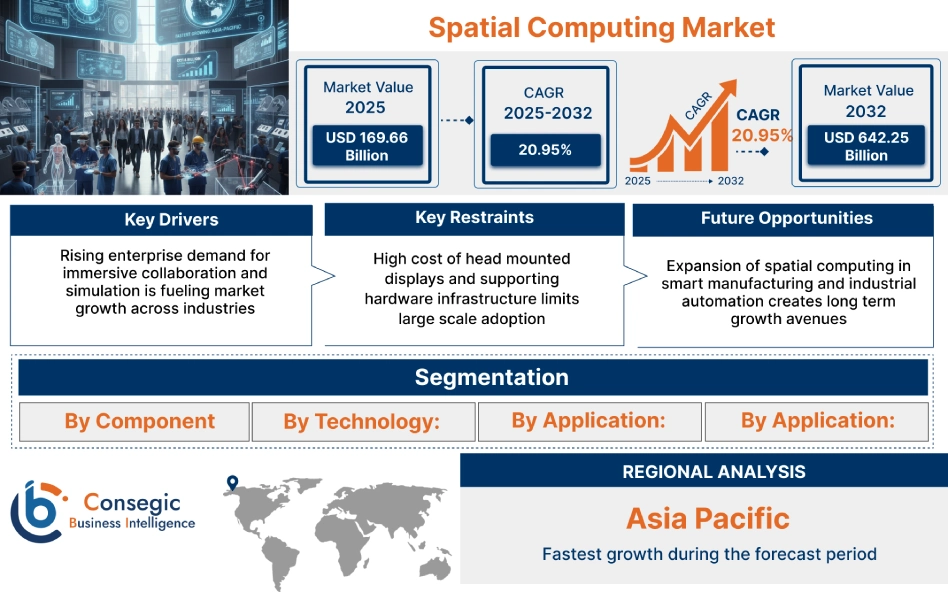
Spatial Computing Market size is estimated to reach over USD 642.25 Billion by 2032 from a value of USD 137.46 Billion in 2024 and is projected to grow by USD 169.66 Billion in 2025, growing at a CAGR of 20.95% from 2025 to 2032
Spatial Computing Market Scope & Overview:
Spatial computing can be described as the convergence of digital content and the physical world using technologies such as augmented reality, virtual reality, mixed reality, computer vision, spatial mapping, and real-time 3D rendering. Spatial computing uses head-mounted displays, depth sensors, cameras, artificial intelligence processors, cloud computing infrastructure, and graphics engines. The aim is to give the user the capability to interact with digital information in a physical environment while being conscious of the context. The infrastructure allows for real-time data processing, environment recognition, gesture recognition, and seamless interaction between devices, users, and business systems.
The industry of spatial computing is emerging due to the increasing demand for immersive user experiences. Companies are investing in digital twin platforms, remote collaboration tools, and simulation-based training solutions. Growth in advanced semiconductor capabilities and edge computing infrastructure has improved device performance and reduced latency constraints. Rising adoption across healthcare, manufacturing, retail, and defense sectors is further supporting industry development.
How is the Spatial Computing Market Affected by AI?
AI enhances spatial computing systems by processing large volumes of spatial data, user interaction inputs, environmental mapping information, and device telemetry with high precision. Machine learning models are able to detect boundaries of objects, gesture patterns, depth variations, and motion trajectories in immersive environments. AI engines are used in real-time scene reconstruction, voice recognition, eye tracking, and content placement in augmented and mixed reality platforms.
AI based systems support continuous environment scanning and adaptive content rendering during user interaction. Predictive algorithms evaluate user behavior, system latency, hardware load, and network conditions before performance gaps occur. This paradigm shift from application design to spatial environments enhances usability and operational efficiency. With the increasing use of immersive platforms in the healthcare, manufacturing, retail, and education industries, the use of AI is adding value to real-time collaboration and spatial data management.
Spatial Computing Market Dynamics - (DRO):
Key Drivers:
Rising enterprise demand for immersive collaboration and simulation is fueling market growth across industries
Companies are using spatial computing platforms to improve remote collaboration, design visualization, and employee training. The manufacturing industry is using immersive simulations for testing production layouts and equipment configuration before actual implementation. The healthcare industry is using spatial visualization for surgical planning and medical training. The defense industry is using immersive systems for mission rehearsal and scenario simulation.
- For instance, in March 2025, Endo launched a spatial computing–based simulator designed to support healthcare providers with immersive, mixed reality training that enhances clinical skills development for hand treatment procedures.
Thus, the growing demand for enterprise class immersive collaboration and simulation solutions is fueling the expansion of the spatial computing market.
Key Restraints:
High cost of head mounted displays and supporting hardware infrastructure limits large scale adoption
The spatial computing solution needs advanced head mounted displays, depth sensors, high performance processors, and edge/cloud infrastructure. The initial investment cost is high for small and medium scale enterprises. The maintenance of devices, software, and integration costs add to the overall cost of ownership. This hampers the widespread adoption of the solution in the enterprise.
Thus, high hardware and infrastructure costs are restraining broader adoption within the spatial computing industry.
Future Opportunities:
Expansion of spatial computing in smart manufacturing and industrial automation creates long term growth avenues
Industrial plants are merging spatial computing with digital twins and automation systems to enhance visibility. Real-time spatial mapping helps with predictive maintenance and production line monitoring. Plant managers employ immersive interfaces to monitor robotic systems and complex equipment. Connectivity with industrial IoT networks improves data-driven decision-making.
- In May 2025, the National Association of Manufacturers found that 51% of manufacturers are currently using AI in their operations, 61% of manufacturers plan to increase investment in AI by 2027, and 80% of manufacturers believe AI will become critical to business growth or continuity by 2030.
Therefore, the growing use of spatial computing in smart manufacturing and industrial automation is opening up new avenues in the spatial computing market.
Spatial Computing Market Segmental Analysis:
By Component:
On the basis of component, the spatial computing market is segmented into spatial computing devices (VR headsets, AR glasses, and hybrid gear), computing software solutions, and services (integration and deployment services, support & maintenance, and consulting services).
Trends in the Component:
- Enterprises are integrating immersive hardware with cloud based spatial platforms.
- Increasing AI integration is strengthening demand for real time spatial software engines.
The spatial computing devices was responsible for the highest revenue share in 2024.
- Head-mounted displays and smart glasses constitute the main access interface for immersive applications.
- Moreover, companies are investing in better sensors and processors to enhance spatial accuracy.
- In addition, upgrades in hardware are enabling better resolution displays and depth tracking
- Further, industrial applications demand rugged and high-performance wearable technology.
- Furthermore, growing enterprise pilots are driving bulk procurement of spatial hardware systems.
- In September 2024, Meta launched Orion, which is the first true augmented reality glasses prototype that aims to lay digital information on top of the physical world, marking a significant milestone in the development of spatial computing hardware.
- Therefore, rising deployment of immersive devices across enterprise environments is supporting dominance of the Spatial Computing Devices segment.
It is anticipated that the computing software solutions will exhibit the highest compound annual growth rate (CAGR) during the forecast period.
- Software platforms manage spatial mapping, rendering, interaction tracking, and data synchronization.
- Moreover, AI based engines enable object recognition and contextual content placement.
- In addition, digital twin integration is expanding enterprise software demand.
- Further, cloud connectivity supports scalable spatial data management across locations.
- Furthermore, cross platform compatibility requirements are increasing software development investments.
- Hence, the shift toward scalable and AI enabled spatial platforms is accelerating growth of the Computing Software Solutions segment.
By Technology:
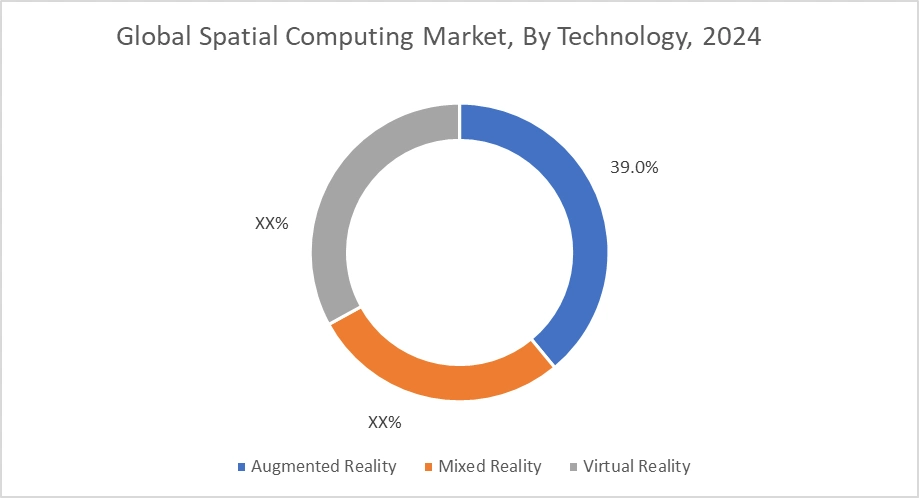
On the basis of technology, the market is divided into augmented reality, mixed reality, and virtual reality.
Trends in the Technology:
- Enterprises are prioritizing immersive visualization for training and design review.
- Hardware advancements are improving field of view and motion tracking precision.
Augmented Reality represented the highest revenue share of 39% in 2024.
- AR solutions provide a digital overlay of information on the real world for operational efficiency.
- Moreover, the manufacturing and logistics industry uses AR for guided workflows and maintenance.
- In addition, the retail and field service industry uses AR for product visualization and remote assistance.
- Further, the deployment complexity of AR devices is lower than that of fully immersive devices.
- Furthermore, enterprise demand for real time contextual information is increasing AR adoption.
- Therefore, widespread enterprise integration is supporting dominance of the Augmented Reality segment.
The mixed reality is expected to have the highest compound annual growth rate (CAGR) during the forecast period.
- Mixed reality platforms enable interactive digital objects anchored within physical environments.
- Moreover, advanced sensors support spatial anchoring and gesture-based control.
- In addition, industrial design and healthcare simulations are expanding MR applications.
- Further, growing investments in next generation headsets are strengthening MR capabilities.
- Furthermore, enterprise focus on immersive collaboration is increasing MR deployment.
- Hence, expanding use in interactive enterprise workflows is accelerating growth of the Mixed Reality segment.
By Application:
On the basis of application, the market is divided into entertainment, design and manufacturing, meetings and interaction, logistics, and others.
Trends in the Application:
- Enterprises are using immersive platforms for remote collaboration and workforce training.
- Digital twin and simulation platforms are gaining adoption in industrial operations.
Design and Manufacturing represented the highest revenue share in 2024.
- Spatial tools support 3D product modeling and real time prototype evaluation.
- Moreover, engineers use immersive visualization to detect design errors before production.
- In addition, integration with CAD and PLM systems improves workflow efficiency.
- Further, simulation reduces dependency on physical testing environments.
- Furthermore, manufacturing firms are expanding digital factory initiatives using spatial platforms.
- Therefore, industrial digitalization strategies are supporting dominance of the Design and Manufacturing segment.
The meetings and interaction segment is expected to have the highest compound annual growth rate (CAGR) during the forecast period.
- Enterprises are adopting immersive meeting platforms for distributed teams.
- Moreover, real time avatar-based interaction improves collaboration across geographies.
- In addition, integration with enterprise communication software supports seamless deployment.
- Further, demand for virtual training and onboarding platforms is increasing.
- Furthermore, hybrid work models are strengthening adoption of immersive collaboration tools.
- Hence, expansion of virtual collaboration ecosystems is accelerating growth of the Meetings and Interaction segment.
By End User:
On the basis of end user, the spatial computing market is divided into BFSI, Government & Public Sector, IT & telecom, travel & hospitality, retail, energy & utilities, healthcare, manufacturing, education, and other end users.
Trends in the End User:
- Industry specific spatial platforms are emerging to address operational requirements.
- Enterprises are investing in immersive systems to improve workforce productivity.
Manufacturing accounted for the largest revenue share in the year 2024.
- Spatial computing supports factory planning and equipment monitoring.
- Moreover, industrial automation platforms integrate with immersive dashboards.
- In addition, real time spatial analytics improve production line visibility.
- Further, workforce training simulations enhance operational safety standards.
- Furthermore, demand for predictive maintenance visualization is expanding deployment.
- According to the International Federation of Robotics (IFR) World Robotics 2025 report, a total of 542,000 industrial robots were installed in 2024, which is more than double the number installed a decade ago, and this is the fourth consecutive year that the number of installations has exceeded 500,000 units annually.
- Therefore, increasing adoption of digital manufacturing ecosystems is supporting dominance of the Manufacturing segment.
Healthcare is anticipated to register the fastest CAGR during the forecast period.
- Hospitals are integrating spatial visualization for surgical planning and diagnostics.
- Moreover, medical training institutions use immersive simulation platforms.
- In addition, remote consultation platforms incorporate AR based guidance systems.
- Further, spatial mapping supports complex procedure rehearsal and risk assessment.
- Furthermore, growing digital health investments are strengthening technology adoption.
- Hence, expanding clinical and training applications are accelerating growth of the Healthcare segment.
Regional Analysis:
North America, Europe, Asia Pacific, the Middle East and Africa, and Latin America are the regions of coverage.
North America region was valued at USD 50.81 billion in 2024. Furthermore, it is expected to increase steadily during the forecast period. Market growth is supported by strong presence of major technology firms and early adoption of immersive platforms across enterprise sectors. Investment in AR and VR hardware development, AI processors, and cloud infrastructure is strengthening deployment of spatial computing solutions. Canada is moving forward with digital twin technology and immersive training solutions. This is helping the growth of industries in the region.
- For example, in April 2024, Apple launched the Vision Pro headset, which is the next generation of spatial computing for business. This is because it enables immersive 3D workspaces, collaborative design, and training that combines digital content with the physical world.
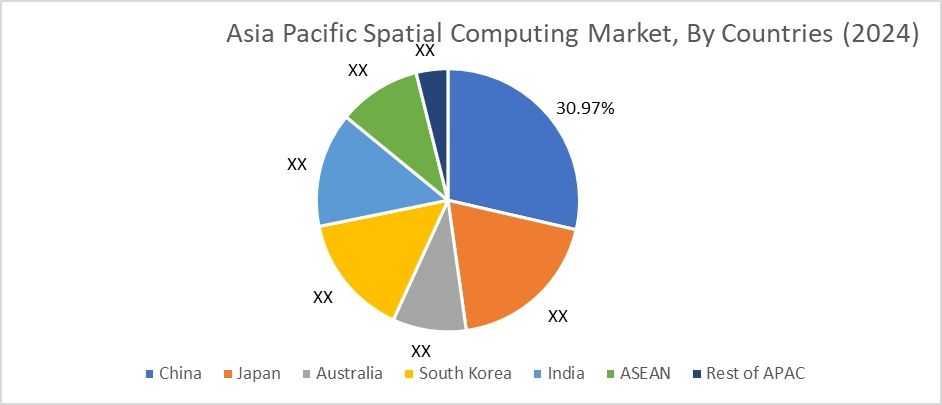
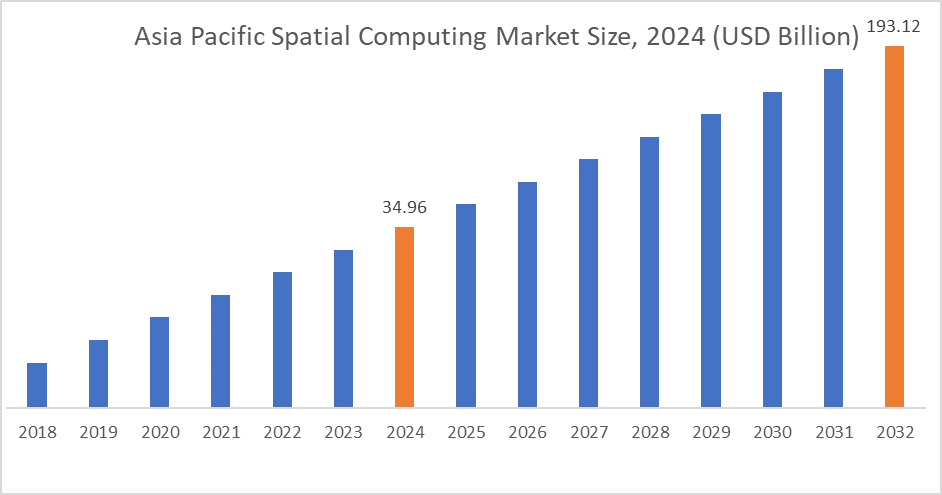
Asia Pacific region was valued at USD 34.36 Billion in 2024. Moreover, it is projected to grow by USD 43.65 Billion in 2025 and reach over USD 193.12 Billion by 2032. Out of this, China accounted for the maximum revenue share of 30.97%. Asia Pacific market is expected to grow at a significant rate during the forecast period. The market is expanding due to the accelerated digital transformation initiatives being adopted in China, Japan, South Korea, and India. The manufacturing and electronics sectors are adopting spatial computing in their design and manufacturing cycles. The development of 5G infrastructure is increasing the capability to process real-time spatial data.
- In December 2025, GSMA Intelligence stated that expanded 5G investment in Indonesia is projected to add USD 41 billion to GDP between 2024 and 2030, which is expected to accelerate spatial computing adoption by improving network capacity, reducing latency, and enabling real-time immersive applications across industries.
Industrial digitization programs and adoption of digital twin platforms in Germany, France, and the Nordic countries are shaping the Europe spatial computing market. Enterprises are integrating immersive visualization tools into engineering design, remote maintenance, and workforce training operations.
In Latin America, spatial computing demand is emerging from digital education initiatives, gaming platforms, and enterprise modernization programs in Brazil, Argentina, and Chile. Industrial operators are exploring immersive systems for training, safety simulations, and facility management applications.
Smart city development programs and national digital economy strategies are fueling the Middle East & Africa spatial computing market, particularly in the UAE and Saudi Arabia. Governments are deploying immersive technologies for urban planning, infrastructure management, and defense applications.
Top Key Players & Market Share Insights:
The spatial computing market is moderately concentrated at the global level. The major tech giants, semiconductor firms, enterprise software firms, and new-age immersive technology firms are actively participating in the market. The players in the market are focusing on hardware ecosystem development, software platform development, collaborations, and community development to increase their competitiveness. The companies are investing in AI-powered spatial engines, optics, wearable device development, and cloud rendering platforms to increase their reach in the enterprise and consumer space. Key participants in the market for spatial computing include:
- Apple Inc. (US)
- Microsoft Corporation (US)
- Meta Platforms, Inc. (US)
- Alphabet Inc. (US)
- NVIDIA Corporation (US)
- Sony Group Corporation (Japan)
- HTC Corporation (Taiwan)
- Magic Leap, Inc. (US)
- Snap Inc. (US)
- Qualcomm Incorporated (US)
Recent Industry Developments:
Product Launches
- In November 2025, Microsoft Research Asia introduced spatial and embodied foundation models designed to strengthen AI-driven spatial computing through improved 3D perception and real-world interaction capabilities.
- In October 2025, Qualcomm announced that the Samsung Galaxy XR device leverages the Snapdragon XR platform to advance spatial computing capabilities through enhanced real-time processing, AI-driven interaction, and immersive extended reality performance.
Spatial Computing Market Report Insights:
| Report Attributes | Report Details |
|---|---|
| Study Timeline | 2019-2032 |
| Market Size in 2032 (USD Trillion) | USD 642.25 Billion |
| CAGR (2025-2032) | 20.95% |
| By Component |
|
| By Technology |
|
| By Application |
|
| By End User |
|
| By Region |
|
| Key Players |
|
| Report Coverage |
|
Key Questions Answered in the Report
How big is the spatial computing market? −
The spatial computing market size is estimated to reach over USD 642.25 Billion by 2032 from a value of USD 137.46 Billion in 2024 and is projected to grow by USD 169.66 Billion in 2025, growing at a CAGR of 20.95% from 2025 to 2032.
Which segmentation details are covered in the spatial computing report? +
The spatial computing report includes specific segmentation details for component, technology, application, end user, and regions.
Which is the fastest segment anticipated to impact the market growth? +
Computing software solutions is the fastest growing segment, driven by increasing enterprise demand for AI enabled spatial platforms and scalable cloud based deployment models.
Who are the major players in the spatial computing market? +
The key participants in the spatial computing market are Apple Inc. (US), Microsoft Corporation (US), Meta Platforms, Inc. (US), Alphabet Inc. (US), NVIDIA Corporation (US), Sony Group Corporation (Japan), HTC Corporation (Taiwan), Magic Leap, Inc. (US), Snap Inc. (US), Qualcomm Incorporated (US), and others.
What are the key trends in the spatial computing market? +
The spatial computing market is shaped by key trends including rising enterprise adoption of immersive collaboration tools, expansion of digital twin integration, growing investment in AR and mixed reality hardware, and increasing use of spatial analytics across industrial operations.
Overview
Reputation & Certifications


Our Services
- Market Intelligence & Forecasting
- Custom Research Solutions
- Market Entry Strategy
- Competitive Intelligence
- Customer Insights
- Industry Innovation Analysis
- Investment Advisory