Jump to Content
Smart Water Management Market- Size, Share, Industry Trends, and Forecasts (2025 - 2032)
Smart Water Management Market Size:
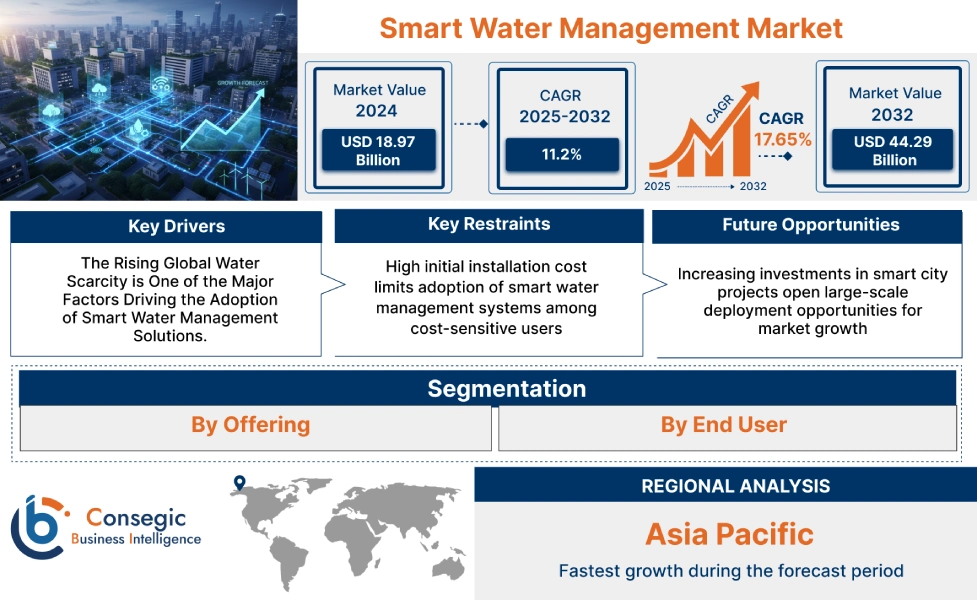
Smart Water Management Market size is estimated to reach over USD 44.29 Billion by 2032 from a value of USD 18.97 Billion in 2024 and is projected to grow by USD 21.08 Billion in 2025, growing at a CAGR of 11.2% from 2025 to 2032
Smart Water Management Market Scope & Overview:
Smart water management is a technology solution that provides monitoring, control, and optimization services using digital technologies to ensure efficient management of water resources. The smart water management system operates by collecting, storing, and analysing data on water consumption and distribution to prevent water wastage and optimize efficiency. The smart water management system is made up of hardware, software, and services that provide real-time monitoring, data analysis, and system management functions in residential, commercial, industrial, agricultural, and municipal water utilities to optimize water management efficiency.
Moreover, the major factors propelling the growth of the smart water management market include the rising water scarcity concerns, adoption of smart water technologies, and the need for efficient water resource management solutions. In addition, the smart water management system has several benefits, such as improved accuracy of water monitoring, reduced water wastage, improved operational control, and efficiency. The smart water management market is experiencing growth as a result of the aforementioned factors.
How is the Smart Water Management Market Affected by AI?
AI uses machine learning and data analysis algorithms to process data related to water consumption and distribution in a more accurate and efficient manner, thus optimizing water monitoring and preventing water wastage and leakage. The AI system learns from past and present water data, which helps in predictive analysis and improves the accuracy of the system for different usage and environmental scenarios. Moreover, AI allows real-time monitoring and decision-making based on consumption patterns and system performance, thus optimizing water management in the utilities.
Additionally, AI enables proactive problem identification through the detection of anomalies, leaks, and unusual water usage, thus allowing utilities to shift from reactive water management to intelligent and predictive water management approaches. This enhances the scalability, efficiency, and sustainability of the system, thus promoting the development of the smart water management market.
Smart Water Management Market Dynamics - (DRO):
Key Drivers:
The Rising Global Water Scarcity is One of the Major Factors Driving the Adoption of Smart Water Management Solutions.
The rising scenario of water scarcity around the globe is one of the major drivers pushing the adoption of smart water management solutions. Governments, as well as water and electricity boards, are adopting advanced water monitoring and conservation solutions such as smart water meters and IoT sensors to track water leaks and optimize water distribution. These solutions enable governments to track water consumption patterns and adopt efficient water conservation strategies.
- UNESCO reported that around 2 billion people lack access to safely managed drinking water services, which shows a huge gap in water availability and management that leads to the water scarcity situation.
Therefore, the smart water management market is experiencing growth as a result of the increasing utilization of smart water solutions in municipal infrastructure.
Key Restraints:
High initial installation cost limits adoption of smart water management systems among cost-sensitive users
The high cost of investment associated with smart water management systems, such as smart water meters, sensors, communication networks, and software platforms, is slowing the adoption of smart water management systems among cost-conscious users. In addition, the cost of the current expenses, including system maintenance, software, and technical support, is also adding to the increase in the total cost of ownership. Budget-conscious utilities and organizations also incur additional costs for system integration, infrastructure upgrades, and staff training, thereby hindering the adoption of smart water management systems among small utilities and developing regions.
Therefore, the smart water management market is being impeded by the high initial installation costs.
Future Opportunities:
Increasing investments in smart city projects open large-scale deployment opportunities for market growth
The increasing investment in smart city projects is thereby creating a positive impact on the use of smart water management systems. Smart city projects aim to improve water conservation, efficient resource management, and infrastructure efficiency, which is thereby increasing the use of smart water meters, monitoring systems, and analytics solutions in residential areas, commercial buildings, and municipal utilities. Furthermore, the integration of smart water management solutions with smart infrastructure and management systems is thus aiding in the efficient management of water resources in urban areas.
- For instance, in January 2026, Vingroup made an announcement regarding its investment of USD 3 billion in Telangana, India to build smart city infrastructure. This investment will have a beneficial effect on the utilization of smart water management.
Hence, the growing emphasis on smart city development is expected to create large-scale deployment opportunities for the smart water management market during the forecast period.
Smart Water Management Market Segmental Analysis:
By Offering:
On the basis of offering, the smart water management market is segmented into solutions (asset management, distribution network monitoring, supervisory control and data acquisition, meter data management, analytics and others), services (integration & deployment, support & maintenance and consulting), and water meters (AMR meters and AMI meters).
Trends in the Offering:
- The growing requirement for efficient monitoring and control of water infrastructure is fueling the adoption of smart water management solutions, water meters, and associated services.
- The growing concerns about water scarcity, non-revenue water, and leakage losses are driving the demand for advanced solutions and smart metering technologies.
The water meter offering was responsible for the highest revenue share in 2024.
- Water meters are the backbone of smart water management solutions and help in precise measurement of water consumption and data acquisition.
- The growing deployment of AMR and AMI meters in residential, commercial, and industrial settings is driving segment dominance.
- Moreover, the adoption of water meters is also being fueled by the need for precise billing, leak detection, and consumption measurement.
- In addition, the growing displacement of traditional meters with smart water meters is also adding to the revenue generation
- Hence, the dominance of the water meters segment is being fueled by the widespread use of smart metering infrastructure.
It is anticipated that the solutions offering will exhibit the highest compound annual growth rate (CAGR) during the forecast period.
- Solutions enable real-time monitoring, data analysis, and efficient management of water distribution systems.
- Moreover, the rising need for reducing water losses and improving operational efficiency is fueling the adoption of smart water management solutions.
- In addition, the use of AI-enabled analytics and cloud-based water management platforms is improving system performance and decision-making.
- Therefore, the trend of adopting intelligent and data-driven water management systems is increasing the growth of the solutions market.
By End User:
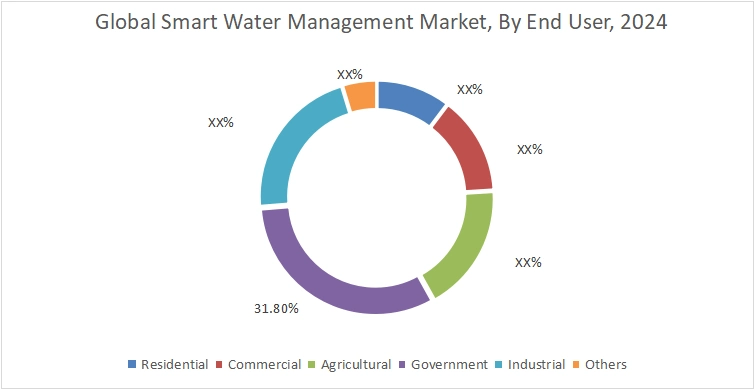
On the basis of end user, the market is divided into residential, commercial, agricultural, industrial, government and other end users.
Trends in the End User:
- The growing requirement for effective water usage monitoring and conservation is driving the adoption of smart water management systems in residential, commercial, agricultural, industrial, and government sectors.
- The growing concerns about water wastage, rising water bills, and the need for sustainable water management are supporting the demand in all end-use industries.
Government sector accounted for the largest revenue share of 31.80% in the year 2024.
- The government sector has large-scale water supply and distribution networks, which require efficient monitoring and management.
- Moreover, the growing adoption of smart water meters and monitoring systems in municipal water supply networks is supporting the sector's dominance.
- Furthermore, the growing government initiatives for smart cities and water conservation are boosting adoption.
- Thus, the government segment's dominance is being driven by the widespread implementation of smart water management systems across public water utilities.
Agricultural sector anticipated to register the fastest CAGR during the forecast period.
- Agriculture consumes a significant amount of water, which increases the need for efficient water management solutions.
- In addition, the increasing use of smart irrigation systems and water monitoring solutions is driving the growth of this market segment.
- Further, the growing need to minimize water waste and optimize irrigation systems is driving the growth of the smart water management market.
- Furthermore, the use of sensors and analytics enables farmers to optimize water consumption and maximize crop yield.
- Therefore, the trend of adopting efficient and automated irrigation management systems is increasing the growth of the agricultural sector.
Regional Analysis:
North America, Europe, Asia Pacific, the Middle East and Africa, and Latin America are the regions of coverage.
North America region was valued at USD 6.46 billion in 2024. Furthermore, it is expected to increase by USD 7.18 billion in 2025 and exceed USD 14.41 billion by 2032. The US accounted for the highest revenue share. Market growth is primarily driven by early adoption of smart water meters and advanced water management systems in residential, commercial, and municipal utilities, which supports regional leadership. Furthermore, the strong regulatory emphasis on water conservation and efficient water infrastructure management is propelling system deployment. While other countries are expected to drive market demand in the North American region over the forecast period.
- For instance, in September 2024, Metron launched two exciting new products, WaterScope Utility, an advanced analytics app streamlining frontline operations across complex municipal water systems, and the Metron Spectrum Wave, an advanced ultrasonic smart meter combining versatility and resilience with best-in-class data capture.
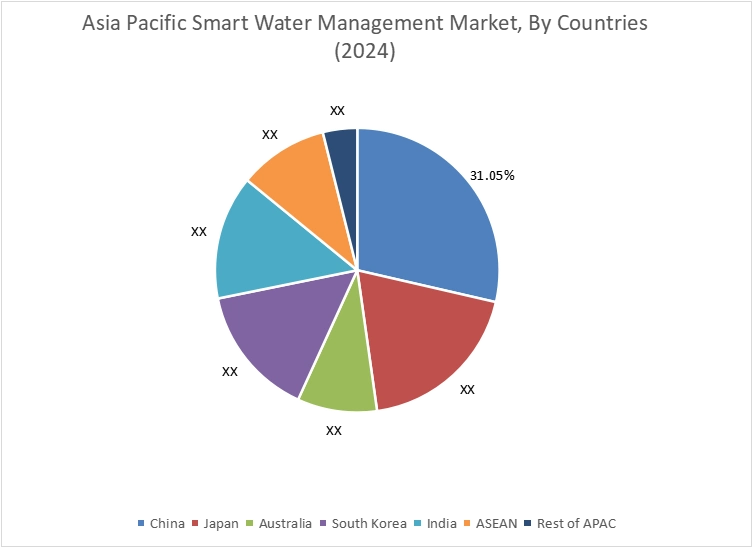
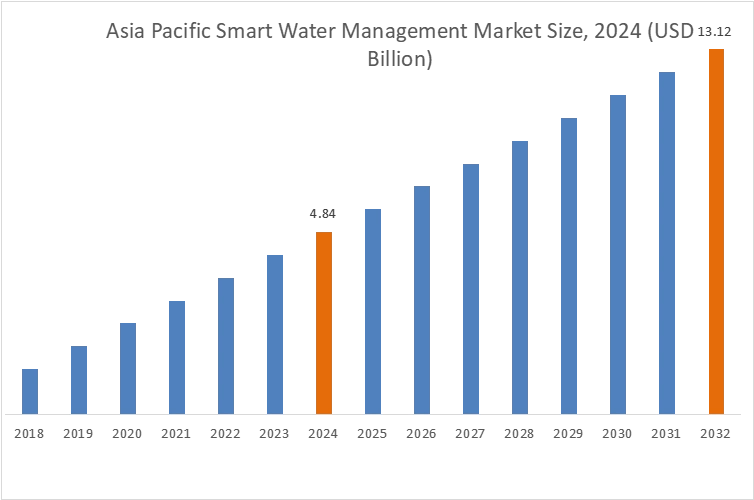
Asia Pacific is projected to exceed USD 13.12 billion in 2032 from USD 4.84 billion in 2024 and is estimated to grow by USD 5.63 billion in 2025. Out of this, China accounted for the maximum revenue share of 31.05%. The Asia Pacific market is growing due to the rising acceptance of smart city initiatives. In addition, the growing investment from the government and the utility industry in water infrastructure and conservation programs is driving the growth of the market in the Asia Pacific region.
- For example, in December 2023, the Central Government of India completed the Water Supply and Distribution Systems at Mangaluru Development Project with a total investment of USD 0.10 billion to optimize water treatment and distribution infrastructure in Karnataka, thus encouraging the use of smart water management practices.
Europe smart water management market is shaped by strict environmental compliance requirements and EU directives focused on water quality and resource efficiency. Utilities across Germany, France, Spain, and Italy are integrating IoT-based sensors and automated control systems to reduce non-revenue water and improve wastewater treatment performance.
Latin America smart water management market is influenced by urban water scarcity, high levels of non-revenue water, and infrastructure gaps in Brazil, Mexico, and Chile. Governments and multilateral agencies are supporting modernization of distribution networks and wastewater facilities to improve efficiency and reduce water losses.
Middle East & Africa smart water management market is driven by water scarcity, desalination dependency, and national sustainability strategies in Saudi Arabia, UAE, and South Africa. Utilities are integrating advanced metering, leak detection, and AI-based consumption analytics to manage limited freshwater resources.
Top Key Players & Market Share Insights:
The smart water management market is highly competitive at the global level, with leading technology companies offering solutions for both developed and developing nations. The companies in the market offer a broad range of solutions such as advanced metering infrastructure, IoT-based monitoring solutions, analytics platforms, and automated control solutions. Furthermore, companies are adopting strategies such as product innovation, strategic partnerships, mergers and acquisitions, and geographic expansion to strengthen their market presence and gain a competitive advantage. Key participants in the smart water management market include:
- Siemens – Germany
- Xylem – US
- Honeywell International Inc. – US
- Shneider Electric – France
- Metron – US
- Itron Inc. – US
- SUEZ Group – France
- Bentley Systems – US
- Bove Technology – China
- Landis+Gyr – Switzerland
- Trimble Inc. – US
Recent Industry Developments:
- In November 2025, Xylem collaborated with Amazon to work with Mexico City and Monterrey to implement the Xylem Vue advanced analytics platform to enhance water management with leak detection, minimize water losses, and ensure water supply reliability, with expected projects to save over 1.3 billion liters of water per year.
- In November 2025, Schneider Electric secured a contract to automate India’s largest water treatment plant in Mumbai, Maharashtra, to improve operational efficiency, optimize water treatment processes, and enable efficient and sustainable water supply management.
- In December 2023, Siemen announced the acquisition of BuntPlanet to enhance its artificial intelligence offerings in the water management industry with smart metering, water quality, asset management, and coupling of hydraulic models and artificial intelligence for leak and anomaly detection in water distribution networks.
Smart Water Management Market Report Insights:
| Report Attributes | Report Details |
|---|---|
| Study Timeline | 2024-2032 |
| Market Size in 2032 (USD Trillion) | USD 44.29 Billion |
| CAGR (2025-2032) | 11.2% |
| By Offering |
|
| By End User |
|
| By Region |
|
| Key Players |
|
| Report Coverage |
|
Key Questions Answered in the Report
How big is the smart water management market? −
Smart Water Management Market size is estimated to reach over USD 44.29 Billion by 2032 from a value of USD 18.97 Billion in 2024 and is projected to grow by USD 21.08 Billion in 2025, growing at a CAGR of 11.2% from 2025 to 2032.
Which segmentation details are covered in the smart water management report? +
The smart water management report includes specific segmentation details for offering, end user, and regions.
Which is the fastest segment anticipated to impact the market growth? +
In the smart water management market, the agriculture sector is the fastest-growing segment during the forecast period, driven by increasing adoption of smart irrigation systems, water monitoring solutions, and advanced analytics to optimize water usage, improve crop productivity, and address rising water scarcity concerns.
Who are the major players in the smart water management market? +
The key participants in the smart water management market are Siemens (Germany), Xylem (US), Honeywell International Inc. (US), Schneider Electric (France), Metron (US), Itron Inc. (US), SUEZ Group (France), Bentley Systems (US), Bove Technology (China), Landis+Gyr (Switzerland), and Trimble Inc. (US) and others.
What are the key trends in the smart water management market? +
The smart water management market is shaped by key trends including rising global water scarcity and other key trends driving the market.
Overview
Reputation & Certifications


Our Services
- Market Intelligence & Forecasting
- Custom Research Solutions
- Market Entry Strategy
- Competitive Intelligence
- Customer Insights
- Industry Innovation Analysis
- Investment Advisory