Jump to Content
Self-Service Technology Market - Size, Share, Industry Trends, and Forecasts (2025-2032)
Self-Service Technology Market Size:
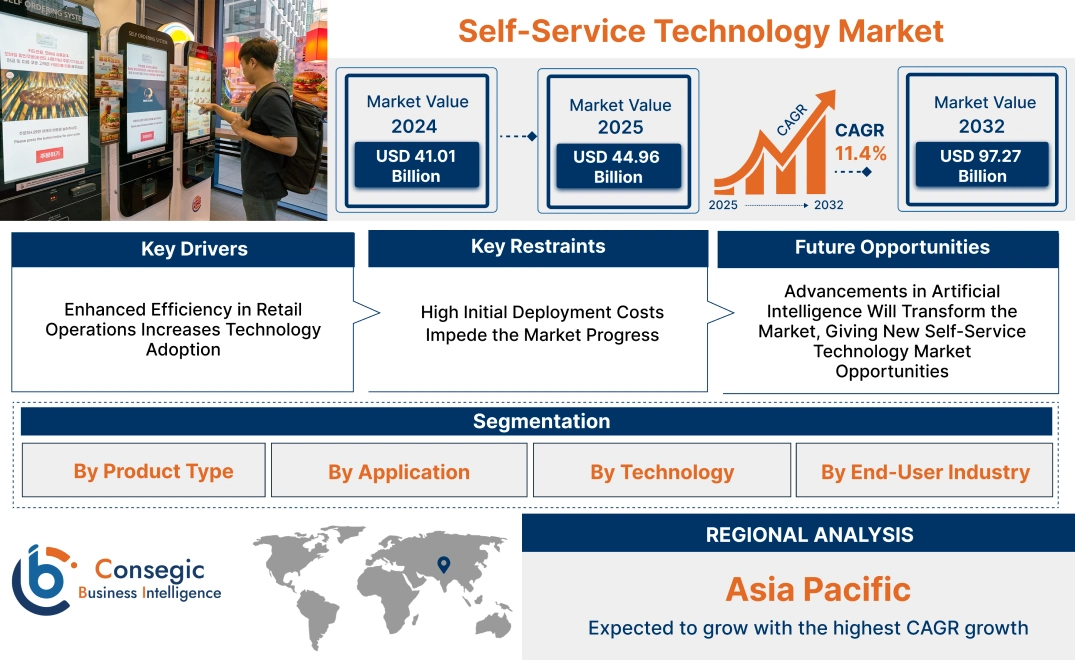
Self-Service Technology Market size is estimated to reach over USD 97.27 Billion by 2032 from a value of USD 41.01 Billion in 2024 and is projected to grow by USD 44.96 Billion in 2025, growing at a CAGR of 11.4% from 2025 to 2032
Self-Service Technology Market Scope & Overview:
Self-service technology refers to automated systems that enable users to independently access services or perform tasks without direct assistance. These technologies include ATMs, kiosks, vending machines, and self-checkout systems. Key features of self-service technology include intuitive interfaces, real-time transaction processing, and enhanced data security. They offer reliability, user-friendly operation, and 24/7 availability to meet diverse consumer needs.
Benefits include reduced operational costs, enhanced customer convenience, and faster service delivery. They also streamline workflows by minimizing manual intervention and improving accuracy. Applications of self-service technology span retail, banking, hospitality, healthcare, and transportation. End-use industries leverage these solutions for ticketing, payment processing, product selection, and customer support. These technologies play a vital role in improving operational efficiency and user satisfaction.
How is AI Transforming the Self-Service Technology Market?
AI is transforming the self-service technology market by delivering personalized, efficient, and accessible solutions, including AI-powered chatbots and virtual assistants for 24/7 support and personalized product recommendations in retail. Also, it enhances self-service with intelligent automation, providing faster, more accurate responses, and freeing up human agents for complex issues. Further, Generative AI is enabling proactive problem-solving by analyzing customer data to create dynamic, relevant content, thus improving the overall customer experience and increasing business efficiency.
Self-Service Technology Market Dynamics - (DRO) :
Key Drivers:
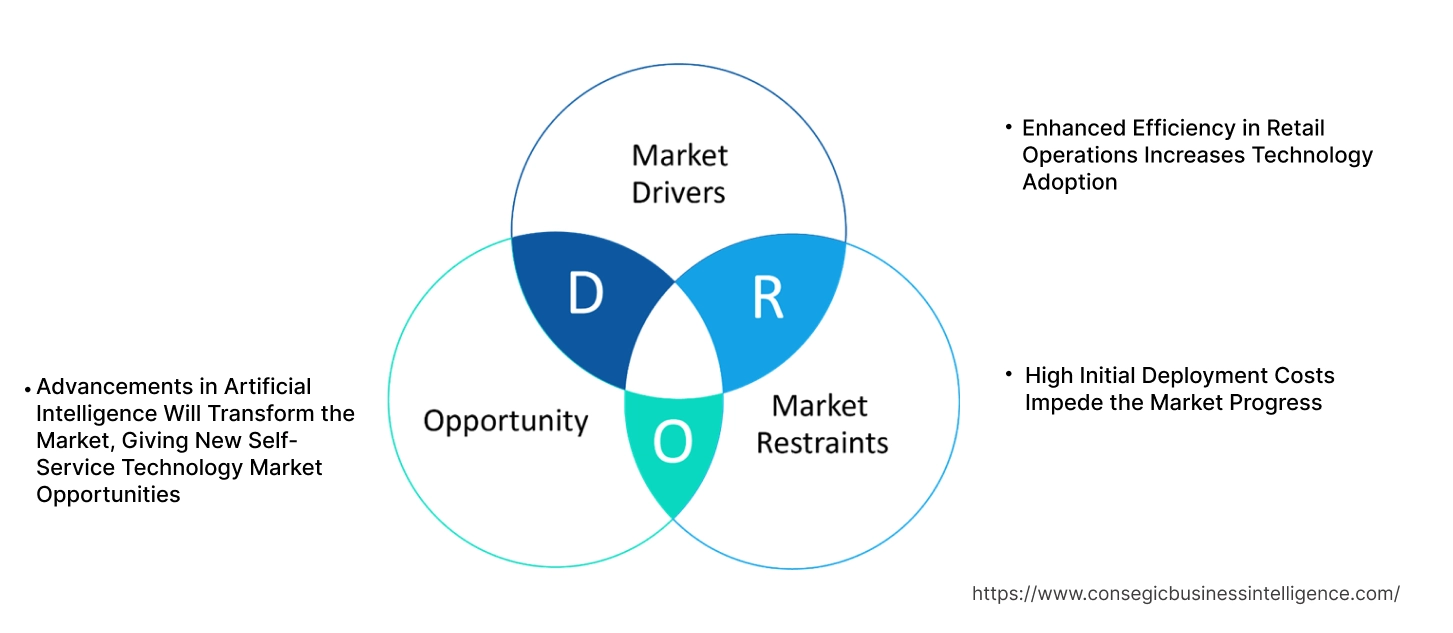
Enhanced Efficiency in Retail Operations Increases Technology Adoption
Self-service technologies such as kiosks, self-checkout systems, and vending machines significantly improve operational efficiency in the retail sector. These technologies streamline processes by reducing checkout times, enhancing inventory management, and enabling better allocation of staff to customer service roles. For instance, self-checkout systems in supermarkets minimize wait times and improve the overall shopping experience for customers. This results in increased customer satisfaction and loyalty, boosting revenue for retailers.Therefore, the rising self-service technology markettrend for improving retail operational efficiency propels the adoption of self-service technologies, driving self-service technology market growth.
Key Restraints:
High Initial Deployment Costs Impede the Market Progress
The deployment of self-service technology involves substantial upfront costs, including procurement, installation, and integration into existing systems. These expenses pose a challenge, especially for small and medium enterprises (SMEs), which may lack the financial resources to adopt these technologies. Additionally, regular maintenance and software upgrades add to the overall cost burden. For instance, integrating an advanced self-checkout system into a retail chain’s operations requires a significant investment in hardware, software, and staff training.These financial barriers limit the adoption of self-service technologies among smaller businesses, restraining self-service technology market growth.
Future Opportunities:
Advancements in Artificial Intelligence Will Transform the Market, Giving New Self-Service Technology Market Opportunities
The integration of artificial intelligence (AI) with self-service technologies is expected to unlock new trend avenues in the market. AI-driven systems, such as interactive kiosks and personalized recommendation engines, enhance user engagement and provide tailored services based on customer preferences. For instance, AI-enabled vending machines with facial recognition can suggest products based on previous purchases or demographic analysis. These advancements improve the functionality and appeal of self-service solutions.Therefore, the ongoing advancements in AI present a promising opportunity for the development of innovative self-service technologies, driving future self-service technology market expansion.
Self-Service Technology Market Segmental Analysis :
By Product Type:
Based on product type, the market is segmented into Automated Teller Machines (ATMs), Kiosks, and Vending Machines.
The Automated Teller Machines (ATMs) sector accounted for the largest revenue in self-service technology market share in 2024.
- Automated Teller Machines (ATMs) are crucial components of the self-service technology market, primarily used for providing banking services such as cash withdrawals, deposits, and balance inquiries.
- ATMs offer convenience and improve customer experience by reducing wait times at banks.
- The sector has evolved with the inclusion of advanced features, such as biometric authentication and touchless interfaces, improving security and accessibility.
- Therefore, according to self-service technology market analysis, with the growing trend for financial services, ATMs have become an essential tool for banking institutions. Moreover, the rise in contactless payment options and ATM network expansion globally supports the trend of this segment.
The Kiosks sector is anticipated to register the fastest CAGR during the forecast period.
- Kiosks are increasingly being utilized in retail, hospitality, and healthcare sectors for self-check-in, ticketing, product ordering, and more.
- They provide an efficient, user-friendly solution that enhances customer experience by minimizing human interaction, reducing queues, and promoting social distancing.
- The rise in digital adoption, particularly in quick-service restaurants (QSR) and retail outlets, is expected to drive the self-service technology market trend for kiosks.
- Thus, according to self-service technology market analysis, innovations in touchscreen technology and payment systems, coupled with the growing need for automation, contribute to the rapid trend of this subsegment.
By Application:
Based on application, the market is segmented into Retail, Quick Service Restaurants (QSR), Banking, Healthcare, Travel & Tourism, and Others.
The retail sector accounted for the largest revenue in self-service technology market share in 2024.
- In the retail sector, self-service technologies are used for checkout automation, product selection, and digital signage.
- The adoption of self-checkout kiosks has grown rapidly due to the need for faster service and reduced operational costs.
- This technology allows customers to scan and pay for items themselves, enhancing the shopping experience while minimizing the need for cashiers.
- Therefore, according to market analysis, the increasing consumer preference for contactless transactions, particularly post-pandemic, has significantly contributed to the market expansion in retail.
The Quick Service Restaurants (QSR) sector is anticipated to register the fastest CAGR during the forecast period.
- Quick Service Restaurants (QSRs) are rapidly integrating self-service technology, including ordering kiosks and mobile apps, to enhance customer convenience and streamline operations.
- These technologies reduce wait times, ensure order accuracy, and provide personalized offers to customers.
- Thus, according to market analysis, the increasing trend for contactless ordering, especially in the wake of the COVID-19 pandemic, is expected to fuel the growth of self-service technologies in this segment.
By Technology:
Based on technology, the market is segmented into Hardware Solutions, Software Solutions, and Connectivity Solutions.
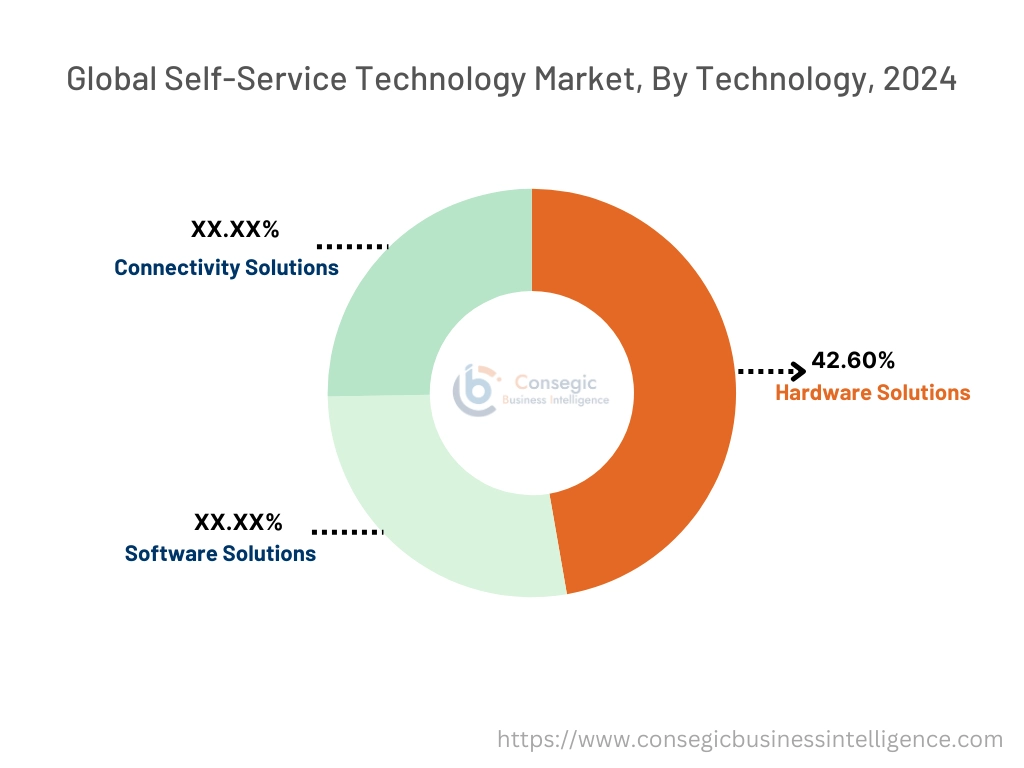
The hardware solutions sector accounted for the largest revenue share by 42.60% in 2024.
- Hardware solutions, including terminals, kiosks, ATMs, and vending machines, dominate the market.
- These devices are critical for delivering the core functionality of self-service solutions, ranging from financial transactions to retail purchases and customer service.
- With advancements in hardware technologies like touchscreen displays, secure payment systems, and enhanced user interfaces, the hardware solutions segment is expected to continue driving the market.
- Therefore, according to market analysis, these solutions offer convenience, security, and efficiency, which are key benefits for businesses adopting self-service models.
The software solutions sector is anticipated to register the fastest CAGR during the forecast period.
- Software solutions are essential for supporting the operation of self-service devices.
- These include user interface software, payment processing systems, and data management software.
- As businesses increasingly adopt digital solutions for customer interactions, the self-service technology market demand for software to manage transactions, monitor performance, and integrate with existing systems is expected to rise.
- Thus, according to market analysis, software innovations that enable better user experiences, personalization, and security features will contribute to the growth of this subsegment.
By End-User Industry:
Based on end-user industry, the market is segmented into Retail, Banking, Healthcare, Hospitality, and Transportation.
The retail sector accounted for the largest revenue share in 2024.
- Retailers are adopting self-service technologies to improve operational efficiency and enhance customer experience.
- Technologies such as self-checkout machines, kiosks, and digital displays are extensively used to streamline processes and reduce the need for manual intervention.
- Therefore, according to market analysis, the growing need for efficient in-store experiences, coupled with the increasing trend toward contactless transactions, drives the retail sector's dominance in the self-service technology market.
The healthcare sector is anticipated to register the fastest CAGR during the forecast period.
- In healthcare, self-service technologies like kiosks for check-in, appointment scheduling, and patient information management are becoming more prevalent.
- These technologies help reduce wait times, improve patient flow, and enhance the overall healthcare experience.
- Thus, according to market analysis, the growing need for efficient patient management and contactless services in healthcare facilities, along with advancements in healthcare technologies, is expected to propel the rapid growth of this segment.
Regional Analysis:
The regions covered are North America, Europe, Asia Pacific, the Middle East and Africa, and Latin America.
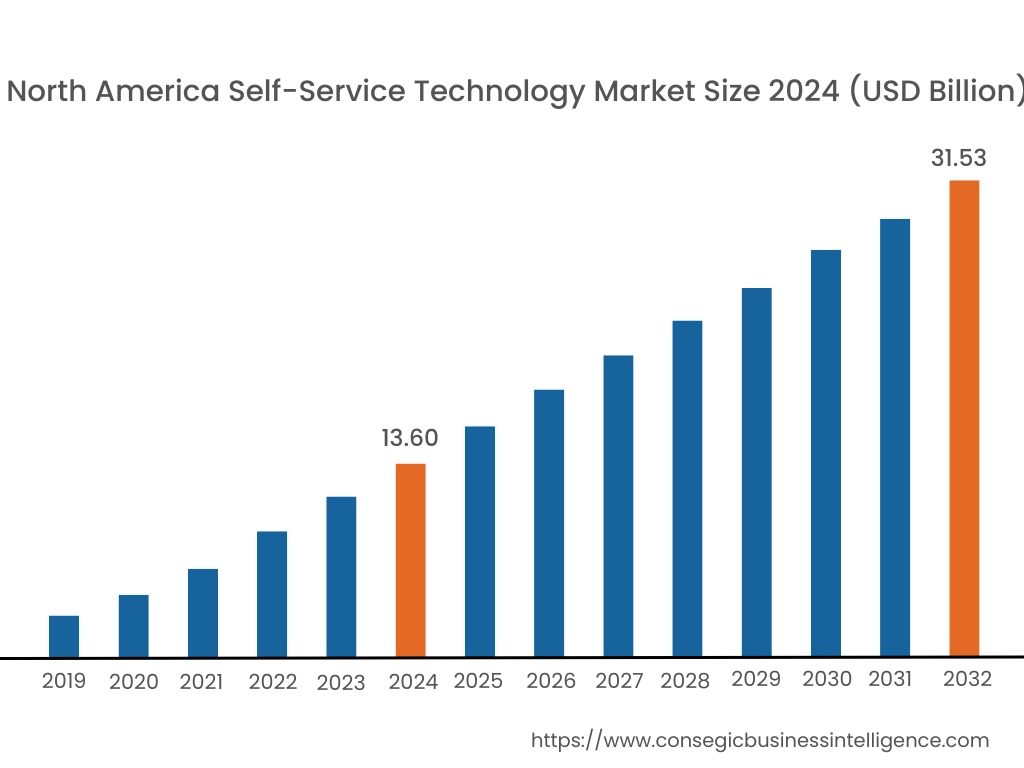
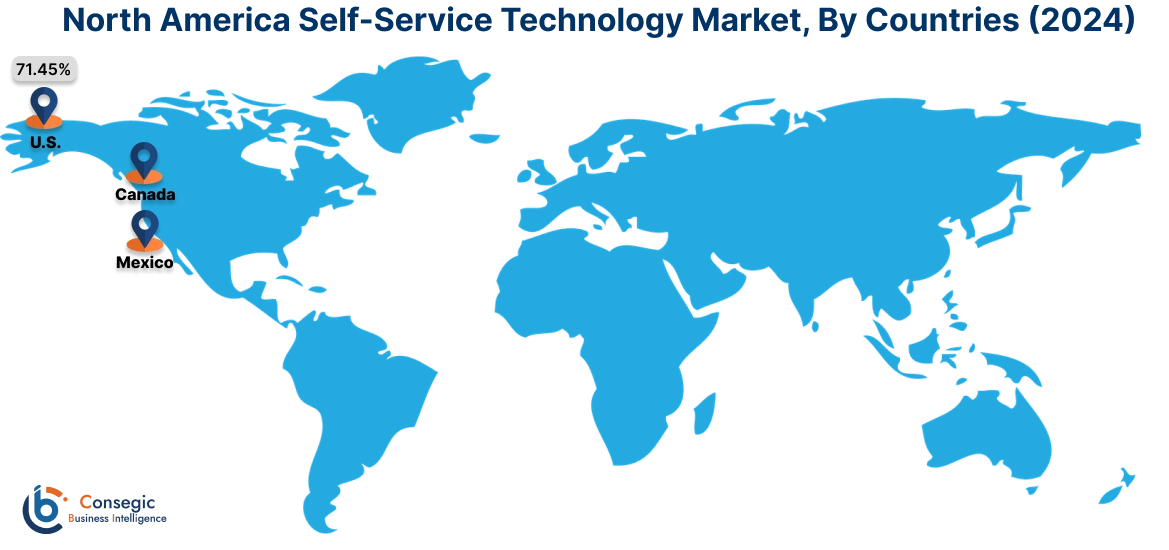
In 2024, North America was valued at USD 13.60 Billion and is expected to reach USD 31.53 Billion in 2032. In North America, the U.S. accounted for the highest share of 71.40% during the base year of 2024.
North America dominates the self-service technology market, with the United States leading in the adoption of self-service kiosks, ATMs, and automated checkout systems. Retail, banking, and hospitality sectors show strong demand for these solutions. The market is supported by technological advancements and a shift towards contactless services, especially in the wake of the COVID-19 pandemic. A high level of consumer preference for convenience and efficiency continues to drive adoption in the region.
In Asia Pacific, the market is experiencing the fastest growth with a CAGR of 11.9% over the forecast period.
Asia-Pacific is experiencing rapid expansion in the self-service technology market, particularly in countries like China, Japan, and India. Increasing urbanization, a growing middle class, and a large tech-savvy population contribute to the market’s progress. Retailers and financial institutions are investing heavily in automated solutions to meet consumer expectations. High mobile penetration and advancements in AI and IoT are further accelerating the adoption of self-service technologies in the region.
Europe shows steady demand for self-service technology, particularly in countries like the United Kingdom, Germany, and France. The retail and financial sectors are the primary adopters, utilizing self-service solutions for improved customer experiences. Increasing adoption of digital payments, coupled with consumer demand for faster and safer transactions, supports the growth of the market. Additionally, strict regulations around data privacy in Europe are shaping the development and deployment of self-service systems.
In the Middle East and Africa, the self-service technology market is emerging, driven by expanding retail and banking sectors in countries like the UAE, Saudi Arabia, and South Africa. The shift towards digital transformation and the desire for enhanced customer experiences are key market drivers. However, infrastructure challenges and the need for education about the benefits of self-service technology are slowing widespread adoption in the region.
Latin America is witnessing an increase in the adoption of self-service technology, particularly in countries like Brazil and Mexico. The retail and financial industries are leading the way in deploying automated solutions to meet consumer demands for convenience. However, market growth is hindered by economic instability and the need for further technological infrastructure. Despite these challenges, increasing mobile device usage and digital payment preferences are fostering market expansion.
Top Key Players and Market Share Insights:
The global self-service technology market is highly competitive with major players providing products and services to the national and international markets. Key players are adopting several strategies in research and development (R&D), product innovation, and end-user launches to hold a strong position in the Global Self-Service Technology Market. Key players in the Self-Service Technology industry include-
- NCR Corporation (United States)
- Diebold Nixdorf, Incorporated (United States)
- Zebra Technologies Corporation (United States)
- Kiosk Information Systems (United States)
- ParTech, Inc. (United States)
- RedyRef Interactive Kiosks (United States)
- Toshiba Global Commerce Solutions (United States)
- Innovative Technology Ltd. (United Kingdom)
- Peerless-AV (United States)
- Advanced Kiosks (United States)
Recent Industry Developments :
Product launches:
- In October 2024, Cerillion introduced version 24.2 of its BSS/OSS suite, featuring a new composable Self Service module designed to enhance digital engagement for telecom operators.
- In July 2024, research published introduced an improved self-checkout system for retail, utilizing an enhanced YOLOv10 network to boost product recognition accuracy and checkout speed.
Partnerships & Collaborations
- In October 2024, ServiceNow and Databricks announced a "Zero Copy" partnership to enhance enterprise productivity through AI-powered workflows. This collaboration integrates Databricks' data intelligence capabilities with ServiceNow's Workflow Data Fabric, providing real-time, secure access to unified business and technology data across enterprises. The partnership aims to bridge the gap between data insights and actionable workflows, enabling businesses to build tailored AI solutions for informed decision-making.
Self-Service Technology Market Report Insights :
| Report Attributes | Report Details |
| Study Timeline | 2019-2032 |
| Market Size in 2032 | USD 97.27 billion |
| CAGR (2025-2032) | 11.4% |
| By Product Type |
|
| By Application |
|
| By Technology |
|
| By End-User Industry |
|
| By Region |
|
| Key Players |
|
| North America | U.S. Canada Mexico |
| Europe | U.K. Germany France Spain Italy Russia Benelux Rest of Europe |
| APAC | China South Korea Japan India Australia ASEAN Rest of Asia-Pacific |
| Middle East and Africa | GCC Turkey South Africa Rest of MEA |
| LATAM | Brazil Argentina Chile Rest of LATAM |
| Report Coverage |
|
Key Questions Answered in the Report
How big is the Self-Service Technology Market? −
In 2024, the Self-Service Technology Market was USD 41.01 billion.
What will be the potential market valuation for the Self-Service Technology Market by 2032? +
In 2032, the market size of Self-Service Technology Market is expected to reach USD 97.27 billion.
What are the segments covered in the Self-Service Technology Market report? +
The product type, application, technology, and end-user industry are the segments covered in this report.
Who are the major players in the Self-Service Technology Market? +
NCR Corporation (United States), Diebold Nixdorf, Incorporated (United States), Zebra Technologies Corporation (United States), Kiosk Information Systems (United States), ParTech, Inc. (United States), RedyRef Interactive Kiosks (United States), Toshiba Global Commerce Solutions (United States), Innovative Technology Ltd. (United Kingdom), Peerless-AV (United States), Advanced Kiosks (United States) are the major players in the Self-Service Technology market.
Overview
Reputation & Certifications


Our Services
- Market Intelligence & Forecasting
- Custom Research Solutions
- Market Entry Strategy
- Competitive Intelligence
- Customer Insights
- Industry Innovation Analysis
- Investment Advisory