Jump to Content
Solid-State Cooling Market - Size, Share, Industry Trends, and Forecasts (2025-2035)
Solid-State Cooling Market Size:
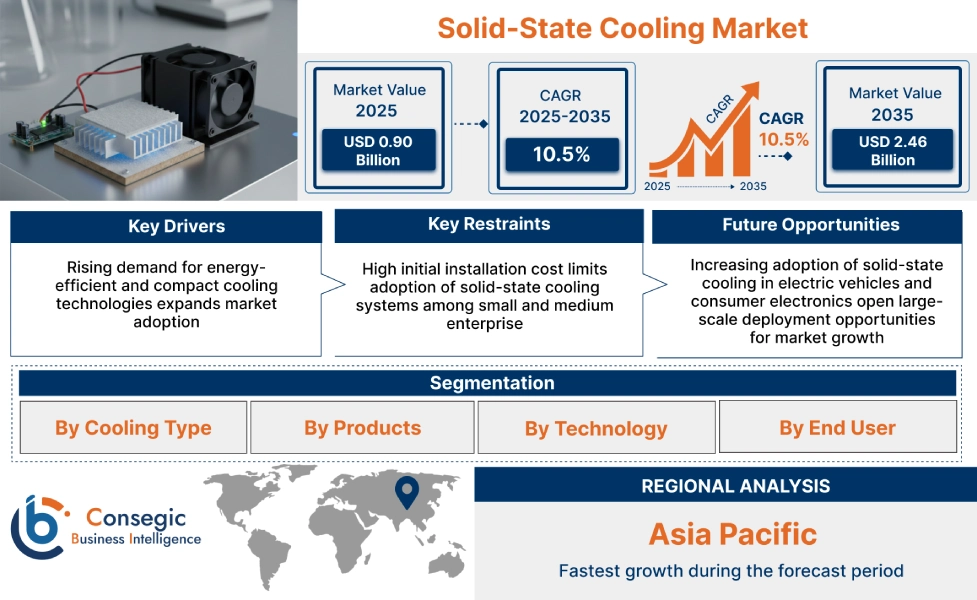
Solid-State Cooling Market size is estimated to reach over USD 2.46 Billion by 2035 from a value of USD 0.82 Billion in 2024 and is projected to grow by USD 0.90 Billion in 2025, growing at a CAGR of 10.5% from 2025 to 2035
Solid-State Cooling Market Scope & Overview:
Solid-state cooling is an advanced cooling technology that provides temperature control and heat management by using semiconductor cooling solutions without the use of refrigerants and mechanical compressors. The solid-state cooling system works by transferring heat using the principles of thermoelectric, electrocaloric, and magnetocaloric effects to provide efficient and precise cooling. The solid-state cooling system includes cooling modules, control modules, and integration components that are used for real-time temperature control and heat management in consumer electronics, automotive, healthcare, telecommunication, and industrial sector.
In addition, the key factors driving the growth of the solid-state cooling market are the rising demand for energy-efficient cooling solutions, the growing adoption of compact electronic devices, and the increasing focus on environmentally friendly cooling solutions technologies. In addition, the solid-state cooling system has several benefits, such as improved energy efficiency, reduced maintenance, precise temperature control, and silent operation. The solid-state cooling market is experiencing growth as a result of the aforementioned factors.
How is the Solid-State Cooling Market Affected by AI?
AI uses machine learning and data analysis algorithms to process temperature and thermal management data in a more accurate and efficient manner, thus optimizing cooling performance and improving energy efficiency. The AI system is trained based on past and present temperature trends, which assists in predictive analysis and enhances the accuracy of the system for various operating conditions. In addition, AI enables real-time monitoring and automatic cooling adjustments based on system performance and cooling requirements, thus optimizing the efficiency of thermal management.
Additionally, AI enables proactive issue identification through the detection of temperature fluctuations, performance anomalies, and system inefficiencies, thus allowing industries to shift from conventional cooling approaches to intelligent and predictive cooling management. This enhances the efficiency, reliability, and performance of cooling systems, thus promoting the development of the solid-state cooling market.
Solid-State Cooling Market Dynamics - (DRO):
Key Drivers:
Rising demand for energy-efficient and compact cooling technologies expands market adoption.
The solid-state cooling market is growing due to rising demand for energy-efficient and environmentally safe cooling technologies. Traditional cooling systems use refrigerants and moving parts, which increase maintenance needs and environmental impact. In contrast, solid-state cooling systems operate without compressors or harmful refrigerants. This reduces energy consumption and supports sustainability goals.
The growing use of compact electronics, medical devices, and precision instruments is increasing the need for small and quiet cooling systems. Solid-state technologies provide precise temperature control, which improves device performance and reliability.
- For instance, in March 2024, Solid State Cooling Systems launched the ThermoCube II line of solid-state recirculating chillers with improved power capacity and advanced digital controls for precise temperature management.
Therefore, the increasing demand for energy-efficient and refrigerant-free cooling technologies is driving the growth of the solid-state cooling market.
Key Restraints:
High initial installation cost limits adoption of solid-state cooling systems among small and medium enterprise
The high cost of investment associated with solid-state cooling systems, such as thermoelectric modules, control systems, and integration components, is slowing the adoption of solid-state cooling systems among cost-conscious enterprises. In addition, the cost of ongoing expenses, including system integration, maintenance, and technical support, is also adding to the increase in the total cost of ownership. Budget-conscious organizations also incur additional costs for system deployment, infrastructure modification, and technical implementation, thereby limiting the adoption of solid-state cooling systems among small and medium enterprises.
Therefore, the solid-state cooling market is being restrained by the high initial installation costs.
Future Opportunities:
Increasing adoption of solid-state cooling in electric vehicles and consumer electronics open large-scale deployment opportunities for market growth
The increasing adoption of electric vehicles and advanced consumer electronics is thereby creating a positive impact on the use of solid-state cooling systems. These technologies help in improving battery performance, maintaining optimal temperature, and enhancing device efficiency, which is thereby increasing the use of solid-state cooling systems in automotive and electronics applications. Furthermore, the integration of solid-state cooling systems with advanced electronic and battery systems is thus aiding in improving system performance and reliability.
- For instance, in August 2025, researchers at Chungbuk National University in South Korea published a study on a novel heat-pipe-based cooling system for 4680-format lithium-ion batteries used in contemporary electric vehicles. The design enhances passive heat dissipation through integrated thermal architecture, offering effective temperature control without pumps or other active components.
Hence, the growing adoption of electric vehicles and advanced electronics is expected to create large-scale deployment opportunities for the solid-state cooling market during the forecast period.
Solid-State Cooling Market Segmental Analysis:
By Cooling Type:
On the basis of cooling type, the solid-state cooling market is segmented into single-stage, multi-stage, and thermocycler.
Trends in Cooling Type:
- The growing demand for precise temperature control and efficient thermal management is fueling the adoption of different solid-state cooling types.
- The increasing use of advanced cooling configurations in medical devices, electronics, and laboratory equipment is driving the demand for single-stage, multi-stage, and thermocycler cooling systems.
The single-stage segment was responsible for the highest revenue share in 2024.
- Single-stage cooling systems are widely used due to their simple design, cost-effectiveness, and reliable performance.
- Also, the growing use of single-stage cooling in consumer electronics, telecommunications, and automotive applications is driving segment dominance.
- Moreover, these systems provide efficient cooling for applications that require moderate temperature differences, contributing to their widespread adoption.
- Additionally, the increasing demand for compact and energy-efficient cooling solutions is further supporting revenue generation in this segment.
- Hence, the dominance of the single-stage segment is being fueled by its broad applicability and operational efficiency.
It is anticipated that the thermocycler segment will exhibit the highest compound annual growth rate (CAGR) during the forecast period.
- Thermocycler cooling systems enable rapid heating and cooling cycles with high precision and efficiency.
- Also, the rising use of thermocyclers in biotechnology, healthcare, and diagnostic applications is fueling segment growth.
- Moreover, increasing demand for advanced medical testing equipment, including PCR and molecular diagnostics, is driving adoption.
- Therefore, the growing trend of advanced diagnostic technologies and laboratory automation is increasing the growth of the thermocycler segment.
By Products:
On the basis of products, the solid-state cooling market is segmented into refrigeration systems and cooling systems.
Trends in Products:
- The growing demand for compact, energy-efficient, and environmentally friendly cooling solutions is fueling the adoption of solid-state refrigeration and cooling systems.
- The increasing use of advanced cooling technologies in electronics, medical devices, automotive, and consumer appliances is driving the demand for both refrigeration and cooling systems.
The cooling systems segment was responsible for the highest revenue share in 2024.
- Cooling systems are widely used in electronics, telecommunications, automotive components, and medical equipment for effective heat dissipation and temperature stabilization.
- Also, the growing demand for reliable and maintenance-free cooling solutions in compact electronic devices is driving segment dominance.
- Moreover, the increasing deployment of solid-state cooling systems in consumer electronics, laser systems, and industrial equipment is contributing to revenue generation.
- Additionally, the shift toward energy-efficient and environmentally friendly cooling technologies is further increasing the adoption of solid-state cooling systems.
- Hence, the dominance of the cooling systems segment is being fueled by the widespread use of advanced thermal management solutions.
It is anticipated that the refrigeration systems segment will exhibit the highest compound annual growth rate (CAGR) during the forecast period.
- Refrigeration systems based on solid-state cooling technologies provide precise temperature control and improved energy efficiency.
- Also, the rising demand for compact and portable refrigeration solutions in medical, food, and consumer applications is fueling segment growth.
- Moreover, the increasing adoption of eco-friendly refrigeration technologies with low environmental impact is supporting market expansion.
- Therefore, the growing trend toward sustainable and advanced refrigeration solutions is increasing the growth of the refrigeration systems segment.
By Technology:
On the basis of technology, the solid-state cooling market is segmented into thermoelectric cooling, electrocaloric cooling, magnetocaloric cooling, and others.
Trends in Technology:
- The growing requirement for efficient and precise cooling solutions is fueling the adoption of solid-state cooling technologies.
- The increasing demand for energy-efficient and compact cooling solutions is driving the demand for thermoelectric and other advanced cooling technologies.
The thermoelectric cooling segment was responsible for the highest revenue share in 2024.
- Thermoelectric cooling systems are the backbone of solid-state cooling technologies and help in efficient heat transfer and temperature management.
- Also, the growing deployment of thermoelectric cooling in electronics, automotive, and healthcare applications is driving segment dominance.
- Moreover, the adoption of thermoelectric cooling is also being fueled by the need for efficient, reliable, and maintenance-free cooling solutions.
- Additionally, the growing replacement of traditional cooling systems with advanced solid-state cooling technologies is also adding to the revenue generation.
- Hence, the dominance of the thermoelectric cooling segment is being fueled by the widespread use of advanced cooling technologies.
It is anticipated that the electrocaloric cooling segment will exhibit the highest compound annual growth rate (CAGR) during the forecast period.
- Electrocaloric cooling enables efficient cooling with improved performance and energy efficiency.
- Also, the rising need for advanced and sustainable cooling solutions is fueling the adoption of electrocaloric cooling technologies.
- Moreover, the use of advanced materials and cooling technologies is improving system performance and efficiency.
- Therefore, the trend of adopting advanced cooling technologies is increasing the growth of the electrocaloric cooling market.
By End User:
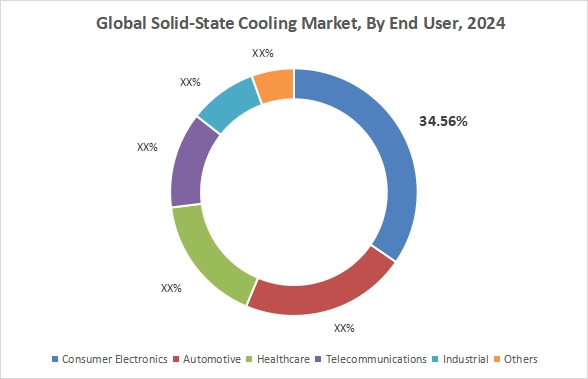
On the basis of end user, the market is divided into consumer electronics, automotive, healthcare, telecommunications, industrial, and other end users.
Trends in the End User:
- The growing requirement for efficient cooling and thermal management is driving the adoption of solid-state cooling systems in consumer electronics, automotive, healthcare, telecommunications, and industrial sectors.
- The growing concerns about device performance, energy efficiency, and system reliability are supporting the demand in all end-use industries.
Consumer electronics sector accounted for the largest revenue share of 34.56% in 2024.
- The consumer electronics sector has a high demand for efficient cooling solutions, which require precise temperature management.
- Additionally, the growing adoption of solid-state cooling systems in smartphones, laptops, and wearable devices is supporting the sector’s dominance.
- Furthermore, the growing demand for compact and high-performance electronic devices is boosting adoption.
- Thus, the consumer electronics segment’s dominance is being driven by the widespread implementation of solid-state cooling systems.
Automotive sector anticipated to register the fastest CAGR during the forecast period.
- Electric vehicles require efficient thermal management systems, which increases the need for solid-state cooling solutions.
- Moreover, the increasing use of solid-state cooling systems in battery thermal management is driving the growth of this market segment.
- Additionally, the growing need to improve battery efficiency and performance is driving the growth of the solid-state cooling market.
- Also, the use of advanced cooling technologies enables efficient battery temperature management and performance optimization.
- Therefore, the trend of adopting advanced thermal management systems is increasing the growth of the automotive sector.
Regional Analysis:
North America, Europe, Asia Pacific, the Middle East and Africa, and Latin America are the regions of coverage.
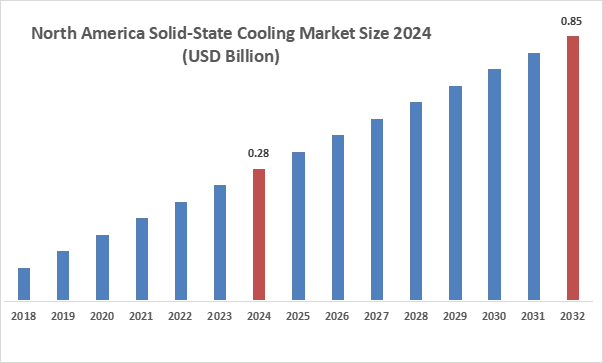
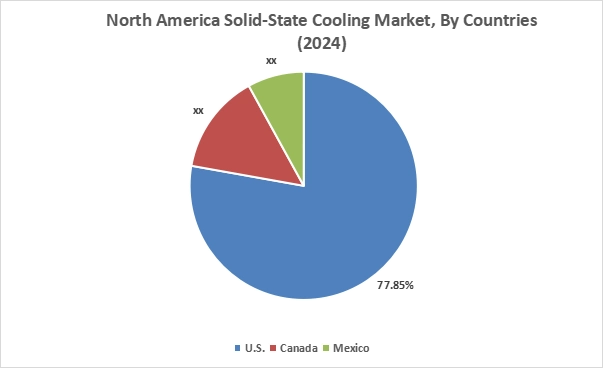
In 2024, North America accounted for the highest market share at 34.60% and was valued at USD 0.28 Billion, and is expected to reach USD 0.85 Billion by 2035. In North America, the U.S. accounted for the highest market share of 77.85% during the base year of 2024. The US accounted for the highest revenue share. Market growth is primarily driven by early adoption of advanced cooling technologies and increasing demand for energy-efficient cooling systems in electronics and automotive industries, which supports regional leadership. Furthermore, strong technological advancements and increasing investment in advanced cooling technologies are propelling system deployment. While other countries are expected to drive market demand in the North American region over the forecast period.
- For instance, in March 2023, the US Department of Energy (DOE) announced USD 40 million in funding for 15 projects that will develop high-performance and energy efficient cooling solutions for data centers.
In Asia Pacific, the Solid-State Cooling market is projected to witness the fastest growth with an estimated CAGR of 12.94% over the forecast period 2025–2035. The Asia Pacific market is growing due to the rising production of consumer electronics and electric vehicles. In addition, the growing investment in advanced technologies and increasing industrial development are driving the growth of the market in the Asia Pacific region.
- For example, according to India Brand Equity Foundation (IBEF), the EV sector in India is projected to reach USD 234 billion by 2030, highlighting a growth opportunity for the solid-state cooling market in the coming future.
Europe solid-state cooling market is growing owing to increasing adoption of energy-efficient cooling technologies and rising demand for compact thermal management solutions in electronics, automotive, and healthcare sectors are driving growth of the solid-state cooling market in this region.
Market growth in the Middle East & Africa solid-state cooling market is expanding due to rising investment in advanced infrastructure, growing adoption of electronics and telecommunications equipment, and increasing demand for reliable cooling solutions in harsh environmental conditions are driving demand in this region.
Latin America solid-state cooling market is driven by increasing adoption of advanced electronics, rising development of industrial infrastructure, and growing demand for efficient and low-maintenance cooling technologies are driving demand for solid-state cooling solutions in this region.
Top Key Players & Market Share Insights:
The solid-state cooling market is fairly competitive, with key manufacturers offering solutions for both national and international markets. Furthermore, players are employing methods such as product launches, partnerships, and expansion to maintain a competitive advantage in the solid-state cooling market. Key participants in the market include:
- Ferrotec Holdings Corporation– Japan
- Coherent Corp– US
- Delta Electronics Inc.– Taiwan
- Tark Thermal Solution – US
- Laird Thermal Systems, Inc. – Germany
- Thermion Company – US
- Mercury Systems, Inc. – US
- RMT Ltd. – Russia
- Kryotherm – Russia
- Phononic Inc. – US
Recent Industry Developments:
- In January 2026, Coherent Corp. launched its Bondable Diamond solutions for thermal management that allows direct bonding to semiconductor die for electronic and opto-electronic applications to improve the cooling performance of devices.
- In November 2025, Delta Electronics exhibited new advanced cooling solutions for AI and HPC systems at Supercomputing 2025, which include new liquid cooling plates and high-capacity coolant distribution units (CDUs) to address the growing demands of thermal management from chip to rack level in AI infrastructure.
- In April 2025, Ferrotec introduced the FTC100 smart temperature controller for thermoelectric modules optimized for precision temperature applications. This controller enhances performance in systems using thermoelectric modules by offering features such as PWM control, bi-directional power support, and broad sensor compatibility.
Solid-State Cooling Market Report Insights:
| Report Attributes | Report Details |
|---|---|
| Study Timeline | 2024-2035 |
| Market Size in 2035 (USD Billion) | USD 2.46 Billion |
| CAGR (2025-2032) | 10.5% |
| By Cooling Type |
|
| By Products |
|
| By Technology |
|
| By End User |
|
| By Region |
|
| Key Players |
|
| Report Coverage |
|
Key Questions Answered in the Report
How big is the solid-state cooling market? −
Solid-state cooling market size is estimated to reach over USD 2.46 Billion by 2035 from a value of USD 0.82 Billion in 2024 and is projected to grow by USD 0.90 Billion in 2025, growing at a CAGR of 10.5% from 2025 to 2035.
Which segmentation details are covered in the solid-state cooling report? +
The solid-state cooling report includes specific segmentation details for cooling type, products, technology, end user, and regions.
Which is the fastest segment anticipated to impact the market growth? +
In the solid-state cooling market, the thermocycler is the fastest-growing segment during the forecast period, driven by the rising use of thermocyclers in biotechnology, healthcare, and diagnostic applications.
Who are the major players in the solid-state cooling market? +
The key participants in the solid-state cooling marketare Ferrotec Holdings Corporation (Japan), Coherent Corp (U.S.), Delta Electronics, Inc. (Taiwan), Tark Thermal Solutions (U.S.), Laird Thermal Systems, Inc. (Germany), Thermion Company (U.S.), Mercury Systems, Inc. (U.S.), RMT Ltd. (Russia), Kryotherm (Russia), and Phononic, Inc. (U.S.) and others.
What are the key trends in the solid-state cooling market? +
The solid-state cooling market is shaped by key trends including increasing demand for energy-efficient cooling solutions and other key trends driving the market.
Overview
Reputation & Certifications


Our Services
- Market Intelligence & Forecasting
- Custom Research Solutions
- Market Entry Strategy
- Competitive Intelligence
- Customer Insights
- Industry Innovation Analysis
- Investment Advisory