Jump to Content
Sleep Apnea Devices Market Size & Industry Share - Growth Trends & Forecasts (2026 - 2034)
Sleep Apnea Devices Market Size:
Sleep Apnea Devices Market is estimated to reach over USD 25.29 Billion by 2034 from a value of USD 9.95 Billion in 2025 and is projected to grow by USD 10.89 Billion in 2026, growing at a CAGR of 9.8% from 2026 to 2034.
Sleep Apnea Devices Market Key Takeaways
- Asia Pacific led the market due to increasing awareness and healthcare investments.
- Therapeutic devices dominated the market, led by PAP therapy systems.
- Adults accounted for the largest share of demand.
- AI-powered monitoring and home sleep testing are improving diagnosis and treatment.
- ResMed, Philips, and Fisher & Paykel Healthcare were key market players.
Sleep Apnea Devices Market Scope & Overview:
Sleep apnea devices are specialized medical instruments designed to diagnose and manage sleep-disordered breathing conditions where a patient's airflow repeatedly stops and starts during sleep. These devices encompass diagnostic tools like polysomnography systems and home testing kits to identify the condition, alongside therapeutic solutions such as positive airway pressure (PAP) machines and custom oral appliances that keep the airway open during rest. Further, key trends driving the market include the widespread decentralization of diagnostics toward convenient home sleep apnea testing (HSAT) and the integration of digital health connectivity, such as AI-enabled monitoring and cloud-based platforms, to enhance patient compliance and clinical oversight. Additionally, there is a growing consumer preference for minimally invasive, portable, and ergonomically designed therapeutic solutions that prioritize comfort and ease of use in everyday environments.

Sleep Apnea Devices Market Dynamics - (DRO):
Market Drivers:
The market is experiencing rapid expansion, primarily propelled by the rising global prevalence of obstructive sleep apnea and a strategic shift toward home-based care models. Increasing obesity rates, sedentary lifestyles, and an aging population are significantly elevating diagnosis numbers, creating a larger patient pool requiring effective long-term therapy. Simultaneously, the industry is transitioning toward decentralized diagnostic and therapeutic pathways, where home sleep apnea testing (HSAT) and remote patient monitoring provide patients with greater convenience, affordability, and comfort compared to traditional, resource-intensive clinical settings. This synergy between heightened disease awareness and the adoption of user-friendly, connected, and portable home-use technologies is streamlining treatment initiation, enhancing patient adherence, and ultimately accelerating market growth.
- For instance, in 2024, EnsoData received FDA clearance for its AI-powered technology that enables the diagnosis of sleep disorders using standard, FDA-cleared pulse oximetry devices. This advancement allows for more accessible sleep diagnostics by leveraging artificial intelligence to analyze data from common oximeters.
Thus, the increasing integration of digital health solutions, improved accessibility to portable diagnostic tools, and the growing demand for personalized long-term therapy contribute significantly to the rise in the sleep apnea devices market size.
Market Restraints:
Diagnostic Barriers and High Costs are Limiting the Market Growth
Diagnostic barriers and high costs continue to act as significant barriers for the global market, hindering widespread adoption and effective disease management. The complexity of the diagnostic pathway, often requiring specialist referrals and lengthy waits for clinical polysomnography, leaves a large portion of the patient population undiagnosed. Furthermore, the high financial burden of premium therapeutic devices, such as CPAP machines, creates a substantial barrier for patients, particularly in regions with limited insurance coverage or out-of-pocket payment models. When coupled with a persistent shortage of trained sleep specialists and the administrative friction of navigating complex reimbursement frameworks, these challenges collectively restrict market penetration and delay essential patient access to treatment.
Market Opportunities:
Technological Advancements Drive Sleep Apnea Devices Market Opportunities
Technological advancements are serving as a primary catalyst for growth in the market, opening up significant opportunities by enhancing both patient experience and clinical efficiency. The integration of artificial intelligence and machine learning is revolutionizing diagnostic accuracy and therapeutic delivery, enabling devices to automatically adjust pressure in real-time based on a patient’s specific breathing patterns. Furthermore, the move toward miniaturization and portable, connected designs, often supported by IoT capabilities, has made remote patient monitoring and cloud-based data management standard, which significantly improves long-term therapy adherence. These innovations not only address the critical demand for more comfortable, user-friendly solutions but also allow healthcare providers to streamline workflows and reach larger, previously undiagnosed patient populations more effectively. Thus, the aforementioned market factors are expected to drive the market opportunities during the forecast period.
Sleep Apnea Devices Market Segmental Analysis:
By Product Type:
Based on the product type, the market is segmented into Therapeutic Devices (PAP Devices, Oral Appliances, Nasal Devices, and Others) and Diagnostic Devices (Polysomnography (PSG) systems, Home Sleep Testing (HST) kits, Pulse Oximeters, and Others).
Trends in the Product Type:
- Next-generation humidifiers automatically adjust moisture levels based on room temperature and breathing patterns to prevent dryness and condensation, which is driving the sleep apnea devices market trends.
- PAP units are becoming more compact, incorporating whisper-quiet blowers and long-lasting battery options to support patient lifestyle and mobility, which in turn drives the market.
Therapeutic Devices (EPS) accounted for the largest revenue share in the year 2025.
- Modern PAP devices now utilize AI and machine learning to adjust pressure in real-time, delivering only the necessary pressure to minimize discomfort and improve sleep continuity, which in turn drives the market.
- Further, custom-fitted mandibular advancement devices (MADs) are increasingly produced using intraoral scanning and 3D printing, replacing traditional, less precise mechanical impressions.
- Furthermore, devices now feature built-in Bluetooth and Wi-Fi for automatic data syncing, allowing clinicians to perform remote adjustments and monitor therapy adherence, which in turn drives the sleep apnea devices market trends.
- Thus, as per the sleep apnea devices market analysis, adaptive airflow algorithms, smart connectivity, and others are driving the market.
Diagnostic Devices is anticipated to register the fastest CAGR during the forecast period.
- There is a growing shift toward Home Sleep Testing (HST) as a first-line diagnostic tool, reducing reliance on expensive, limited-capacity in-lab polysomnography.
- Further, artificial intelligence is being integrated into diagnostic software to analyze sleep data, significantly reducing the time required for manual interpretation by specialists, which subsequently propels the sleep apnea devices market expansion.
- Furthermore, newer patch-based sensors and wearables are replacing bulky nasal cannulas and chest belts, allowing for multi-night monitoring in natural settings, which in turn drives the market.
- Therefore, based on analysis, the aforementioned factors are anticipated to boost the market during the forecast period.
By Patient Type:
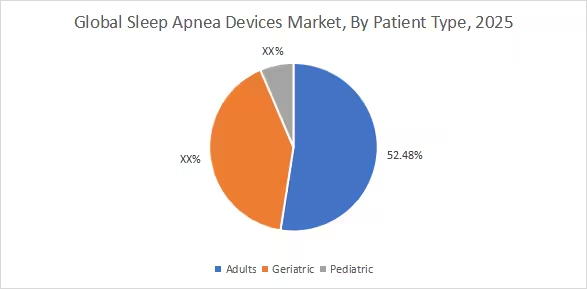
Based on the patient type, the market is segmented into adults, geriatric, and pediatric.
Trends in the Patient Type:
- Development of smaller, ergonomically designed masks and accessories that are specifically sized and shaped for pediatric facial structures to improve comfort is expected to drive the sleep apnea devices market demand.
- Innovations like heated humidification and climate-smart tubing are standard in geriatric care to prevent common issues like dry mouth and nasal irritation, driving the sleep apnea devices market share.
Adults accounted for the largest revenue share of 52.48 % in the year 2025.
- Adults are increasingly using a mix of traditional CPAP with new weight-loss medications to manage both the airway obstruction and the underlying obesity condition.
- Further, devices now feature smartphone-like color touchscreens and voice-guided setups, making it easier for adult users to manage their own therapy at home, which subsequently propels the market.
- Furthermore, due to high CPAP abandonment rates, there is a significant shift toward oral appliances and implantable neurostimulation devices, which in turn drives the market.
- Thus, as per the sleep apnea devices market analysis, personalized combination therapy, advanced user interfaces, and others are driving the market.
Geriatric is anticipated to register the fastest CAGR during the forecast period.
- Manufacturers are prioritizing highly intuitive, simplified device designs that require minimal dexterity or complex manual adjustments, which in turn drives the market.
- Further, routine follow-ups are increasingly moving to telehealth platforms, reducing the burden of travel for elderly patients, in turn driving the sleep apnea devices industry.
- Furthermore, devices are evolving to monitor broader health metrics beyond just airflow, such as oxygen saturation, which is vital for elderly patients with complex healthcare demands, which in turn drives the market.
- Therefore, based on analysis, the aforementioned trends are anticipated to boost the market during the forecast period.
By End User:
Based on the end user, the market is segmented into home care settings and hospitals & sleep clinics.
Trends in the End User:
- Sleep labs are adopting advanced digital PSG platforms that improve signal accuracy and streamline data interpretation, allowing for higher patient throughput, which in turn drives the sleep apnea devices market growth.
- Clinics are evolving into multi-specialty centers that integrate sleep medicine with ENT, dental, and weight-management services to provide comprehensive treatment plans, in turn driving the market.
Home care settings accounted for the largest revenue share in the year 2025 and is anticipated to register a significant CAGR during the forecast period.
- Home sleep apnea testing (HSAT) has become the first-line diagnostic pathway for many patients, significantly reducing wait times and bypassing the demand for a traditional sleep lab.
- Further, connected PAP devices automatically sync data to the cloud, allowing clinicians to monitor therapy adherence and adjust settings remotely without requiring patient visits.
- Furthermore, many providers now offer subscription-based models for devices and consumables, which reduces upfront costs and increases long-term patient engagement.
- Thus, based on analysis, the aforementioned factors are anticipated to boost the growth of the market during the forecast period.
Sleep Apnea Devices Market Regional Analysis:
The regions covered are North America, Europe, Asia Pacific, Middle East and Africa, and Latin America.
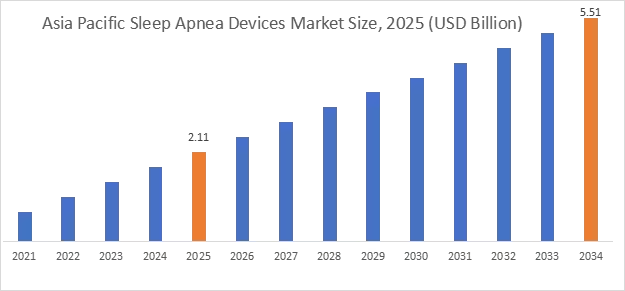
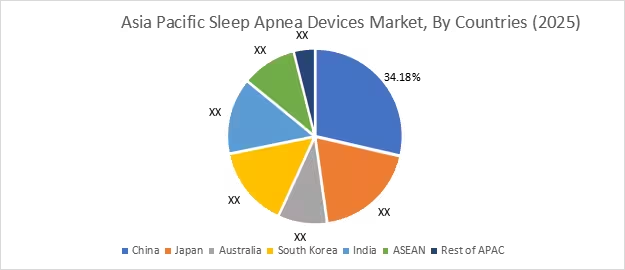
The Asia Pacific region was valued at USD 2.11 Billion in 2025. Moreover, it is projected to grow by USD 2.31 Billion in 2026 and reach over USD 5.51 Billion by 2034. Out of this, China accounted for the maximum revenue share of 34.18%. The market growth is mainly driven by the increasing prevalence of sleep disorders, such as obstructive sleep apnea, linked to rising obesity rates, sedentary lifestyles, and an aging population. Additionally, expanding healthcare infrastructure, greater awareness of sleep health, and supportive government initiatives are accelerating market expansion across the region.
For instance, in May 2026, Apple launched new health features in India, bringing sleep apnea notifications to Apple Watch and a clinically validated Hearing Test feature to AirPods Pro. These tools are designed to empower users to proactively monitor their health by detecting conditions that might otherwise go unnoticed, all from the convenience of their own homes.
North America is estimated to reach over USD 10.61 Billion by 2034 from a value of USD 4.19 Billion in 2025 and is projected to grow by USD 4.59 Billion in 2026. The North American market is primarily driven by the increasing prevalence of obstructive sleep apnea, fueled by rising obesity rates and an aging population. Additionally, growth is significantly supported by a well-established healthcare infrastructure, favorable reimbursement frameworks, and widespread patient awareness.
- For instance, in March 2024, ResMed launched the AirFit F40 in the United States, an ultra-compact, under-the-nose full-face mask designed to improve sleep apnea therapy compliance. The mask is specifically engineered for flexibility, with 96% of users reporting that it allows them to sleep comfortably in their preferred positions throughout the night.
The regional trends analysis depicts that an aging population and shift toward convenient, home-based diagnostic and therapeutic solutions in Europe are driving the market. Additionally, the factors driving the market in the Middle East and African region are technological advancements and the rising adoption of home-based diagnostics. Further, expanded healthcare infrastructure and growing awareness in the Latin America region are driving the market.
Top Key Players & Market Share Insights:
The global sleep apnea devices market is highly competitive, with major players providing solutions to the national and international markets. Key players are adopting several strategies in research and development (R&D), product innovation, and end-user launches to hold a strong position in the sleep apnea devices industry. Key players in the market include-
- ResMed Inc. (U.S.)
- Koninklijke Philips N.V (Netherlands)
- Fisher & Paykel Healthcare (New Zealand)
- Inspire Medical Systems, Inc. (U.S.)
- SomnoMed Limited (Australia)
- BMC Medical Co., Ltd. (China)
- Löwenstein Medical (Germany)
- Drive DeVilbiss Healthcare (U.S.)
- Natus Medical Incorporated (U.S.)
- Nihon Kohden Corporation (Japan)
Recent Industry Developments:
Product Launch
- In November 2024, Fisher & Paykel Healthcare launched its F&P Nova Micro nasal pillows mask in the for treating obstructive sleep apnea. As the company's smallest and lightest mask to date, it weighs under 1.4 ounces and features a soft, inflating cushion designed to conform to the user's nostrils, providing enhanced stability and flexibility for various sleeping positions.
Sleep Apnea Devices Market Insights:
| Report Attributes | Report Details |
| Study Timeline | 2021-2034 |
| Market Size in 2034 | USD 25.29 Billion |
| CAGR (2026-2034) | 9.8% |
| By Product Type |
|
| By Patient Type |
|
| By End User |
|
| By Region |
|
| Key Players |
|
| Report Coverage |
|
Key Questions Answered in the Report
How big is the sleep apnea devices market? −
The sleep apnea devices market is estimated to reach over USD 25.29 Billion by 2034 from a value of USD 9.95 Billion in 2025 and is projected to grow by USD 10.89 Billion in 2026, growing at a CAGR of 9.8% from 2026 to 2034.
What specific segmentation details are covered in the report? +
The report includes specific segmentation details for product type, patient type, end user, and regions.
Which is the fastest segment anticipated to impact the market growth? +
In the market, diagnostic devices is the fastest-growing segment during the forecast period.
Who are the major players in the market? +
The key participants in the market are ResMed Inc. (U.S.), Koninklijke Philips N.V (Netherlands), Fisher & Paykel Healthcare (New Zealand), Inspire Medical Systems, Inc. (U.S.), SomnoMed Limited (Australia), BMC Medical Co., Ltd. (China), Löwenstein Medical (Germany), Drive DeVilbiss Healthcare (U.S.), Natus Medical Incorporated (U.S.), Nihon Kohden Corporation (Japan), and others.
What are the key trends in the market? +
The market is being shaped by several key trends including rapid decentralization of diagnostic and therapeutic care toward home-based settings, the widespread integration of AI-driven digital health and remote monitoring platforms, and a strong emphasis on developing more comfortable, portable, and user-friendly devices.
Overview
Reputation & Certifications


Our Services
- Market Intelligence & Forecasting
- Custom Research Solutions
- Market Entry Strategy
- Competitive Intelligence
- Customer Insights
- Industry Innovation Analysis
- Investment Advisory