Jump to Content
Soil Testing Equipment Market - Size, Share, Industry Trends, and Forecasts (2025-2032)
Soil Testing Equipment Market Size:
Soil Testing Equipment Market size is estimated to reach over USD 11.89 Billion by 2032 from a value of USD 5.32 Billion in 2024 and is projected to grow by USD 5.79 Billion in 2025, growing at a CAGR of 10.6% from 2025 to 2032.
Soil Testing Equipment Market Scope & Overview:
Soil testing equipment comprises a range of specialized instruments used to evaluate the physical and chemical properties of soil across agricultural, construction, and geotechnical applications. These systems are designed to measure parameters such as moisture content, pH level, nutrient composition, compaction, permeability, and shear strength. The instrumentation varies from portable field kits to lab-based analyzers, depending on the depth and accuracy required for specific testing protocols.
Typical components include core samplers, augers, penetrometers, consolidation apparatus, and spectrophotometers, each optimized to assess unique soil characteristics. The soil testing equipment ensures that data from sensors under the surface is captured with accuracy and repeatability, enhancing decision making in both field and laboratory settings.
End-users range from civil engineers and agronomists to environmental consultants and academic researchers who rely on precise diagnostics for evaluating the site, foundation design, or fertility assessment.

Soil Testing Equipment Market Dynamics - (DRO) :
Key Drivers:
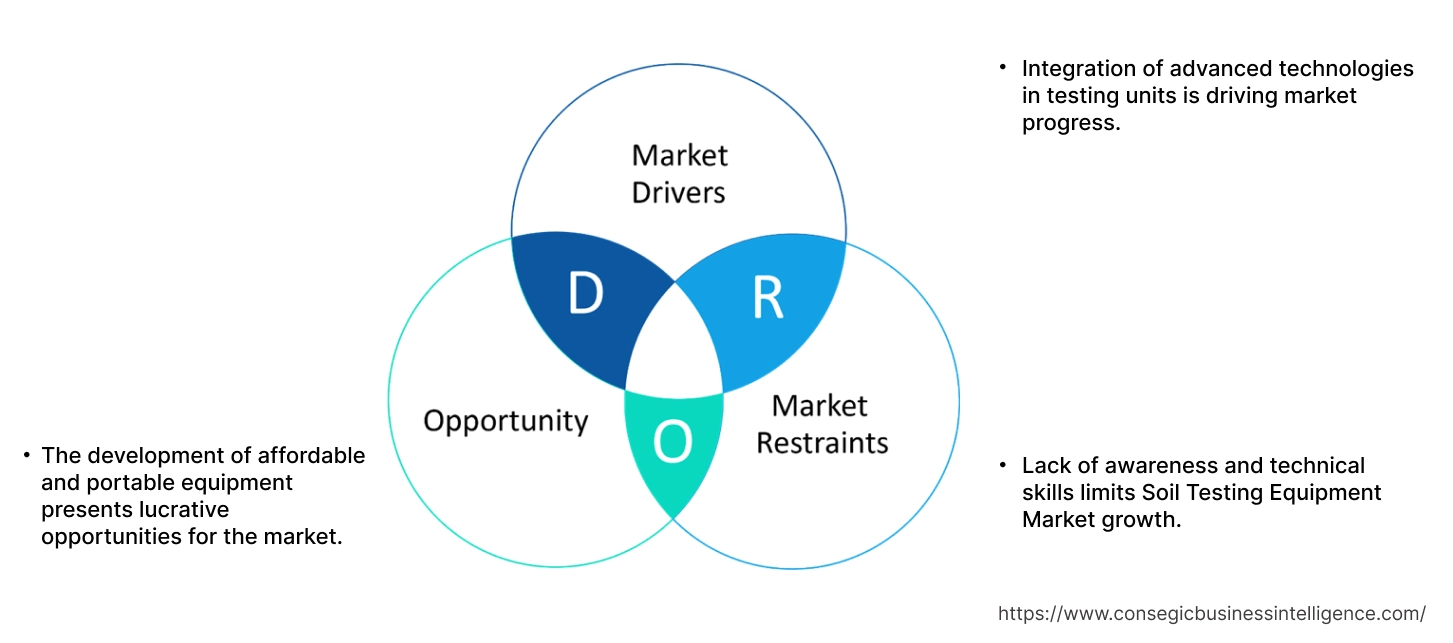
Integration of advanced technologies in testing units is driving market progress.
Advanced technologies are taking over conventional soil testing methods. The integration of digital technologies like IoT, real-time data monitoring, and automation is revolutionizing the agriculture and construction markets. These advancements enable farmers and agricultural researchers to access precise soil data in real time, significantly enhancing decision-making processes. Additionally, the automation of testing reduces human error, speeds up the testing process, and provides more consistent results. As these advanced systems become more affordable and user-friendly, small and large-scale farming operations integrate them into their practices, thus improving productivity and resource efficiency.
- For instance, in May 2024, Hefei Institutes of Physical Science of Chinese Academy of Sciences announced the development of the High Throughput Soil Composition Intelligent Detection Robot Equipment. This equipment is capable of detecting soil nutrients and heavy metals automatically and fully unmanned.
Furthermore, growing food production, and the need for sustainable practices are fostering significant market progress.
Key Restraints:
Lack of awareness and technical skills limits Soil Testing Equipment Market growth.
In many rural and remote farming regions, there is a significant gap in awareness and technical expertise regarding advanced soil testing equipment. Many farmers still rely on traditional agricultural practices, often overlooking the potential benefits of modern testing methods. The complex configuration of advanced soil testing devices, combined with a lack of sufficient training and education, restricts their adoption. Farmers in these areas may not fully understand how to interpret the results, or they may find it challenging to operate high-tech systems effectively. This lack of accessibility to training and support discourages farmers from making the necessary investment in advanced soil testing tools, thereby limiting the growth and adoption of these systems in underdeveloped agricultural regions. Therefore, the large inaccessible education and training in rural areas impedes market growth and limits their potential.
Future Opportunities :
The development of affordable and portable equipment presents lucrative opportunities for the market.
Many small-scale farmers, particularly in developing regions, lack access to professional soil testing services due to geographic or financial barriers. Portable, easy-to-use devices that offer quick, accurate soil study will be a game-changer in these markets. Additionally, these devices will provide rapid on-site results and help them in making informed decisions about irrigation, fertilization, and crop management without the need for external labs.
- For instance, In November 2024, The Indian Institute of Technology Kanpur (IITK) announced the launch of ‘Soil Nutrient Sensing Device’ and to boost its worldwide acceptance, they signed a technology transfer MoU with ScaNxt Scientific Technologies Pvt. Ltd. This device is compact and delivers real-time soil nutrient analysis and leverages Near-Infrared (NIR) Spectroscopy that provides rapid soil insights directly on the phone.
Furthermore, reducing the operational costs of this technology will make it easier for the farmers in rural areas to avail and not only improve soil management practices but also empower farmers with the tools necessary to enhance productivity and sustainability, boosting global soil testing equipment market opportunities.
Soil Testing Equipment Market Segmental Analysis :
By Test Type:
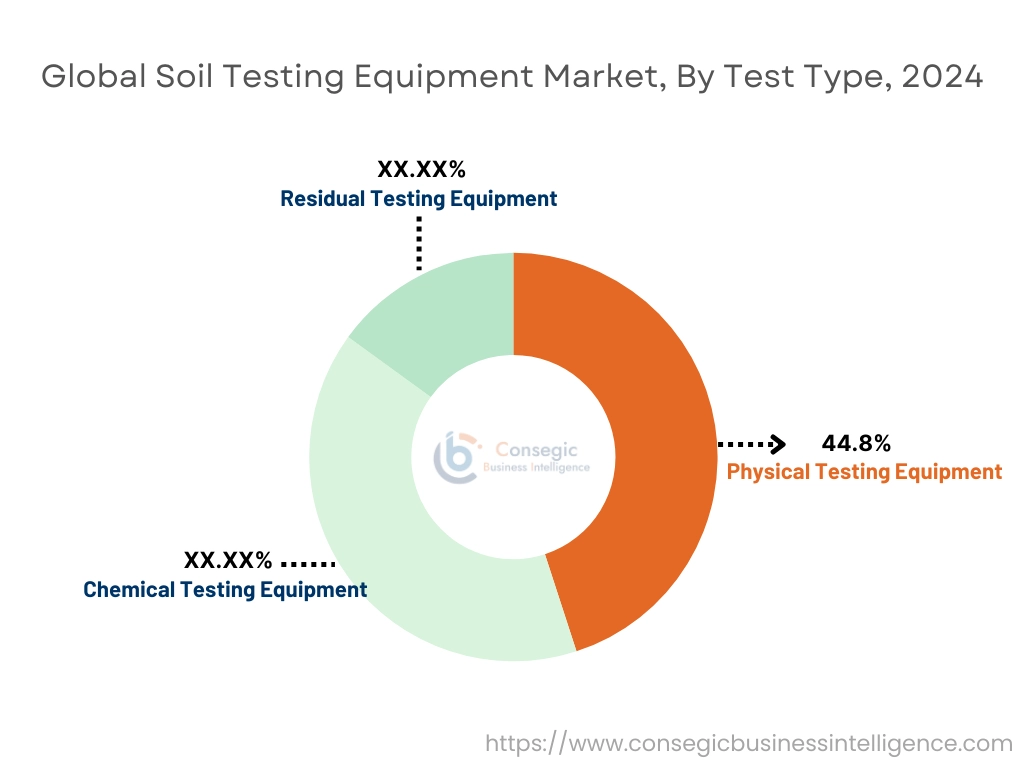
Based on test type, the market is categorized into Physical Testing Equipment (Grain Size Testing Equipment, Permeability Equipment, Shear Strength Equipment, Field Testing Equipment, and Others), Chemical Testing Equipment (pH Meters, EC Meters, Spectrophotometers, and Others), and Residual Testing Equipment (GC-MS, ICP-MS, and Others).
The physical testing equipment holds the largest revenue of the overall Soil Testing Equipment Market share of 44.8% in the year 2024.
- The physical soil testing equipment assesses soil features like moisture content, soil compaction, density, and strength.
- Instruments such as shear boxes, proctor compaction tools, and permeability cells are critical to ensuring soil stability prior to construction or land use.
- Additionally, these systems are commonly used across government labs, universities, and construction market processes due to well-established international standards.
- According to the soil testing equipment market analysis, the wide variety of components and uses of physical testing equipment make it the largest segment, fueling the soil testing equipment market expansion.
The chemical testing equipment segment is expected to grow at the fastest CAGR during the forecast period.
- Chemical testing equipment is essential for evaluating soil pH, organic matter, nutrient levels, salinity, and contamination, making it a key tool in modern precision agriculture.
- Instruments such as spectrophotometers, ion-selective electrodes, and colorimeters are increasingly being miniaturized and integrated into portable formats, improving accessibility for agronomists.
- Additionally, the increased adoption of nutrient management systems specific to sites and reduced fertilizer use has boosted market growth.
- As per the market analysis, efficient environment monitoring and rising regenerative farming methods, fuel the global soil testing equipment market trends.
By Site:
Based on site, the market is categorized into laboratory testing and on-site testing.
The laboratory testing holds the largest revenue of the overall Soil Testing Equipment Market share in the year 2024.
- Laboratory testing enables higher accuracy, reliability, and consistency of soil test results due to controlled environmental conditions and advanced instrumentation.
- Laboratory testing continues to dominate procurement budgets across research institutions and infrastructure development firms.
- Additionally, centralized testing facilities are typically equipped with automated testing platforms, that allow for bulk processing and detailed geochemical and geotechnical analyses of the soil.
- For instance, in January 2025, Coromandel International Limited opened an advanced Soil and Leaf Testing Laboratory in Kakinada. It is equipped with cutting-edge technologies to provide accurate soil and plant nutrient analysis, assisting farmers across India with better soil and its nutrients understanding.
- According to the soil testing equipment market analysis, dependency of various industries on laboratory-based assessments and the ability to cater to high precision and accuracy demands, laboratories contribute to the largest market share, significantly fueling the market growth.
The on-site testing segment is expected to grow at the fastest CAGR during the forecast period.
- On-site testing equipment offers rapid results for decision-making in field operations, construction zones, and mobile agronomic services.
- On-site testing allows for real-time corrective actions such as fertilizer application or site excavation decisions, enhancing operational efficiency.
- Rising use of mobile laboratories in smart farming initiatives and remote infrastructure projects is increasing the penetration of field-based testing methods.
- For instance, in August 2024, EarthOptics announced a merger with Pattern Ag to provide a digital twin of on-site soil sensing technologies to give farmers insights into soil nutrients, biofertility, pests and pathogens, and more.
- As per the market trends, rising requirements for rapid soil testing and evaluation have substantially driven the global soil testing equipment market demand.
By End-use Industry:
Based on end-use industry, the market is categorized into agriculture, construction, and others.
The construction segment holds the largest revenue share of the overall Soil Testing Equipment Market in the year 2024.
- Soil testing plays a pivotal role in determining the foundation design, slope stability analysis, and drainage planning in civil construction and infrastructure projects.
- Major construction firms and government contractors deploy specialized equipment for bearing heavy load, permeability, and ensuring balanced infrastructure.
- The expansion of transportation networks, urban housing projects, and residential infrastructure across emerging economies requires high demand for soil testing.
- Thus, the market analysis shows that high demand in construction firms ensure strong soil capacity and heavy reliance on this equipment, significantly driving the soil testing equipment market trends.
The agriculture segment is expected to grow at the fastest CAGR during the forecast period.
- Soil testing is crucial for precision farming, which emphasizes input optimization, crop-specific nutrient balancing, and sustainability.
- Farmers, cooperatives, and Agri-tech providers are readily adopting portable and cost-effective soil testing kits to improve crop yield and soil fertility.
- Additionally, many government initiatives are being led to empower smart agriculture practices to promote soil testing adoption in farming.
- For instance, in February 2025, Governor Mutula Kilonzo Jr., of Makueni County in Kenya, launched a digital soil testing exercise. The initiative, led by the National Agricultural Value Chain Development Project (NAVCDP) in partnership with the county government through Kenya Agricultural and Livestock Research Organization (KALRO) aims to support crop development, food production and better nutrient quality in Makueni.
- According to the market analysis, the shifting trend of smart soil testing practices in farming and expanding agriculture segment is significantly fueling the global soil testing equipment market expansion.
Regional Analysis:
The regions covered are North America, Europe, Asia Pacific, Middle East and Africa, and Latin America.
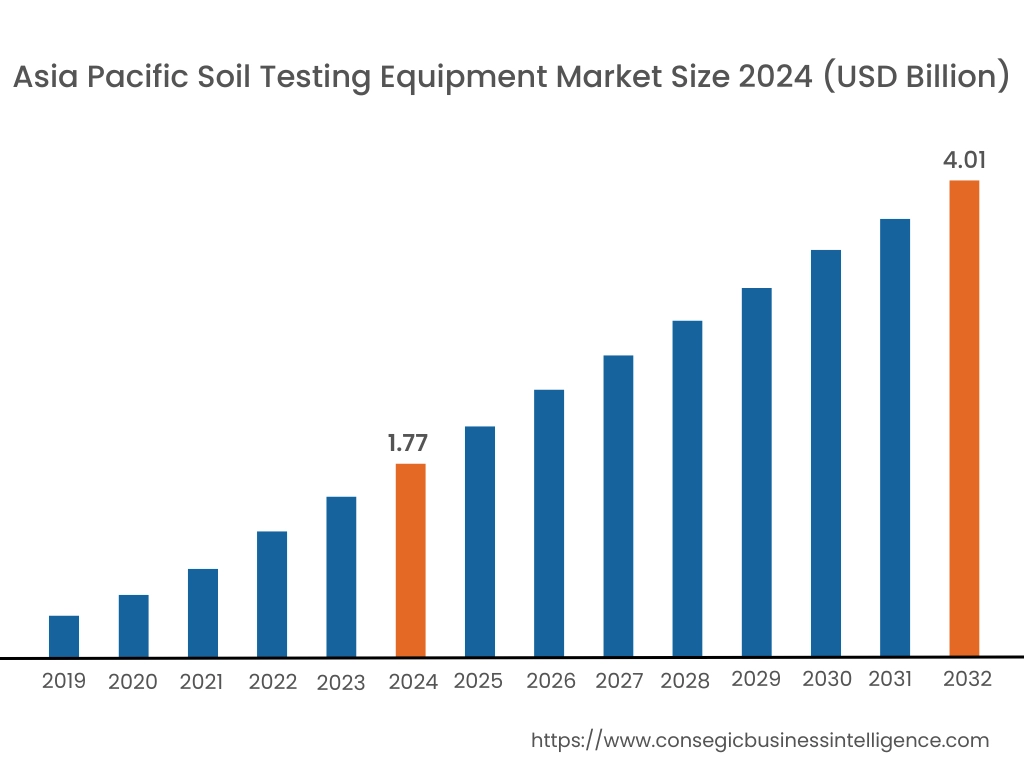
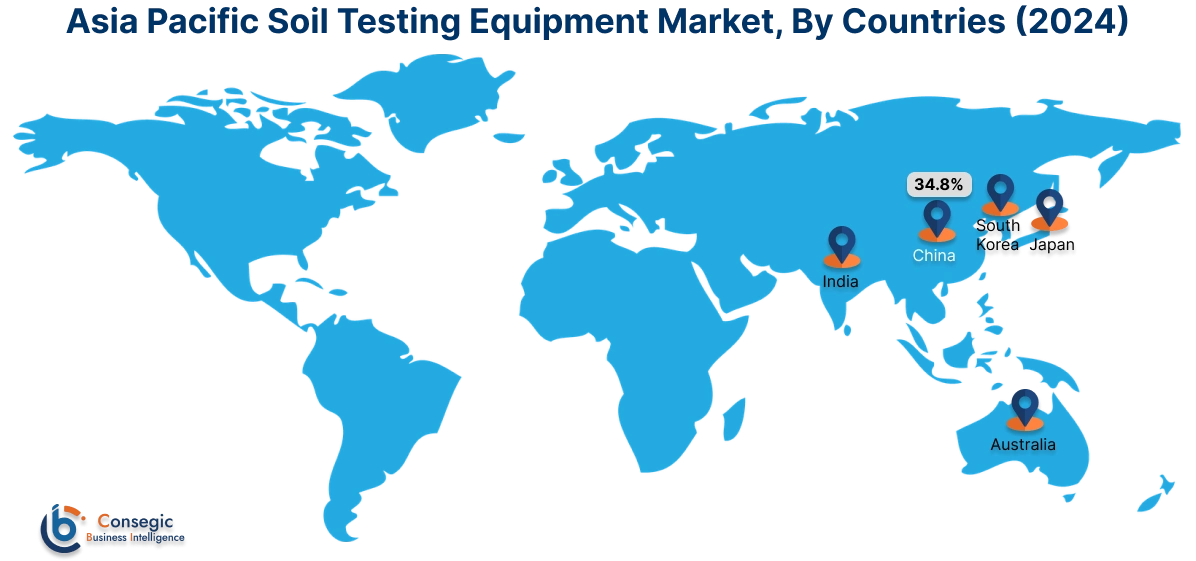
Asia Pacific region was valued at USD 1.77 Billion in 2024. Moreover, it is projected to grow by USD 1.93 Billion in 2025 and reach over USD 4.01 Billion by 2032. Out of this, China accounted for the maximum revenue share of 34.8%.
Asia-Pacific region is predominated by agricultural practices mainly in countries like China, India, Indonesia and Australia. Additionally, rapid industrialization and diverse agriculture are fostering the adoption of modern soil testing solutions.
- For instance, in January 2025, Reddy’s Laboratories and Dr. Reddy’s Foundation, based in Hyderabad, announced the inauguration of their new soil testing resource centre. It is spread across an area of 14,750 sq. ft., aimed to deliver rapid and affordable soil testing to various market experts, agronomists and farmers.
Furthermore, the proactive government initiatives to provide farmers with subsidies, tax credits, and incentives have significantly driven the soil testing equipment market demand.
North America is estimated to reach over USD 3.51 Billion by 2032 from a value of USD 1.56 Billion in 2024 and is projected to grow by USD 1.70 Billion in 2025.
In North America, the market is influenced by the rising trend in precision farming and advanced agriculture practices. Additionally, the rising investments by market giants to leverage technological advancements in smart sensor technology for accurate field monitoring and precise soil testing performance fuels the market development.
- For instance, in June 2024, Agilent Technologies Inc. introduced two new products at the 72nd ASMS Conference on Mass Spectrometry and Allied Topics. One of which being the ‘Agilent 7010D Triple Quadrupole GC/MS System’, a gas chromatography-mass spectroscopy specially designed to precisely test environmental samples like soil and water and food samples.
Furthermore, the increasing collaboration and partnerships between manufacturers and agricultural stakeholders have significantly driven the soil testing equipment industry in this region.
Europe exhibits a strong presence in the market due to the robust focus on sustainability and soil conservation practices. Additionally, shifting trend towards innovative technological advances enable farmers to optimize their fertilizer usage based on real‑time soil data, while another trend focuses on incorporating advanced optical and chemical sensors into the testing process. Furthermore, stringent regulations and environmental priorities put forward by government agencies have significantly boosted the soil testing equipment market in this region.
The Soil Testing Equipment Market in the Middle East and Africa experiences steady growth mainly due to the unique climatic conditions, and unsteady water resources. A significant trend observed in this region is the rise in demand for customization of digital monitoring tools to manage soil requirements. Furthermore, growing modern agricultural infrastructure and supportive policy measures have fueled the soil testing equipment market in this region.
In Latin America, the shifting trend for sustainable crop management to improve soil fertility and crop quality cater to the market demand in this region. Additionally, market players are contributing to the advancements in testing equipment, integrating them with smart sensor technologies and platforms that combine on‑field data with remote management systems. Furthermore, the growing awareness about precision farming and implementing sustainability drives soil testing equipment market growth in this region.
Top Key Players and Market Share Insights:
The Soil Testing Equipment Market is highly competitive with major players providing products and services to the national and international markets. Key players are adopting several strategies in research and development (R&D), product innovation, and end-user launches to hold a strong position in the global Soil Testing Equipment Market. Key players in the Soil Testing Equipment industry include -
- LaMotte Company (United States)
- Reddy’s Laboratories Ltd. (India)
- Controls S.p.A. (Italy)
- GroundTruth Ag, Inc. (United States)
- Coromandel International Limited (India)
- Humboldt Mfg. Co. (United States)
- ELE International (United Kingdom)
- Agilent Technologies Inc. (United States)
- Thermo Fisher Scientific Inc. (United States)
- Geotechnical Testing Equipment UK Ltd (United Kingdom)
Recent Industry Developments :
Research and Development:
- In January 2025, Cornell Tech at Cornell Institute developed a SoilScanner device, that transfers radio waves at different frequencies from an RF transmitter and analyses lead contamination levels with the help of machine learning in the soil.
Product Launches:
- In April 2024, EarthOptics launched its new subscription-based Total Farm Program, combining the EarthOptics GroundOwl sensor suite, soil biological test results (DNA), a farmer’s yield data, satellite images of the field to ensure soil fertility, and provide crop planning recommendations to farmers.
Soil Testing Equipment Market Report Insights:
| Report Attributes | Report Details |
| Study Timeline | 2019-2032 |
| Market Size in 2032 | USD 11.89 Billion |
| CAGR (2025-2032) | 10.6% |
| By Test Type |
|
| By Site |
|
| By End-Use Industry |
|
| By Region |
|
| Key Players |
|
| North America | U.S. Canada Mexico |
| Europe | U.K. Germany France Spain Italy Russia Benelux Rest of Europe |
| APAC | China South Korea Japan India Australia ASEAN Rest of Asia-Pacific |
| Middle East and Africa | GCC Turkey South Africa Rest of MEA |
| LATAM | Brazil Argentina Chile Rest of LATAM |
| Report Coverage |
|
Key Questions Answered in the Report
How big is the Soil Testing Equipment Market? −
Soil Testing Equipment Market size is estimated to reach over USD 11.89 Billion by 2032 from a value of USD 5.32 Billion in 2024 and is projected to grow by USD 5.79 Billion in 2025, growing at a CAGR of 10.6% from 2025 to 2032.
What specific segments are covered in the Soil Testing Equipment Market? +
The Soil Testing Equipment Market specific segments for Test Type, Site, End-Use Industry, and Region.
Which is the fastest-growing region in the Soil Testing Equipment Market? +
Asia-Pacific is the fastest growing region in the Soil Testing Equipment Market.
What are the major players in the Soil Testing Equipment Market? +
The key players in the Soil Testing Equipment Market are ELE International (United Kingdom), Agilent Technologies Inc. (United States), Thermo Fisher Scientific Inc. (United States), Geotechnical Testing Equipment UK Ltd (United Kingdom), LaMotte Company (United States), Dr. Reddy’s Laboratories Ltd. (India), Controls S.p.A. (Italy), Humboldt Mfg. Co. (United States), GroundTruth Ag, Inc. (United States), Coromandel International Limited (India), and others.
Overview
Reputation & Certifications


Our Services
- Market Intelligence & Forecasting
- Custom Research Solutions
- Market Entry Strategy
- Competitive Intelligence
- Customer Insights
- Industry Innovation Analysis
- Investment Advisory