Jump to Content
Surveillance Radars Market - Size, Share, Industry Trends, and Forecasts (2025 - 2032)
Surveillance Radars Market Size:
Surveillance Radars Market size is estimated to reach over USD 21,034.02 Million by 2032 from a value of USD 10,444.06 Million in 2024 and is projected to grow by USD 11,217.54 Million in 2025, growing at a CAGR of 10.1% from 2025 to 2032.
Surveillance Radars Market Scope & Overview:
The surveillance radars encompass radar systems designed to monitor and detect objects or activities in a specified area, ensuring situational awareness and security. These radars are utilized across various applications, including border security, air traffic control, maritime surveillance, and infrastructure protection. They provide real-time data on the movement and positioning of objects, enabling precise tracking and monitoring.
These systems are available in different configurations, such as ground-based, airborne, and naval radars, catering to specific operational needs. They are engineered to operate efficiently in diverse environments, offering features such as long-range detection, high-resolution imaging, and advanced signal processing. The integration of modern technologies ensures reliability and accuracy in critical operations.
End-users include defense agencies, aviation authorities, and commercial sectors requiring advanced monitoring and detection capabilities. These radars play a vital role in enhancing safety, security, and operational efficiency across various industries.
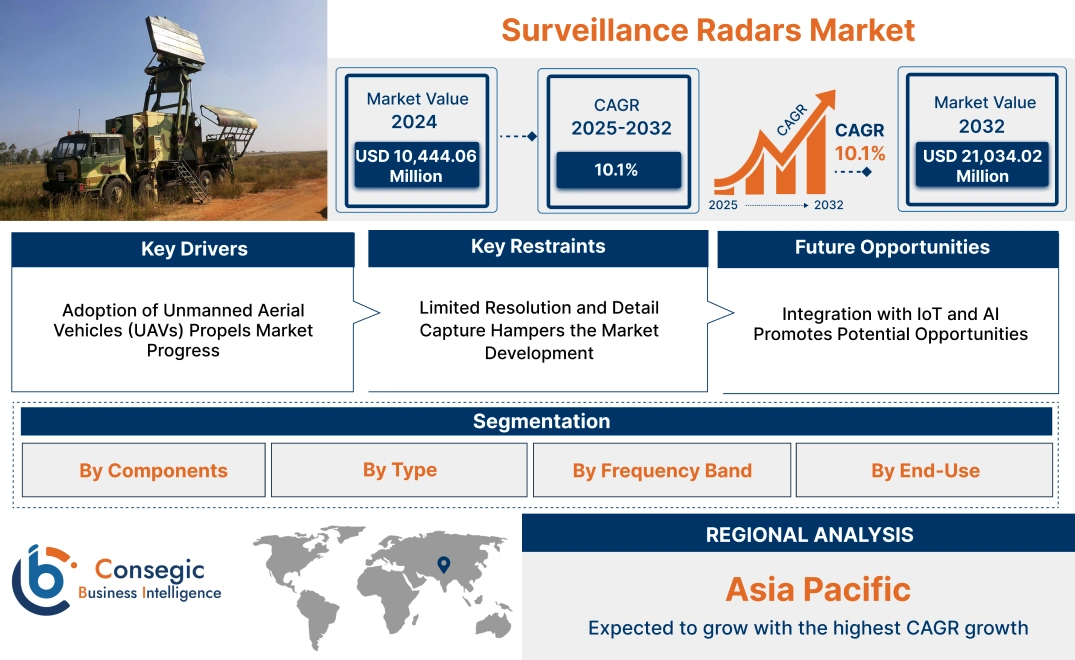
Surveillance Radars Market Dynamics - (DRO) :
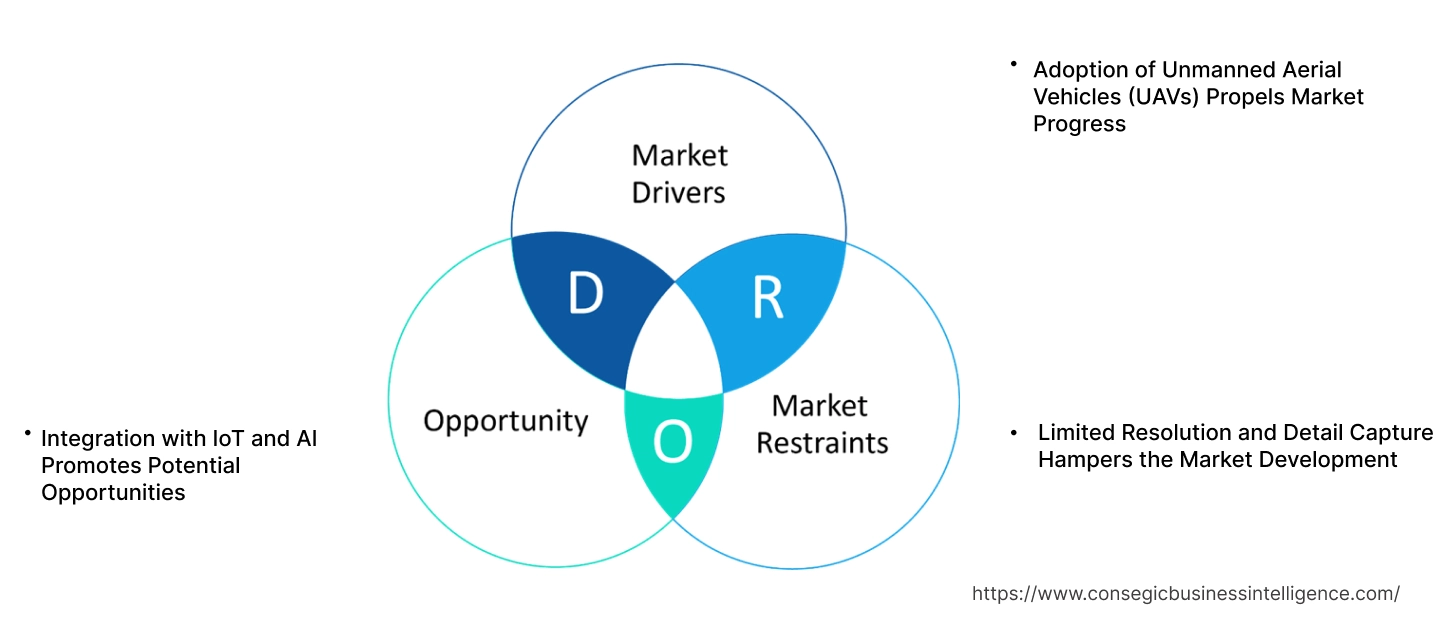
Key Drivers:
Adoption of Unmanned Aerial Vehicles (UAVs) Propels Market Progress
The growing adoption of unmanned aerial vehicles (UAVs) in surveillance and reconnaissance operations is significantly boosting the demand for compact and lightweight radar systems. These radars are crucial for enhancing UAV capabilities, enabling precise target detection and accurate navigation in challenging environments. Equipped with advanced features, such as high-resolution imaging and real-time data processing, these radar systems allow UAVs to efficiently monitor vast areas and identify threats with greater accuracy.
Additionally, these systems ensure obstacle avoidance, making UAVs more reliable in dynamic and complex operational scenarios. The rising use of UAVs in defense, border security, and disaster management underscores the critical role of radar technologies in improving mission outcomes. As the UAV market continues to grow, radar systems designed for lightweight aerial platforms are expected to experience substantial demand, driving innovation and adoption across various industries. Thus, the aforementioned factors are driving the surveillance radars market growth.
Key Restraints:
Limited Resolution and Detail Capture Hampers the Market Development
Surveillance radars often face issues in capturing high-resolution images and fine details, particularly in long-range operations. This limitation reduces their effectiveness in scenarios requiring precise identification of small or concealed objects, such as distinguishing between similar-sized targets or detecting minor movements. The inability to provide detailed imaging hinders their application in sectors like advanced reconnaissance and critical infrastructure monitoring, where high precision is essential. These constraints limit their adoption in operations demanding intricate target analysis, impacting overall surveillance radars market demand.
Future Opportunities :
Integration with IoT and AI Promotes Potential Opportunities
The integration of radar systems with IoT devices and AI-based analytics is revolutionizing surveillance and security operations. By combining radar technology with IoT connectivity, these systems share real-time data across networks, enabling seamless coordination between devices. AI-powered analytics enhance the precision of radar systems by automating threat detection, identifying patterns, and predicting potential risks. This capability is particularly valuable in high-security environments such as military bases, airports, and critical infrastructure.
Additionally, IoT and AI integration enables the creation of smart surveillance networks that monitor multiple zones simultaneously while reducing human intervention. These advancements not only improve the operational efficiency of radar systems but also pave the way for more intelligent and proactive security solutions, driving surveillance radars market opportunities. As industries increasingly adopt IoT and AI technologies, this integration is expected to become a key growth driver in the radar industry.
Surveillance Radars Market Segmental Analysis :
By Components:
Based on components, the market is segmented into antennas, transmitters, power amplifiers, receivers, duplexers, digital signal processors, and other components.
The antennas segment accounted for the largest revenue of the total surveillance radars market share in 2024.
- Antennas play a crucial role in enabling the detection and tracking capabilities of surveillance radars across various applications.
- The increasing integration of advanced phased array antennas enhances precision and coverage, driving the dominance of this segment.
- Modern radar systems rely heavily on power amplifiers and digital signal processors for better data accuracy and processing capabilities.
- According to industry analysis, the rising adoption of multi-functional antennas supports their leadership in this segment, contributing to the surveillance radars market expansion.
The digital signal processors segment is expected to register the fastest CAGR during the forecast period.
- Digital signal processors facilitate real-time data processing, enabling efficient identification and classification of targets.
- The rapid advancements in AI-driven algorithms and machine learning enhance the accuracy of radar systems, boosting this segment.
- Digital signal processors reduce latency in processing radar data, making them highly relevant for defense and commercial applications.
- As per the surveillance radars market analysis, the segment’s growth is further supported by increasing investments in upgrading radar technology to meet modern requirements.
By Type:
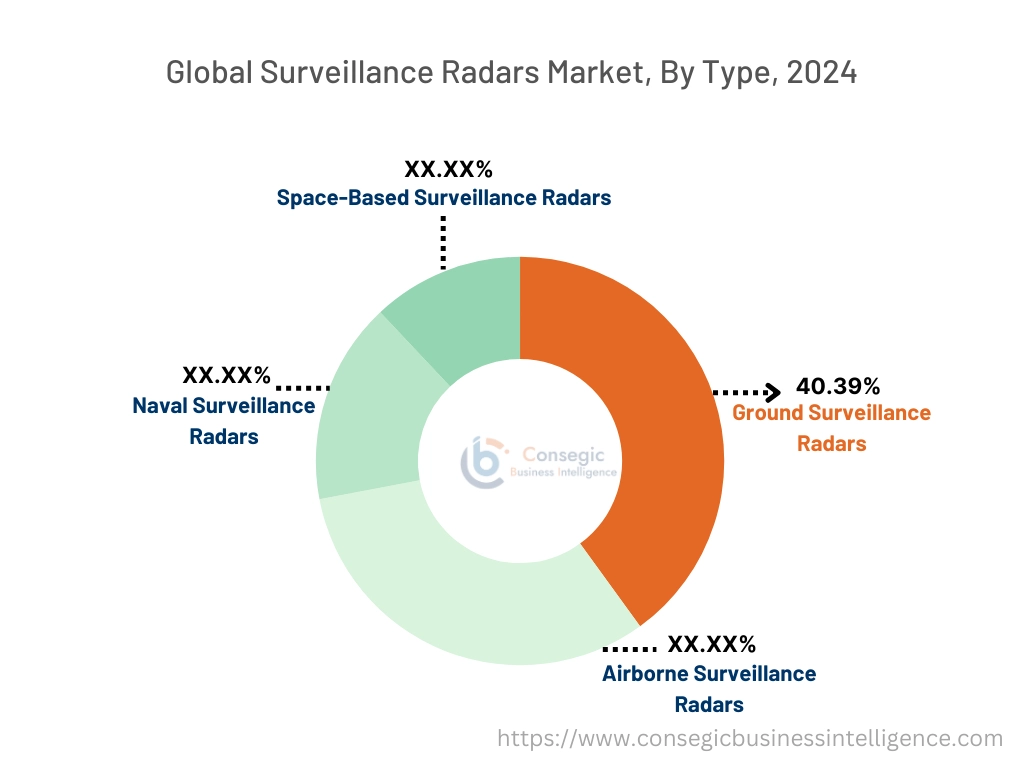
Based on type, the market is segmented into ground surveillance radars, airborne surveillance radars, naval surveillance radars, and space-based surveillance radars.
The ground surveillance radars segment held the largest revenue of 40.39% of the total surveillance radars market share in 2024.
- Ground surveillance radars are widely adopted for border security, infrastructure protection, and perimeter monitoring, driving their prominence.
- The segment benefits from increased defense spending on advanced radar systems for homeland security and military operations.
- These radars provide high-resolution imaging capabilities, ensuring efficient detection and tracking of threats in ground-based scenarios.
- As per the surveillance radars market trends, the dominance of this segment is attributed to its critical role in securing sensitive areas and preventing potential security breaches.
The airborne surveillance radars segment is anticipated to grow at the fastest CAGR during the forecast period.
- Airborne surveillance radars are extensively used for intelligence gathering, reconnaissance, and air traffic management.
- The growing adoption of UAVs and fighter jets equipped with advanced radar systems is a major growth driver for this segment.
- Technological advancements, including synthetic aperture radar (SAR) technology, enhance the capabilities of airborne radars.
- Thus, the increasing demand for real-time situational awareness and improved airspace management supports this segment’s rapid growth, fueling the surveillance radars market demand.
By Frequency Band:
Based on the frequency band, the market is segmented into Ka (26.5–40 GHz), Ku (12–18 GHz), X (8–12 GHz), C (4–8 GHz), S (2–4 GHz), L (1–2 GHz), UHF (300 MHz–1 GHz), VHF (30–300 MHz), and HF (3–30 MHz).
The X-band segment held the largest revenue share in 2024.
- X-band radars are extensively used in military and commercial applications due to their superior resolution and range capabilities.
- This frequency band is preferred for air traffic control, weather monitoring, and maritime surveillance, boosting its adoption.
- Technological advancements in X-band radars enable precise detection of small targets, enhancing operational efficiency.
- The dominance of the X-band segment reflects its versatility and effectiveness in meeting the needs of modern surveillance systems, boosting the surveillance radars market growth.
The Ka-band segment is expected to exhibit the fastest CAGR during the forecast period.
- Ka-band radars provide high-frequency operations, ensuring detailed imaging and accurate target identification.
- This segment benefits from the growing adoption of space-based surveillance systems and satellite communication technologies.
- The integration of Ka-band radars in next-generation military applications further boosts this segment’s adoption.
- The segment’s rapid growth is attributed to its ability to address high-bandwidth requirements in advanced radar systems, fueling the surveillance radars market expansion.
By End-Use:
Based on end-use, the market is segmented into military and commercial sectors.
The military segment held the largest revenue share in 2024.
- Military applications extensively rely on advanced surveillance radars for border security, threat detection, and intelligence operations.
- Increasing defense budgets worldwide drive investments in upgrading military radar systems, supporting this segment.
- These radars provide enhanced situational awareness, ensuring better decision-making during critical missions.
- As per the surveillance radars market analysis, the dominance of the military segment reflects its indispensable role in national security and defense strategies.
The commercial segment is anticipated to grow at the fastest CAGR during the forecast period.
- Commercial radars are widely used in air traffic management, maritime navigation, and environmental monitoring.
- The growing adoption of autonomous vessels and aircraft increases the demand for advanced radar systems in the commercial sector.
- The integration of AI and IoT in radar technologies enhances operational efficiency, boosting the commercial segment.
- As per the market trends, the segment’s growth is driven by the rising need for reliable and efficient radar systems across various industries, creating significant surveillance radars market opportunities.
Regional Analysis:
The regions covered are North America, Europe, Asia Pacific, the Middle East and Africa, and Latin America.
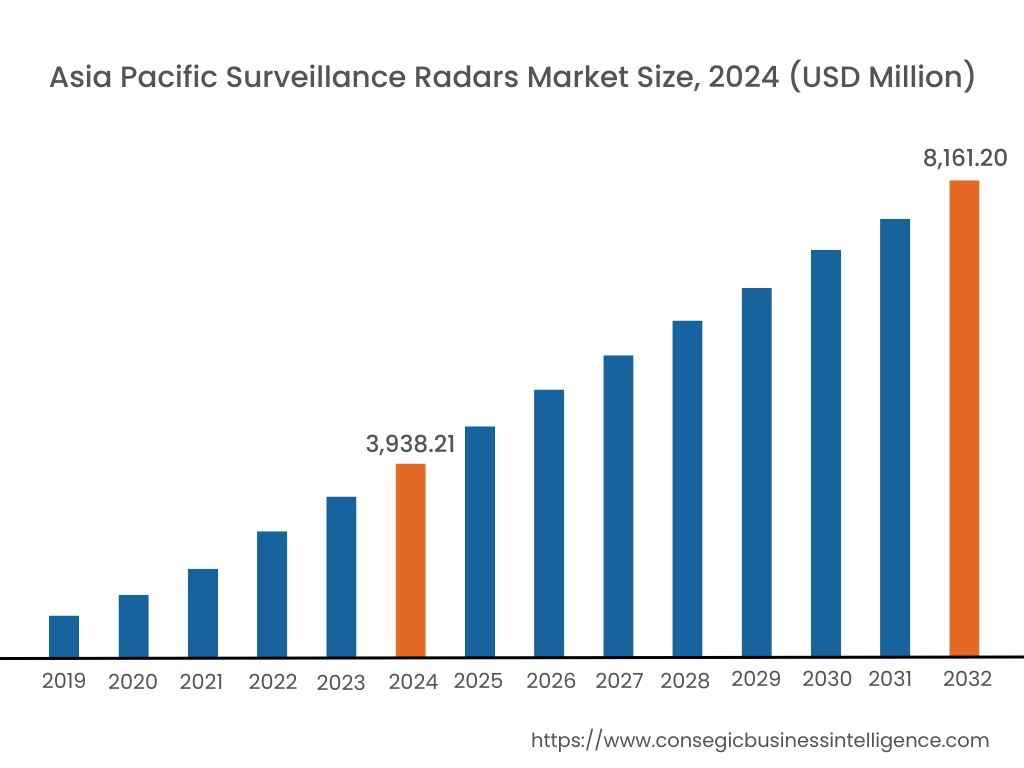
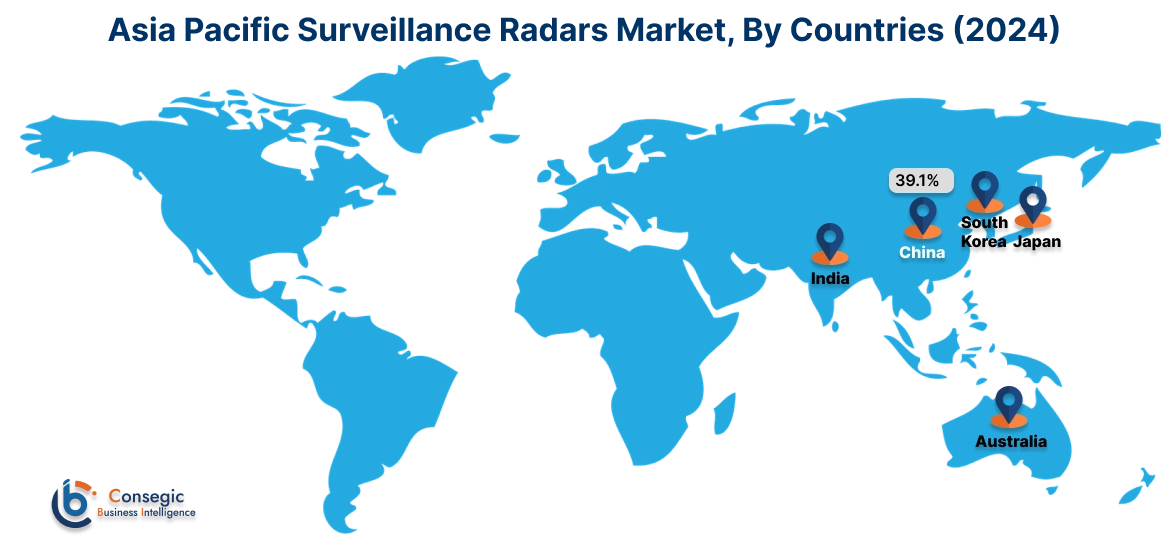
Asia Pacific region was valued at USD 3,938.21 Million in 2024. Moreover, it is projected to grow by USD 4,240.08 Million in 2025 and reach over USD 8,161.20 Million by 2032. Out of this, China accounted for the maximum revenue share of 39.1%. The Asia-Pacific region is experiencing rapid advancements in the surveillance radars market, driven by industrial expansion and technological progress in countries such as China, India, and Japan. The increasing need for border security and the growing threat of missiles have intensified the adoption of advanced radar systems. As per the surveillance radars market trends, government initiatives supporting defense modernization further influence market trends.
North America is estimated to reach over USD 5,826.42 Million by 2032 from a value of USD 2,934.25 Million in 2024 and is projected to grow by USD 3,147.87 Million in 2025. This region commands a significant portion of the surveillance radars market, driven by substantial defense budgets and the presence of leading industry players. The United States, in particular, emphasizes the modernization of aircraft, ships, and border surveillance systems to address cross-border conflicts and illegal activities. A notable trend is the integration of advanced radar technologies to enhance detection capabilities and situational awareness. Analysis indicates that ongoing investments in border security and detection technologies are propelling market dynamics in this region.
Europe represents a substantial segment of the global surveillance radars market, with countries like Germany, France, and the United Kingdom leading in both adoption and innovation. The region's focus on strengthening defense capabilities and ensuring national security has led to increased requirements for advanced radar systems. A significant trend is the deployment of surveillance radars for air traffic control and maritime surveillance to enhance safety and security.
The Middle East & Africa region is gradually embracing surveillance radar technologies, particularly within the defense and homeland security sectors. Nations like the United Arab Emirates are investing in modern radar solutions to enhance operational efficiency and comply with international standards. Analysis suggests an emerging trend toward adopting surveillance radars to improve border security and monitor critical infrastructure.
Latin America is an emerging market for surveillance radars, with countries such as Brazil and Mexico contributing to its development. The region's focus on modernizing defense infrastructure and improving national security has spurred interest in advanced radar solutions. Government policies aimed at enhancing technological capabilities influence market trends.
Top Key Players and Market Share Insights:
The Surveillance Radars market is highly competitive with major players providing products and services to the national and international markets. Key players are adopting several strategies in research and development (R&D), product innovation, and end-user launches to hold a strong position in the global Surveillance Radars market. Key players in the Surveillance Radars industry include -
- Lockheed Martin Corporation (USA)
- Raytheon Technologies Corporation (USA)
- Elbit Systems Ltd. (Israel)
- Hensoldt AG (Germany)
- Indra Sistemas, S.A. (Spain)
- Northrop Grumman Corporation (USA)
- Saab AB (Sweden)
- Thales Group (France)
- BAE Systems plc (UK)
- Leonardo S.p.A. (Italy)
Recent Industry Developments:
- In November 2024, Thales launched CoastShield, a modular coastal surveillance system integrating advanced sensors like the CoastWatcher radar, drones, and electro-optical sensors. With AI-enhanced real-time monitoring, it provides situational awareness over 100 nautical miles, enabling faster and more accurate decision-making. The system supports civil and military collaboration, detects maritime and air threats, and secures critical infrastructures. Its open architecture and user-friendly interface facilitate integration with additional systems for comprehensive maritime protection.
Surveillance Radars Market Report Insights :
| Report Attributes | Report Details |
| Study Timeline | 2019-2032 |
| Market Size in 2032 | USD 21,034.02 Million |
| CAGR (2025-2032) | 10.1% |
| By Components |
|
| By Type |
|
| By Frequency Band |
|
| By End-Use |
|
| By Region |
|
| Key Players |
|
| North America | U.S. Canada Mexico |
| Europe | U.K. Germany France Spain Italy Russia Benelux Rest of Europe |
| APAC | China South Korea Japan India Australia ASEAN Rest of Asia-Pacific |
| Middle East and Africa | GCC Turkey South Africa Rest of MEA |
| LATAM | Brazil Argentina Chile Rest of LATAM |
| Report Coverage |
|
Key Questions Answered in the Report
What is the size of the Surveillance Radars Market? −
The Surveillance Radars Market size is estimated to reach over USD 21,034.02 Million by 2032 from a value of USD 10,444.06 Million in 2024 and is projected to grow by USD 11,217.54 Million in 2025, growing at a CAGR of 10.1% from 2025 to 2032.
What are the key segments in the Surveillance Radars Market? +
The market is segmented by components (antennas, transmitters, power amplifiers, receivers, duplexers, digital signal processors, others), type (ground surveillance radars, airborne surveillance radars, naval surveillance radars, space-based surveillance radars), frequency band (Ka, Ku, X, C, S, L, UHF, VHF, HF), and end-use (military, commercial).
Which segment is expected to grow the fastest in the Surveillance Radars Market? +
The airborne surveillance radars segment is expected to grow at the fastest CAGR during the forecast period, driven by the growing adoption of UAVs and fighter jets equipped with advanced radar systems for intelligence gathering and reconnaissance.
Who are the major players in the Surveillance Radars Market? +
Major players in the Surveillance Radars Market include Lockheed Martin Corporation (USA), Raytheon Technologies Corporation (USA), Northrop Grumman Corporation (USA), Saab AB (Sweden), Thales Group (France), BAE Systems plc (UK), Leonardo S.p.A. (Italy), Elbit Systems Ltd. (Israel), Hensoldt AG (Germany), and Indra Sistemas, S.A. (Spain).
Overview
Reputation & Certifications


Our Services
- Market Intelligence & Forecasting
- Custom Research Solutions
- Market Entry Strategy
- Competitive Intelligence
- Customer Insights
- Industry Innovation Analysis
- Investment Advisory