Jump to Content
Telepresence Robots Market - Size, Share, Industry Trends, and Forecasts (2025 - 2032)
Telepresence Robots Market Size:
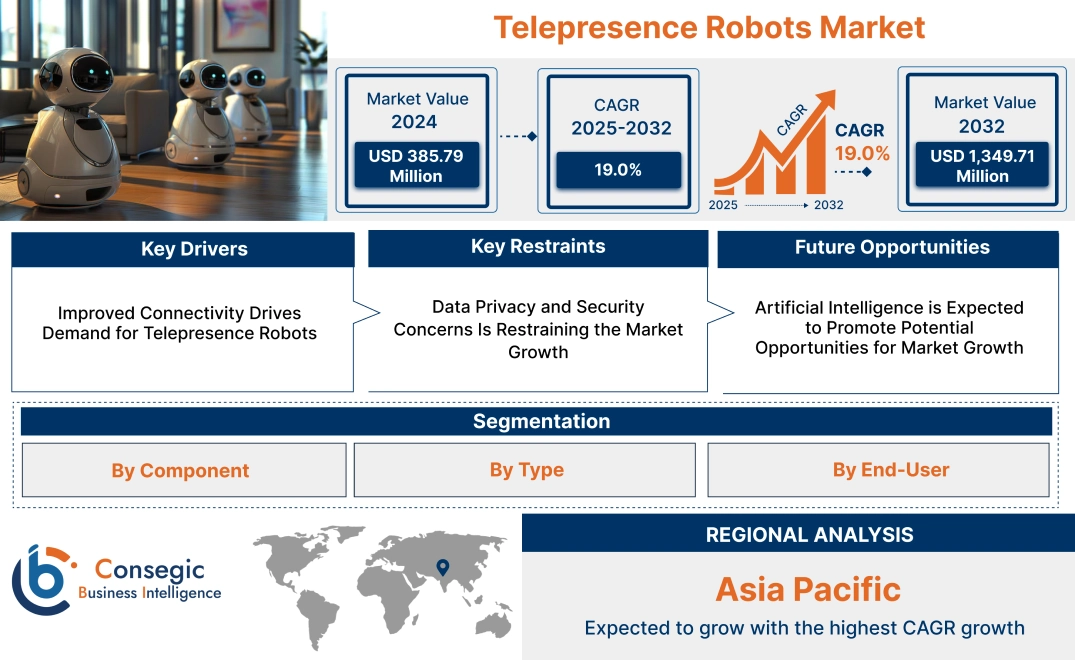
Telepresence Robots Market is estimated to reach over USD 1,349.71 Million by 2032 from a value of USD 385.79 Million in 2024 and is projected to grow by USD 444.46 Million in 2025, growing at a CAGR of 19.0% from 2025 to 2032.
Telepresence Robots Market Scope & Overview:
Telepresence robots are a combination of high-definition video and crystal-clear audio for seamless and engaging remote collaboration. Additionally, the advantages include enhanced remote contribution, improved communication, cost and time savings, increased convenience, and others. Moreover, the adoption of robots in healthcare, education, business, and home applications among others is driving the growth of the telepresence robots market. Further, the increasing adoption of assistance during surgeries and medical procedures as well as remote patient monitoring and consultations is driving the telepresence robots market size.
Telepresence Robots Market Dynamics - (DRO) :
Key Drivers:
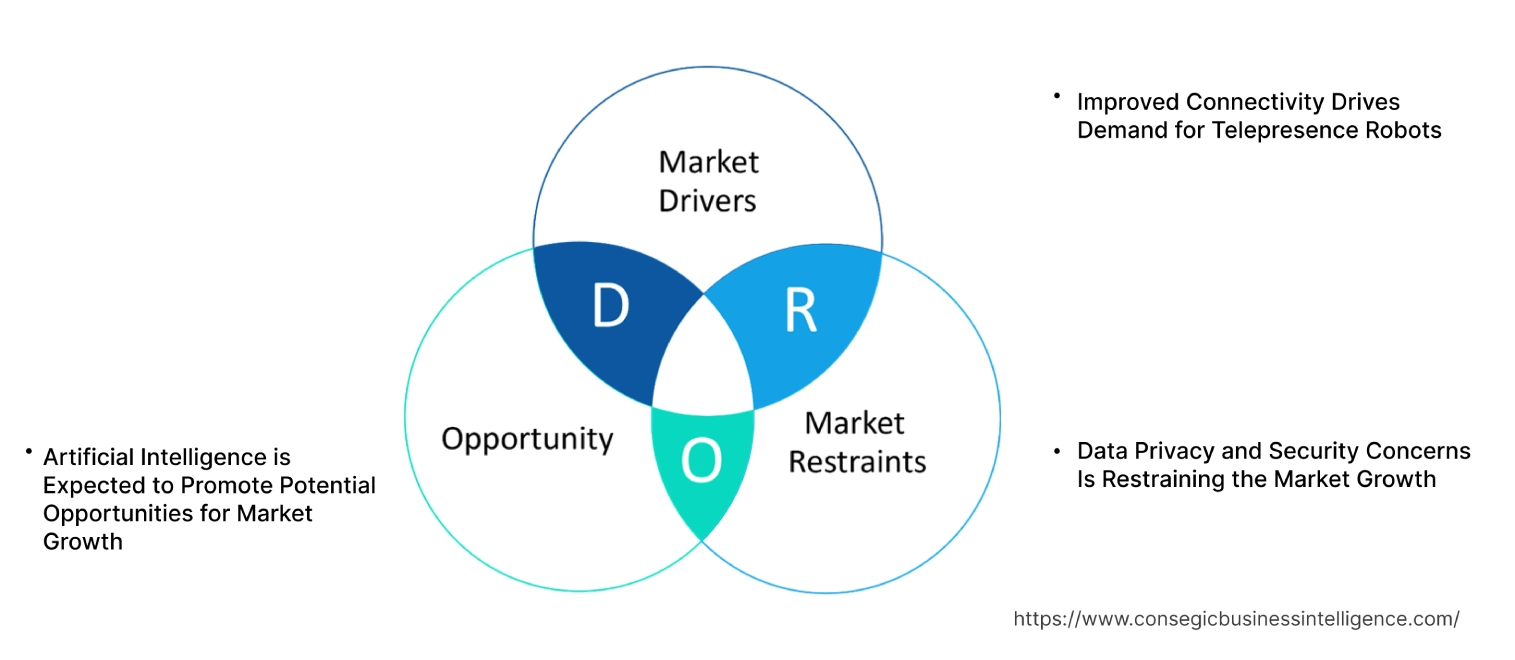
Improved Connectivity Drives Demand for Telepresence Robots
The rapid growth of digitalization is driving the need for faster data transmission and higher bandwidth as most of the technology is dependent on high-speed internet connectivity for the smooth functioning of various equipment. Additionally, the rise of cloud computing and remote work has also contributed to the increased need for enhanced speed and bandwidth. Further, robots majorly utilize Wi-Fi technology for smooth operation and improved connectivity during virtual meetings which in turn drives the telepresence robots market growth. Furthermore, the robots are equipped with Wi-Fi technology which works only when connected to wireless routers driving the need for enhanced connectivity solutions in turn fueling the telepresence robots market size.
- For instance, in January 2022, Silex Technology launched Wi-Fi 6E Module, engineered to enhance embedded medical & industrial IoT devices. Additionally, the 6 GHz spectrum provides enhanced Wi-Fi communications implementation, improved stability, and increased efficiency.
Thus, the demand for improved connectivity solutions to enhance the operation of robots is fueling the telepresence robots market share.
Key Restraints:
Data Privacy and Security Concerns Is Restraining the Market Growth
Telepresence robots have components such as cameras, microphones, storage devices, and others that constantly collect data and record audio and video which are susceptible to hacking. Moreover, the robots when compromised enable hackers to analyze the behavior patterns and other factors hindering the market adoption. Further, the high risk of data being compromised with the adoption of robots in business is restraining the telepresence robots market expansion.
Thus, the risk associated with data breaches and privacy concerns is hindering the telepresence robots market expansion.
Future Opportunities :
Artificial Intelligence is Expected to Promote Potential Opportunities for Market Growth
Artificial intelligence embedded into robots aims to improve the performance and increase the accuracy of tasks assigned. The AI technology is embedded into cameras, sensors, and other components for improving the operation of robots driving the telepresence robots market opportunity. Further, the benefits of adopting AI into robots include increased productivity, improved quality, and enhanced worker safety among others. Also, AI helps in automating various tasks assigned to the robots by analyzing the information gathered and acting upon it in real-time. Furthermore, businesses are leveraging AI-enabled robots to solve problems and transform their business models to meet changing business scenarios in turn fueling the market progress.
- For instance, in September 2024, Vention launched MachineMotion AI, which is an AI-enabled automation controller. The MachineMotion AI is integrated seamlessly with safety devices, computer vision systems, telepresence cameras, and more. Additionally, the controller is designed for small and medium-sized enterprises.
Hence, the integration of AI into robots is anticipated to increase the utilization in turn promoting telepresence robots market opportunities during the forecast period.
Telepresence Robots Market Segmental Analysis :
By Component:
Based on the component, the market is segmented into hardware, software, and service.
Trends in the Component:
- Presence sensors are embedded into robots for providing robot spatial vision sensing for object detection fueling the telepresence robots market trend.
- Power management sensors are integrated into robots for voltage regulation, and thermal management for increasing the lifespan of robots.
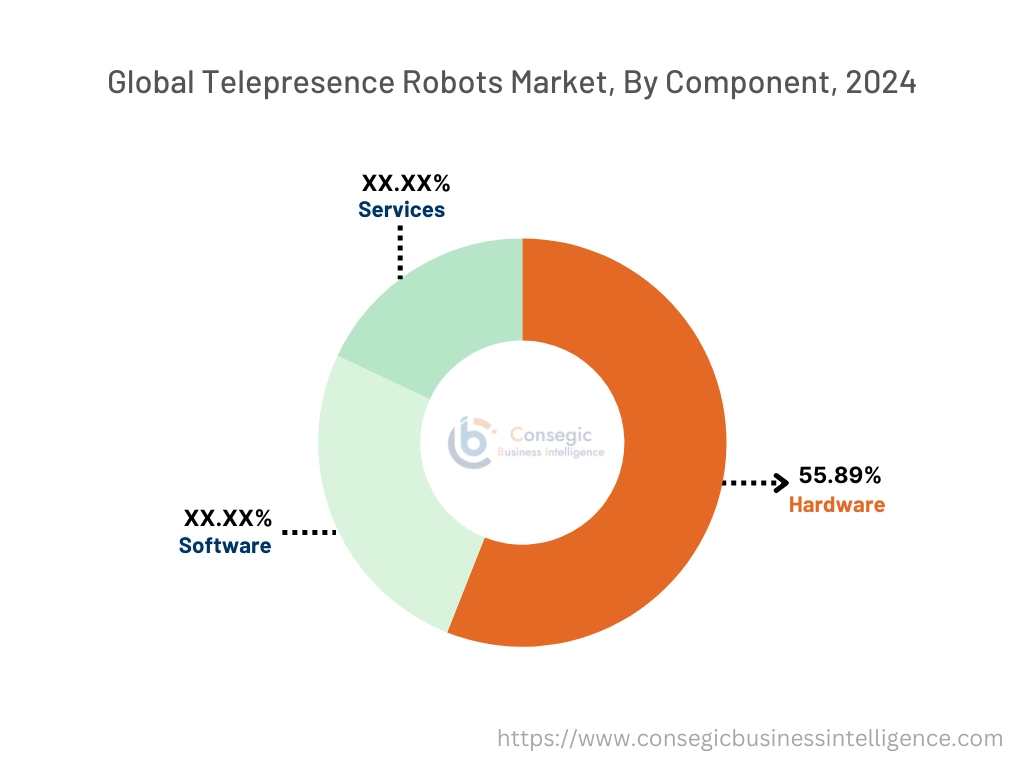
Hardware accounted for the largest revenue share of 55.89% in the year 2024.
- The hardware components include cameras, sensors, displays, speakers, microphones and others collectively working together to provide remote communication, participation, engagement, and interaction with personnel.
- Moreover, robots seamlessly integrate with various home automation devices enabling remote monitoring and control propelling the market development.
- Further, the rising demand for remote healthcare monitoring and consulting services is driving the telepresence robots market growth.
- For instance, in August 2024, VSee Health, Inc. partnered with Ava Robotics to provide telepresence solutions across US patients. In the healthcare industry telepresence robots are designed to provide personalized care remotely.
- Thus, as per the market analysis, the rising adoption of home automation and remote healthcare is driving the telepresence robots market demand for hardware components.
Service is anticipated to register the fastest CAGR during the forecast period.
- The service component associated with the market mainly includes installation, maintenance, training, rental, and others.
- The advantages of service components include flexibility, scalability, expert support, cost-effectiveness, and others.
- Further, the rising adoption of rent-as-a-service in businesses, educational institutions, healthcare facilities, and individuals is propelling the market development.
- For instance, The Good Robot Factory Pty Ltd is a leading rental-as-a-service provider for robots such as GoBe Robot by Blue Ocean Robotics, Double3 by Double Robotics, Reception Mini by OrionStar Robotics, and Ava by Ava Robotics.
- Therefore, as per the market analysis, the increasing adoption of rental services is anticipated to boost the market during the forecast period.
By Type:
Based on the type, the market is bifurcated into stationary and mobile.
Trends in the Type:
- Stationary robots are majorly used in libraries to interact with library staff remotely for virtual reference assistance or remote meetings driving the market trend.
- The growing need for healthcare monitoring devices is driving the telepresence robots market trend.
Mobile accounted for the largest revenue share in the year 2024 and is anticipated to register the fastest CAGR during the forecast period.
- Mobile robots provide accessibility to the user for the robot's movement and other behavior through a computer, tablet, or smartphone that is connected to the internet or other network.
- The increasing need for tele-education systems for helping students suffering from long-term illnesses is driving the mobile telepresence robots market demand.
- For instance, in December 2021, The Ministry of National Education, Youth, and Sports deployed 1750 Beam mobile telepresence-based robots for middle and high school students and universities in France.
- Thus, according to the telepresence robots market analysis, an increasing number of educational institutes are driving the mobile telepresence robots market share.
By End-User:
Based on the end-user, the market is segmented into corporate, education, manufacturing, healthcare, and others.
Trends in the End-User:
- The trend towards integration of telerobots with smart home security systems for providing monitoring and remote access to home devices.
- Businesses leverage tele robots facilities for remote audit which is cost-effective and analyze data remotely for inspection.
The healthcare sector accounted for the largest revenue share in the year 2024.
- The primary role of robots in the healthcare sector is to deliver quality care to patients from remote locations with limited mobility or disability.
- Further, robots provide a significant advantage in providing remote visualization and communication capabilities during surgeries and medical procedures driving the market trend.
- Furthermore, the need for remote patient monitoring and consultations is fueling the telepresence robots market.
- For instance, in August 2024, OhmniLabs launched a Mobile Telehealth Robot for Veteran healthcare. The robots help in seamless telehealth connectivity, enhanced patient engagement, and others.
- Thus, as per the market analysis, the need for remote patient monitoring and consultations is driving the market demand in the healthcare sector.
The education sector is anticipated to register the fastest CAGR during the forecast period.
- The robots help students with disabilities to remotely socialize with the school environment and make the teaching experience more interactive.
- Further, the need for remote learning and virtual classrooms is driving the telepresence robots market.
- For instance, in November 2024, according to the Centre for Young Lives, UK, the adoption of telepresence-based robots in schools significantly increased attendance by 21%, and 40% increase in the number of hours that pupils engage with social opportunities.
- Therefore, according to the telepresence robots market analysis, the need for remote learning and virtual classrooms is anticipated to boost the market during the forecast period.
Regional Analysis:
The regions covered are North America, Europe, Asia Pacific, the Middle East and Africa, and Latin America.
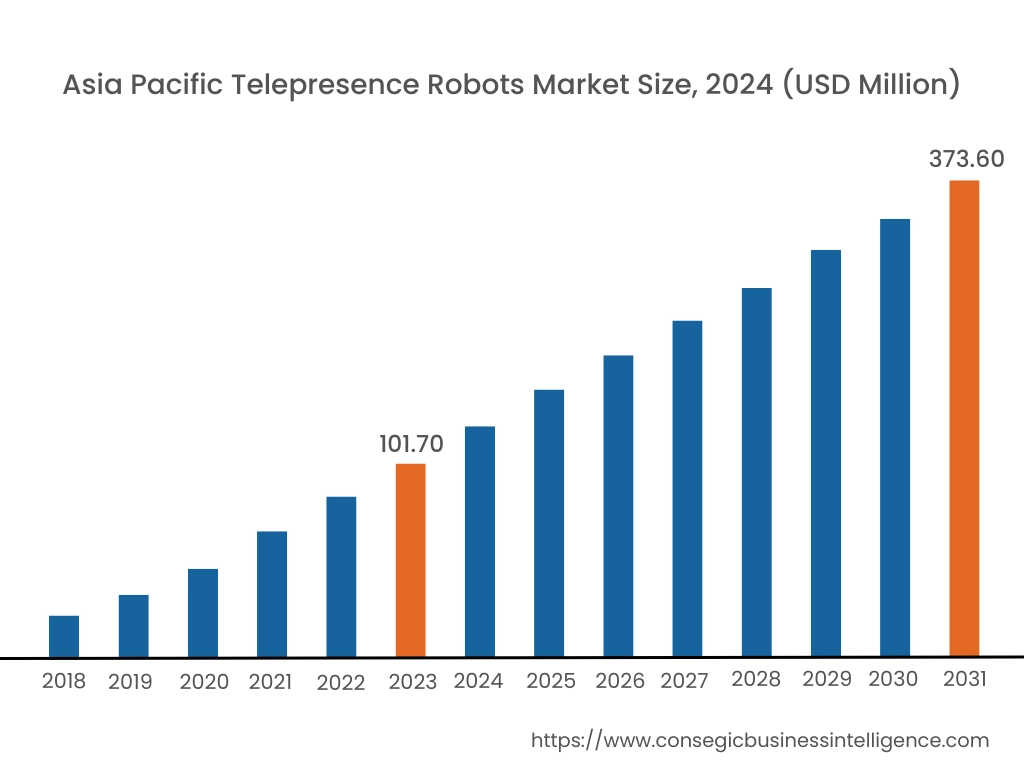
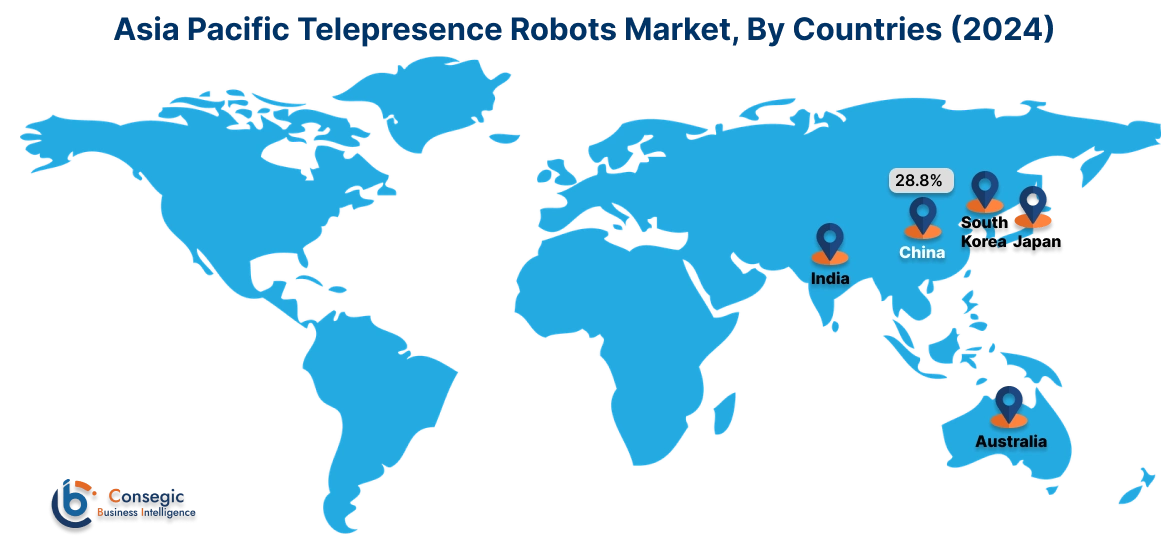
Asia Pacific region was valued at USD 101.70 Million in 2024. Moreover, it is projected to grow by USD 117.65 Million in 2025 and reach over USD 373.60 Million by 2032. Out of this, China accounted for the maximum revenue share of 28.8%. The market growth for the telepresence robots industry is mainly driven by their deployment in healthcare, education, and other industries. Furthermore, factors including remote learning and training are projected to drive the market progress in the Asia Pacific region during the forecast period.
- For instance, in July 2022, Changi General Hospital (CGH) based out in Singapore, deployed 80 telepresence robots at the Intensive Care Unit for teleconsultations with doctors.
North America is estimated to reach over USD 431.64 Million by 2032 from a value of USD 122.60 Million in 2024 and is projected to grow by USD 141.32 Million in 2025. The North American region's growing healthcare sector offers lucrative growth prospects for the market. Additionally, the development of remote learning and virtual classrooms is driving the market.
- For instance, in October 2022, Josh Williams Motorsports deployed OhmniLabs Telepresence robots for children to provide virtual experience at-track garage tours from hospital beds.
The regional trends analysis depicts that the increasing focus on remote media consulting services in Europe is driving the market. Additionally, the primary factor driving the market in the Middle East and African region is increasing collaboration between institutions and manufacturers for the deployment of robots in various educational institutions. Further, the rising need for healthcare assistance is paving the way for the progress of the market in the Latin America region.
Top Key Players and Market Share Insights:
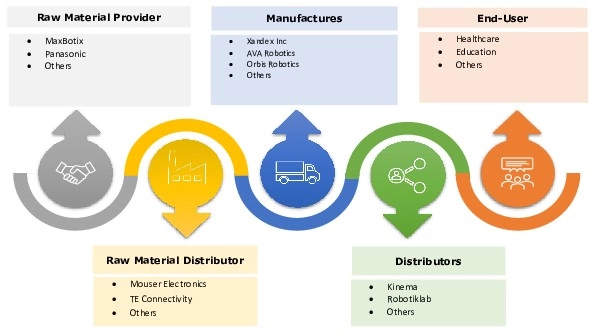
The global telepresence robots market is highly competitive with major players providing robots to the national and international markets. Key players are adopting several strategies in research and development (R&D), product innovation, and end-user launches to hold a strong position in the telepresence robots industry. Key players in the telepresence robots market include-
- AXYN Robotique (Europe)
- Mantaro Product Development Services, Inc. (USA)
- AVA Robotics (USA)
- Orbis Robotics (USA)
- Guangzhou Inbot Technology Ltd. (China)
- Double Robotics, Inc. (USA)
- VGo Communications, Inc. (USA)
- SMP Robotics (USA)
- Awabot (Europe)
- Xandex Inc. (USA)
Recent Industry Developments :
Mergers & Acquisitions:
- In March 2024, Mendaera Inc. acquired Avail Medsystems, Inc. to utilize a telepresence technology portfolio to streamline patient care within healthcare systems as well as virtually connect during procedures to collaborate and share clinical expertise.
- In December 2024, Symbotic Inc. acquired OhmniLabs to enhance automation capabilities in both the supply chain and healthcare sectors.
Fundings:
- In September 2024, Mendaera, Inc. closed USD 73 million in Series B funding to scale robotics and AI across mainstream medical procedures.
Telepresence Robots Market Report Insights :
| Report Attributes | Report Details |
| Study Timeline | 2019-2032 |
| Market Size in 2032 | USD 1,349.71 Million |
| CAGR (2025-2032) | 19.0% |
| By Component |
|
| By Type |
|
| By End-User |
|
| By Region |
|
| Key Players |
|
| North America | U.S. Canada Mexico |
| Europe | U.K. Germany France Spain Italy Russia Benelux Rest of Europe |
| APAC | China South Korea Japan India Australia ASEAN Rest of Asia-Pacific |
| Middle East and Africa | GCC Turkey South Africa Rest of MEA |
| LATAM | Brazil Argentina Chile Rest of LATAM |
| Report Coverage |
|
Key Questions Answered in the Report
How big is the Telepresence Robots market? −
The Telepresence Robots Market is estimated to reach over USD 1,349.71 Million by 2032 from a value of USD 385.79 Million in 2024 and is projected to grow by USD 444.46 Million in 2025, growing at a CAGR of 19.0% from 2025 to 2032.
What specific segmentation details are covered in the telepresence robots report? +
The telepresence robots report includes specific segmentation details for component, type, end-user, and regions.
Which is the fastest segment anticipated to impact the market growth? +
In the telepresence robots market, mobile telepresence robots are the fastest-growing segment during the forecast period due to the increasing need for tele-education systems to help students suffering from long-term illnesses not miss out on school and social life.
Who are the major players in the telepresence robots market? +
The key participants in the telepresence robots market are AXYN Robotique (Europe), Mantaro Product Development Services, Inc. (USA), Double Robotics, Inc. (USA), VGo Communications, Inc. (USA), SMP Robotics (USA), Awabot (Europe), Xandex Inc. (USA), AVA Robotics (USA), Orbis Robotics (USA), Guangzhou Inbot Technology Ltd. (China) and others.
What are the key trends in the telepresence robots market? +
The telepresence robots market is being shaped by several key trends including the trend towards integration of telerobots with smart home security systems for providing monitoring and remote access to home devices and the growing need for healthcare monitoring devices as well as Power management sensors are integrated into robots for voltage regulation, and thermal management for increasing the lifespan of robots are the key trends driving the market.
Overview
Reputation & Certifications


Our Services
- Market Intelligence & Forecasting
- Custom Research Solutions
- Market Entry Strategy
- Competitive Intelligence
- Customer Insights
- Industry Innovation Analysis
- Investment Advisory