Jump to Content
Tennis Ball Machine Market - Size, Share, Industry Trends, and Forecasts (2025-2032)
Tennis Ball Machine Market Size:
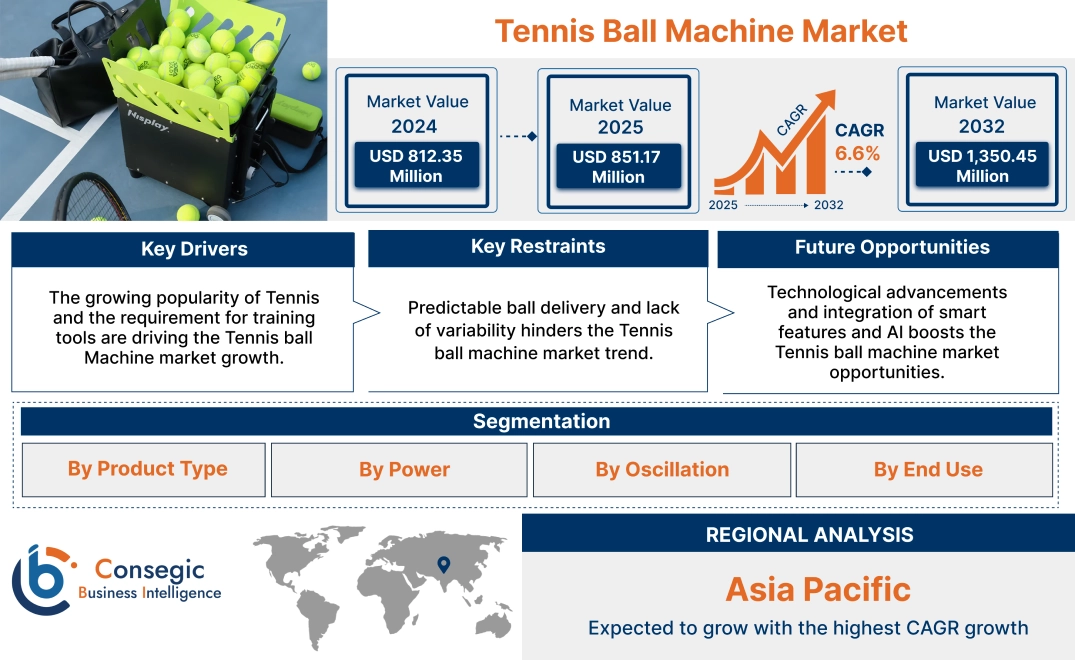
Tennis Ball Machine Market size is estimated to reach over USD 1,350.45 Million by 2032 from a value of USD 812.35 Million in 2024 and is projected to grow by USD 851.17 Million in 2025, growing at a CAGR of 6.6% from 2025 to 2032.
Tennis Ball Machine Market Scope & Overview:
A tennis ball machine is a training tool that automatically feeds tennis balls to a player, allowing them to practice their game without needing a partner or opponent. These machines are adjusted to deliver balls at various speeds, spins, and trajectories, helping players improve consistency, footwork, and reaction time. They are categorized as portable, manual, and robotic. Their primary goal is to provide consistent and repetitive shots, enabling players to focus on specific aspects of their game, be it their forehand, backhand, volley, footwork or stamina. At its core, the launcher consists of a mechanism to shoot the balls, a feeding system to load the balls, and a control panel or remote to adjust settings such as speed, spin, and trajectory. These machines come in various sizes and complexities, from basic models for beginners to advanced systems used by professionals. Their end user industries include sports clubs, schools and colleges, and coaching academies.
Tennis Ball Machine Market Dynamics - (DRO):
Key Drivers:
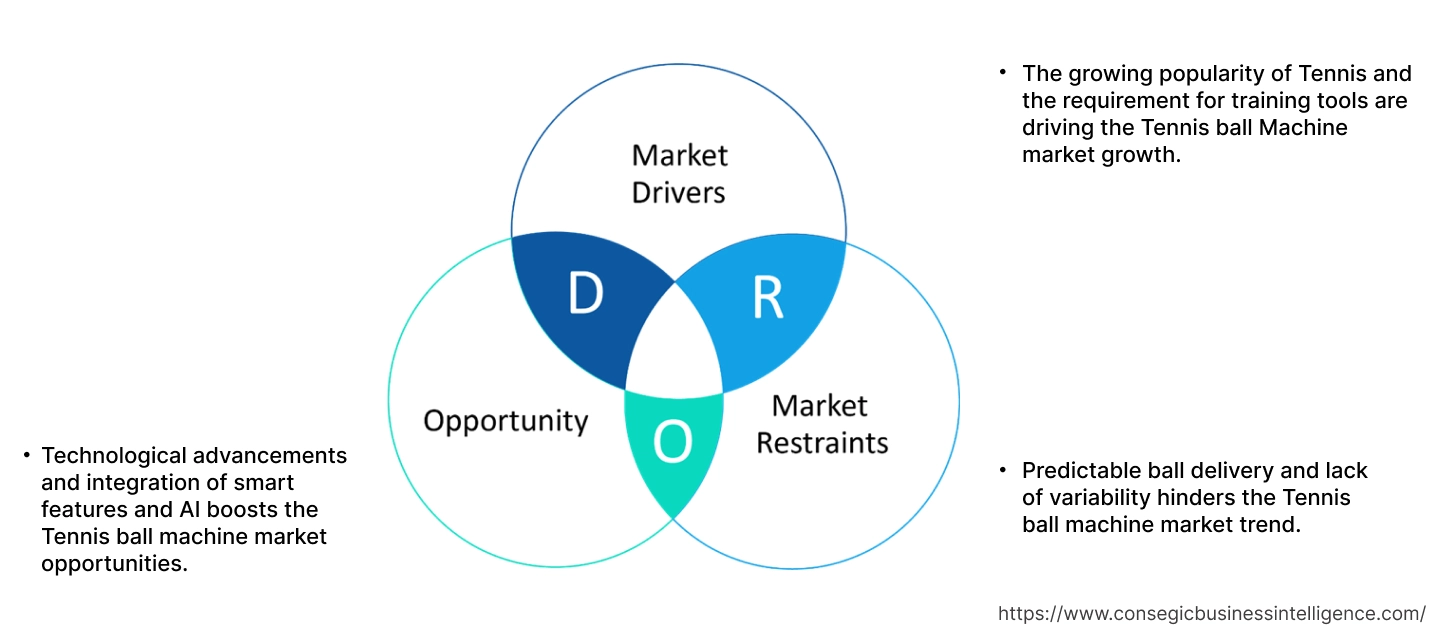
The growing popularity of Tennis and the requirement for training tools are driving the Tennis ball Machine market growth.
As tennis becomes more popular, both as a recreational and professional sport, more people are taking up the game, leading to a larger pool of potential customers for tennis training equipment. The ability to practice alone with a tennis ball machine allows players to focus on specific areas of their game and develop their skills at their own pace, which is especially attractive to players seeking individualized training plans.
Many players, both recreational and competitive, seek ways to improve their skills and performance. They offer a convenient and efficient way to practice independently, addressing this need. Modern machines are evolving with features like programmable drills, adjustable ball speed and spin, and remote control, making them more appealing and versatile for players of all skill levels.
- For instance, in November 2024, Tennibot, the company behind the game-changing autonomous ball-collecting robot, The Rover, announces its newest innovation in tennis technology: The Partner. This state-of-the-art ball machine goes beyond traditional training, creating a dynamic and adaptive practice experience that is as close as it gets to playing with a human partner.
Thus, the growing trend of tennis drives the market as more people seek to improve their skills and enjoy sport, leading to increased demand for automated training equipment.
Key Restraints:
Predictable ball delivery and lack of variability hinders the Tennis ball machine market trend.
While tennis ball machines are helpful for certain aspects of training, they do have limitations. One of the biggest drawbacks is the lack of variability in shots. The machines cannot adjust to a player's abilities or adapt to changing conditions, which limits their effectiveness in replicating game-like situations. Unlike a human player, ball machines deliver balls in a predictable manner, which hinders the development of quick reactions and adaptability to unpredictable match situations. Machines often struggle to simulate the nuances of a real match, such as varying shot placement, spin, and pace, which limits the development of a well-rounded game.
Another limitation of this machine training is the lack of feedback. Players may not be able to receive personalized advice on their technique, footwork, or other aspects of their game. This makes it difficult for players to identify and correct their weaknesses.
Thus, the predictability of ball delivery and lack of variability of the ball machine impacts the tennis ball machine market demand.
Future Opportunities:
Technological advancements and integration of smart features and AI boosts the Tennis ball machine market opportunities.
Modern machines boast advancements like AI-powered personalization, remote control via apps, customizable drills, variable speed, unpredictable spin, variable trajectory, and increased portability, making training more effective and convenient. Some machines use AI to analyze a player's performance and adjust the ball's speed, spin, and trajectory in real-time, creating a more customized and effective training experience. Machines are becoming more autonomous, with features that allows the machine to follow the player around the court and automatically adjusts the shot placement based on the player's position. More advanced features like sophisticated machines with features like programmable drills, remote control, and app-based customization. Players are now able to control the machine's settings remotely via smartphone apps, allowing for easy adjustments without interrupting their practice. Features such as oscillation and randomization enables the machine to shoot balls to different areas of the court, simulating a real opponent’s unpredictability.
- For instance, in October 2024, PongBot has launched the Pace S Series, the world's most advanced AI-powered tennis robot designed for players of all skill levels. The Pace S Pro utilizes sophisticated AI algorithms and smart sensors to monitor players' movements in real-time, adjusting serves to simulate game conditions. With over 300 built-in drills tailored for various skill levels, users customizes their training sessions and track their progress effectively.
Thus, the technological advancements of these machines offering programmable drills, and ball delivery variation and integration with AI are driving the future Tennis ball machine market opportunities.
Tennis Ball Machine Market Segmental Analysis :
By Product Type:
Based on product type, the market is segmented into lightweight and heavy weight.
The lightweight segment accounted for the largest segment in the Tennis ball machine market in 2024 and is anticipated to have the fastest CAGR during the forecast period.
- Lightweight ball machines are in trend and hold the largest share, driven by their portability and affordability, making them ideal for various users requiring frequent machine movements.
- They are more stable and long-lasting, making them suitable for commercial environments like tennis clubs and training facilities.
- Players are able to practice alone without relying on a playing partner, enhancing accessibility to regular practice.
- New technology enables manufacturers to build advanced features into compact machines without losing their practicality.
- New technology enables manufacturers to build advanced features into compact machines without losing their practicality.
- Thus, the lightweight segment is the largest and the fastest growing in the market due to its portability, ease of use, and affordability, making it ideal for casual and entry-level tennis players, as well as those seeking convenient practice options further driving the tennis ball machine market trend.
By Power:
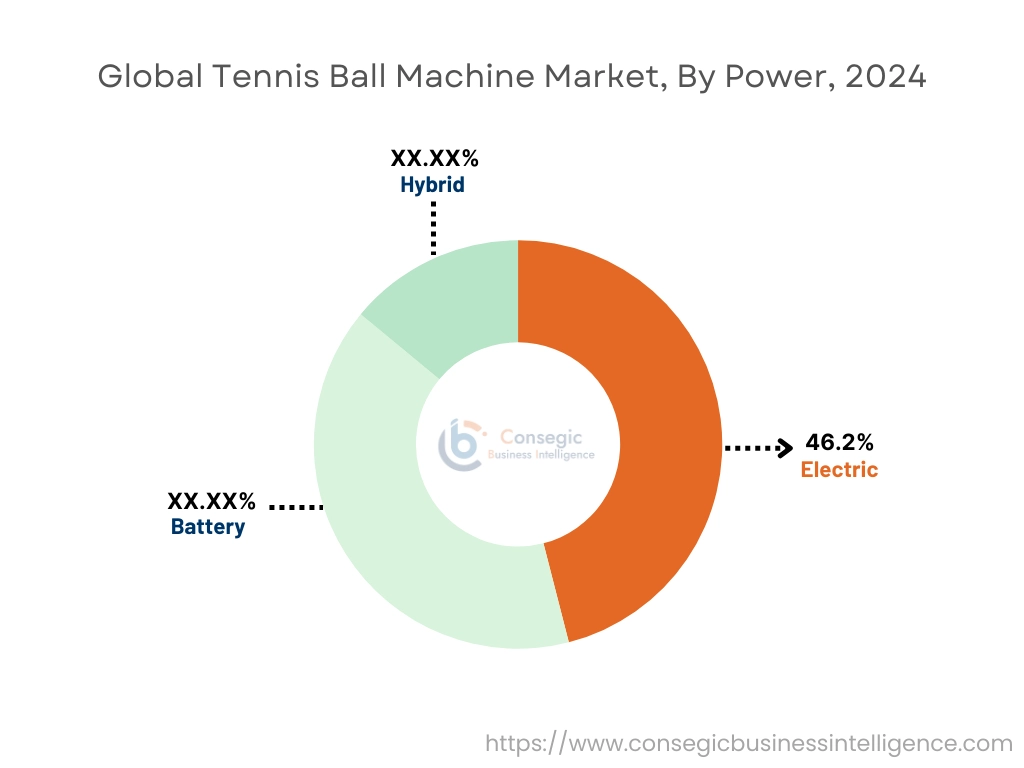
Based on power, the market is segmented into electric, battery and hybrid.
The Electric segment accounted for the largest revenue in the tennis ball machine market share of 46.2% in 2024.
- Electric tennis ball machines are powered directly through an AC connection, offering uninterrupted operation without concerns of battery depletion during extended sessions.
- They are favored for their consistency and reliability in high-volume usage environments, particularly in advanced-level training programs that demand longer practice intervals without downtime.
- These machines are primarily deployed in fixed locations such as indoor tennis clubs, coaching centers, and professional training academies where constant power supply is readily available.
- Thus, their demand in professional sports and consistent power supply significantly fuel the tennis ball machine market growth.
The Battery segment is anticipated to have the fastest CAGR during the forecast period.
- Battery-powered machines are a popular choice because they are lightweight and easy to transport, making them ideal for players who want to practice on the go or in different locations.
- They are widely used because of their portability and ease of use, allowing players to practice alone or with a small group without relying on a partner or a power outlet.
- Many battery-powered machines offer customizable settings, such as ball speed, trajectory, and spin, allowing players to tailor their practice to their specific needs.
- These machines are used by players of all skill levels, from beginners to advanced players, for various drills and practice routines.
- Thus, their portability and non-reliance on power outlet boost their trend driving the tennis ball machine market demand.
By Oscillation:
Based on oscillation, the market is segmented into horizontal, vertical and random.
The horizontal segment accounted for the largest revenue in the tennis ball machine market in 2024.
- Horizontal oscillation refers to a side-to-side movement that allows the machine to deliver balls to different areas across the court, useful for practicing various shots and drills.
- Horizontal oscillation, also called as "sweep," enables the machine to deliver balls to the forehand, backhand, and center positions in a random pattern.
- The machine has a motorized movement that rotates back and forth horizontally, allowing the balls to be thrown to different locations across the court.
- Players practice hitting shots to different areas of the court, which improves their overall game. Horizontal oscillation simulates the randomness of shots in a real match, which helps players prepare for competitive play.
- Thus, the horizontal segment accounted for the largest share of revenue in the tennis ball machine market.
Random oscillation is anticipated to register the highest CAGR during the forecast period.
- Random oscillation refers to a feature that allows the machine to feed balls to random locations across the court width, simulating match-play conditions and forcing the player to move and react to unpredictable shots.
- Random oscillation shows a motorized movement that allows the machine to rotate back and forth horizontally, throwing balls to different positions on the court (forehand, backhand, and center) in a random pattern.
- It forces players to move around the court and react to unpredictable shots, which is more realistic than practicing with a machine that consistently feeds to the same spot.
- The random nature of oscillation helps players develop their footwork and preparation for different strokes and the random nature of oscillation helps players develop their footwork and preparation for different strokes.
- Thus, the randomness in ball delivery giving the players the realistic simulation in practice is driving the tennis ball machine market expansion.
By End User:
Based on end user, the market is segmented into sports clubs, schools and colleges, and personal.
The sports clubs segment accounted for the largest revenue in the tennis ball machine market share in 2024 and are anticipated to have the fastest CAGR during the forecast period.
- The market analysis shows that sports clubs need robust, high-performance equipment for large-scale training programs, and they are willing to invest in these machines to provide members with a competitive edge.
- Sports clubs, including tennis academies and professional training facilities, require these machines to facilitate structured and repetitive practice for a large number of players.
- Clubs often purchase these machines in bulk, making them a significant driver of market demand.
- Tennis clubs are investing in infrastructure, including specialized equipment like tennis ball machines, to enhance their facilities and attract players.
- For instance, Arlington Tennis Center, a tennis facility that provides tennis equipment, such as string and grips, and other accessories and it also has ball machines for both tennis and pickleball available to use on site, as well as prompt stringing service by highly qualified professionals.
- Thus, sports clubs are the largest revenue shareholders of the market and are expected to be the fastest growing segment in the forecast period.
Regional Analysis:
The regions covered are North America, Europe, Asia Pacific, the Middle East and Africa, and Latin America.
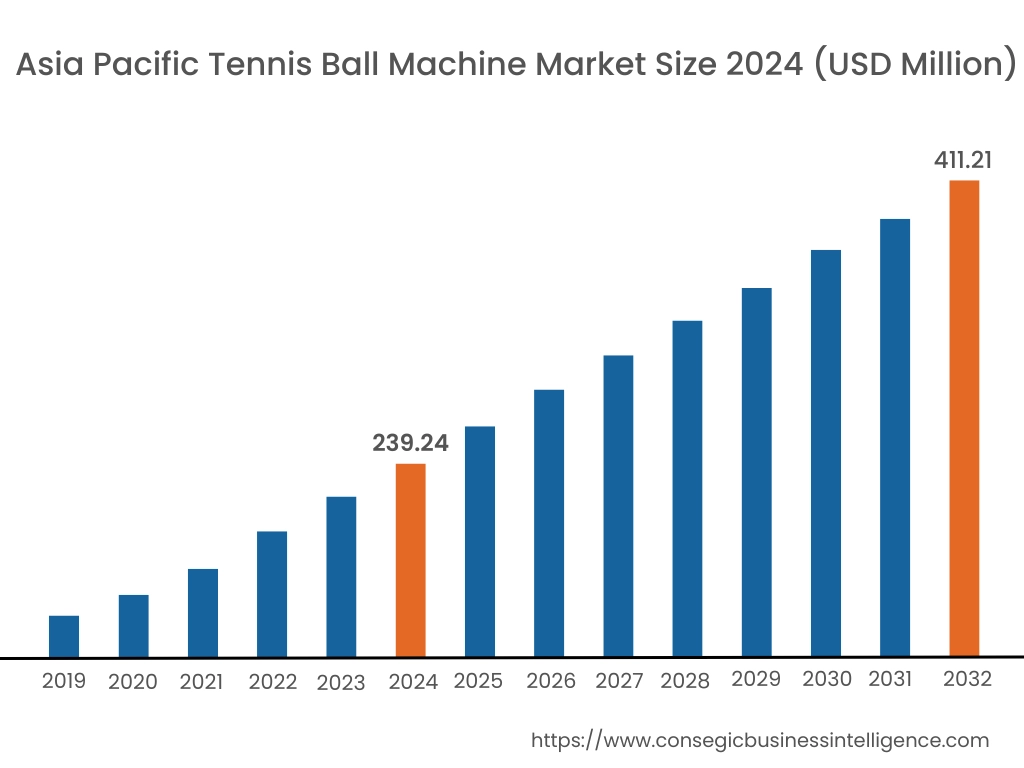
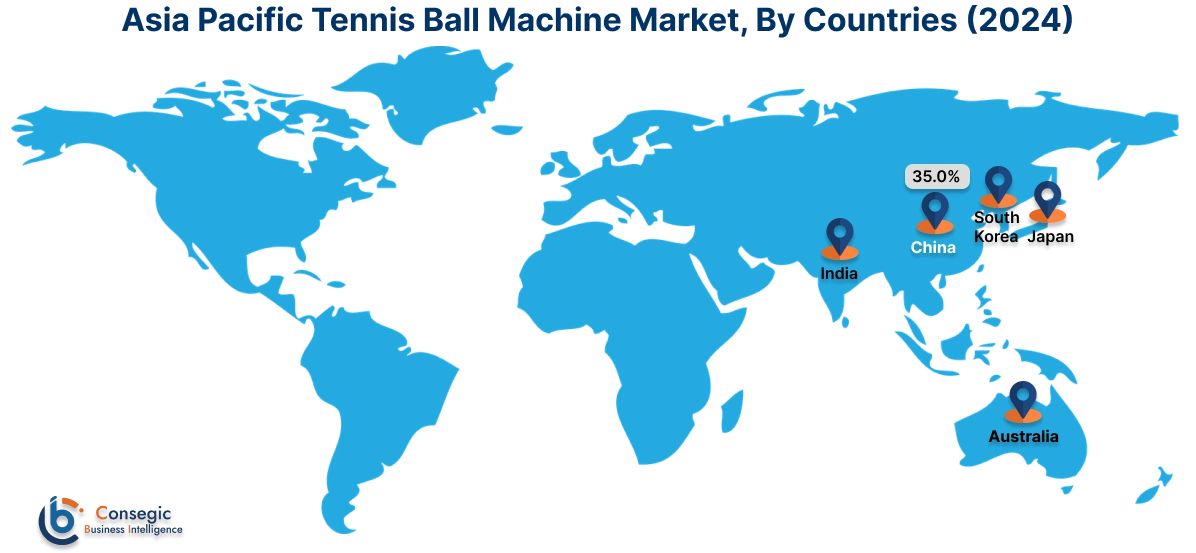
Asia Pacific region was valued at USD 239.24 Million in 2024. Moreover, it is projected to grow by USD 251.38 Million in 2025 and reach over USD 411.21 Million by 2032. Out of this, China accounted for the maximum revenue share of 35.0%.
The trend of using tennis ball machines is experiencing significant growth in Asia, particularly in countries like China and India, driven by increasing tennis participation and disposable income.
Tennis is gaining popularity in Asia, with more people taking up the sport. As incomes rise, more people are able to invest in tennis equipment, including ball machines. Some governments are actively promoting sports, leading to increased requirement for these machines by clubs, schools, and training centers. Furthermore, several tennis clubs have invested in lawn tennis infrastructures and have used specialized ball machines having the ability to compete with professionals.
Thus, the tennis ball machine market analysis shows the rising popularity of tennis in APAC region is leading to a shift in the demand of tennis ball machines.
North America is estimated to reach over USD 437.68 Million by 2032 from a value of USD 269.46 Million in 2024 and is projected to grow by USD 281.80 Million in 2025.
North American region is the largest revenue holder in the global tennis ball market due to its strong tennis culture and infrastructure. Tennis ball machines are used primarily for training, recreational play, and professional coaching. Tennis clubs and schools in the United States, in particular, are employing these machines for professional training. Coaches use the machines to help participants excel, tailoring the machine's settings to each player's weaknesses and strengths.
In the United States, they are used by players of all levels, from beginners to professionals, to enhance their practice sessions by providing a consistent and controlled practice environment, allowing players to focus on specific shots and improve their game without needing a partner. They are becoming a preferred choice by the individual players for one-on-one training sessions since they provide a reliable and effective method of practicing.
Thus, the tennis ball machine market analysis highlights the dominance of tennis in the North American region, particularly in the United States resulting in the expansion of the market.
Europe is recognized as a major market for tennis ball machines, driven by the sport's popularity and the increasing investment in training infrastructure. The trend of using these ball machines is high in Europe, particularly in countries with a strong tennis heritage like the UK, France, and Spain, due to increasing investments in training infrastructure and growing tennis popularity. Ball machines are used for various applications, including solo practice, skill development, and training for both professional and recreational players, offering customizable training conditions. They provide a consistent stream of balls, allowing players to focus on their technique and develop muscle memory. Tennis is gaining popularity globally, and this trend is reflected in France, UK and Germany, which leads to growing need for training equipment like ball machines.
Thus, the market analysis shows the requirement of ball machines in tennis due to the growing popularity of tennis and investments in sports technology and training infrastructure further driving the Tennis Ball Machine market expansion.
The growing popularity of tennis in the Middle East and Africa fuels the demand for the tennis ball machine industry, as more players seek efficient training tools to improve their skills, leading to increased sales and market growth for these machines. They are used by players and coaches to enhance training, refine strokes, and improve overall performance, particularly in countries like the UAE and South Africa, where there's a growing focus on sports and fitness. While the Middle East & Africa represent a niche but growing market for ball machines, the trend isn't as high as in mature markets like North America or Europe, though it's driven by increasing sports and fitness focus. The need for lightweight machines is high in the middle eastern region, as they are easy to move and suitable for both beginners and experts. Thus, the market analysis shows the emerging popularity of tennis in the middle eastern countries such as UAE and in African region is driving the market growth.
Latin America is an emerging market with a rising number of tennis players, potentially leading to gradual growth in the adoption of training machines in the region. The Latin American region is characterized by a developing sports culture, with tennis gaining traction, which leads to gradual growth in the adoption of training machines in the region. The rising number of tennis players in Latin America, both amateur and professional, fuels the demand for training equipment like ball machines. The growth of the market is attributed to the increasing popularity of tennis, the need for reliable training equipment in tennis academies, and advancements in sports technology. Thus, the market analysis shows the emergence of lawn tennis is fueling the tennis ball machine market.
Top Key Players & Market Share Insights:
The Tennis Ball Machine market is highly competitive with major players providing products and services to the national and international markets. Key players are adopting several strategies in research and development (R&D), product innovation, and end-user launches to hold a strong position in the global Tennis Ball Machine market. Key players in the Tennis Ball Machine industry include –
- Lobster sports (US)
- Spinshot Sports (Ireland)
- Dunlop Sports (UK)
- Spinfire Sport (US)
- Match Mate (US)
- Titan Ball Machines (US)
- Wilson (US)
- PlayMate (US)
- Deuce industries Ltd. (US)
- Sports tutor (US)
Recent Industry Developments :
- For instance, in October 2024, A new sports tech startup, Volley, aimed to revolutionize the way racquet sports players (platform tennis, tennis, padel and pickleball) train with its AI-enabled sports training machine. Unlike traditional machines that simply launch balls at varying speeds and heights, Volley’s trainer robot leverages AI and vision software to collect data as one plays, learn their skill level and simulate live gameplay — making it so one never need a full team to have a decent training session.
Tennis Ball Machine Market Report Insights:
| Report Attributes | Report Details |
| Study Timeline | 2019-2032 |
| Market Size in 2032 | USD 1,350.45 Million |
| CAGR (2025-2032) | 6.6% |
| By Product Type |
|
| By Power |
|
| By Oscillation |
|
| By End Use |
|
| By Region |
|
| Key Players |
|
| North America | U.S. Canada Mexico |
| Europe | U.K. Germany France Spain Italy Russia Benelux Rest of Europe |
| APAC | China South Korea Japan India Australia ASEAN Rest of Asia-Pacific |
| Middle East and Africa | GCC Turkey South Africa Rest of MEA |
| LATAM | Brazil Argentina Chile Rest of LATAM |
| Report Coverage |
|
Key Questions Answered in the Report
What are Tennis Ball Machines? −
A tennis ball machine is a training equipment having the ability to automatically feed balls to a player, allowing them to practice their game without needing a companion. They offer ball delivery at various speeds, spins, and trajectories, helping others improve their footwork, reaction time, and focus on various aspects of their game such as backhand, forehand, volley, and stamina.
What are the major drivers of the Tennis Ball Machine Market growth? +
The growing popularity of tennis and the requirement of training tools is the major driver of the tennis ball machine market. As tennis is gaining more popularity, it is shifting people’s focus, leading to a larger pool of potential customers of tennis ball machines for them to practice. These ball machines offer convenient and efficient way to practice independently with the addition of features such as programmable drills, adjustable ball speed and spin, and remote control.
What major segments are covered in the tennis ball machine market and how is the dominating segment impacting the market? +
The market is segmented on the basis of product type, power, oscillation, and end-user. The sports club, for instance, is the largest consumer in the End-user segment, due to the robust and high performance equipment requirement of these sports clubs for large-scale training programs. Sports centers facilitate structured and repetitive practice for a large number of players.
Who are the major key players in the tennis ball machine market? +
Lobster sports (US), Spinshot Sports (Ireland), Titan Ball Machines (US), Wilson (US), PlayMate (US), Deuce industries Ltd. (US), Sports tutor (US), Dunlop Sports (UK), Spinfire Sport (US), Match Mate (US).
Overview
Reputation & Certifications


Our Services
- Market Intelligence & Forecasting
- Custom Research Solutions
- Market Entry Strategy
- Competitive Intelligence
- Customer Insights
- Industry Innovation Analysis
- Investment Advisory