Jump to Content
Food Waste Disposers Market - Size, Share, Industry Trends, and Forecasts (2025-2032)
Food Waste Disposers Market Size:
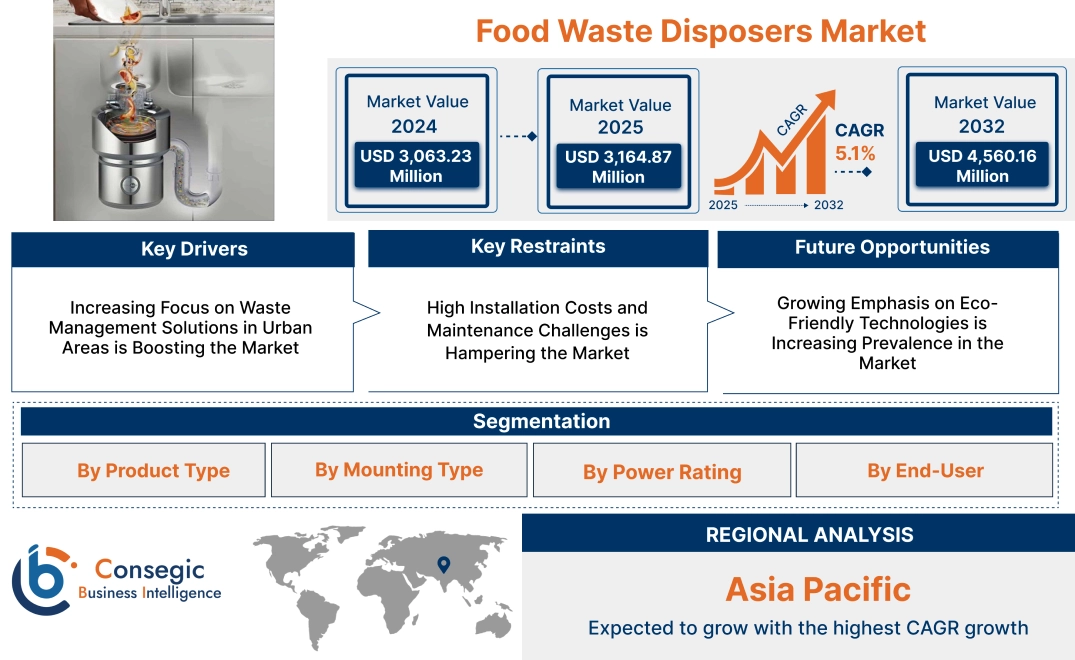
The Food Waste Disposal Market is estimated to reach USD 4,560.16 million by 2032 from USD 3,063.23 million in 2024 and is projected to grow by USD 3,164.87 million in 2025, growing at a CAGR of 5.1% from 2025 to 2032.
Food Waste Disposers Market Scope & Overview:
The food waste disposers are devices designed to grind and dispose of food waste through plumbing systems, offering an efficient and environmentally friendly alternative to traditional waste disposal methods. These disposers are widely used in residential, commercial, and industrial settings, helping to reduce organic waste accumulation and support sustainable waste management practices. The market includes a variety of disposers with features such as high-speed grinding, noise reduction, and energy efficiency.
Key characteristics of food waste disposers include compact designs, durability, and compatibility with modern plumbing systems. The benefits include reduced kitchen waste, improved hygiene, and decreased reliance on landfill disposal, contributing to sustainable waste management initiatives.
Applications span households, restaurants, hotels, and food processing units, where efficient waste disposal is critical. End-users include homeowners, hospitality businesses, and waste management organizations, driven by increasing awareness of food waste issues, advancements in disposer technology, and growing emphasis on eco-friendly solutions in waste management.
Food Waste Disposers Market Dynamics - (DRO) :

Key Drivers:
Increasing Focus on Waste Management Solutions in Urban Areas is Boosting the Market
The rising need for efficient waste management systems in urban regions is a significant driver for the waste disposers market. Food waste has become a critical environmental issue with rapid urbanization and the growing number of households in metropolitan areas. Food waste disposers offer a convenient solution by grinding organic waste into fine particles, which can be easily processed in wastewater treatment plants. This reduces the strain on landfills and promotes sustainable waste management practices. Additionally, the integration of advanced disposers with modern kitchen designs is further supporting the adoption of these systems in residential and commercial spaces.
Key Restraints:
High Installation Costs and Maintenance Challenges is Hampering the Market
The market faces limitations due to the high initial cost of food waste disposers and the additional expense associated with their installation and maintenance. These devices require proper plumbing and electrical connections, which can be challenging and expensive in older buildings or homes. Furthermore, concerns over clogging and the need for regular maintenance deter some consumers from investing in disposers, particularly in cost-sensitive regions where affordability remains a primary concern.
Future Opportunities :
Growing Emphasis on Eco-Friendly Technologies is Increasing Prevalence in the Market
The increasing emphasis on sustainable and eco-friendly solutions presents a significant opportunity for the food waste disposers market. Manufacturers are developing energy-efficient disposers that minimize water and electricity consumption while effectively processing organic waste. Additionally, innovations such as disposers equipped with odor-control systems and advanced grinding technologies are attracting environmentally conscious consumers. These advancements are particularly valuable in regions with stringent waste management regulations, where households and businesses are encouraged to adopt environmentally responsible practices.
These dynamics highlight the critical role food waste disposers play in addressing waste management challenges. While high costs and maintenance issues pose challenges, the growing demand for eco-friendly technologies is paving the way for the broader adoption of waste disposers devices in residential and commercial applications.
Food Waste Disposers Market Segmental Analysis :
By Product Type:
Based on product type, the market is segmented into continuous-feed food waste disposers and batch feed food waste disposers.
The continuous feed food waste disposers segment accounted for the largest revenue of food waste disposers market share in 2024.
- Continuous feed disposers are widely preferred for their convenience and ability to handle large volumes of waste continuously.
- Increasing adoption in residential settings due to their ease of operation and affordability supports this segment’s dominance.
- Advancements in noise reduction and grinding efficiency enhance consumer preference for continuous feed models.
- Expanding product offerings from manufacturers with improved safety features drive food waste disposers market growth.
The batch feed food waste disposers segment is anticipated to register the fastest CAGR during the forecast period.
- Batch feed disposers offer enhanced safety by operating only when the cover is in place, appealing to households with children.
- Increasing adoption in high-end residential properties and small-scale commercial kitchens supports trends in this segmental analysis.
- Rising consumer awareness about safety and energy efficiency drives food waste disposers market demand for batch feed disposers.
- Technological advancements in compact designs and grinding mechanisms enhance their appeal in space-constrained environments.
By Mounting Type:
Based on mounting type, the market is segmented into built-in/under-sink food waste disposers and freestanding food waste disposers.
The built-in/under-sink food waste disposers segment accounted for the largest revenue share in 2024.
- Built-in models are highly popular in residential kitchens due to their space-saving and integrated design.
- Increasing adoption in newly constructed residential and commercial kitchens supports this segment’s dominance.
- Advancements in easy-to-install under-sink models with enhanced grinding capabilities drive growth.
- Rising consumer preference for modern kitchen solutions enhances demand for built-in food waste disposers.
The freestanding food waste disposers segment is anticipated to register the fastest CAGR during the forecast period.
- Freestanding disposers are preferred in commercial kitchens and areas where plumbing integration is not feasible.
- Growing advancement for portable and flexible waste disposal solutions in catering services and temporary setups fuels as shown in this segmental analysis.
- Expanding use in small-scale commercial applications, such as food trucks and cafes, supports food waste disposers market opportunities.
- Increasing availability of durable and high-capacity freestanding models enhances their adoption.
By Power Rating:
Based on power rating, the market is segmented into up to 0.5 HP, 0.5 to 1 HP, and above 1 HP.
The 0.5 to 1 HP segment accounted for the largest revenue of food waste disposers market share in 2024.
- This power range is ideal for most residential and small commercial applications, balancing performance and energy efficiency.
- Increasing adoption in urban households with moderate waste disposal needs supports this segment’s growth.
- Advancements in motor technology for quieter and more efficient operations drive trends in this power category.
- Rising consumer preference for mid-range disposers with enhanced grinding capabilities bolsters food waste disposers market trends.
The above 1 HP segment is anticipated to register the fastest CAGR during the forecast period.
- High-power disposers are increasingly adopted in large commercial kitchens, such as restaurants and hotels, for handling large waste volumes.
- Growing demand for heavy-duty, high-capacity food waste disposers in industrial settings supports trends in this segment.
- Technological innovations in energy-efficient and low-noise high-power disposers enhance their appeal.
- Expanding use in high-traffic commercial kitchens drives market surge for disposers above 1 HP.
By End-User:
Based on end-users, the market is segmented into residential and commercial.
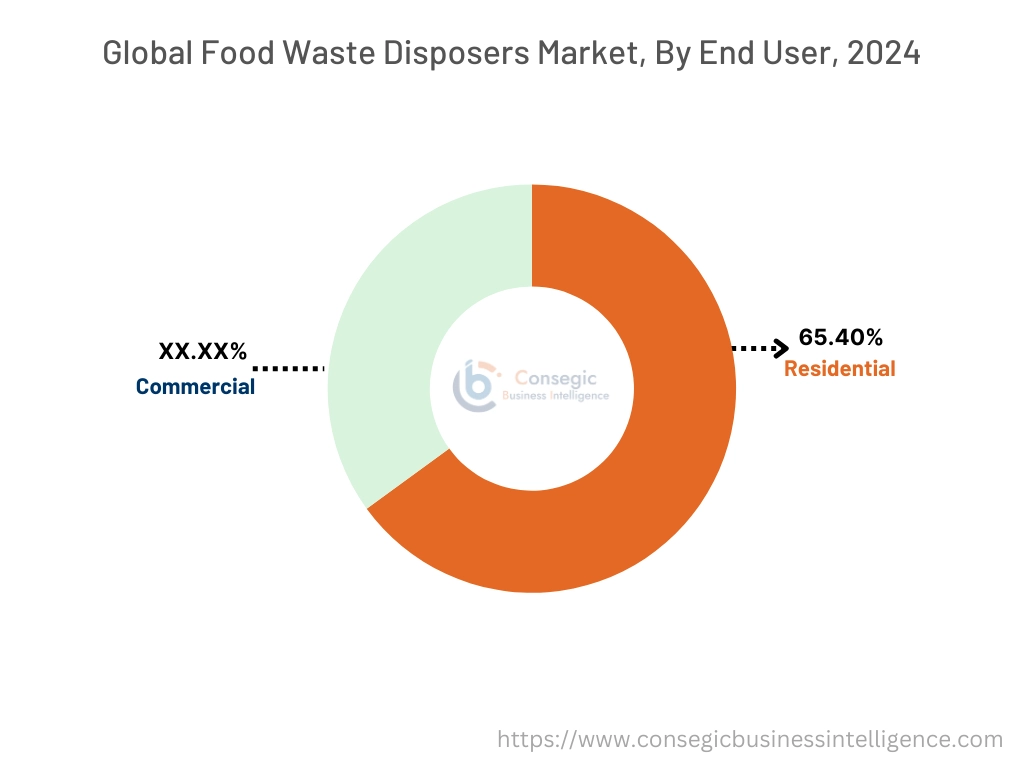
The residential segment accounted for the largest revenue share of 65.40% in 2024.
- Increasing urbanization and rising disposable incomes have driven food waste disposers market trends for waste disposers in residential kitchens.
- Growing consumer awareness about eco-friendly waste management solutions supports adoption in households.
- Rising integration of waste disposers in modern kitchen designs bolsters surge in the residential segment.
- Expanding availability of affordable and compact disposers tailored for residential use drives food waste disposers market demand.
The commercial segment is anticipated to register the fastest CAGR during the forecast period.
- Commercial kitchens in hotels, restaurants, and catering services require efficient waste management solutions, driving appeal.
- Increasing adoption of high-capacity food waste disposers in institutional settings, such as schools and hospitals, supports trends.
- Rising focus on sustainability and waste reduction in the food service industry boosts demand for commercial disposers.
- Expansion of the hospitality and food service industries in emerging markets drives trends in this segment.
Regional Analysis:
The regions covered are North America, Europe, Asia Pacific, the Middle East and Africa, and Latin America.
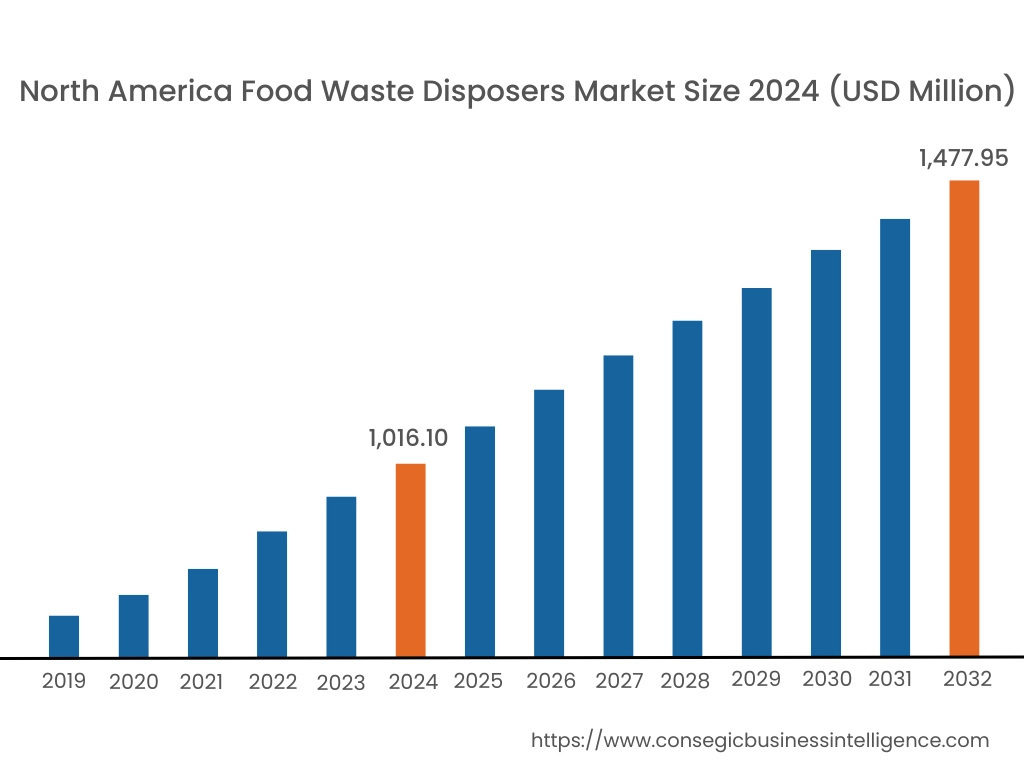
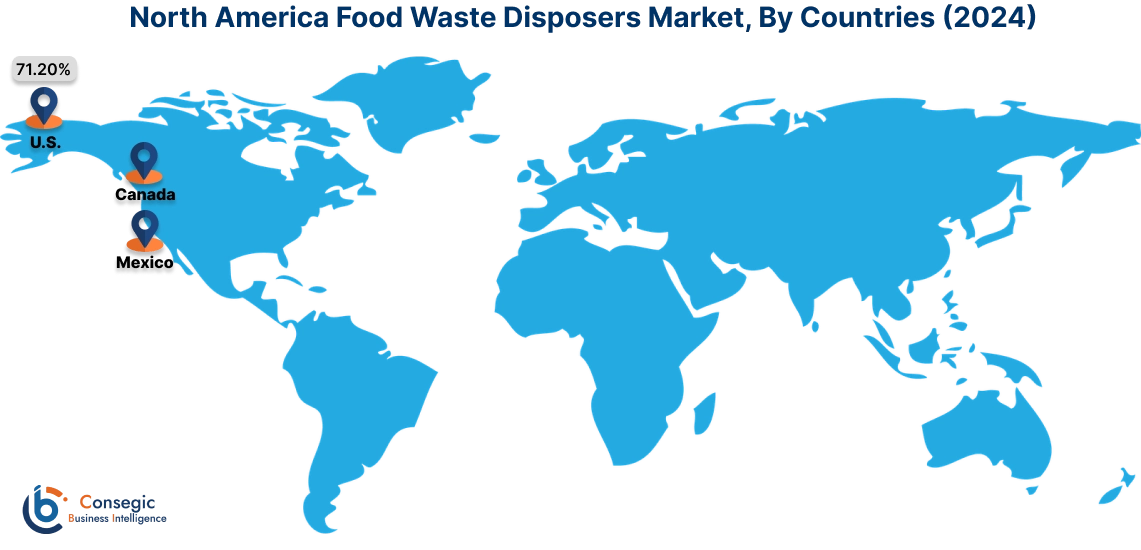
In 2024, North America was valued at USD 1,016.10 Million and is expected to reach USD 1,477.95 Million in 2032. In North America, the U.S. accounted for the highest share of 71.20% during the base year of 2024. North America holds a significant share of the global food waste disposers market, driven by the high adoption of modern kitchen appliances, increasing awareness about waste management, and stringent environmental regulations. The U.S. leads the region due to widespread usage of food waste disposers in households, driven by high disposable incomes and a preference for sustainable solutions. Additionally, government policies encouraging organic waste management support market growth as per the analysis. Canada contributes through rising trends in residential and commercial sectors, particularly in urban areas. However, high installation costs and maintenance requirements may limit market penetration in some regions.
In Asia Pacific, the market is experiencing the fastest growth with a CAGR of 5.5% over the forecast period. The food waste disposers market is fueled by rapid urbanization, rising disposable incomes, and growing awareness about efficient waste management in China, India, and Japan. China dominates the market with the increasing adoption of food waste disposers in urban households and government-led initiatives for sustainable waste management. India’s growing middle class and increasing focus on modern kitchen appliances support demand, particularly in urban areas. Japan emphasizes compact and energy-efficient disposers tailored for small kitchen spaces, leveraging its advanced appliance manufacturing sector. However, affordability and lack of awareness in rural areas may restrict growth.
Europe is a prominent market for food waste disposers, supported by growing environmental concerns, stringent regulations on waste disposal, and increasing adoption of sustainable kitchen solutions. Countries like Germany, the UK, and France are key contributors. The regional analysis of Germany shows it drives advancement with its strong focus on eco-friendly waste management practices and increasing adoption of food waste disposers in urban households. The UK emphasizes residential and commercial adoption of disposers to reduce landfill waste, while France promotes sustainable kitchen appliances in line with environmental initiatives. However, cultural preferences for composting over mechanical waste disposal may hinder food waste disposers market expansion in some parts of the region.
The Middle East & Africa region is witnessing steady growth in the market, driven by rising residential and commercial infrastructure investments and growing demand for modern kitchen appliances. The food waste disposers market analysis displays that countries like Saudi Arabia and the UAE are adopting food waste disposers in luxury residential and hospitality projects, supported by increasing awareness of sustainable living practices. In Africa, South Africa is emerging as a key market, focusing on reducing landfill waste through the adoption of food waste disposers in urban households. However, limited infrastructure for waste management and high costs of disposers may pose challenges in some parts of the region.
Latin America is an emerging market, with Brazil and Mexico leading the region. Brazil’s growing urban population and increasing adoption of modern kitchen appliances drive applications for food waste disposers in residential settings. The food waste disposers market analysis displays, that Mexico focuses on integrating disposers in both residential and commercial kitchens as part of sustainable urban development projects. The region also benefits from rising awareness of environmental conservation and waste reduction practices. However, inconsistent access to waste disposal infrastructure and economic instability in smaller economies may restrict food waste disposers market growth.
Top Key Players and Market Share Insights:
The food waste disposers market is highly competitive with major players providing products and services to the national and international markets. Key players are adopting several strategies in research and development (R&D), product innovation, and end-user launches to hold a strong position in the global food waste disposers market. Key players in the food waste disposers industry include -
- InSinkErator (Emerson Electric Co.) (United States)
- Whirlpool Corporation (United States)
- General Electric Company (United States)
- Hobart Corporation (United States)
- Franke Group (Switzerland)
- Haier Group Corporation (China)
- Bosch Siemens Hausgeräte GmbH (Germany)
- Kitchenaid (United States)
- Moen Incorporated (United States)
- Midea Group (China)
Recent Industry Developments :
Product launch:
- In September 2023, InSinkErator introduced the next generation of garbage disposals, featuring redesigned Power and Advance Series models with enhanced MultiGrind and SoundSeal Technology, aiming to encourage greater usage for healthier, more sustainable kitchens.
- In January 2023, Bionetix International, a subsidiary of Cortec Corporation, introduced ECO-DISPOSAL™, a probiotic-based cleaner and freshener designed for garbage disposals. Each water-soluble pouch contains 2.5 Million beneficial bacteria that activate upon contact with water, initiating the digestion of organic waste. These probiotics adhere to the walls of garbage disposals and drains, providing continuous cleaning and maintenance benefits between routine cleanings. Additionally, ECO-DISPOSAL™ imparts a fresh lemon fragrance, enhancing the overall user experience.
Food Waste Disposers Market Report Insights :
| Report Attributes | Report Details |
| Study Timeline | 2019-2032 |
| Market Size in 2032 | USD 4,560.16 Million |
| CAGR (2025-2032) | 5.1% |
| By Product Type |
|
| By Mounting Type |
|
| By Power Rating |
|
| By End-User |
|
| By Region |
|
| Key Players |
|
| North America | U.S. Canada Mexico |
| Europe | U.K. Germany France Spain Italy Russia Benelux Rest of Europe |
| APAC | China South Korea Japan India Australia ASEAN Rest of Asia-Pacific |
| Middle East and Africa | GCC Turkey South Africa Rest of MEA |
| LATAM | Brazil Argentina Chile Rest of LATAM |
| Report Coverage |
|
Key Questions Answered in the Report
What is the size of the Food Waste Disposers Market? −
The Food Waste Disposal Market is estimated to reach USD 4,560.16 million by 2032 from USD 3,063.23 million in 2024 and is projected to grow by USD 3,164.87 million in 2025, growing at a CAGR of 5.1% from 2025 to 2032.
What are the main product types in the Food Waste Disposers Market? +
The market is segmented into continuous feed food waste disposers and batch feed food waste disposers, each catering to specific consumer needs.
Which product type holds the largest share in the Food Waste Disposers Market? +
Continuous feed food waste disposers held the largest share in 2024, driven by their convenience and ability to handle large waste volumes continuously.
What are the key factors driving the Food Waste Disposers Market? +
Increasing urbanization, a focus on sustainable waste management, and advancements in disposer technology are major drivers of market growth.
Overview
Reputation & Certifications


Our Services
- Market Intelligence & Forecasting
- Custom Research Solutions
- Market Entry Strategy
- Competitive Intelligence
- Customer Insights
- Industry Innovation Analysis
- Investment Advisory