Jump to Content
UAV Battery Market - Size, Share, Industry Trends, and Forecasts (2025-2032)
UAV Battery Market Size:
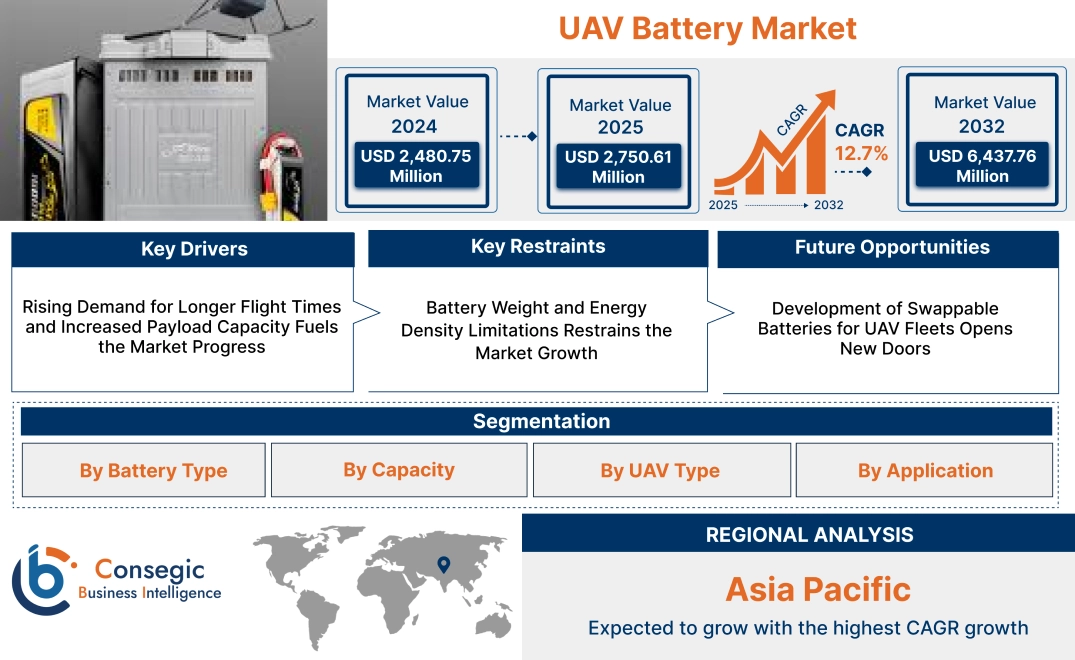
UAV Battery Market size is estimated to reach over USD 6,437.76 Million by 2032 from a value of USD 2,480.75 Million in 2024 and is projected to grow by USD 2,750.61 Million in 2025, growing at a CAGR of 12.7% from 2025 to 2032.
UAV Battery Market Scope & Overview:
A UAV battery is a critical component that powers unmanned aerial vehicles, enabling them to perform various operations such as surveillance, mapping, delivery, and inspections. These batteries are designed to provide optimal energy efficiency, lightweight construction, and reliable performance, ensuring that UAVs achieve desired flight times and payload capacities. They are tailored to meet the specific energy requirements of various UAV types, including fixed-wing, rotary-wing, and hybrid models.
UAV batteries are available in different chemistries, including lithium-ion, lithium-polymer, and solid-state configurations, each offering unique advantages based on application needs. These batteries are engineered with features such as fast charging capabilities, thermal management systems, and high energy density to enhance UAV performance and operational safety. Advanced designs focus on maximizing flight duration while minimizing weight to optimize the overall efficiency of UAV systems.
End-users include industries such as defense, agriculture, logistics, and cinematography, where UAVs are extensively deployed for critical tasks. UAV batteries play a vital role in ensuring the reliability and effectiveness of unmanned aerial operations across various sectors.
UAV Battery Market Dynamics - (DRO) :
Key Drivers:
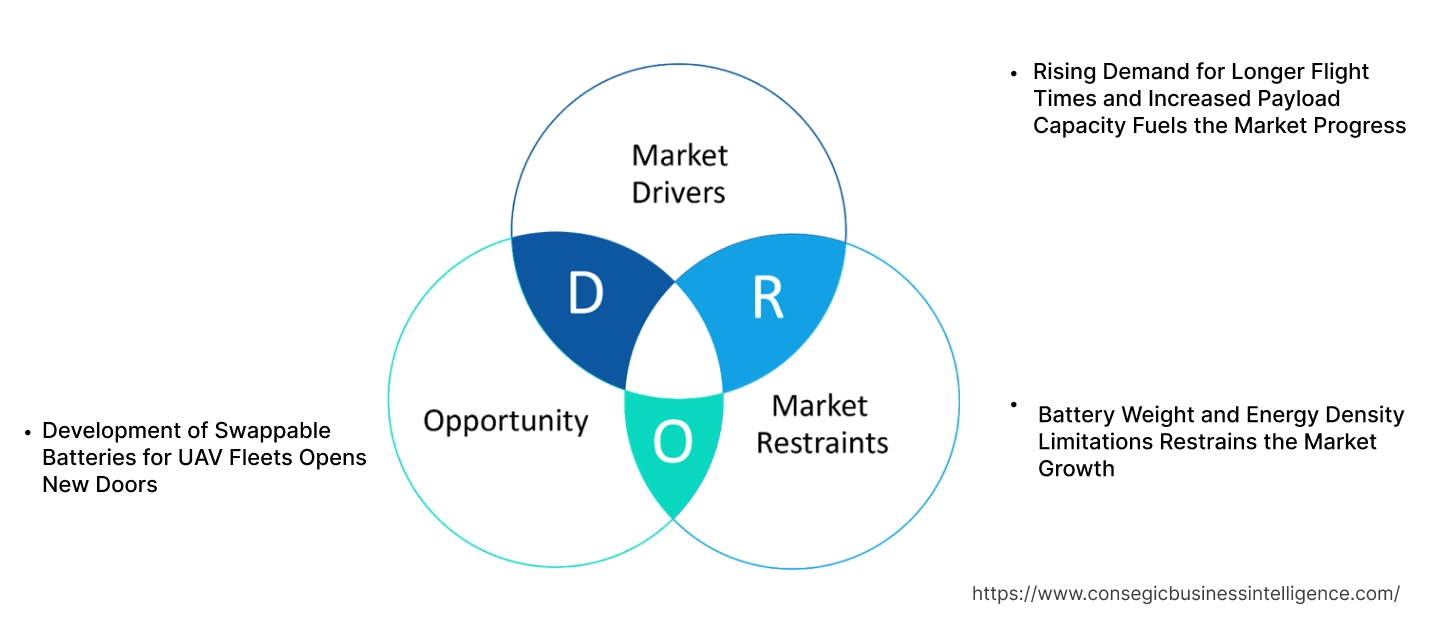
Rising Demand for Longer Flight Times and Increased Payload Capacity Fuels the Market Progress
The growing demand for longer flight durations and higher payload capacities in UAVs is significantly driving the need for more efficient, high-capacity batteries. UAVs are increasingly utilized in applications such as surveillance, delivery services, and agriculture, where extended flight times and the ability to carry heavier payloads are essential for operational success. For instance, in delivery applications, drones must carry packages of varying sizes and weights over longer distances, requiring powerful batteries that provide sufficient energy without compromising efficiency. Similarly, in agricultural monitoring, UAVs need to carry sensors, cameras, and other equipment over large areas for extended periods. As these applications need higher endurance and greater energy storage, battery technology must evolve to meet these needs. The push for longer flight times and increased payload capacities is accelerating advancements in battery efficiency, helping UAVs operate more effectively and meet the growing needs of these diverse industries. Therefore, the aforementioned factors are driving the UAV battery market growth.
Key Restraints:
Battery Weight and Energy Density Limitations Restrains the Market Growth
A significant restraint in the UAV battery market is the ongoing issue of balancing energy density and weight. Batteries, being the heaviest component of any UAV, directly impact the performance and operational efficiency of the drone. While advancements in battery technology have improved energy storage, the need to pack more energy into a lighter, compact form without compromising safety remains a complex issue. The risk of overheating, thermal runaway, or even fire when batteries are pushed beyond their weight-to-energy ratio is a critical concern. This limitation becomes even more pronounced in aviation, where weight reduction is essential for flight efficiency. Consequently, battery weight and energy density continue to be major constraints, limiting flight time and payload capacity. As UAVs require lighter, higher-capacity batteries for longer, more efficient missions, this issue remains a key constraint in the development of advanced, high-performance battery systems for drones, hampering the UAV battery market demand.
Future Opportunities :
Development of Swappable Batteries for UAV Fleets Opens New Doors
The development of swappable batteries for UAV fleets presents a significant opportunity, particularly in industries where rapid turnaround and continuous operations are crucial, such as drone delivery services. Swappable battery systems allow operators to quickly exchange depleted batteries for fully charged ones, eliminating the need for long recharging periods. This significantly reduces downtime, enabling UAVs to resume operations almost immediately and enhancing overall fleet productivity. In delivery services, where timely, on-demand deliveries are essential, swappable batteries can improve the efficiency of last-mile logistics, allowing drones to operate longer hours with minimal interruption. Additionally, this approach reduces operational costs by extending battery life and minimizing the need for infrastructure that supports slow charging. Swappable batteries also provide flexibility, as they can be swapped at centralized stations or in the field, further optimizing the UAV fleet’s operational capacity and reducing fleet maintenance costs. Thus, the above mentioned factors are creating significant UAV battery market opportunities.
UAV Battery Market Segmental Analysis :
By Battery Type:
Based on battery type, the market is segmented into lithium-ion batteries, lithium-polymer batteries, nickel-cadmium batteries, fuel cells, and others.
The lithium-ion batteries segment held the largest revenue of the total UAV battery market share in 2024.
- Lithium-ion batteries are widely used due to their high energy density and longer lifespan, making them ideal for various UAV applications.
- Their lightweight design enhances UAV flight performance, especially in long-endurance and surveillance operations.
- The segment benefits from continuous advancements in lithium-ion technology, including faster charging capabilities and improved energy efficiency.
- Thus, increasing requirement for UAVs in commercial and military industry supports the dominance of lithium-ion batteries, fueling the UAV battery market expansion.
The fuel cells segment is projected to register the fastest CAGR during the forecast period.
- Fuel cells provide extended flight durations and higher energy output, addressing the limitations of conventional battery technologies.
- Growing interest in hydrogen fuel cells for sustainable UAV operations drives the adoption of this segment.
- The segment benefits from advancements in fuel cell technology, including compact designs and improved reliability for long-endurance missions.
- As per the UAV battery market analysis, the rising focus on eco-friendly power sources in defense and commercial applications fuels the rapid growth of fuel cells.
By Capacity:
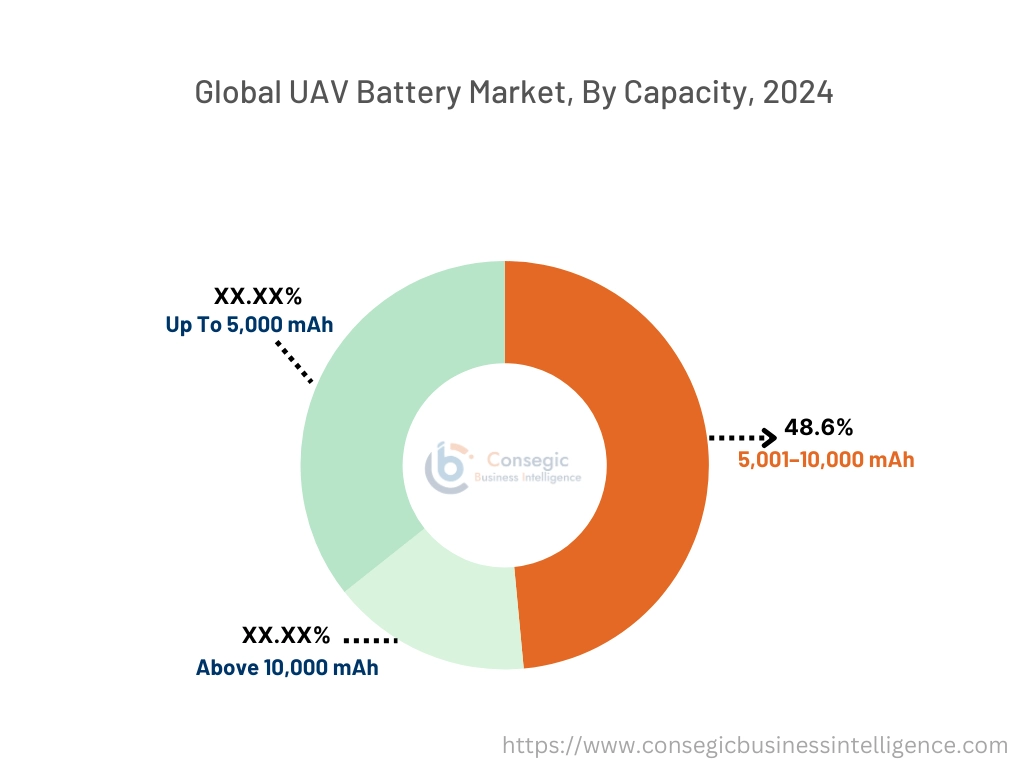
Based on capacity, the market is segmented into up to 5,000 mAh, 5,001–10,000 mAh, and above 10,000 mAh.
The 5,001–10,000 mAh segment held the largest revenue of 48.6% of the total UAV battery market share in 2024.
- Batteries in this range offer an optimal balance between weight and energy output, making them suitable for medium-sized UAVs.
- These batteries are commonly used in agricultural, delivery, and surveillance drones due to their extended flight times.
- Increasing demand for UAVs in logistics and environmental monitoring supports the growth of this segment.
- As per market analysis, the affordability and efficiency of batteries in this range drive their widespread adoption, further boosting the UAV battery market demand.
The above 10,000 mAh segment is expected to grow at the fastest CAGR during the forecast period.
- High-capacity batteries cater to long-endurance missions, including military surveillance and disaster response.
- These batteries are integral to large UAVs requiring extended flight durations and higher payload capacities.
- Advancements in battery technology, including higher energy density and reduced charging times, support the growth of this segment.
- As per the UAV battery market trends, the segment benefits from increasing investments in high-performance UAV systems for critical operations.
By UAV Type:
Based on UAV type, the market is segmented into medium-altitude long endurance (MALE), high-altitude long endurance (HALE), and small UAVs.
The small UAVs segment accounted for the largest revenue share in 2024.
- Small UAVs are widely used across industries, including agriculture, delivery, and entertainment, due to their affordability and versatility.
- The segment benefits from increased adoption of small UAVs for aerial photography, mapping, and inspection purposes.
- Technological advancements in battery systems for small UAVs enhance their flight time and operational efficiency.
- Rising consumer interest in hobby drones further contributes to the segment’s dominance, fueling the UAV battery market growth.
The high-altitude long endurance (HALE) segment is projected to grow at the fastest CAGR during the forecast period.
- HALE UAVs require advanced battery systems to support their extended operational range and high-altitude capabilities.
- The segment is driven by increased need for HALE UAVs in defense applications, including border surveillance and intelligence gathering.
- Advancements in lightweight and high-capacity battery technologies enable longer flight durations for HALE UAVs.
- As per the UAV battery market analysis, rising government investments in high-altitude UAV programs support the segment’s rapid expansion.
By Application:
Based on application, the market is segmented into surveillance, military operations, delivery, crop monitoring, and others.
The surveillance segment held the largest revenue share in 2024.
- UAVs equipped with advanced battery systems are extensively used for real-time surveillance in defense, law enforcement, and environmental monitoring.
- High energy efficiency and extended flight durations support the use of UAVs for long-term surveillance operations.
- The segment benefits from increasing requirement for UAVs in border security, disaster response, and wildlife monitoring applications.
- As per the UAV battery market trends, technological advancements in UAV cameras and sensors further enhance the effectiveness of surveillance drones.
The delivery segment is expected to register the fastest CAGR during the forecast period.
- UAVs powered by high-capacity batteries are increasingly adopted for last-mile delivery in e-commerce and logistics.
- The segment benefits from rising demand for fast and cost-effective delivery solutions in urban and remote areas.
- Advancements in battery technology, enabling longer flight durations and higher payload capacities, support the adoption of delivery drones.
- As per the market trends, increasing partnerships between UAV manufacturers and logistics companies drive the rapid growth of this segment, creating substantial UAV battery market opportunities.
Regional Analysis:
The regions covered are North America, Europe, Asia Pacific, the Middle East and Africa, and Latin America.
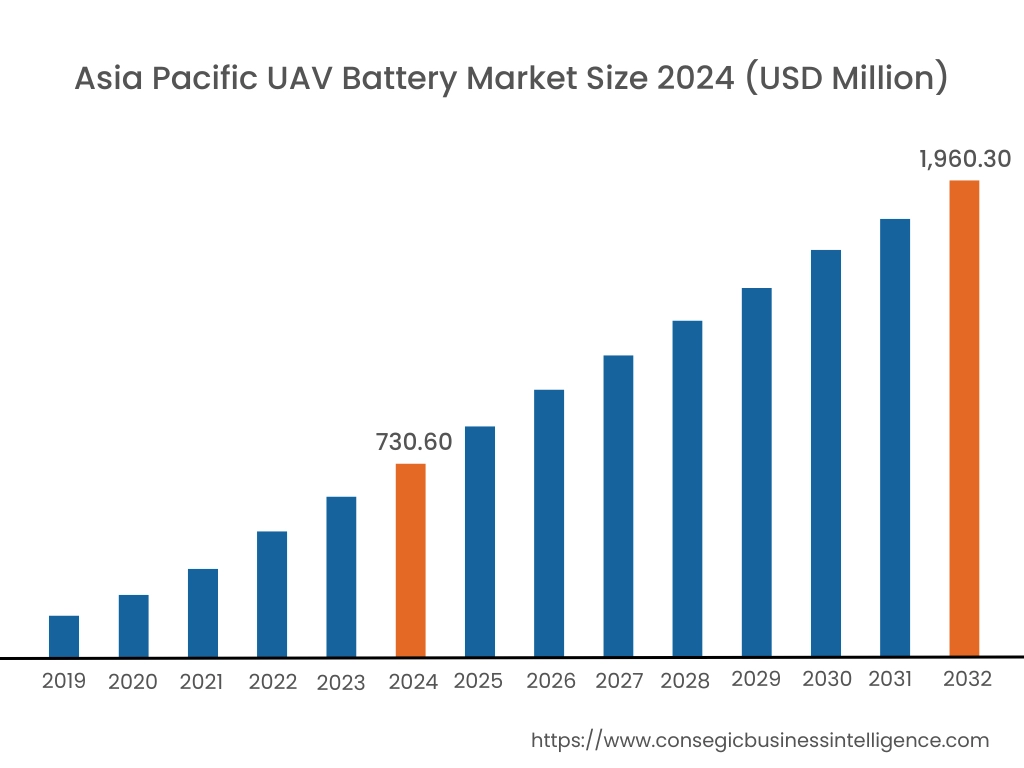
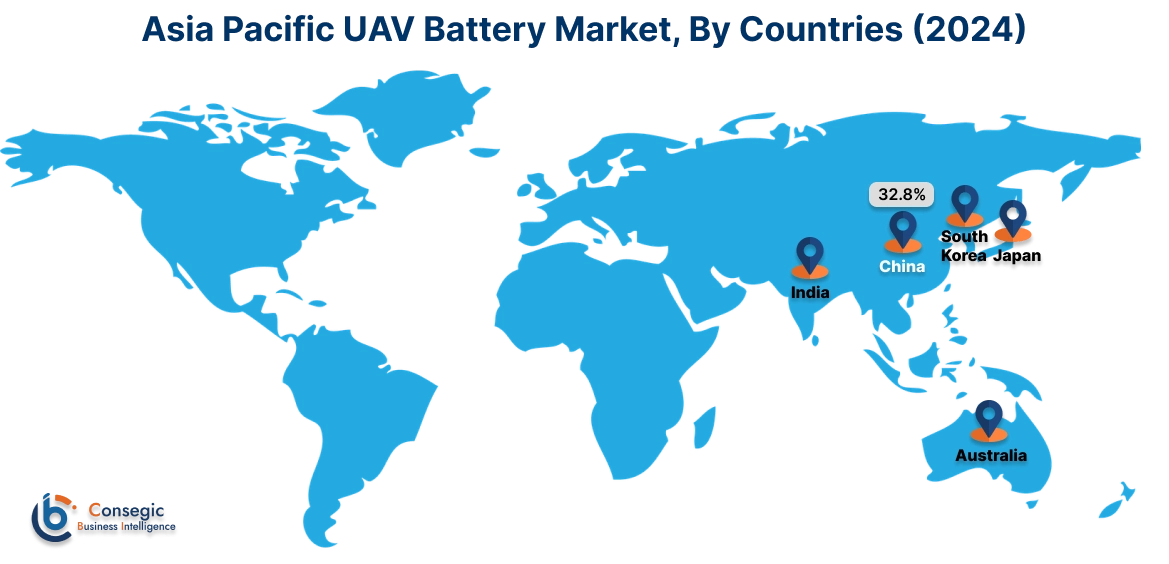
Asia Pacific region was valued at USD 730.60 Million in 2024. Moreover, it is projected to grow by USD 812.37 Million in 2025 and reach over USD 1,960.30 Million by 2032. Out of this, China accounted for the maximum revenue share of 32.8%. The Asia-Pacific region is witnessing rapid advancements in UAV battery technology, with countries like China and India leading the charge. A prominent trend is the development and testing of large cargo drones and advanced UAVs, supported by government initiatives to promote a low-altitude economy. Analysis indicates that the increasing orders for different UAV configurations for many military and commercial applications are key factors influencing the UAV battery market expansion in this area.
North America is estimated to reach over USD 2,086.48 Million by 2032 from a value of USD 822.89 Million in 2024 and is projected to grow by USD 910.66 Million in 2025. This region holds a substantial share of the UAV battery market, driven by the United States' emphasis on enhancing defense capabilities through advanced UAV technologies. A notable trend is the increasing investment in research and development to enhance battery efficiency and reliability. Analysis indicates that the integration of sophisticated battery systems into military and commercial UAVs is progressing, with companies focusing on developing high-energy-density batteries to meet the rising requirement for longer flight times and improved performance.
European countries are actively exploring UAV battery technologies to address environmental concerns and enhance operational efficiency. A significant trend is the collaboration between governments and private companies to develop advanced battery solutions, focusing on reducing carbon emissions and noise pollution. Analysis suggests that countries like Germany and the UK are leading in adoption, driven by stringent environmental regulations and a strong emphasis on technological innovation.
In the Middle East, nations are investing in UAV battery technologies to enhance surveillance and security capabilities. The focus is on developing state-of-the-art battery systems to support long-endurance UAV operations in harsh environmental conditions. In Africa, the market is gradually evolving, with efforts to utilize UAVs for various applications, including agriculture and infrastructure monitoring. Analysis indicates that infrastructure development and regulatory frameworks are crucial factors influencing the adoption of advanced UAV battery systems in these regions.
Latin American countries are exploring UAV battery technologies to address challenges in areas such as agriculture, disaster management, and border surveillance. A notable trend is the interest in developing cost-effective and reliable battery systems suitable for diverse applications. Nonetheless, economic constraints and limited technological infrastructure may impact the pace of adoption. The market trends suggests that partnerships with international companies and investments in infrastructure could play a pivotal role in advancing the UAV battery market in this region.
Top Key Players and Market Share Insights:
The UAV Battery market is highly competitive with major players providing products and services to the national and international markets. Key players are adopting several strategies in research and development (R&D), product innovation, and end-user launches to hold a strong position in the global UAV Battery market. Key players in the UAV Battery industry include -
- DJI (China)
- Legend Batteries (USA)
- Enix Power Solutions (France)
- Custom Power (USA)
- mPower Technology (India)
- EaglePicher Technologies (USA)
- MaxAmps Lithium Batteries (USA)
- Grepow Battery Co. (China)
- Intelligent Energy (UK)
- Alexander Battery Technologies (UK)
Recent Industry Developments :
Product Enhancements:
- In February 2024, AeroVironment Puma 3 AE Now Offers Extended 3-Hour Endurance with the new PS2500 battery, extending flight endurance to three hours. The high-energy-density 24.5Ah lithium-ion battery enhances mission flexibility for land and maritime operations. Operators can choose between the standard 2.5-hour battery or the PS2500 for longer missions, without altering the existing battery bay. This upgrade reinforces Puma’s modularity and versatility for various applications.
Product Launches:
- In September 2023, Amprius Technologies and Tenergy unveiled a next-gen drone battery pack at CUAV Las Vegas. The pack is 31% lighter and delivers 6% more energy than standard options, enabling longer flight times and higher payloads. It uses Amprius' silicon anode technology, available commercially, targeting the $38B UAS market. Leaders hail it as a breakthrough for UAS performance and sustainable battery innovation, transforming industry standards.
UAV Battery Market Report Insights :
| Report Attributes | Report Details |
| Study Timeline | 2019-2032 |
| Market Size in 2032 | USD 6,437.76 Million |
| CAGR (2025-2032) | 12.7% |
| By Battery Type |
|
| By Capacity |
|
| By UAV Type |
|
| By Application |
|
| By Region |
|
| Key Players |
|
| North America | U.S. Canada Mexico |
| Europe | U.K. Germany France Spain Italy Russia Benelux Rest of Europe |
| APAC | China South Korea Japan India Australia ASEAN Rest of Asia-Pacific |
| Middle East and Africa | GCC Turkey South Africa Rest of MEA |
| LATAM | Brazil Argentina Chile Rest of LATAM |
| Report Coverage |
|
Key Questions Answered in the Report
What is the size of the UAV Battery Market? −
The UAV Battery Market size is estimated to reach over USD 6,437.76 Million by 2032 from a value of USD 2,480.75 Million in 2024 and is projected to grow by USD 2,750.61 Million in 2025, growing at a CAGR of 12.7% from 2025 to 2032.
What are the key segments in the UAV Battery Market? +
The market is segmented by battery type (lithium-ion batteries, lithium-polymer batteries, nickel-cadmium batteries, fuel cells, and others), capacity (up to 5,000 mAh, 5,001–10,000 mAh, above 10,000 mAh), UAV type (medium-altitude long endurance (MALE), high-altitude long endurance (HALE), small UAVs), and application (surveillance, military operations, delivery, crop monitoring, and others).
Which segment is expected to grow the fastest in the UAV Battery Market? +
The fuel cells segment is projected to register the fastest CAGR during the forecast period, driven by advancements in fuel cell technology and the growing interest in hydrogen fuel cells for sustainable UAV operations.
Who are the major players in the UAV Battery Market? +
Key players in the UAV Battery market include DJI (China), Legend Batteries (USA), EaglePicher Technologies (USA), MaxAmps Lithium Batteries (USA), Grepow Battery Co. (China), Intelligent Energy (UK), Alexander Battery Technologies (UK), Enix Power Solutions (France), Custom Power (USA), mPower Technology (India).
Overview
Reputation & Certifications


Our Services
- Market Intelligence & Forecasting
- Custom Research Solutions
- Market Entry Strategy
- Competitive Intelligence
- Customer Insights
- Industry Innovation Analysis
- Investment Advisory