Jump to Content
Quantum Warfare Market - Size, Share, Industry Trends, and Forecasts (2025 - 2032)
Quantum Warfare Market Size:
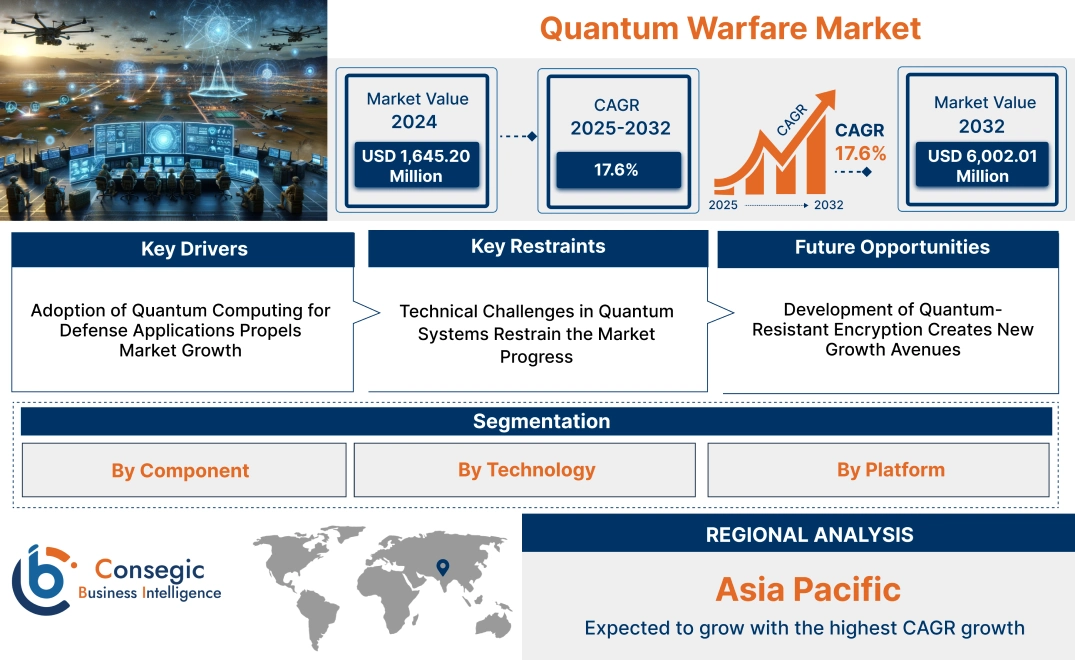
Quantum Warfare Market size is estimated to reach over USD 6,002.01 Million by 2032 from a value of USD 1,645.20 Million in 2024 and is projected to grow by USD 1,904.78 Million in 2025, growing at a CAGR of 17.6% from 2025 to 2032.
Quantum Warfare Market Scope & Overview:
Quantum warfare refers to the application of quantum technologies in defense and strategic operations, leveraging advancements in quantum computing, quantum cryptography, and quantum sensing. These technologies are designed to enhance capabilities in secure communication, intelligence gathering, and precision targeting, offering a significant edge in modern military operations. The concept revolves around integrating quantum-based systems to address the complexities of evolving threats in warfare.
This approach includes tools such as quantum-encrypted communication networks to prevent interception, quantum sensors for precise navigation in GPS-denied environments, and quantum computing for rapid data processing and decision-making. These systems are engineered to operate reliably in high-stress and unpredictable scenarios, ensuring efficiency and security in critical missions.
End-users include defense agencies, intelligence organizations, and research institutions seeking advanced technologies to support next-generation military strategies. Quantum warfare systems play a pivotal role in transforming defense capabilities and ensuring operational superiority in future conflicts.
Quantum Warfare Market Dynamics - (DRO) :
Key Drivers:
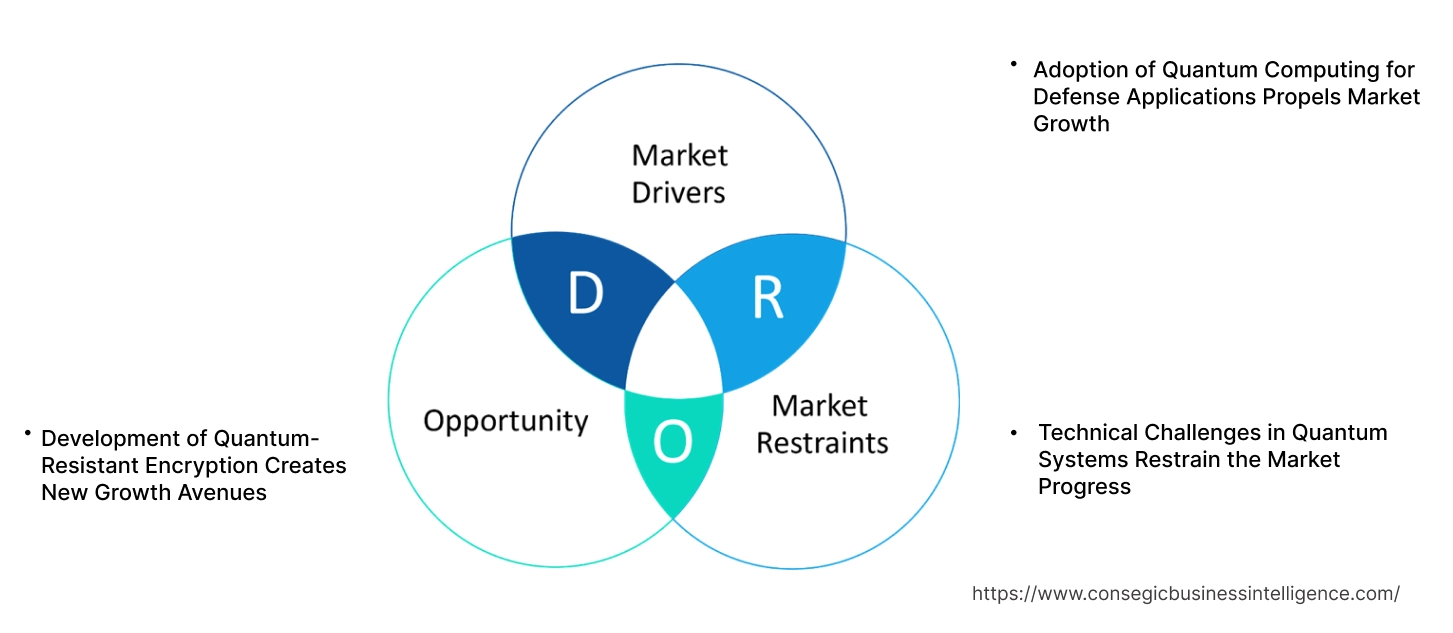
Adoption of Quantum Computing for Defense Applications Propels Market Growth
Quantum computing is transforming the defense landscape by providing unmatched computational power for processing complex algorithms. Its capability to perform operations at speeds far exceeding traditional computers enhances cryptographic systems, ensuring secure communication channels and safeguarding sensitive military data. Quantum-based encryption techniques, such as quantum key distribution (QKD), offer tamper-proof communication, essential for mission-critical operations. Furthermore, quantum computing's ability to decode encrypted enemy signals gives defense organizations a strategic advantage in intelligence and counterintelligence activities. In addition, advanced simulation capabilities powered by quantum systems enable precise modeling of battlefield scenarios, weapon designs, and operational strategies. These applications are driving significant investments in quantum research and development, as global defense agencies aim to harness this cutting-edge technology for superior security and strategic dominance. As a result, quantum computing is becoming a cornerstone in the evolution of modern warfare systems, driving significant quantum warfare market growth.
Key Restraints:
Technical Challenges in Quantum Systems Restrain the Market Progress
Quantum technologies, despite their immense potential, face significant technical constraints that hinder their deployment in defense applications. High error rates in quantum computations, caused by environmental interference and quantum decoherence, compromise the reliability of these systems. Maintaining quantum stability requires highly controlled environments, such as ultra-low temperatures and vacuum conditions, which are costly and difficult to achieve, especially in operational military settings. Additionally, the fragility of quantum states limits the scalability and portability of quantum devices, creating barriers to widespread adoption in real-world scenarios.
The complexity of quantum hardware and software further adds to the restraints, requiring advanced expertise and substantial investment in research and development. These limitations not only slow the commercialization of quantum technologies but also restrict their practical application in critical defense functions, such as secure communications and advanced simulations, where reliability and scalability are paramount. Thus, the aforementioned factors limit the quantum warfare market demand.
Future Opportunities :
Development of Quantum-Resistant Encryption Creates New Growth Avenues
The advent of quantum computing poses a significant threat to existing encryption systems, as quantum algorithms are able to potentially break traditional cryptographic methods. This has led to a surge in demand for quantum-resistant encryption, which uses algorithms designed to withstand quantum computational attacks. Governments and defense organizations are prioritizing investments in post-quantum cryptographic standards to secure sensitive communications and data against future threats. Initiatives by global regulatory bodies, such as NIST's (National Institute of Standards and Technology) efforts to standardize quantum-resistant algorithms, are accelerating the development of secure encryption protocols. These advancements present significant opportunities for companies specializing in encryption technologies, enabling them to play a crucial role in safeguarding critical infrastructures. As industries prepare for the quantum era, quantum-resistant encryption is emerging as a cornerstone of cybersecurity, ensuring resilience against evolving computational capabilities and further boosting the quantum warfare market opportunities.
Quantum Warfare Market Segmental Analysis :
By Component:
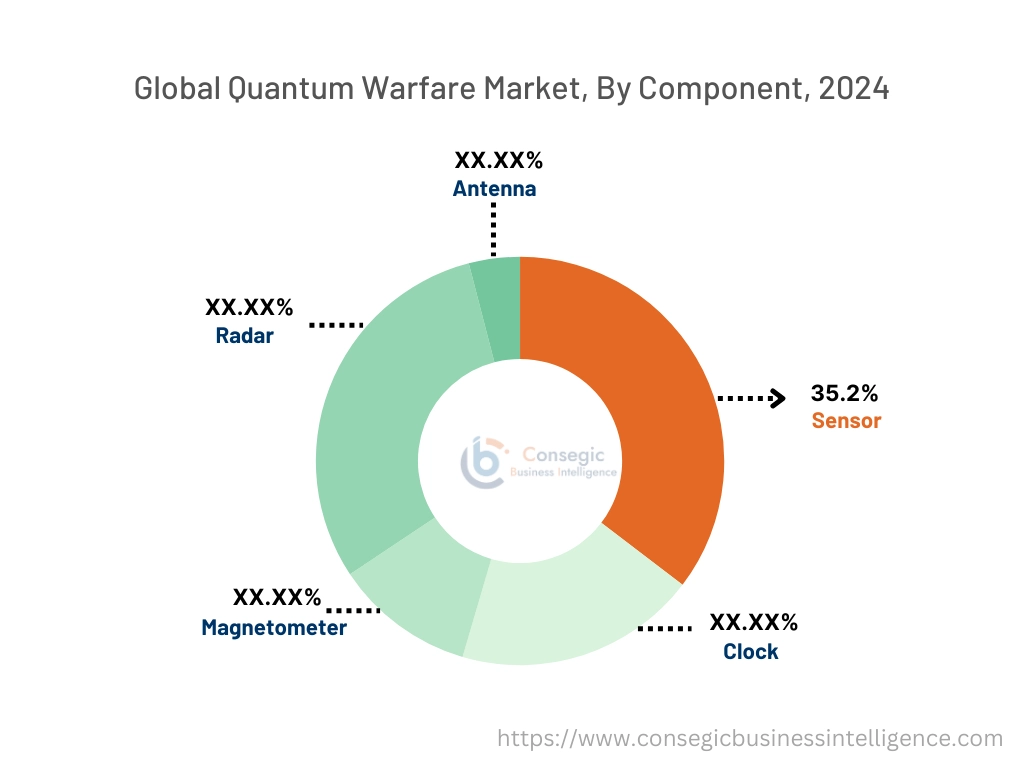
Based on components, the market is segmented into antenna, clock, magnetometer, radar, and sensor.
The sensor segment held the largest revenue of 35.2% of the total quantum warfare market share in 2024.
- Sensors play a pivotal role in quantum sensing and metrology, enabling accurate detection of physical quantities such as gravitational fields and electromagnetic waves.
- Their integration into defense platforms enhances intelligence and surveillance operations, making them indispensable for advanced military strategies.
- The adoption of quantum sensors is driven by their ability to function in extreme environments and deliver unparalleled precision.
- As per the quantum warfare market analysis, the dominance of this segment reflects its critical contribution to improving operational capabilities across various platforms.
The radar segment is anticipated to register the fastest CAGR during the forecast period.
- Quantum radar systems enhance detection capabilities, enabling the identification of stealth aircraft and advanced missiles.
- The increasing focus on modernizing defense systems is contributing to the adoption of quantum radar technologies.
- Advanced radar systems are being deployed in naval and air-based platforms to counter sophisticated electronic warfare tactics.
- The market trends depict that the rapid technological developments in radar technology further position this segment as a critical area of innovation, contributing to the quantum warfare market expansion.
By Technology:
Based on technology, the market is segmented into quantum communication and cryptography, quantum computing and simulations, and quantum sensing and metrology.
The quantum communication and cryptography segment accounted for the largest revenue of the total quantum warfare market share in 2024.
- Quantum communication technologies provide unbreakable encryption, securing military and intelligence communications against cyber threats.
- Defense organizations are adopting quantum cryptography solutions to safeguard critical data transmission.
- The increasing focus on cybersecurity in national defense strategies drives the adoption of quantum communication technologies.
- As per the quantum warfare market trends, this segment’s dominance is attributed to its role in mitigating risks associated with data breaches and cyberattacks.
The quantum computing and simulations segment is projected to grow at the fastest CAGR during the forecast period.
- Quantum computing enables advanced simulations for defense applications, including mission planning and real-time decision-making.
- The demand for high-performance computing solutions in military operations supports the growth of this segment.
- Quantum simulations are being used to optimize resource allocation in military logistics and enhance operational efficiency.
- Ongoing investments in R&D for quantum computing technologies fuel its rapid expansion in the defense industry, which further fuels the quantum warfare market demand.
By Platform:
Based on platforms, the market is segmented into land-based, naval-based, air-based, and space-based systems.
The land-based platform segment held the largest revenue share in 2024.
- Land-based systems utilize quantum technologies for intelligence gathering, secure communication, and counter-terrorism operations.
- The deployment of quantum sensors in land-based platforms enhances situational awareness and decision-making in real time.
- Defense organizations are investing heavily in upgrading land-based platforms with quantum-enabled capabilities.
- The dominance of this segment is attributed to its broad applicability across defense and homeland security operations, driving the quantum warfare market growth.
The space-based platform segment is expected to register the fastest CAGR during the forecast period.
- Space-based platforms leverage quantum technologies for satellite communication and surveillance in space operations.
- The increasing focus on space defense initiatives drives investments in quantum-enabled satellites and related technologies.
- Quantum technologies are being utilized to enhance the accuracy and reliability of space-based navigation systems.
- Thus, as per the market trends, the rapid advancements in space technologies position this segment for significant growth in the coming years, creating significant quantum warfare market opportunities.
Regional Analysis:
The regions covered are North America, Europe, Asia Pacific, the Middle East and Africa, and Latin America.
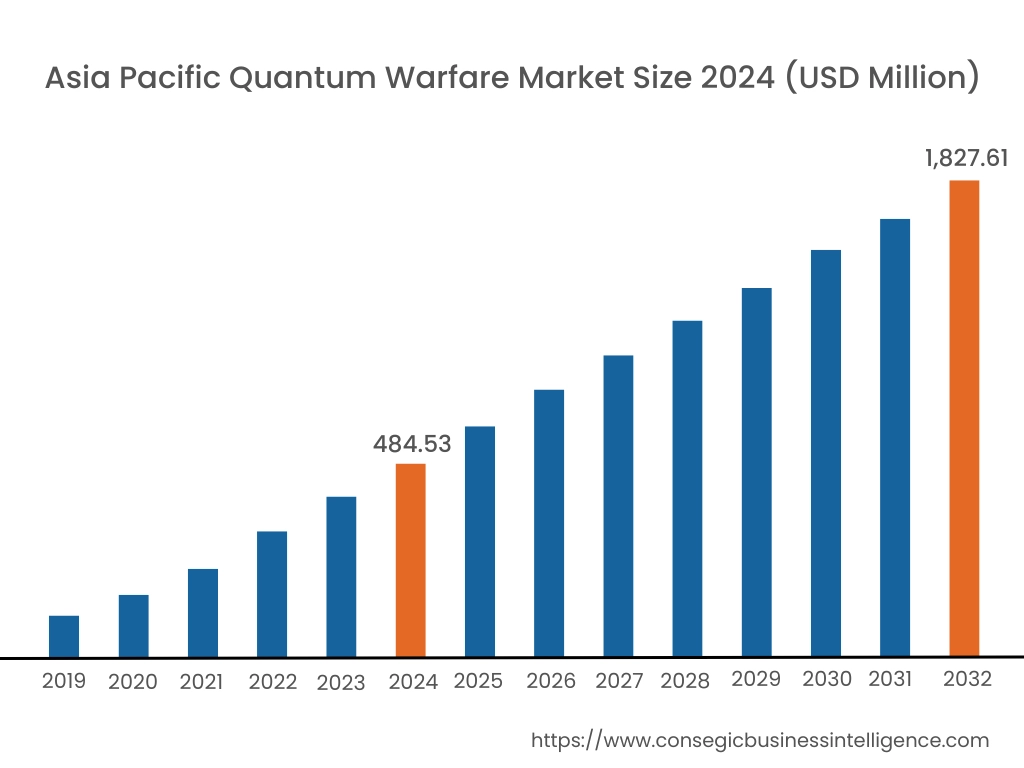
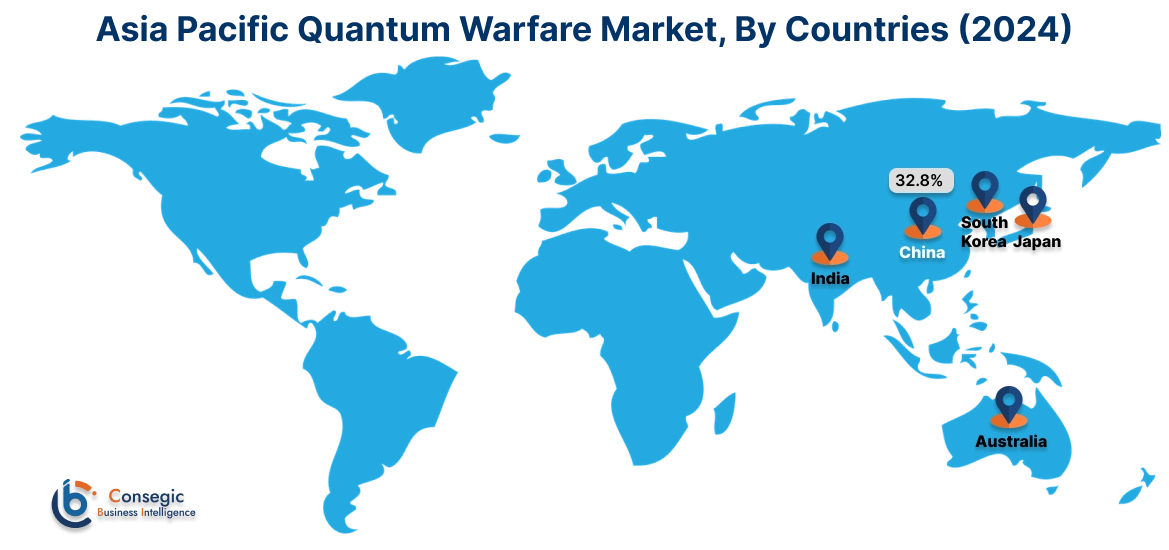
Asia Pacific region was valued at USD 484.53 Million in 2024. Moreover, it is projected to grow by USD 562.56 Million in 2025 and reach over USD 1,827.61 Million by 2032. Out of this, China accounted for the maximum revenue share of 32.8%. Asia-Pacific is witnessing rapid advancements in the market, with China, Japan, and South Korea leading regional initiatives. Trends in quantum key distribution (QKD) for secure military communication and quantum radar systems are significant in China, which has established dedicated programs for defense-related quantum technologies. Japan and South Korea focus on enhancing quantum sensing capabilities for surveillance and early threat detection. The quantum warfare market analysis also highlights regional efforts to counter potential quantum-enabled threats through collaborative research and technological integration.
North America is estimated to reach over USD 1,945.25 Million by 2032 from a value of USD 545.73 Million in 2024 and is projected to grow by USD 630.62 Million in 2025. North America leads the quantum warfare market, driven by substantial investments in quantum computing and cryptographic defense technologies. The United States plays a pivotal role, with trends focusing on integrating quantum systems for secure communication and advanced battlefield strategies. The analysis highlights collaborations between defense agencies, such as the Department of Defense, and leading technology firms to develop quantum-resistant algorithms and enhance cyber defense infrastructure. Canada contributes through its strong research ecosystem in quantum cryptography and computing applications.
Europe is emerging as a key region in the market, with countries like Germany, France, and the UK leading efforts in developing quantum-based military applications. Trends in secure quantum communication networks, particularly for NATO operations, are driving innovation in the region. The analysis shows that the European Union’s investments in quantum research, under initiatives like the Quantum Flagship program, are fostering advancements in quantum sensing and encryption technologies tailored for military use, fueling the quantum warfare market expansion. Emphasis on strengthening defense against quantum cyber threats is also prominent in this region.
The Middle East and Africa region is gradually entering the quantum warfare market, with countries like the UAE and Israel investing in quantum technologies for national defense. Trends in deploying quantum-enhanced cybersecurity measures and advanced surveillance systems are shaping the regional market. The analysis points to Israel’s focus on leveraging quantum computing for military intelligence and the UAE’s emphasis on partnerships with global tech leaders to build quantum infrastructure.
Latin America is an emerging region with Brazil and Mexico showing interest in quantum technology integration for defense purposes. The quantum warfare market trends show that regional collaborations with global technology providers are paving the way for the adoption of quantum-secure communication systems. The analysis highlights Brazil’s initiatives in quantum computing research for military applications and Mexico’s focus on enhancing cybersecurity frameworks using quantum-resistant technologies drives the market growth.
Top Key Players and Market Share Insights:
The Quantum Warfare market is highly competitive with major players providing products and services to the national and international markets. Key players are adopting several strategies in research and development (R&D), product innovation, and end-user launches to hold a strong position in the global Quantum Warfare market. Key players in the Quantum Warfare industry include -
- IBM Corporation (USA)
- Honeywell International Inc. (USA)
- D-Wave Systems Inc. (Canada)
- NVIDIA Corporation (USA)
- Northrop Grumman Corporation (USA)
- Google LLC (USA)
- Microsoft Corporation (USA)
- Rigetti Computing (USA)
- IonQ, Inc. (USA)
- Alibaba Group Holding Limited (China)
Quantum Warfare Market Report Insights :
| Report Attributes | Report Details |
| Study Timeline | 2019-2032 |
| Market Size in 2032 | USD 6,002.01 Million |
| CAGR (2025-2032) | 17.6% |
| By Component |
|
| By Technology |
|
| By Platform |
|
| By Region |
|
| Key Players |
|
| North America | U.S. Canada Mexico |
| Europe | U.K. Germany France Spain Italy Russia Benelux Rest of Europe |
| APAC | China South Korea Japan India Australia ASEAN Rest of Asia-Pacific |
| Middle East and Africa | GCC Turkey South Africa Rest of MEA |
| LATAM | Brazil Argentina Chile Rest of LATAM |
| Report Coverage |
|
Key Questions Answered in the Report
What is the size of the Quantum Warfare Market? −
The Quantum Warfare Market size is estimated to reach over USD 6,002.01 Million by 2032 from a value of USD 1,645.20 Million in 2024 and is projected to grow by USD 1,904.78 Million in 2025, growing at a CAGR of 17.6% from 2025 to 2032.
What are the key segments in the Quantum Warfare Market? +
The market is segmented by component (antenna, clock, magnetometer, radar, sensor), technology (quantum communication & cryptography, quantum computing & simulations, quantum sensing & metrology), platform (land-based, naval-based, air-based, space-based), and region (Asia-Pacific, Europe, North America, Latin America, Middle East & Africa).
Which segment is expected to grow the fastest in the Quantum Warfare Market? +
The quantum computing and simulations segment is expected to grow at the fastest CAGR during the forecast period, driven by the increasing demand for advanced simulations in defense applications and the growing need for high-performance computing solutions.
Who are the major players in the Quantum Warfare Market? +
Major players in the Quantum Warfare Market include IBM Corporation (USA), Honeywell International Inc. (USA), Google LLC (USA), Microsoft Corporation (USA), Rigetti Computing (USA), IonQ, Inc. (USA), Alibaba Group Holding Limited (China), D-Wave Systems Inc. (Canada), NVIDIA Corporation (USA), and Northrop Grumman Corporation (USA).
Overview
Reputation & Certifications


Our Services
- Market Intelligence & Forecasting
- Custom Research Solutions
- Market Entry Strategy
- Competitive Intelligence
- Customer Insights
- Industry Innovation Analysis
- Investment Advisory