Jump to Content
Voyage Data Recorder (VDR) Market - Size, Share, Industry Trends, and Forecasts (2025-2032)
Voyage Data Recorder (VDR) Market Size:
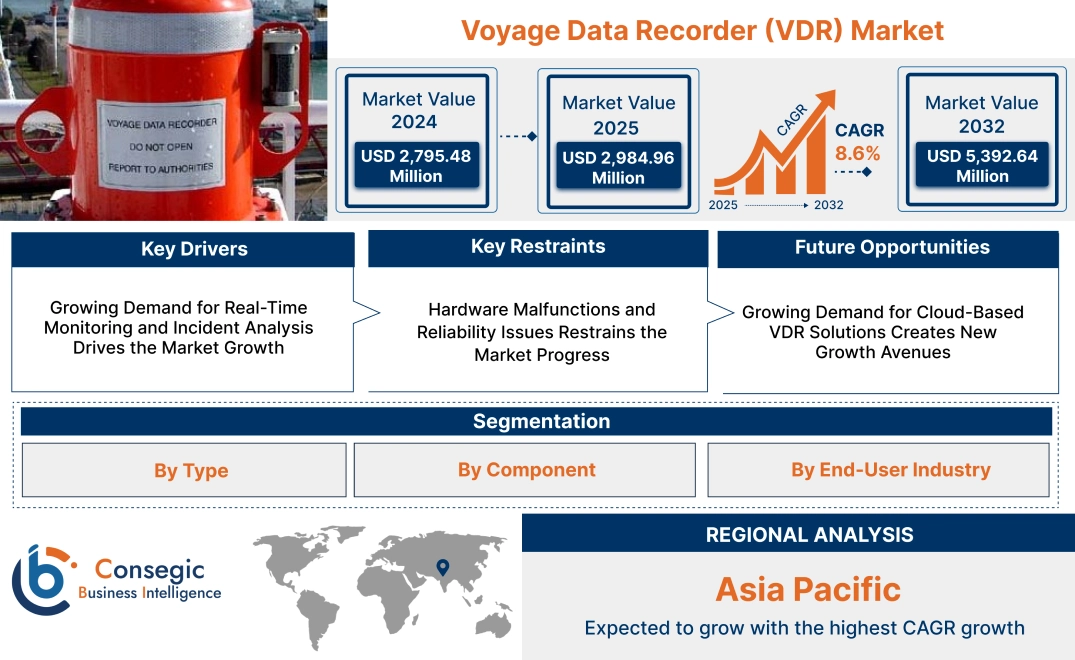
Voyage Data Recorder (VDR) Market size is estimated to reach over USD 5,392.64 Million by 2032 from a value of USD 2,795.48 Million in 2024 and is projected to grow by USD 2,984.96 Million in 2025, growing at a CAGR of 8.6% from 2025 to 2032.
Voyage Data Recorder (VDR) Market Scope & Overview:
A Voyage Data Recorder (VDR) is a critical maritime device designed to capture and store information about a ship’s operational data and activities for analysis and review. Often referred to as the "black box" of a vessel, the VDR records parameters such as navigation status, engine performance, communication, and environmental conditions. These systems are essential for ensuring compliance with international maritime regulations and supporting investigations into maritime incidents.
VDR systems are equipped with robust data collection and storage components to function reliably under extreme maritime conditions. They feature advanced capabilities such as real-time data recording, secure data storage, and integration with other onboard systems. The information captured by the VDR aids in improving safety protocols, operational efficiency, and accident prevention measures.
End-users include commercial shipping operators, naval forces, and vessel owners seeking reliable data recording solutions for compliance, safety, and operational improvement. VDR systems play a vital role in modernizing maritime safety standards and enhancing the transparency of vessel operations.
Voyage Data Recorder (VDR) Market Dynamics - (DRO) :
Key Drivers:
Growing Demand for Real-Time Monitoring and Incident Analysis Drives the Market Growth
The growing need for real-time monitoring in maritime operations is a key driver of the demand for Voyage Data Recorders (VDRs). These systems collect critical data during a voyage, including navigational, operational, and environmental parameters such as speed, heading, engine performance, and weather conditions. This real-time data is invaluable for maritime authorities and shipping companies, providing them with insights into vessel operations, ensuring adherence to safety protocols, and improving decision-making processes. In the event of an incident, VDRs play a crucial role in reconstructing the chain of events, aiding in the investigation and helping identify root causes. This analysis not only enhances safety but also enables the implementation of corrective actions to prevent future incidents. As maritime industries increasingly prioritize operational efficiency and safety, the demand for VDR systems to support these goals continues to grow, making them a critical component of modern shipping operations. Thus, the aforementioned factors are fueling the voyage data recorder market growth.

Key Restraints:
Hardware Malfunctions and Reliability Issues Restrains the Market Progress
The Voyage Data Recorder's hardware failing to function properly without triggering an alarm, leads to undetected system failures. This results in the loss of critical data, especially during incidents or accidents when the VDR’s data is most needed for analysis. Such malfunctions compromise the reliability and effectiveness of VDRs, which are essential for enhancing maritime safety and providing valuable evidence in investigations. Since VDRs play a crucial role in recording navigational, operational, and environmental data, any hardware malfunction that goes unnoticed hinder the proper functioning of the system. This lack of real-time awareness of hardware failures increases the risk of non-compliance with safety regulations and impact the quality of incident analysis, posing difficulties to both vessel operators and regulatory authorities. In conclusion, the hardware malfunctions represents a significant constraint for the voyage data recorder market demand.
Future Opportunities :
Growing Demand for Cloud-Based VDR Solutions Creates New Growth Avenues
The growing adoption of cloud computing presents a significant opportunity for the Voyage Data Recorder (VDR) market. Cloud-based VDR systems offer efficient and scalable data storage solutions, eliminating the need for physical storage devices onboard vessels. These systems enable real-time data access, allowing maritime authorities, shipping companies, and investigators to remotely monitor vessel operations and perform incident analysis from any location. Cloud integration streamlines data sharing, making it easier to collaborate across various stakeholders and ensuring faster response times during critical events. The ability to securely store and manage large volumes of data in the cloud enhances the functionality of VDRs, making them more accessible, flexible, and reliable. Furthermore, cloud-based solutions reduce the operational and maintenance costs associated with physical infrastructure, driving the adoption of these systems in the maritime sector as they improve data analysis, decision-making, and compliance with regulatory requirements. Therefore, the aforementioned factors are creating substantial voyage data recorder market opportunities.
Voyage Data Recorder (VDR) Market Segmental Analysis :
By Type:
Based on type, the market is segmented into general voyage data recorder and simplified voyage data recorder.
The general voyage data recorder segment held the largest revenue of the total voyage data recorder market share in 2024.
- The widespread adoption of general VDRs across large commercial ships ensures compliance with IMO regulations, driving segment dominance.
- These recorders provide comprehensive data for incident investigation and operational efficiency improvement, making them a preferred choice for maritime operators.
- Their robust design and capacity to handle extensive data storage cater to the needs of complex marine operations.
- The increasing deployment of general VDRs across naval vessels further supports their significant market share, contributing to the voyage data recorder market expansion.
The simplified voyage data recorder segment is projected to witness the fastest CAGR during the forecast period.
- The cost-effective nature of simplified VDRs makes them suitable for smaller vessels and offshore support ships.
- These recorders are easier to install and maintain, contributing to their growing preference in emerging markets.
- Simplified VDRs meet compliance requirements for smaller vessels, driving adoption in niche maritime segments.
- As per the voyage data recorder market analysis, the increasing use of simplified VDRs in private and leisure boating sectors boosts the segment’s rapid expansion.
By Component:
Based on component, the market is segmented into data recording unit, data collecting unit, protective storage unit, sensors, and others.
The data recording unit segment accounted for the largest revenue of the total voyage data recorder market share in 2024.
- Data recording units serve as the core of VDR systems, storing critical voyage data for post-incident analysis and operational reviews.
- Their ability to continuously record navigation, communication, and environmental parameters supports compliance with international standards.
- The adoption of advanced recording units with higher data storage capabilities enhances their role in safety and operational optimization.
- As per the voyage data recorder market trends, the increasing deployment of recording units in commercial and military fleets ensures their leading market position.
The sensors segment is anticipated to register the fastest CAGR during the forecast period.
- Sensors play a pivotal role in collecting real-time data on vessel performance, environmental conditions, and onboard activities.
- The rising integration of IoT-enabled sensors in modern VDR systems enhances data accuracy and analytics capabilities.
- Sensors are crucial in supporting predictive maintenance and operational optimization, driving their growing need across end-user industries.
- The continuous development of sensor technologies for advanced applications ensures the segment’s rapid growth, further boosting the voyage data recorder market demand.
By End-User Industry:
Based on end-user industry, the market is segmented into military & defense, logistics, oil & gas, and others.
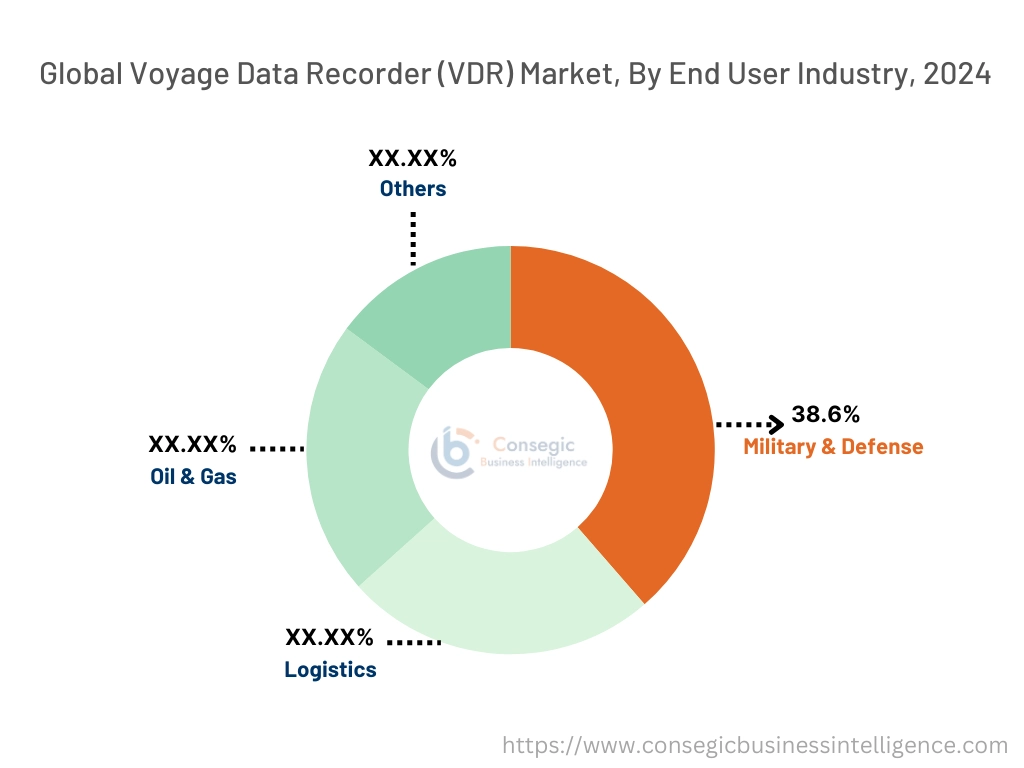
The military & defense segment held the largest revenue share of 38.6% in 2024.
- The deployment of VDRs in naval fleets ensures compliance with international safety regulations and operational efficiency.
- Military applications benefit from VDRs for real-time monitoring, incident investigation, and fleet management.
- The increasing focus on maritime security and fleet modernization supports the dominance of this segment.
- VDRs in military vessels enhance mission-critical operations and communication efficiency, ensuring their widespread adoption, fueling the voyage data recorder market growth.
The logistics segment is projected to exhibit the fastest CAGR during the forecast period.
- The growing demand for efficient fleet management in maritime logistics drives the adoption of VDR systems.
- Logistics operators leverage VDRs for tracking, operational analytics, and compliance with safety standards.
- The rise of automated shipping operations and digital transformation across the logistics sector accelerates the segment’s growth.
- As per the voyage data recorder market analysis, increasing trade activities and containerized shipping bolster the adoption of VDRs in the logistics sector.
Regional Analysis:
The regions covered are North America, Europe, Asia Pacific, the Middle East and Africa, and Latin America.
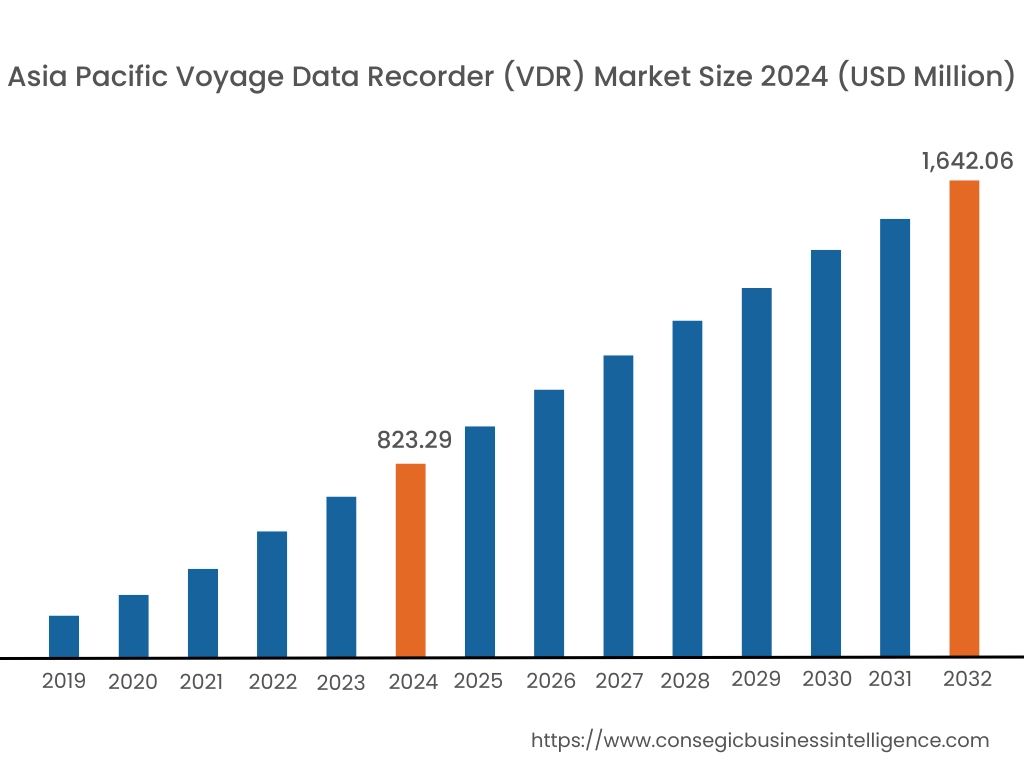
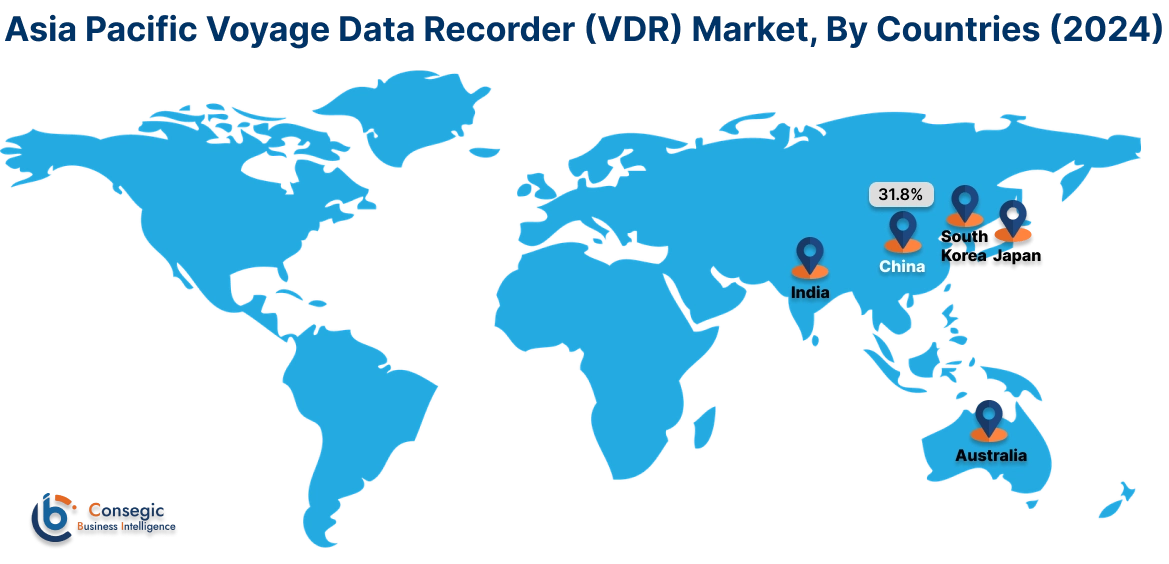
Asia Pacific region was valued at USD 823.29 Million in 2024. Moreover, it is projected to grow by USD 881.58 Million in 2025 and reach over USD 1,642.06 Million by 2032. Out of this, China accounted for the maximum revenue share of 31.8%. The Asia-Pacific region is witnessing rapid growth in the VDR market, attributed to the expansion of commercial shipping activities and increasing maritime trade. A prominent trend is the adoption of simplified VDRs (S-VDRs) by smaller vessels, driven by regulatory requirements and cost considerations. The voyage data recorder market trends indicate that the market is further stimulated by the region's growing shipbuilding sector and the enforcement of international maritime safety regulations.
North America is estimated to reach over USD 1,747.75 Million by 2032 from a value of USD 927.28 Million in 2024 and is projected to grow by USD 988.24 Million in 2025. This region holds a substantial portion of the VDR market, driven by stringent maritime safety regulations and a robust shipping sector. A notable trend is the integration of advanced data analytics and real-time monitoring capabilities into VDR systems, enhancing operational efficiency and safety. Analysis indicates that the adoption of such technologies is propelled by the need for improved accident investigation and compliance with international maritime standards, creating new voyage data recorder market opportunities.
European countries, particularly those with extensive maritime operations, are key players in the VDR market. A significant trend is the emphasis on environmental monitoring features within VDRs, aligning with the region's focus on sustainable shipping practices. The market trends suggests that the implementation of these advanced systems is supported by both regulatory mandates and industry initiatives aimed at enhancing maritime safety and environmental compliance.
In the Middle East, the VDR market is influenced by the region's strategic importance in global oil and gas transportation. The focus is on equipping tankers and large cargo vessels with advanced VDR systems to ensure compliance with international safety standards. In Africa, the market is gradually developing, with efforts to enhance maritime safety and security. Market trends suggests that international collaborations and investments in maritime infrastructure are crucial for voyage data recorder market expansion in these regions.
Latin American countries are increasingly recognizing the importance of VDRs in improving maritime safety and operational efficiency. A notable trend is the modernization of existing fleets with updated VDR technology to comply with international regulations. However, economic constraints and varying regulatory frameworks may impact the pace of adoption. Market trends indicates that regional initiatives to standardize maritime safety practices could facilitate broader implementation of VDR systems.
Top Key Players and Market Share Insights:
The Voyage Data Recorder (VDR) market is highly competitive with major players providing products and services to the national and international markets. Key players are adopting several strategies in research and development (R&D), product innovation, and end-user launches to hold a strong position in the global Voyage Data Recorder (VDR) market. Key players in the Voyage Data Recorder (VDR) industry include -
- Furuno Electric Co., Ltd. (Japan)
- Japan Radio Co., Ltd. (JRC) (Japan)
- TOKYO KEIKI Inc. (Japan)
- Ocean Voyager Marine Electronics Systems Co., Ltd. (Turkey)
- Maretron LLP (USA)
- Danelec Marine A/S (Denmark)
- NetWave Systems B.V. (Netherlands)
- Headway Technology Co., Ltd. (China)
- Kongsberg Maritime AS (Norway)
- AMI Marine Ltd. (UK)
Recent Industry Developments :
Product Launches:
- In September 2024, Danelec launched Remote Operational Performance Test (OPT) at SMM 2024, simplifying mandatory VDR compliance tests for ships. Part of the Safety Insights suite, it enables remote VDR testing under MSC.333(90) and IEC 61996-1 ed.2, reducing onboard crew workload. Accessible via a browser-based platform, it ensures compliance, operational efficiency, and documentation availability while minimizing downtime and fines. Combined with VDR alarm monitoring, Remote OPT enhances safety and reliability for fleets.
Acquisitions & Mergers:
- In November 2023, Danelec acquired MacGregor's Voyage Data Recorder (VDR) business, increasing its installed base to 16,000 units and strengthening its position in maritime safety and green initiatives. This acquisition enhances Danelec's technological capabilities and aligns with its commitment to the IMO's 2050 carbon-neutral goals. It also integrates MacGregor's team and expertise, fostering shared values and synergies.
Voyage Data Recorder (VDR) Market Report Insights :
| Report Attributes | Report Details |
| Study Timeline | 2019-2032 |
| Market Size in 2032 | USD 5,392.64 Million |
| CAGR (2025-2032) | 8.6% |
| By Type |
|
| By Component |
|
| By End-User Industry |
|
| By Region |
|
| Key Players |
|
| North America | U.S. Canada Mexico |
| Europe | U.K. Germany France Spain Italy Russia Benelux Rest of Europe |
| APAC | China South Korea Japan India Australia ASEAN Rest of Asia-Pacific |
| Middle East and Africa | GCC Turkey South Africa Rest of MEA |
| LATAM | Brazil Argentina Chile Rest of LATAM |
| Report Coverage |
|
Key Questions Answered in the Report
What is the size of the Voyage Data Recorder (VDR) Market? −
The Voyage Data Recorder (VDR) Market size is estimated to reach over USD 5,392.64 Million by 2032 from a value of USD 2,795.48 Million in 2024 and is projected to grow by USD 2,984.96 Million in 2025, growing at a CAGR of 8.6% from 2025 to 2032.
What are the key segments in the Voyage Data Recorder (VDR) Market? +
The market is segmented by type (general voyage data recorder, simplified voyage data recorder), component (data recording unit, data collecting unit, protective storage unit, sensors, and others), and end-user industry (military & defense, logistics, oil & gas, and others).
Which segment is expected to grow the fastest in the Voyage Data Recorder (VDR) Market? +
The simplified voyage data recorder segment is projected to witness the fastest CAGR during the forecast period, driven by its cost-effectiveness and growing adoption in smaller vessels.
Who are the major players in the Voyage Data Recorder (VDR) Market? +
Key players in the Voyage Data Recorder (VDR) market include Furuno Electric Co., Ltd. (Japan), Japan Radio Co., Ltd. (JRC) (Japan), Danelec Marine A/S (Denmark), NetWave Systems B.V. (Netherlands), Headway Technology Co., Ltd. (China), Kongsberg Maritime AS (Norway), AMI Marine Ltd. (UK), Maretron LLP (USA), TOKYO KEIKI Inc. (Japan), and Ocean Voyager Marine Electronics Systems Co., Ltd. (Turkey).
Overview
Reputation & Certifications


Our Services
- Market Intelligence & Forecasting
- Custom Research Solutions
- Market Entry Strategy
- Competitive Intelligence
- Customer Insights
- Industry Innovation Analysis
- Investment Advisory