Jump to Content
Military Antenna Market - Size, Share, Industry Trends, and Forecasts (2025-2035)
Military Antenna Market 2025 - 2035:
- The Global Military Antenna Market reached USD 4.73 billion in 2025.
- The market is projected to expand at a CAGR of 5.30% during 2025–2035.
- The market value is estimated to reach USD 7.93 billion by 2035.
- North America accounted for the largest share of the Military Antenna Market in 2024.
Market Scope & Overview:
The military antennas are communication systems designed to provide support for secure and reliable signal transmission. These antennas are used on land vehicles, naval vessels, aircraft, and unmanned vehicles to provide voice, data, and communication capabilities. The industry includes antenna hardware, signal processing components, mounting structures, and integration software. Major end users include defense forces, homeland security agencies, and military communication network providers.
The military antennas market is growing, driven by the increasing need for secure communication systems on the battlefield. Defense agencies are increasing investments in advanced communication systems to strengthen network centric operations and situational awareness. Continuous modernization of military equipment and the deployment of unmanned and satellite communication systems are supporting antenna demand. Rising defense budgets across the US, Europe, and Asia are also encouraging procurement of advanced antenna technologies.
Market Size & Forecast
- 2024 Market Size: USD 4.49 Billion
- 2025 Market Size: USD 4.73 Billion
- 2035 projected Market Size: USD 7.93 Billion
- CAGR (2025-2035): 5.30%
- Largest Market in 2025: North America
How is the Military Antenna Market Affected by Tariff?
Artificial intelligence improves 55 resources by processing massive amounts of weather information, grid load patterns, and equipment performance with a high degree of accuracy. Machine learning algorithms detect variability in power generation, equipment malfunctions, and efficiency losses in solar farms, wind farms, and energy storage plants. AI systems are also used for demand forecasting, smart inverter management, and automatic grid balancing in distributed energy resources.
AI-enabled platforms allow for the continuous monitoring of 55 resources and real-time decision-making in the transmission and distribution of energy. Predictive models assess turbine degradation, panel deterioration, battery performance, and power generation optimization before any system failure.

Military Antenna Market Dynamics - (DRO):
Key Drivers:
Increasing global defense expenditure supports investment in military communication infrastructure
The budgets allocated by governments in the US, China, India, and European countries are increasing to improve national security. Governments are investing a larger portion of their defense budget in modern communication systems, including those used in land, air, and naval forces. Military forces are upgrading their traditional communication systems to ensure real-time data exchange.
- For instance, in April 2025, SIPRI announced that global military spending stood at USD 2.71 trillion in 2024, increasing for the tenth consecutive year and up 37% since 2015, indicating a decade-long acceleration in military spending globally.
Therefore, the increasing defense spending worldwide is boosting investment in military communication infrastructure.
Key Restraints:
Complex regulatory approvals and export control policies restrict international defense equipment trade
The military antenna systems are subject to defense export regulations and technology control regimes. Governments impose licensing requirements and approval procedures for the transfer of defense communication equipment across borders. The defense export regulations and technology control regimes are slowing down the procurement process and limiting defense trade internationally.
Therefore, complex regulatory procedures and export control measures are limiting the scope of global market growth for military antenna manufacturers.
Future Opportunities:
Rising investment in satellite based military communication networks creates growth avenues
The defense sector is also increasing satellite communication networks for global connectivity and secure communication. For this purpose, advanced antenna systems are needed for efficient signal transmission among ground stations, satellites, and moving military equipment. An increase in satellite-based defense programs is creating a need for high-frequency and electronically steerable antennas for satellite communication systems.
- For instance, in May 2025, SES announced plans for launching satellite orchestration technology for military communications, with the aim of replacing PACE plans with resilient and automated multi-orbit networks.
Hence, rising investment in satellite based military communication networks is creating growth opportunities in the military antennas industry.
Military Antenna Market Segmental Analysis:
By Component:
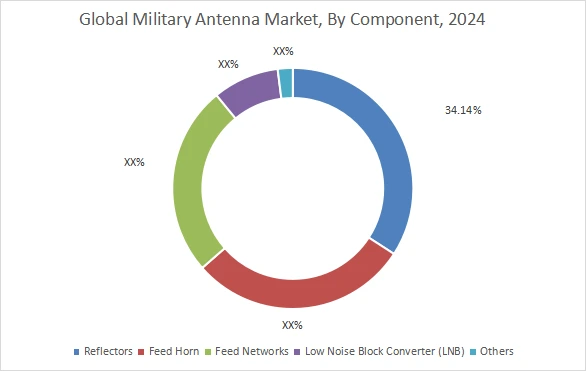
On the basis of component, the military antenna market is segmented into reflectors, feed horn, feed networks, low noise block converter (LNB), and others.
Trends in the Component:
- Increasing deployment of satellite and radar communication systems is supporting demand for antenna components.
- Defense manufacturers are focusing on improving signal reception and transmission efficiency.
The reflectors was responsible for the highest revenue share of 34.14% in 2024.
- Reflectors enable directional signals and communication over longer distances.
- Moreover, defense radar and satellite communication systems require reflector-based antenna structures.
- In addition, naval and airborne platforms use reflector antennas for long distance communication.
- Further, integration in ground-based defense communication infrastructure is supporting steady demand.
- Therefore, wide usage in radar and satellite communication systems is supporting dominance of the reflectors segment.
It is anticipated that the low noise block converter (LNB) will exhibit the highest compound annual growth rate (CAGR) during the forecast period.
- LNB components enhance signal reception for satellite communication systems.
- Also, defense communication networks via satellites are on the increase.
- In addition, military communication systems require improved signal clarity and reduced noise levels.
- Moreover, rising deployment of mobile satellite communication terminals is strengthening demand.
- Therefore, increasing satellite communication programs are driving growth of the LNB segment.
By Frequency Band:
On the basis of frequency band, the military antenna market is divided into high frequency (HF), very high frequency (VHF), ultra high frequency (UHF), super high frequency (SHF), and extremely high frequency (EHF).
Trends in the Frequency Band:
- Defense communication systems require multiple frequency bands for reliable signal transmission.
- The military uses various frequency ranges for communication, radar, and satellite systems.
Ultra high frequency (UHF) accounted for the largest revenue share in the year 2024.
- UHF antennas support reliable communication across land and naval platforms.
- Moreover, military forces use UHF bands for tactical communication and data transmission.
- In addition, these frequencies support stable signal performance in mobile battlefield environments.
- Further, integration across vehicles, ships, and airborne systems supports wide adoption.
- Therefore, extensive use in tactical communication systems is supporting dominance of the UHF segment.
Extremely high frequency (EHF) is anticipated to register the fastest CAGR during the forecast period.
- EHF bands support secure satellite communication and high bandwidth data transfer.
- Also, defense agencies are investing in advanced satellite communication infrastructure.
- In addition, these frequencies improve resistance to signal interception and interference.
- Moreover, next generation military satellite programs require EHF communication capabilities.
- Therefore, growing investment in secure satellite communication networks is driving growth of the EHF segment.
By Type:
On the basis of type, the military antenna market is divided into dipole antennas, monopole antennas, array antennas, loop antennas, aperture antennas, and traveling wave antennas.
Trends in the Type:
- Defense communication platforms require antennas with improved signal strength and operational flexibility.
- Manufacturers are focusing on antenna designs that support multi-platform deployment.
Array antennas accounted for the largest revenue share in the year 2024.
- Array antennas are used in the development of advanced radar systems and satellite communications.
- Moreover, the use of these antennas is beneficial in steering the beam.
- In addition, defense surveillance systems rely on array antennas for long range detection.
- Further, integration in naval vessels and airborne radar platforms supports strong demand.
- Therefore, increasing deployment in radar and surveillance systems is supporting dominance of the array antennas segment.
Aperture antennas is anticipated to register the fastest CAGR during the forecast period.
- Aperture antennas support high frequency communication and radar applications.
- Also, defense forces are adopting advanced radar systems for surveillance operations.
- In addition, these antennas provide strong signal direction and improved transmission efficiency.
- Moreover, integration in satellite and airborne communication systems is increasing adoption.
- Therefore, rising demand for advanced radar and satellite communication systems is driving growth of the aperture antennas segment.
By Application:
On the basis of application, the military antenna market is divided into surveillance, electronic warfare, navigation, communication, SATCOM, and telemetry.
Trends in the Application:
- The emphasis on secure battlefield communications is boosting the need for advanced antenna systems.
- Military forces are integrating communication networks across multiple defense platforms.
Communication accounted for the largest revenue share in the year 2024.
- Military operations rely on continuous voice and data communication across platforms.
- Moreover, antennas support communication between command centers and deployed units.
- In addition, defense vehicles, aircraft, and naval vessels require stable communication networks.
- Further, modernization of tactical communication infrastructure is increasing antenna deployment.
- Therefore, increasing requirement for secure and reliable communication systems is supporting dominance of the communication segment.
SATCOM is anticipated to register the fastest CAGR during the forecast period.
- Satellite communication supports global connectivity for defense operations.
- Also, military forces rely on satellite networks for communication in remote locations.
- In addition, modern defense programs require real time data transmission across long distances.
- Moreover, governments are investing in next generation military satellite systems.
- Therefore, growing deployment of satellite communication networks is driving growth of the SATCOM segment.
Regional Analysis:
North America, Europe, Asia Pacific, the Middle East and Africa, and Latin America are the regions of coverage.
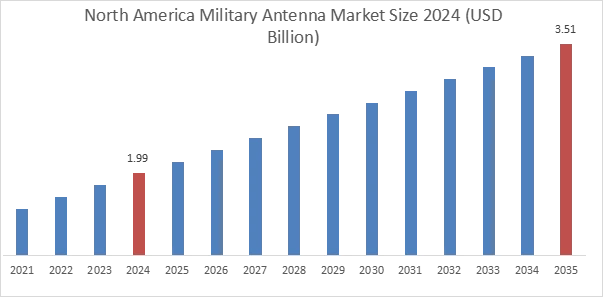
IMAGE - by RegionIn 2024, North America accounted for the highest market share at 44.3% and was valued at USD 1.99 Billion, and is expected to reach USD 3.51 Billion by 2035. In North America, the U.S. accounted for the highest market share of 79.21% during the base year of 2024. Market growth is fueled by high defense spending and continuous modernization of military communication infrastructure. Defense agencies are upgrading communication systems across land, naval, and airborne platforms to support secure data transmission and network centric operations.
- For example, in April 2025, SIPRI reported that military spending in the USA increased to USD 997 billion in 2024, growing by 5.7% from the spending in 2023 and increasing by 19% over the past decade, continuing the upward trend in military spending.
Asia Pacific is likely to record the fastest growth during the forecast period. China is investing in military communication infrastructure and satellite communication systems. India is strengthening its military modernization programs and procuring advanced communication systems. Japan and South Korea are integrating advanced radar and communication systems in their naval and airborne defense systems.
- For example, In February 2025, ATLAS Space Operations has formed a strategic partnership with HawkEye 360, incorporating its Mingenew, Australia, and Awarua, New Zealand, ground stations into HawkEye 360's constellation to enhance RF capability, decrease latency, and add high-speed X-band data downlinks from HawkEye 360's Cluster 11 satellites.
The military antennas market in Europe is growing, driven by an increase in military modernization programs in countries such as Germany, France, and the UK. Governments are investing in military communication networks and surveillance systems to strengthen regional defense capabilities.
The Latin America military antennas market is driven by the military modernization programs in Brazil and Mexico. Military communication systems are being enhanced to facilitate military operations and border surveillance activities.
The Middle East and Africa military antennas market is driven by the increasing defense investments in the UAE, Saudi Arabia, and South Africa. Military agencies are investing in communication systems to facilitate surveillance, border surveillance, and military operations in the region.
Top Key Players & Market Share Insights:
The military antennas market is moderately concentrated with companies that offer products in the areas of antenna systems, communications components, and integration solutions. Defense technology companies are currently focusing their efforts on product development to enhance the performance of their antennas to support the development of new communications systems and radar systems. Key participants in the market for military antenna include:
- L3Harris Technologies – US
- RTX Corporation – US
- Lockheed Martin Corporation – US
- Northrop Grumman Corporation – US
- Thales Group – France
- BAE Systems plc – UK
- CAES – US
- Rohde & Schwarz GmbH & Co. KG – Germany
- Hensoldt AG – Germany
- Leonardo S.p.A. – Italy
Recent Industry Developments:
- In March 2026, BAE Systems developed Silver Link, a conformal antenna solution for air dominance platforms, including collaborative combat aircraft and sixth-generation fighter aircraft, which maintains aerodynamics while ensuring communication capabilities.
- In September 2025, Collins Aerospace developed a new hybrid SATCOM phased array antenna, which was flown for the first time, aiming to connect various satellite constellations for reliable, low-latency communication.
Military Antenna Market Report Insights:
| Report Attributes | Report Details |
|---|---|
| Study Timeline | 2019-2035 |
| Market Size in 2035 (USD Billion) | USD 7.93 Billion |
| CAGR (2025-2035) | 5.30% |
| By Component |
|
| By Frequency Band |
|
| By Type |
|
| By Application |
|
| By Region |
|
| Key Players |
|
| Report Coverage |
|
Key Questions Answered in the Report
How big is the military antenna market? −
The military antenna market size is estimated to reach over USD 7.93 Billion by 2035 from a value of USD 4.49 Billion in 2024 and is projected to grow by USD 4.73 Billion in 2025, growing at a CAGR of 5.30% from 2025 to 2035.
Which segmentation details are covered in the military antenna report? +
The military antenna report includes specific segmentation details for component, frequency band, type, application, and regions.
Which is the fastest segment anticipated to impact the market growth? +
SATCOM is growing rapidly due to rising deployment of satellite based military communication networks.
Who are the major players in the military antenna market? +
The key participants in the military antenna market are L3Harris Technologies (US), RTX Corporation (US), Lockheed Martin Corporation (US), Northrop Grumman Corporation (US), Thales Group (France), BAE Systems plc (UK), CAES (US), Rohde & Schwarz GmbH & Co. KG (Germany), Hensoldt AG (Germany), Leonardo S.p.A. (Italy), and others.
What are the key trends in the military antenna market? +
Increasing defense communication modernization and rising investment in satellite communication systems are shaping the market.
Overview
Reputation & Certifications


Our Services
- Market Intelligence & Forecasting
- Custom Research Solutions
- Market Entry Strategy
- Competitive Intelligence
- Customer Insights
- Industry Innovation Analysis
- Investment Advisory