Jump to Content
1-Decanol Market - Size, Share, Industry Trends, and Forecasts (2025-2032)
1-Decanol Market Size:
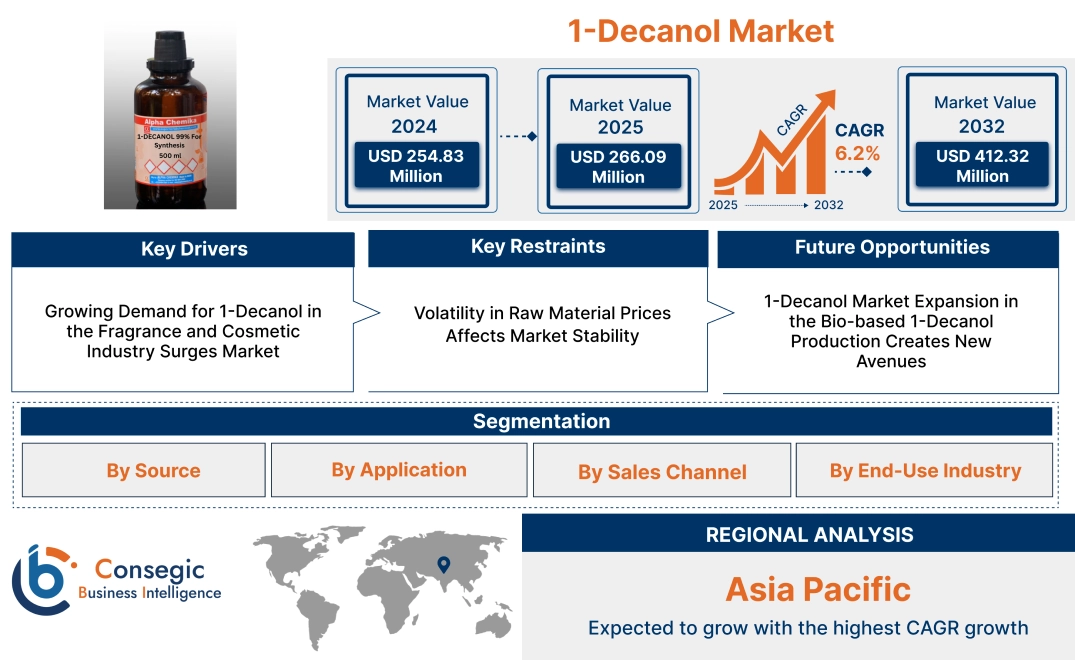
1-Decanol Market size is estimated to reach over USD 412.32 Million by 2032 from a value of USD 254.83 Million in 2024 and is projected to grow by USD 266.09 Million in 2025, growing at a CAGR of 6.2% from 2025 to 2032.
1-Decanol Market Scope & Overview:
1-Decanol is a saturated fatty alcohol with a long carbon chain, offering versatile applications across various industries. It is derived from natural or synthetic sources and is widely recognized for its chemical stability, hydrophobic nature, and low volatility.
The properties of 1-decanol include its colorless liquid form, high boiling point, and excellent lubricating characteristics. It is also known for its emulsifying and wetting abilities, making it a vital component in diverse formulations.
The benefits of 1-decanol include its effectiveness as a solvent, emulsifier, and intermediate in chemical synthesis. It enhances the performance and stability of products, contributing to improved functionality in end-use applications.
Applications of 1-decanol span personal care products, including lotions and creams, where it acts as a thickener and emulsifier. It is also used in the production of lubricants, detergents, and surfactants. In the chemical industry, it serves as a raw material for plasticizers and esters.
End-use industries for 1-decanol include cosmetics, pharmaceuticals, industrial manufacturing, and agriculture. Its versatility and functional properties make it a critical ingredient for enhancing product quality and performance across these sectors.
1-Decanol Market Dynamics - (DRO) :
Key Drivers:
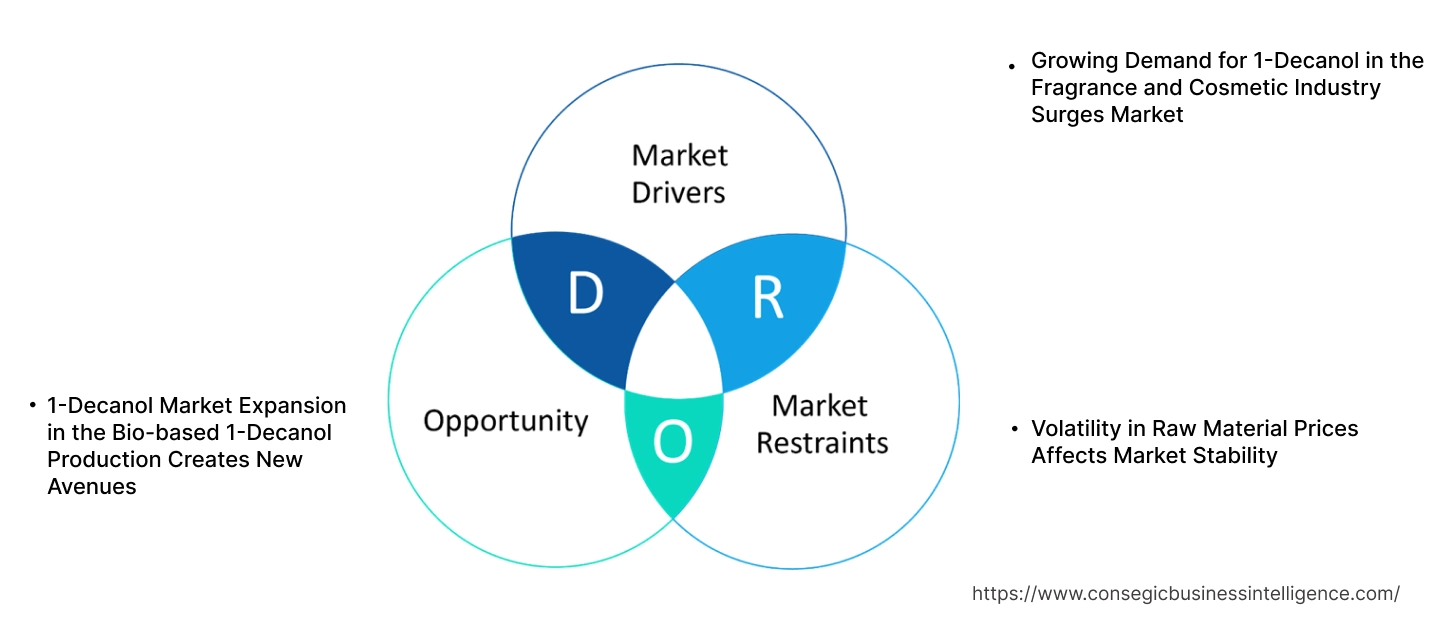
Growing Demand for 1-Decanol in the Fragrance and Cosmetic Industry Surges Market
1-Decanol is a key ingredient in the production of fragrances and cosmetics due to its pleasant floral odor. The increasing consumer preference for natural and long-lasting scents in personal care products is driving the demand for 1-decanol. In particular, it is widely used in perfumes, deodorants, and lotions, where it enhances the fragrance profile and contributes to product stability. The cosmetic industry's growing focus on high-quality, premium products, often with long-lasting effects, has resulted in 1-decanol becoming a preferred choice in the formulation of fragrances.
For example, major fragrance manufacturers like Givaudan and Firmenich utilize 1-decanol in the production of perfumes and colognes, capitalizing on its ability to improve scent duration and overall fragrance balance. Additionally, the increasing consumer interest in organic and natural beauty products is propelling the adoption of ingredients like 1-decanol, which is derived from natural sources. Thus, the demand for 1-decanol in the fragrance and cosmetics sector continues to rise, bolstering the market for this compound.
Key Restraints:
Volatility in Raw Material Prices Affects Market Stability
1-Decanol is primarily derived from natural oils or synthetic processes that require specific raw materials, such as palm oil or petrochemical derivatives. The volatility in the prices of these raw materials significantly impacts the production cost of 1-decanol, thereby hindering the stability of its market. Fluctuations in the global prices of palm oil or crude oil can lead to unpredictable cost structures for manufacturers. This, in turn, results in price instability for the end-product, making it challenging for manufacturers to offer competitive prices in the market.
For example, if the price of crude oil rises significantly, the cost of synthesizing 1-decanol from petroleum-based sources also increases, leading to higher production costs for companies. Smaller manufacturers may struggle with these rising costs, which can limit their ability to compete effectively. The inability to secure consistent raw material pricing can hinder the growth and market penetration of 1-decanol, particularly in price-sensitive regions or sectors.
Future Opportunities :
1-Decanol Market Expansion in the Bio-based 1-Decanol Production Creates New Avenues
The increasing global focus on sustainability presents a significant 1-Decanol Market opportunity. With growing 1-Decanol Market trend for eco-friendly and renewable chemicals, the development of bio-based 1-decanol is expected to see substantial growth in the coming years. Bio-based 1-decanol is produced from renewable sources such as plant oils, and it aligns with the rising consumer preference for products that are sustainable and environmentally friendly.
For instance, companies such as BASF and Evonik are investing in the development of bio-based processes for the production of 1-decanol, tapping into the green chemistry trend. These sustainable alternatives offer manufacturers the ability to reduce their carbon footprint and appeal to environmentally conscious consumers. The expansion of bio-based production methods will allow for more cost-effective and sustainable production of 1-decanol, driving its demand in various industries, including cosmetics, automotive, and pharmaceuticals.
Therefore, as consumer and regulatory pressures for sustainable products continue to rise, the bio-based production of 1-decanol offers a promising opportunity to propel the market forward.
1-Decanol Market Segmental Analysis :
By Source:
Based on source, the 1-decanol market is segmented into natural and synthetic sources.
The synthetic 1-decanol segment accounted for the largest revenue share in 2024.
- Synthetic 1-decanol is primarily produced through the hydrogenation of fatty acids or via chemical synthesis methods.
- This segment dominates due to the ease of production, availability, and cost-effectiveness compared to natural alternatives.
- Additionally, synthetic 1-decanol has a higher supply capacity and consistency, making it ideal for various industrial applications.
- It is widely used in the production of lubricants, plasticizers, and surfactants.
- The trend for synthetic 1-decanol continues to rise, driven by its extensive use in the chemicals, personal care, and automotive industries.
- Therefore, according to 1-Decanol Market analysis, synthetic 1-decanol holds a dominant position in the market due to its cost-efficiency and widespread industrial usage.
The natural 1-decanol segment is anticipated to register the fastest CAGR during the forecast period.
- Natural 1-decanol, derived from plant-based oils like coconut or palm oil, is gaining traction due to increasing consumer preference for natural and sustainable products.
- This type of 1-decanol is used in high-end cosmetics, fragrances, and flavoring applications, where natural sourcing is highly valued.
- Additionally, the growing focus on eco-friendly and renewable resources is expected to accelerate the adoption of natural 1-decanol.
- As consumers continue to shift towards greener products, the trend for natural 1-decanol is expected to increase rapidly.
- Thus, according to 1-Decanol Market analysis, the natural segment’s growth is fueled by the rising preference for sustainable and eco-friendly ingredients in consumer products.
By Application:
Based on application, the 1-decanol market is segmented into surfactants, plasticizers, lubricants, solvents, flavoring and fragrance agents, and others.
The surfactants segment accounted for the largest revenue share in 2024.
- 1-Decanol is widely used as a surfactant in detergents, soaps, and cleaning agents due to its ability to reduce surface tension and enhance cleaning efficacy.
- It also plays a crucial role in the formulation of personal care products such as shampoos and body washes.
- The growing trend for household and industrial cleaning products, as well as personal care items, has propelled the growth of the surfactants segment.
- As environmental concerns over chemical surfactants increase, 1-decanol, being a biodegradable and milder option, is expected to see sustained demand.
- Thus, according to market analysis, the surfactants segment remains the leading application due to its versatility and demand across multiple industries.
The plasticizers segment is anticipated to register the fastest CAGR during the forecast period.
- Plasticizers are substances added to plastics to increase their flexibility and workability.
- The demand for plasticizers in the automotive, construction, and packaging industries is expected to fuel the growth of this segment.
- As 1-decanol is used to produce certain types of plasticizers, its market is growing as the use of flexible plastics increases in various applications.
- Additionally, the shift towards eco-friendly and non-toxic plasticizers is expected to boost the trend for natural and synthetic 1-decanol.
- Therefore, according to market analysis, the plasticizers segment is set to experience rapid growth, driven by increasing demand for flexible plastics in key industries.
By Sales Channel:
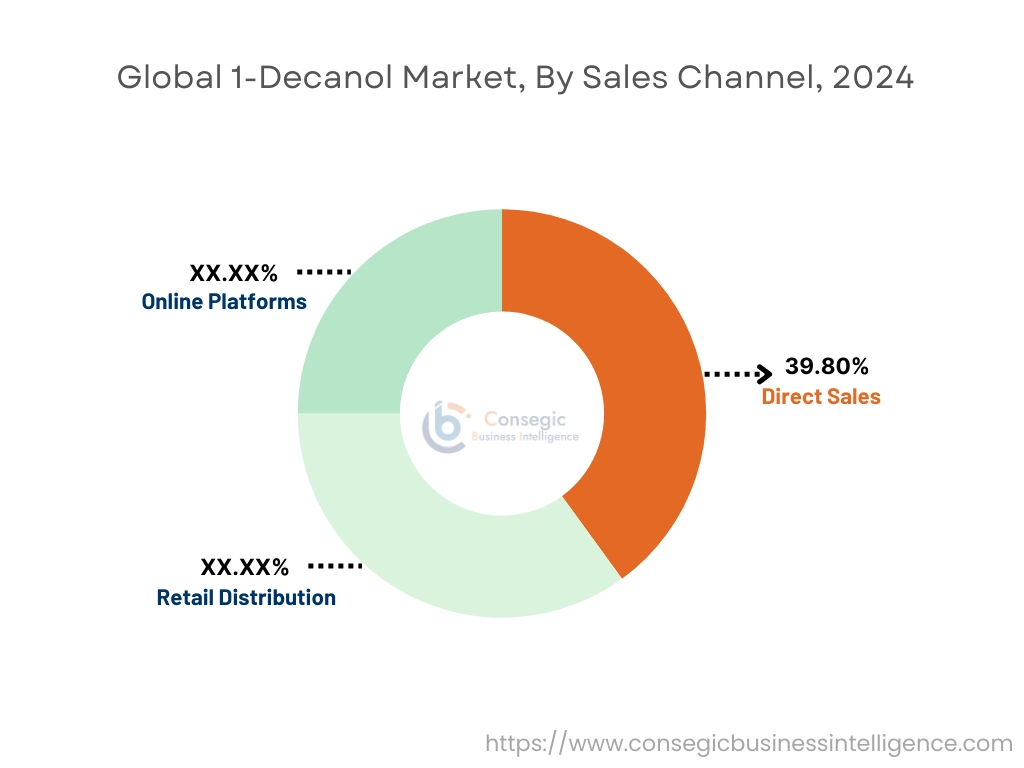
Based on sales channel, the 1-decanol market is segmented into direct sales, retail distribution, and online platforms.
The direct sales segment accounted for the largest revenue share by 39.80% in 2024.
- Direct sales involve selling 1-decanol directly to industrial consumers, which include chemical manufacturers, pharmaceutical companies, and personal care producers.
- This sales channel is preferred by large-scale manufacturers due to the bulk quantities of 1-decanol required.
- Additionally, direct sales offer better pricing advantages and allow for more streamlined transactions.
- Therefore, according to market analysis, direct sales dominate the market due to its efficiency in catering to large-volume industrial customers.
The online platforms segment is anticipated to register the fastest CAGR during the forecast period.
- The growth of e-commerce has led to an increasing trend of purchasing chemicals and specialty ingredients like 1-decanol through online platforms.
- Online sales provide convenience, broader market reach, and the ability to compare prices across suppliers, making it a preferred option for smaller businesses and individual consumers.
- The convenience of digital purchasing and the rise of e-commerce in developing markets are expected to drive the rapid growth of this sales channel.
- Thus, according to market analysis, online platforms are projected to grow significantly, driven by the shift toward e-commerce in the chemicals industry.
By End Use Industry:
Based on end-use industry, the 1-decanol market is segmented into personal care & cosmetics, food & beverage, pharmaceuticals, chemicals, and industrial sectors.
The personal care & cosmetics segment accounted for the largest revenue share in 2024.
- 1-Decanol is widely used in personal care and cosmetic products due to its moisturizing, emollient, and solvent properties.
- It is commonly found in lotions, creams, shampoos, and other skincare formulations.
- With the growing global trend for personal care products, especially in emerging markets, this segment is experiencing steady growth.
- Additionally, increasing consumer preference for high-quality, natural, and sustainable ingredients further boosts the demand for 1-decanol in cosmetics.
- Therefore, according to market analysis, the personal care & cosmetics segment remains dominant due to the increasing demand for premium and effective cosmetic products.
The pharmaceuticals segment is anticipated to register the fastest CAGR during the forecast period.
- In the pharmaceutical industry, 1-decanol is used as a solvent and excipient in drug formulations.
- Its ability to improve drug delivery and stability has driven its use in various therapeutic products.
- As the pharmaceutical sector continues to expand globally, the demand for excipients and solvents like 1-decanol is expected to grow rapidly.
- Furthermore, with the increasing focus on the development of new drug delivery systems, the use of 1-decanol is likely to see a surge in applications.
- Thus, according to market analysis, the pharmaceuticals sector is set to experience the fastest growth, driven by the expanding drug development pipeline and the increasing need for advanced pharmaceutical formulations.
Regional Analysis:
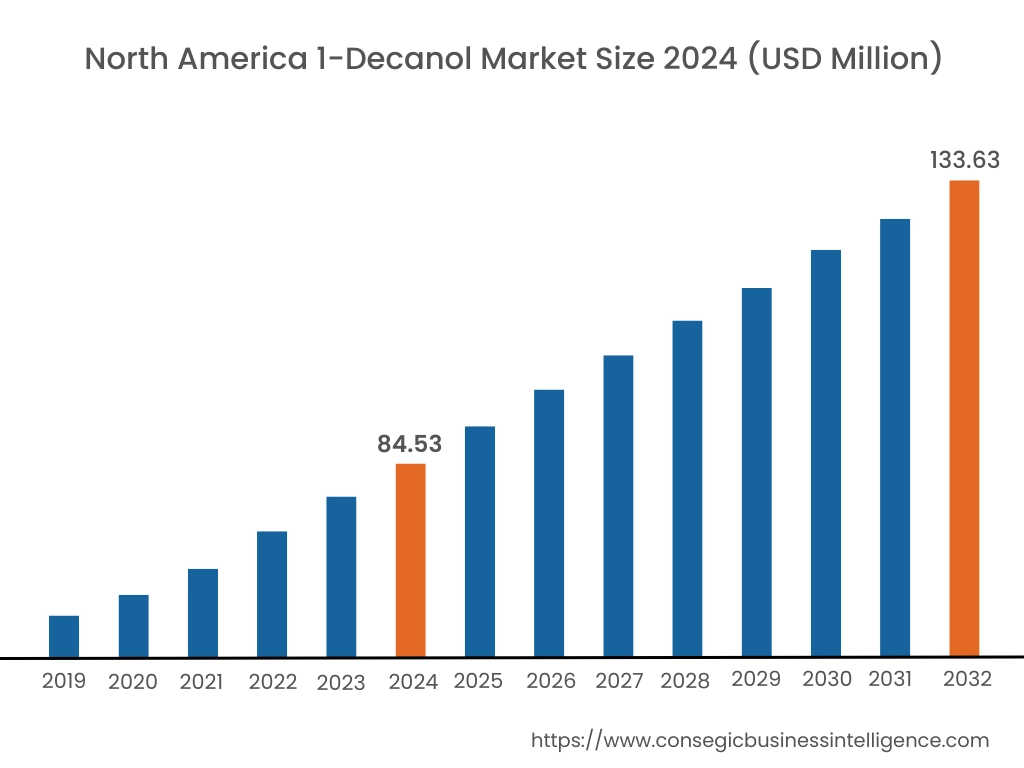
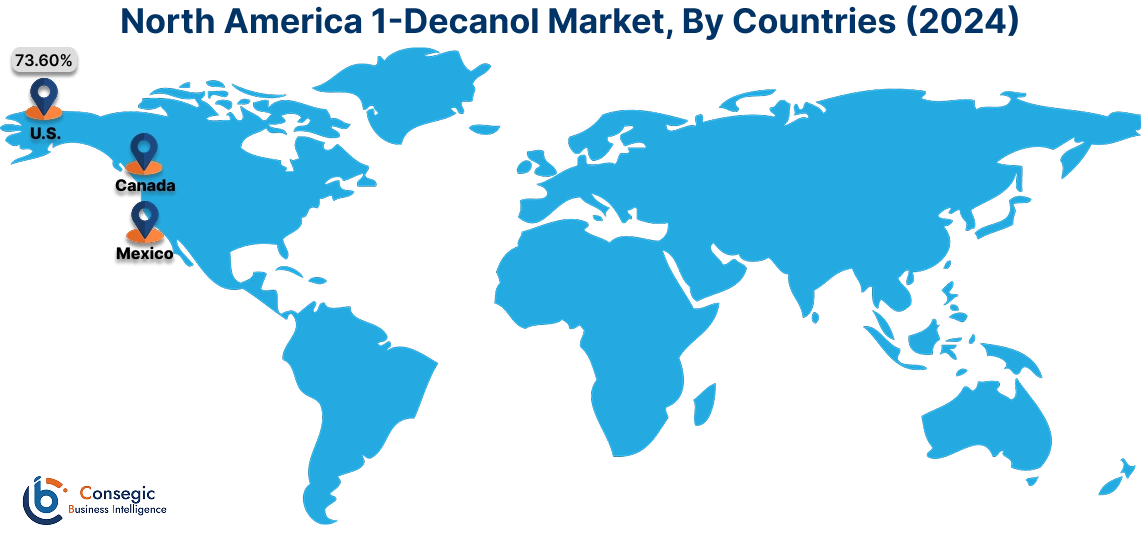
In 2024, North America was valued at USD 84.53 Million and is expected to reach USD 133.63 Million in 2032. In North America, the U.S. accounted for the highest share of 73.60% during the base year of 2024. North America holds a prominent 1-Decanol Market share, with significant 1-Decanol Market demand from the chemical, automotive, and personal care industries. The U.S. leads in production and consumption due to its well-established chemical manufacturing base. The region benefits from robust industrial applications and increasing demand for 1-decanol in lubricants, surfactants, and plasticizers. Ongoing research and development activities further enhance market prospects.
In Asia Pacific, the market is experiencing the fastest growth with a CAGR of 6.6% over the forecast period. Asia-Pacific exhibits strong potential for the 1-decanol market, with countries like China, India, and Japan showing increased consumption in various industrial sectors. Rapid industrialization, particularly in China, fuels demand for 1-decanol in coatings, adhesives, and personal care products. The region’s large manufacturing base and growing consumer markets contribute to its expanding role in the global market. Additionally, favorable government policies supporting chemical production encourage market growth.
Europe is a key market for 1-decanol, driven by demand from the chemical and automotive industries. Countries like Germany, France, and Italy lead in consumption due to the presence of major manufacturing companies. The region also sees significant use of 1-decanol in personal care formulations, with a growing emphasis on sustainable and eco-friendly production practices. Regulatory standards in the European Union further impact market dynamics, with a focus on reducing environmental impact.
The Middle East and Africa region shows moderate 1-Decanol Market growth, with demand primarily driven by the chemical processing industry. Growing industrialization in the Gulf Cooperation Council (GCC) countries, especially in petrochemical production, creates demand for 1-decanol in manufacturing processes. However, challenges related to economic diversification and infrastructure development in certain areas limit faster market expansion.
Latin America demonstrates steady demand for 1-decanol, driven by industries such as agriculture, automotive, and personal care. Brazil and Mexico are key markets, with a focus on the use of 1-decanol in agrochemicals and consumer products. Economic fluctuations and trade barriers pose challenges, but increasing investments in industrial manufacturing contribute to regional market development.
Top Key Players & Market Share Insights:
The Global 1-Decanol Market is highly competitive with major players providing FWA to the national and international markets. Key players are adopting several strategies in research and development (R&D), product innovation, and end-user launches to hold a strong position in the Global 1-Decanol Market. Key players in the 1-Decanol Market industry include-
- BASF SE (Germany)
- Kraton Polymers LLC (United States)
- Lonza Group (Switzerland)
- Celanese Corporation (United States)
- Nippon Steel Chemical & Material Co., Ltd. (Japan)
- Eastman Chemical Company (United States)
- The Dow Chemical Company (United States)
- SABIC (Saudi Arabia)
- LG Chem Ltd. (South Korea)
1-Decanol Market Report Insights:
| Report Attributes | Report Details |
| Study Timeline | 2019-2032 |
| Market Size in 2032 | USD 412.32 Million |
| CAGR (2025-2032) | 6.2% |
| By Source |
|
| By Application |
|
| By Sales Channel |
|
| By End-Use Industry |
|
| By Region |
|
| Key Players |
|
| North America | U.S. Canada Mexico |
| Europe | U.K. Germany France Spain Italy Russia Benelux Rest of Europe |
| APAC | China South Korea Japan India Australia ASEAN Rest of Asia-Pacific |
| Middle East and Africa | GCC Turkey South Africa Rest of MEA |
| LATAM | Brazil Argentina Chile Rest of LATAM |
| Report Coverage |
|
Key Questions Answered in the Report
How big is the 1-Decanol Market? −
In 2024, the 1-Decanol Market was USD 254.83 million.
What will be the potential market valuation for the 1-Decanol Market by 2032? +
In 2032, the market size of 1-Decanol Market is expected to reach USD 412.32 million.
What are the segments covered in the 1-Decanol Market report? +
The source, application, sales channel, and end-use industry are the segments covered in this report.
Who are the major players in the 1-Decanol Market? +
BASF SE (Germany), Kraton Polymers LLC (United States), Eastman Chemical Company (United States), OXEA GmbH (Germany), The Dow Chemical Company (United States), SABIC (Saudi Arabia), LG Chem Ltd. (South Korea), Lonza Group (Switzerland), Celanese Corporation (United States), Nippon Steel Chemical & Material Co., Ltd. (Japan) are the major players in the 1-Decanol market.
Overview
Reputation & Certifications


Our Services
- Market Intelligence & Forecasting
- Custom Research Solutions
- Market Entry Strategy
- Competitive Intelligence
- Customer Insights
- Industry Innovation Analysis
- Investment Advisory