Jump to Content
Activated Bleaching Earth Market - Size, Share, Industry Trends, and Forecasts (2025 - 2032)
Activated Bleaching Earth Market Size:
Activated Bleaching Earth Market size is growing with a CAGR of 4.6% during the forecast period (2025-2032), and the market is projected to be valued at USD 3,245.28 Million by 2032 from USD 2,297.03 Million in 2024.
Activated Bleaching Earth Market Scope & Overview:
Activated bleaching earth (ABE), which is a specialized clay mineral, is primarily derived from bentonite clay, which is rich in montmorillonite. To enhance its bleaching capabilities, this clay undergoes a chemical treatment process. This activation process alters the clay's structure, increasing its surface area and porosity. As a result, the activated bleaching earth becomes highly effective in adsorbing impurities, such as color, odor, and other contaminants. This makes it a necessary tool in the refining process, leading to the production of clearer, purer, and more stable products. In terms of application, they find extensive use in edible oil refining, mineral oil refining, water treatment, and decolorization of chemicals among others. By the end-use industry, petrochemical, pharmaceutical, food and beverage, water treatment, and others are major consumers.
How is AI Transforming the Activated Bleaching Earth Market?
AI algorithms can analyze data from sensors in real-time, adjusting parameters such as temperature, pressure, and acid concentration during the activation process to maximize activated bleaching earth yield and quality. This leads to increased efficiency, reduced waste, and enhanced performance of activated bleaching earth in various applications such as edible oil refining. Also, AI-powered systems can monitor equipment health and predict potential failures, reducing downtime and maintenance costs. Moreover, AI can help manage inventory levels of both raw materials and finished activated bleaching earth products, minimizing storage costs and preventing shortages.

Activated Bleaching Earth Market Dynamics - (DRO) :
Key Drivers:
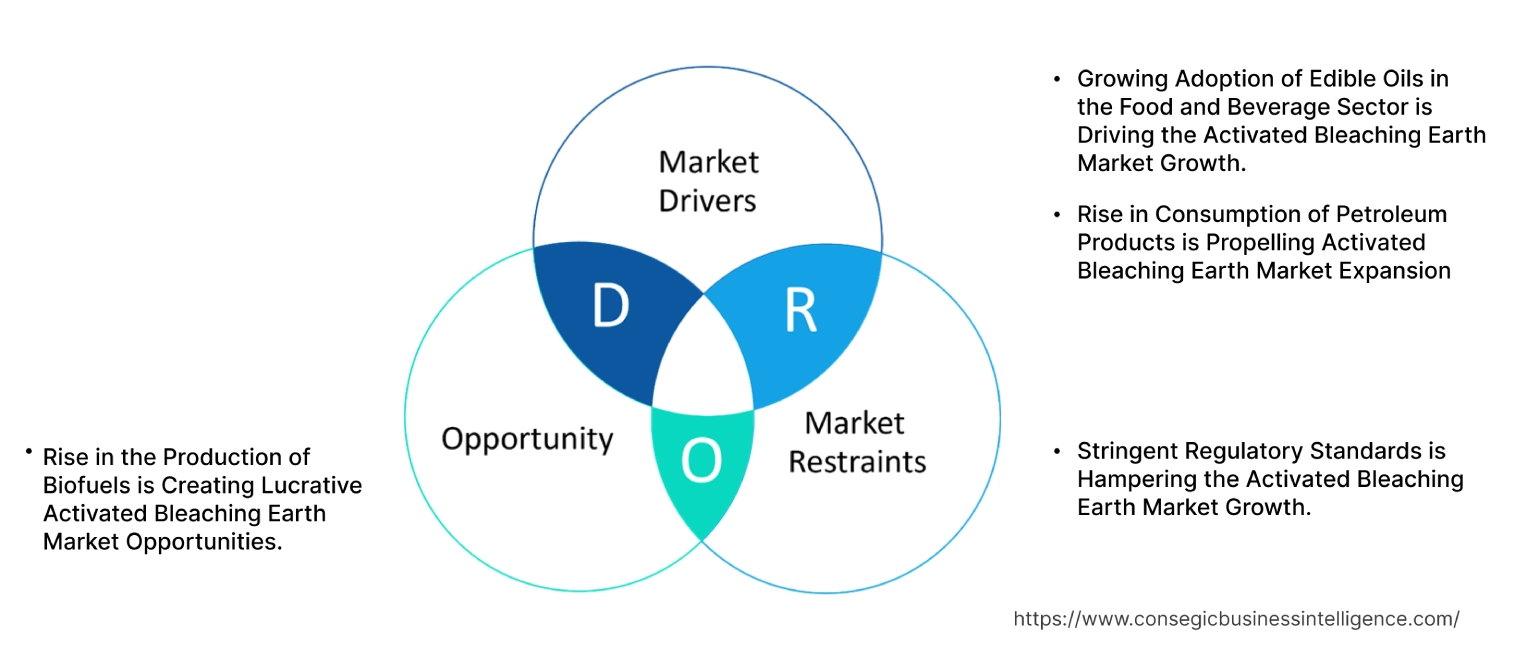
Growing Adoption of Edible Oils in the Food and Beverage Sector is Driving the Activated Bleaching Earth Market Growth.
The growing food and beverage sector is a significant driver of the activated bleaching earth market. As the requirement for high-quality, refined edible oils surges, the need for effective purification techniques increases. Activated bleaching earth plays a pivotal role in this process, eliminating impurities, color, and odor from vegetable oils such as cotton seed oil, sunflower oil, castor oil, palm oil, mustard oil, coconut oil, olive oil, and others. Its ability to enhance the clarity, flavor, and shelf life of these oils aligns perfectly with the industry's stringent quality standards. The rise in the utilization of edible oils such as olive oil is influencing the use of this material.
- For instance, in 2023, according to reports from the S. Department of Agriculture, and the International Olive Council, the U.S. consumed 375,000 tons of olive oil overtaking Spain as the second largest consumer. ABE plays a crucial role in the refining process of olive oil, removing impurities and enhancing its color and flavor.
Thus, the rise in the consumption of edible oils such as olive oil which is refined for consumption is driving the activated bleaching earth market demand.
Rise in Consumption of Petroleum Products is Propelling Activated Bleaching Earth Market Expansion
The growing requirement for petroleum products is a key driver propelling the expansion of the activated bleaching earth industry. As the consumption of petroleum products like gasoline, diesel, and lubricants among others continues to rise, so does the need for purifying processes to enhance their quality and purity. Activated bleaching earth plays a crucial role in these purifying processes by effectively removing impurities, color, and odor from various petroleum products. The rise in the consumption of petroleum products leads to the rise in the utilization of bleaching products.
- For instance, according to the data published in the Industry POL & NG con report, in 2023, the significant increase in High-Speed Diesel (HSD) consumption by 12.6% in January 2023 is a strong indicator of economic growth and increased manufacturing activity. As HSD is primarily used in transportation and manufacturing sectors, this growth directly impacts refined petroleum products. Activated bleaching earth plays a crucial role in the purifying process of HSD. It helps in removing impurities, color, and odor.
Thus, the increased requirement for refined petroleum products such as diesel, coupled with the unique properties of this material, is driving significant growth in the market.
Key Restraints :
Stringent Regulatory Standards is Hampering the Activated Bleaching Earth Market Growth.
Stringent regulatory standards imposed on the production and use of Activated Bleaching Earth are significantly hindering the market. Governments worldwide are increasingly implementing stricter environmental regulations to minimize the impact of manufacturing activities on the environment. These regulations mainly involve stringent quality control measures, emission standards, and waste disposal guidelines.
The implementation of stringent environmental regulations necessitates significant capital expenditure for manufacturers. To comply with emission standards and waste disposal guidelines, producers must invest in advanced pollution control equipment, such as scrubbers, filters, and electrostatic precipitators. Additionally, robust waste treatment facilities are required to manage and dispose of hazardous byproducts generated during the production process. Furthermore, rigorous quality assurance systems, including laboratory testing and quality control measures, are essential to ensure the consistent quality and safety of the final product. These investments significantly increase the overall production costs of these materials, impacting on its price competitiveness, and thus hindering the market.
Future Opportunities :
Rise in the Production of Biofuels is Creating Lucrative Activated Bleaching Earth Market Opportunities.
The developing biofuel sector presents a significant opportunity for the activated bleaching earth market. As the global shift towards renewable energy sources accelerates, the requirement for biofuels derived from plant oils and animal fats is rapidly increasing. It plays a crucial role in the refining process of these feedstocks, removing impurities and improving the quality of the final biofuel product. The rapidly growing global demand for biofuels significantly influences the use of this material in various refining procedures.
- For instance, the International Energy Agency (IEA) forecasts a 28% increase in global biofuel demand between 2021 and 2026, driven by government policies and the increasing focus on sustainable energy solutions. ABE plays a crucial role in the refining process of biofuels, ensuring the removal of impurities and enhancing the quality of the final product.
As the biofuel sector expands, the requirement for this material is expected to rise, creating lucrative activated bleaching earth market opportunities for manufacturers and suppliers.
Activated Bleaching Earth Market Segmental Analysis :
By Application:
Based on applications, the market is categorized into edible oil refining, mineral oil refining, water treatment, decolorization of chemicals, and others
Trends in Application:
- The growing trends for activated bleaching earth in the decolorization of chemicals are influencing the segment.
- The demand for edible oil is propelling the segment.
The edible oil refining segment accounted for the largest market share in the year 2024.
- Activated bleaching earth plays a crucial role in the refining process of edible oils.
- It acts as a powerful adsorbent, effectively removing impurities, color pigments, and odor-causing compounds from crude vegetable oils.
- By selectively adsorbing these contaminants, activated bleaching earth significantly improves the quality, clarity, and stability of the refined oil. This process enhances the oil's appearance, taste, and nutritional value, making it suitable for various culinary and industrial applications.
- Additionally, it helps to extend the shelf life of the refined oil by neutralizing free radicals and preventing oxidative degradation. This ensures that the oil retains its desired properties and remains fresh for longer periods, which leads to a rise in the consumption of edible oils such as vegetable oils.
- For instance, according to the data published in the Manitoba Report in 2022, it states that India is the second-largest vegetable oil market globally, consuming over 10% of the world's edible oil supply, reaching 22 million tons in 2021. This substantial consumption necessitates efficient refining processes to ensure the quality and purity of the edible oils. Activated bleaching earth plays a pivotal role in this refining process.
- Thus, as per the analysis, the rise in edible oil refining propels the activated bleaching earth market demand.
The water treatment segment is expected to grow at the fastest CAGR over the forecast period.
- Activated bleaching earth is employed in water treatment to remove various contaminants and impurities.
- Its high adsorption capacity allows it to effectively bind to pollutants such as heavy metals, organic dyes, and pesticides.
- By passing water through a bed of activated bleaching earth, these harmful substances are absorbed and removed, resulting in cleaner and safer water.
- Additionally, this material is used to decolorize wastewater from sectors like textile and paper manufacturing, improving its aesthetic quality and reducing its environmental impact.
- Overall, activated bleaching earth emerges as a versatile and effective tool in water treatment. Its exceptional adsorption capacity enables it to efficiently remove a wide range of contaminants, including heavy metals, organic dyes, and pesticides.
By End-Use Industry:
Based on the end-use industry, the market is categorized into petrochemical, pharmaceutical, food & beverage, water treatment, and others.
Trends in the End-Use Industry:
- The trends for sustainable solutions for refining are boosting the segment.
- The adoption of bleaching solutions for water treatment is influencing the segment.
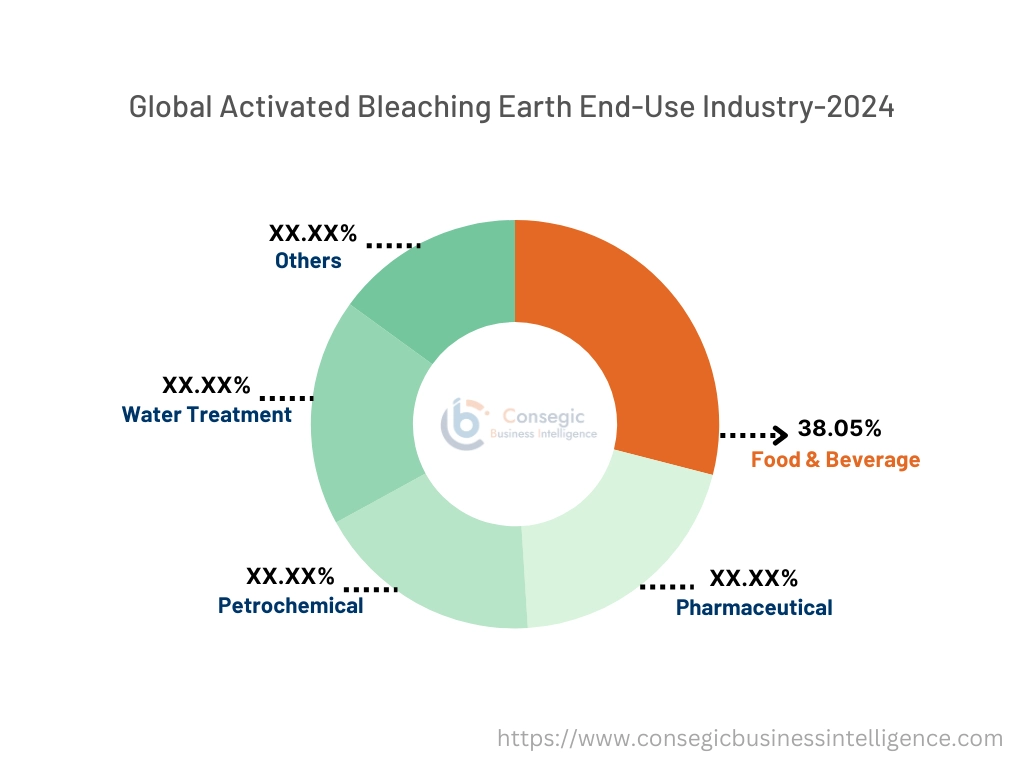
The food & beverage segment accounted for the largest activated bleaching earth market share of 38.05% in the year 2024.
- Activated bleaching earth plays a crucial role in the food and beverage sector, particularly in the refining of edible oils.
- Its exceptional adsorptive properties allow it to effectively remove impurities, color pigments, and odor-causing compounds from crude vegetable oils.
- By purifying these oils, activated bleaching earth enhances their quality, clarity, and stability, making them suitable for various food applications.
- Additionally, it helps to extend the shelf life of these oils by neutralizing free radicals and preventing oxidative degradation.
- This ensures that the refined oils retain their desired properties, such as taste, aroma, and nutritional value, contributing to the overall quality and safety of food products.
- The rise in the production of edible oils for food & beverage applications for removing impurities and contaminants from the oils.
- For instance, the Edible Oil Producers Association (EOPA) represents U.S., Canadian, and Mexican refiners that produce 95% of domestic edible fats and oils used in a wide variety of foods and beverages. To ensure the quality and purity of these oils, EOPA member companies often employ advanced refining techniques, including the use of activated bleaching earth.
- Thus, as per the analysis, the utilization of activated bleaching earth in the food & beverage sector is influencing the activated bleaching earth market trends.
The water treatment segment is expected to grow at the fastest CAGR over the forecast period.
- Activated bleaching earth plays a significant role in wastewater treatment.
- It effectively removes organic pollutants, colorants, and other impurities from industrial effluents before they are discharged into water bodies.
- The mineral clay’s high adsorption capacity enables it to bind with these contaminants, leading to a significant reduction in water pollution.
- This application is particularly beneficial for sectors such as textiles, paper, and chemical manufacturing, which generate wastewater laden with organic pollutants and dyes.
- By incorporating this material into their wastewater treatment processes, these sectors contribute to environmental sustainability and comply with stringent water quality regulations.
- Thus, the incorporation of these compounds for water treatment is influencing the market demand.
Regional Analysis:
The regional segment includes North America, Europe, Asia Pacific, the Middle East and Africa, and Latin America.
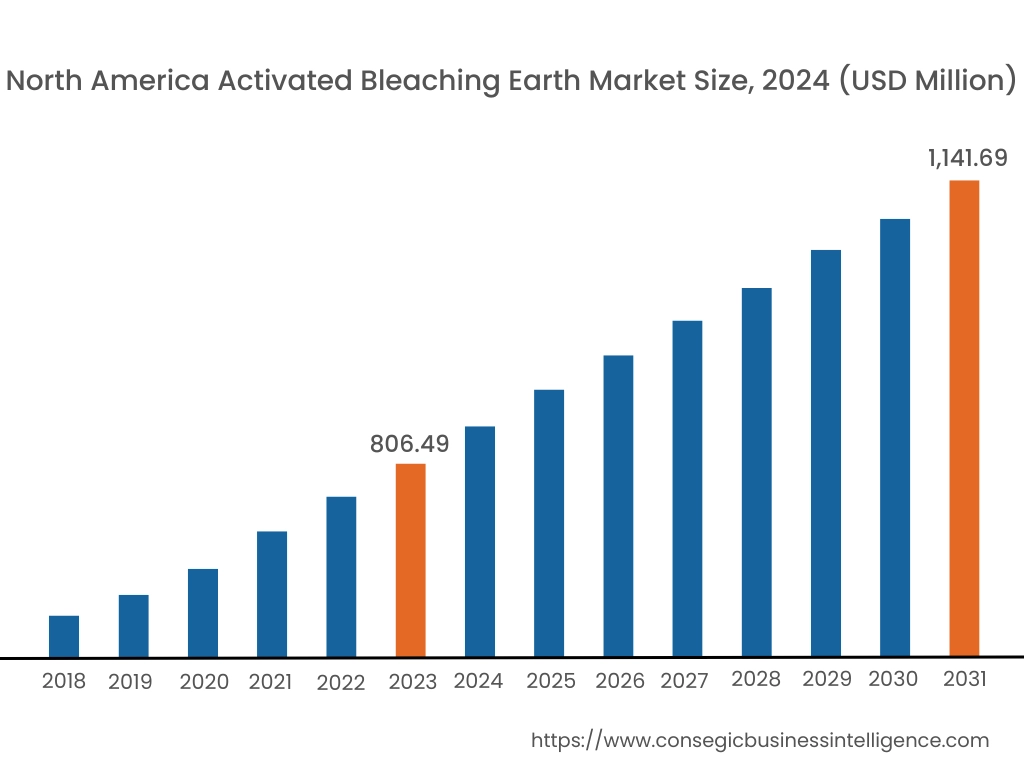
In 2024, Aisa Pacific accounted for the highest market share at 35.11% and was valued at USD 806.49 Million and is expected to reach USD 1,141.69 Million in 2032. In Asia Pacific, China accounted for the highest global activated bleaching earth market share of 28.67%during the base year of 2024. The Asia Pacific region is a significant consumer and producer of Activated Bleaching Earth. Countries like India, China, Indonesia, and Malaysia are key players in the industry. This material finds wide application in the refining of edible oils, primarily palm oil and soybean oil. The region's growing demand for refined oils, coupled with increasing consumer awareness about food safety and quality, has boosted the requirement for this material.
- For instance, according to the data published by the India Brand Equity Foundation, India's petroleum refining capacity has significantly increased from 215.1 Million Metric Tons Per Annum (MMTPA) to 256.8 MMTPA in 2014. This rise is linked to the rising requirement for refined petroleum products, fueled by India's robust economic development and increasing urbanization
Additionally, based on the activated bleaching earth market analysis, the region's expanding pharmaceutical and chemical sector also contributes to the requirement for this material. Overall, with increasing investments in research and development, and a focus on sustainable production practices, the activated bleaching earth market trends are rising in this region’s share.
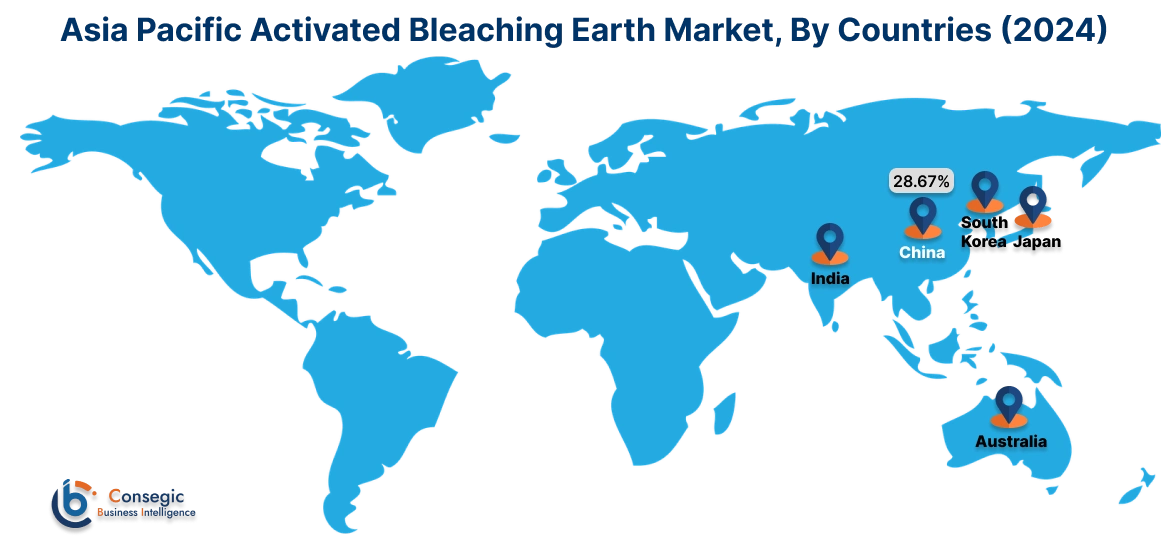
North America is experiencing the fastest growth with a CAGR of 5.1% over the forecast period. The region's robust food and beverage, particularly the vegetable oil refining sector, drives the requirement for ABE. The US and Canada are key markets, primarily used in the refining of soybean oil and other vegetable oils. The increasing focus on food safety and quality standards in North America has further fueled the requirement for high-quality ABE. Additionally, the region's growing pharmaceutical and chemical sector contributes to the requirement for this material in specific applications. As per the analysis, while the market for ABE in North America is relatively mature, ongoing technological advancements and evolving consumer preferences continue to shape the sector's dynamics, thus influencing the activated bleaching earth market expansion in the coming years.
Europe, a region with a significant focus on food quality and safety, is a substantial consumer of Activated Bleaching Earth. Countries like Germany, France, Italy, and Spain are key markets for ABE due to their robust food processing sector. ABE is extensively used in the refining of vegetable oils, including sunflower, rapeseed, and olive oil. The stringent regulations governing food safety and quality standards in Europe necessitate the use of high-quality refining agents. Additionally, the growing trends for organic and natural food products have further fueled the requirement for this material, as it is a natural and effective refining agent. Overall, based on the activated bleaching earth market analysis, these factors are propelling market growth.
The Middle East and Africa present a dynamic market for Activated Bleaching Earth. Countries like Saudi Arabia, Egypt, and South Africa are key consumers of ABE, primarily for refining edible oils such as sunflower, soybean, and palm oil among others. The growing population and increasing disposable incomes in these regions have led to a surge in the requirement for refined oils. Additionally, the growing pharmaceutical sector, coupled with stringent quality and safety regulations, has fueled the requirement for high-quality refined oils. Moreover, as per the analysis, with increasing investments in local production capacities and a focus on sustainable and eco-friendly refining practices, the future of this material in the Middle East and Africa appears promising.
Latin America presents a dynamic market for Activated Bleaching Earth. Countries like Brazil and Argentina, with significant agricultural production, particularly in oilseeds like soybeans and sunflower, drive the requirement for this material in the edible oil refining sector. The region's growing food and beverage sector, coupled with increasing consumer awareness about food safety and quality, further fuels the requirement for this material. Additionally, the pharmaceutical and chemical sectors in Latin America contribute to the market. Moreover, as per the analysis, with increasing investments in local production capacities and technological advancements, the future of this material in Latin America appears promising, thus influencing the market trends.
Top Key Players and Market Share Insights:
The Activated Bleaching Earth market is highly competitive with major players providing precise products to the national and international markets. Key players are adopting several strategies in research and development (R&D) and product innovation to hold a strong position in the global Activated Bleaching Earth market. Key players in the Activated Bleaching Earth industry include-
- Clariant (Switzerland)
- Dwi Karya Bentonit Indonesia (Indonesia)
- Global Active Clay LLP (India)
- Bajaj Earth (India)
- Indian Clay & Mineral Co. (India)
- Global Bleach Chem Pvt. Ltd.. (India)
- Refoil Earth Pvt Ltd (India)
- Natural Active Clay (India)
Activated Bleaching Earth Market Report Insights :
| Report Attributes | Report Details |
| Study Timeline | 2019-2032 |
| Market Size in 2032 | USD 3,245.28 Million |
| CAGR (2025-2032) | 4.6% |
| By Application |
|
| By End Use Industry |
|
| By Region |
|
| Key Players |
|
| North America | U.S. Canada Mexico |
| Europe | U.K. Germany France Spain Italy Russia Benelux Rest of Europe |
| APAC | China South Korea Japan India Australia ASEAN Rest of Asia-Pacific |
| Middle East and Africa | GCC Turkey South Africa Rest of MEA |
| LATAM | Brazil Argentina Chile Rest of LATAM |
| Report Coverage |
|
Key Questions Answered in the Report
How big is the Activated Bleaching Earth market? −
In 2024, the Activated Bleaching Earth market is USD 2,297.03 Million.
Which is the fastest-growing region in the Activated Bleaching Earth market? +
North America is the fastest-growing region in the Activated Bleaching Earth market.
What specific segmentation details are covered in the Activated Bleaching Earth market? +
Application and End-Use Industry segmentation details are covered in the Activated Bleaching Earth market.
Who are the major players in the Activated Bleaching Earth market? +
Clariant (Switzerland), Dwi Karya Bentonit Indonesia (Indonesia), Indian Clay & Mineral Co. (India) are some of the major players in the market.
Overview
Reputation & Certifications


Our Services
- Market Intelligence & Forecasting
- Custom Research Solutions
- Market Entry Strategy
- Competitive Intelligence
- Customer Insights
- Industry Innovation Analysis
- Investment Advisory