Jump to Content
Zirconium Dioxide Market - Size, Share, Industry Trends, and Forecasts (2026 - 2034)
Zirconium Dioxide Market Size:
Zirconium Dioxide Market size is estimated to reach over USD 1,828.71 Million by 2034 from a value of USD 1,113.46 Million in 2025 and is projected to grow by USD 1,159.71 Million in 2026, growing at a CAGR of 5.2% from 2026 to 2034
Zirconium Dioxide Market Key Takeaways
- Strong Demand Drivers: Growth is fueled by rising use in advanced ceramics, dental restorations, and electronics.
- Dominant Application Segment: Ceramics remain the largest segment due to durability, thermal stability, and wide industrial use.
- Fastest-Growing Segment: Fuel cells are the fastest-growing application, driven by clean energy and decarbonization trends.
- Leading Product Type: Yttria Partially Stabilized Zirconia holds the largest market share.
- Regional Leadership: North America leads the market, while Asia-Pacific shows strong growth due to urbanization and infrastructure.
- Key Growth Opportunity: Increasing adoption in green energy technologies and solid-state batteries presents major future potential.
- Major Challenge: High raw material and processing costs (due to complex extraction and regulations) restrain market growth.
Zirconium Dioxide Market Scope & Overview:
The zirconium dioxide is a highly durable, heat-resistant white crystalline oxide. They are known for their incredible strength, crack resistance, and thermal stability, which is boosting the zirconium dioxide market demand. Additionally, the white crystalline oxide is increasingly being adopted in various applications, including advanced technical ceramics, dental implants, optical coatings, and as a diamond simulant. Further, the key advantages offered include exceptional strength & toughness, outstanding biocompatibility, low thermal conductivity, chemical & corrosion stability, among others. Furthermore, the rising preference for natural-looking, durable dental restorations is boosting the zirconium dioxide market growth.

Zirconium Dioxide Market Dynamics - (DRO) :
Key Drivers:
Rising adoption of dental restorations drives demand for zirconium dioxide
The patients and clinicians are increasingly favoring zirconia for crowns, bridges, and implants over traditional materials due to its superior biocompatibility, long-term durability, and tooth-like aesthetics, which is driving the market growth. Additionally, the rising need for non-allergenic, metal-free alternatives is increasing the adoption of zirconia as it offers a natural and translucent appearance, which in turn is fueling the market demand. Further, the rising demand for durable prosthetic solutions for tooth decay is fueling the market progress.
- For instance, in May 2024, Ural Federal Universitycollaborated with the Institute of High-Temperature Electrochemistry of the Ural Branch for the development of zirconium dioxide ceramics for crowns. and implants.
Therefore, the rising demand for durable prosthetic solutions is in turn proliferating the growth of the market.
Key Restraints :
High raw material and operational costs are restraining the market growth
The extraction process requires complex, high-temperature calcination processes, and the availability and pricing of zircon mineral sands are hindering the market expansion. Also, mining and purifying zirconium materials are subject to strict environmental and radiation management regulations, which in turn increases the operating cost and acquisition cost of raw materials. Further, the high cost increases the adoption of alternatives to substitute zirconia.
Therefore, the high costs of raw materials and operational costs are restraining the zirconium dioxide market expansion.
Future Opportunities :
Rising adoption of energy and green technology is expected to promote potential opportunities for market growth
The thermal stability and ionic conductivity offered by the material are essential for next-generation, eco-friendly energy solutions, which in turn are propelling the zirconium dioxide market opportunities. Also, the material is increasingly being adopted for the manufacture of solid-state batteries as zirconia improves energy density, cycle life, and overall safety as compared to traditional batteries. Further, the compound nanoparticles act as highly efficient photocatalysts, capable of degrading organic pollutants in water and air, which is driving the market adoption.
- For instance, Luxfer MEL Technologies is a leading manufacturer of zirconium oxides and doped zirconium oxides for driving applications in the green energy market. The material is used mainly to help manufacturers achieve their net-zero strategies.
Hence, the rising adoption of energy and green technologies is anticipated to increase the utilization, in turn promoting prospects for market opportunities during the forecast period.
Zirconium Dioxide Market Segmental Analysis:
By Product Type:
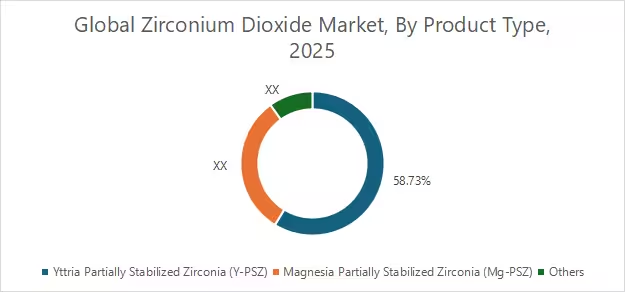
Based on the product type, the market is segmented into yttria partially stabilized zirconia (Y-PSZ), magnesia partially stabilized zirconia (Mg-PSZ), and others.
Trends in the Product Type:
- The rising need for biomedical implants and piezoelectric devices is increasing the adoption of magnesia-partially stabilized zirconia (Mg-PSZ), which in turn is fueling the market trends.
- The strong shift toward YSZ in digital dentistry for highly durable, metal-free dental crowns is fueling the zirconium dioxide market trends.
The yttria partially stabilized zirconia (Y-PSZ) accounted for the largest revenue share of 58.73% in the year 2025.
- The yttria partially stabilized zirconia (Y-PSZ) is a high-performance ceramic composed of zirconia doped with a small percentage of Yttrium Oxide.
- The formulation is designed to prevent the material from cracking during temperature changes, which in turn results in exceptional fracture toughness and mechanical durability, boosting the market size.
- Further, the strong global consumer shift toward all-ceramic dental restorations is driving the adoption of yttria partially stabilized zirconia (Y-PSZ), which in turn is fueling the market share.
- Moreover, the YSZ is widely used for advanced thermal barrier coatings in jet engines and gas turbines due to its exceptional heat resistance, mechanical strength, and other is driving the industry.
- Thus, as per thezirconium dioxide market analysis, the aforementioned factors are driving the market progress.
The magnesia partially stabilized zirconia (Mg-PSZ) is anticipated to register the fastest CAGR during the forecast period.
- The magnesia partially stabilized zirconia (Mg-PSZ) is known for exceptional fracture toughness, thermal shock resistance, and performance in harsh, high-moisture environments.
- Additionally, the surge in structural ceramics, dental implants, fuel cells, and refractories used in smelting and glass manufacturing is driving the adoption of magnesia partially stabilized zirconia (Mg-PSZ), which in turn is boosting the zirconium dioxide market size.
- Further, the rising need for highly durable wear-resistant components is driving the adoption of Mg-PSZ, which in turn is boosting the zirconium dioxide market share.
- Furthermore, the global push for cleaner energy technologies is driving the adoption of high-purity and nano-zirconia powders.
- Therefore, as per the market analysis, the need for cleaner energy technologies and highly durable wear-resistant components is anticipated to boost the market during the forecast period.
By Application:
Based on the application, the market is segmented into ceramics, refractory products, dental, jewelry, fuel cells, aviation engines, and others.
Trends in the Application:
- The trend towards the market adoption to protect underlying metal superalloysfrom temperatures of jet engines is driving the market progress.
- The trend towards the adoption of materials for efficient conversion of hydrogenfuels into electricity as the material exhibits high oxygen-ion conductivity at elevated temperatures.
The ceramics accounted for the largest revenue share in the year 2025.
- The ceramic applications are renowned for high fracture toughness, thermal stability, and biocompatibility.
- Also, the ceramics are mainly used in healthcare & dentistry for dental crowns, bridges, and orthopedic implants.
- Additionally, the ceramics are used for high-wear environments, including ceramic bearings, valves, cutting blades, and contamination-free grinding media.
- Further, the expanding commercial and residential building, smart city projects, and luxury developments drive the need for appealing ceramic tiles and sanitaryware.
- Thus, as per themarket analysis, the aforementioned factor is driving the market progress.
The fuel cells is anticipated to register the fastest CAGR during the forecast period.
- The compound plays a crucial role in solid oxide fuel cells application by primarily acting as a dense, high-temperature electrolyte. Also, it is utilized to prevent gas crossover and conduct oxygen ions between electrodes.
- Additionally, the global decarbonization targets and supportive government policies are boosting the need for zero-emission energy solutions, which in turn is driving the market adoption for fuel cell applications.
- Further, the growing market adoption of stationary backup systems, such as data centers and commercial power grids, is fueling the progress of fuel cell applications.
- Furthermore, the market is increasingly being integrated into lithium-ion batteries and supercapacitors, which in turn is boosting the fuel cell application.
- Therefore, as per themarket analysis, the growing adoption of stationary backup systems, lithium-ion batteries, and supercapacitors is anticipated to boost the market during the forecast period.
By End-User Industry:
Based on the end-user industry, the market is segmented into automotive, aerospace, healthcare, electronics, and others.
Trends in the End-User Industry:
- The stringent global pollution standards requiring highly accurate exhaust gas monitoring in the automotive sector are driving the market progress.
- The trend towards the use of zirconia-based ceramics to reduce the weight of aircraft and missile engine components is driving the market adoption in the aerospace sector.
The healthcare accounted for the largest revenue share in the year 2025 and is anticipated to register the fastest CAGR during the forecast period.
- The market is widely utilized for metal-free dental implants, artificial joints, tissue-engineering scaffolds, and targeted drug delivery systems in the healthcare sector.
- Also, the compound offers antibacterial, antioxidant, and anticancer activity, making them excellent compound for the healthcare sector.
- Further, the healthcare sector is transitioning toward metal-free biomedical solutions, which in turn is driving the market progress.
- Furthermore, the aging global population and rising disposable incomes in emerging economies are driving the market adoption in healthcare.
Thus, as per the market analysis, the transition toward metal-free biomedical solutions is driving the market progress.
Regional Analysis:
The regions covered are North America, Europe, Asia Pacific, Middle East and Africa, and Latin America.
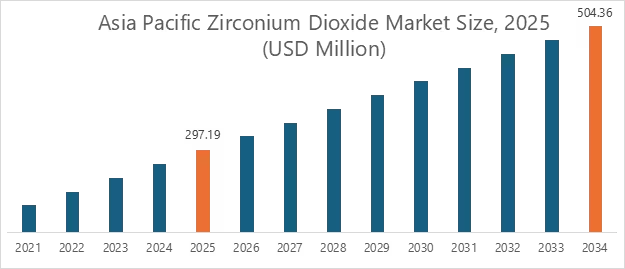
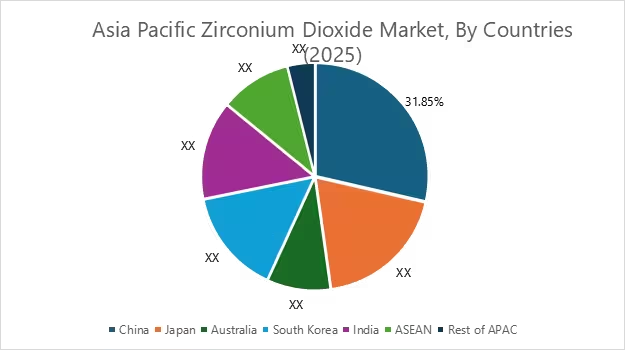
Asia Pacific region was valued at USD 297.19 Million in 2025. Moreover, it is projected to grow by USD 310.68 Million in 2026 and reach over USD 504.36 Million by 2034. Out of this, China accounted for the maximum revenue share of 31.85%. The market progress is mainly driven by urbanization and infrastructure investments. Furthermore, factors including the rising demand in dental restorations and green energy initiatives in countries such as India and China are projected to drive the market growth in Asia Pacific region during the forecast period.
North America is estimated to reach over USD 595.43 Million by 2034 from a value of USD 359.47 Million in 2025 and is projected to grow by USD 374.76 Million in 2026. The North American region's growing utilization of compound as a thermal barrier coating in jet engines offers lucrative growth prospects for the market. Additionally, the rising adoption in the production of advanced electronic components, fuel cells, and structural ceramics is driving the market progress.
The regional analysis depicts that the automakers and aerospace industries are utilizing the material for thermal barrier coatings, engine parts, and sensors due to its supreme heat, wear, and corrosion resistance is driving the market in Europe. Additionally, the key factor driving the market is the surging need for advanced ceramics, paints, coatings, and refractory materials, as well as growing regional investment in foundries is propelling the market adoption in the Middle East and African region. Further, the expanding infrastructure and building material sectors, increasing healthcare access, and rising disposable income are paving the way for the progress of the market in Latin America region.
- For instance, according to World Integrated Trade Solution, India importedgermanium oxides and zirconium dioxides of quantity of 3,267.64 metric tons, which were worth USD 35.92 million in 2023. Additionally, China imported zirconium ores and concentrates in the quantity of 1,556,150 metric tons, which were worth USD 1,332.81 million in 2023.
Top Key Players & Market Share Insights:
The zirconium dioxide market is highly competitive with major players providing products and services to the national and international markets. Key players are adopting several strategies in research and development (R&D), product innovation, and end-user launches to hold a strong position in the global zirconium dioxide market. Key players in the zirconium dioxide industry include -
- Tosoh Corporation(Japan)
- Saint-Gobain ZirPro(France)
- Zircomet Limited (United Kingdom)
- C. Starck GmbH (Germany)
- Showa Denko K.K. (Japan)
- American Elements (United States)
- Jiangxi Kingan Hi-Tech Company (China)
- Imerys Fused Minerals (France)
- DAIICHI KIGENSO KAGAKU KOGYO CO., LTD. (Japan)
- Solvay SA (Belgium)
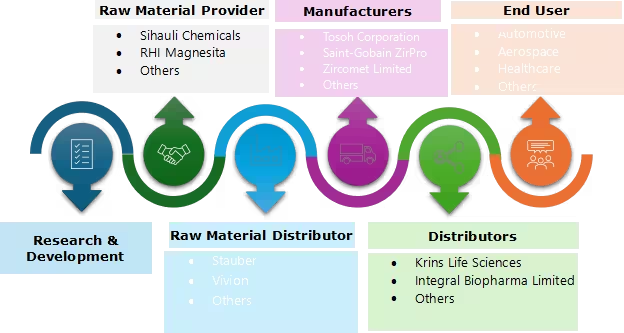
Zirconium Dioxide Market Ecosystem:
Zirconium Dioxide Market Report Insights :
| Report Attributes | Report Details |
| Study Timeline | 2021-2034 |
| Market Size in 2034 (USD Million) | USD 1,828.71 Million |
| CAGR (2026-2034) | 5.2% |
| By Product Type |
|
| By Application |
|
| By End-User Industry |
|
| By Region |
|
| Key Players |
|
Key Questions Answered in the Report
How big is the zirconium dioxide market? −
The market size is estimated to reach over USD 1,828.71 Million by 2034 from a value of USD 1,113.46 Million in 2025 and is projected to grow by USD 1,159.71 Million in 2026, growing at a CAGR of 5.2% from 2026 to 2034.
Which segmentation details are covered in the report? +
The report includes specific segmentation details for product type, application, end-user industry, and regions.
Which is the fastest segment anticipated to impact the market growth? +
In the market, the fuel cells application is the fastest-growing segment during the forecast period due to the growing adoption in stationary backup systems, lithium-ion batteries and supercapacitors.
Who are the major players in the market? +
The key participants in the market are Tosoh Corporation (Japan), Saint-Gobain ZirPro (France), Zircomet Limited (United Kingdom), H.C. Starck GmbH (Germany), Showa Denko K.K. (Japan), American Elements (United States), Jiangxi Kingan Hi-Tech Company (China), Imerys Fused Minerals (France), DAIICHI KIGENSO KAGAKU KOGYO CO., LTD. (Japan), Solvay SA (Belgium) and others.
What are the key trends in the market? +
The market is being shaped by several key trends including the growing adoption to protect underlying metal superalloys from temperatures of jet engines and strong shift toward YSZ in digital dentistry for highly durable, metal-free dental crowns are the key trends driving the market.
Overview
Reputation & Certifications


Our Services
- Market Intelligence & Forecasting
- Custom Research Solutions
- Market Entry Strategy
- Competitive Intelligence
- Customer Insights
- Industry Innovation Analysis
- Investment Advisory