Jump to Content
Lubricants Market Size & Industry Share - Growth Trends & Forecasts (2026 - 2034)
Lubricants Market Size:
The Lubricants Market is expected to expand from 134.09 (US$B) in 2025 to 137.58 (US$B) in 2026, and is forecast to surpass 168.94 (US$B) by 2034, growing at a CAGR of 2.6% between 2026 and 2034, according to a recent report from Consegic Business Intelligence.
Lubricants Market Scope & Overview:
A lubricant is a substance used to reduce friction between surfaces in mutual contact. Typically they contain 90% base oil and less than 10% additives. A lubricant is in liquid (oil, water, etc.), solid (graphite, graphene, molybdenum disulfide), gaseous (air), or even semisolid (grease) forms. Various features include a high viscosity index, thermal stability, corrosion prevention, and others. There are several types of lubricants based on base oil type such as mineral oil, synthetic, and bio-based. Further, mineral oil lubricants are derived from the refining of crude oil, whereas synthetic ones are artificially synthesized in the laboratory. The lubricants are widely used in industries such as automotive, agriculture, renewable energy, and others.
How is AI Transforming the Lubricants Market?
There is a rising adoption of AI in the lubricants market, mainly for optimizing production operations, enhancing supply chains, and improving operational efficiency. AI-powered systems can monitor real-time data from manufacturing plants, identify inefficiencies, and suggest adjustments to improve output and reduce waste.
Moreover, AI systems can monitor critical parameters throughout the production process, in turn identifying deviations earlier during the production process and ensuring consistent product quality. Further, AI-powered automation systems increase throughput and reduce labor costs associated with lubricant manufacturing. Consequently, the above factors are expected to propel the market growth during the forecast period.

Lubricants Market Dynamics - (DRO) :
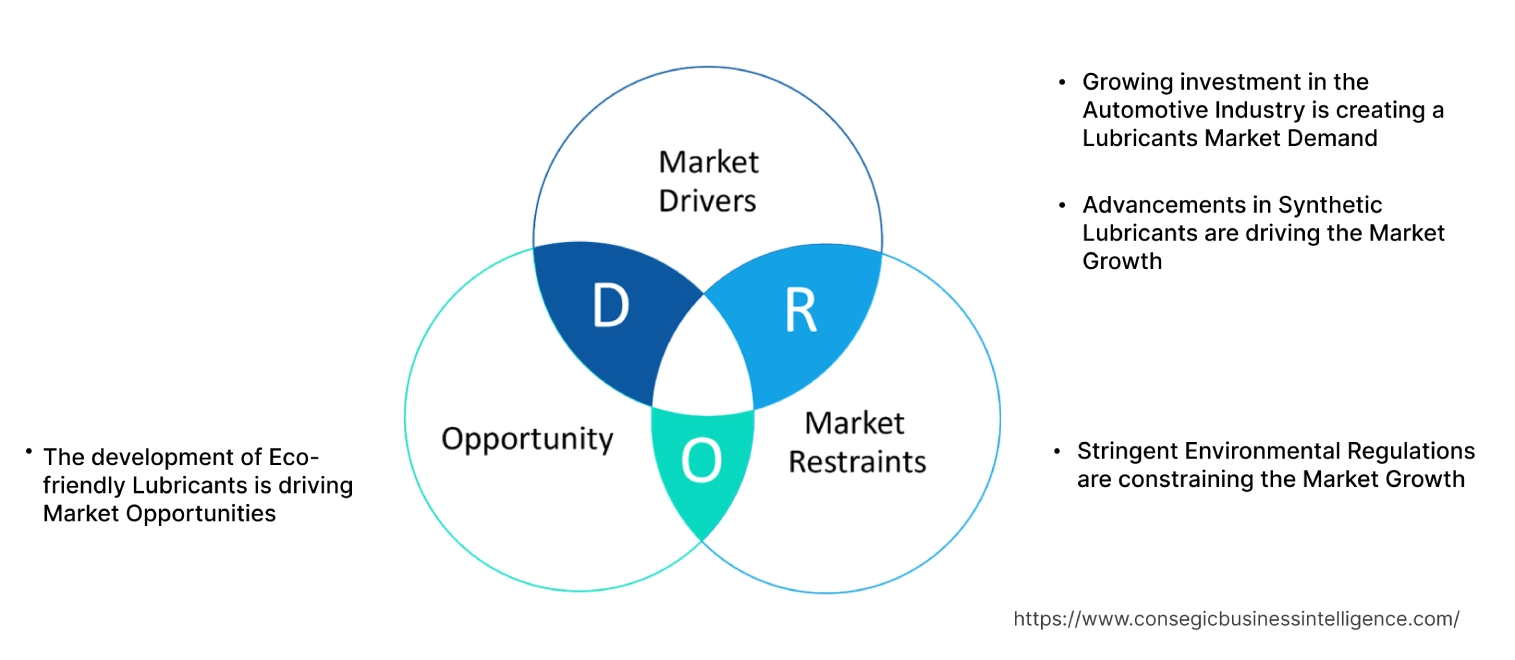
Key Drivers:
Growing investment in the Automotive Industry is creating a Lubricants Market Demand
Various types of lubricants such as engine oils, hydraulic oils, greases, and others are used in the automotive industry. This industry needs lubrication for smooth operation and better protection of vehicle engines against friction. Governments in countries like India, Germany, and others are investing heavily in the automotive industry. Further, in India, the government is allocating a budget for the automotive industry under the Component Champion Incentive Scheme.
- In 2023, according to an Invest India report, USD 3.27 Billion is allocated by the Government of India for the automotive industry under the Component Champion Incentive Scheme. This scheme offers financial incentives to boost domestic manufacturing of advanced automotive technology products and attract investments in the automotive manufacturing value chain. It is creating demand for the market due to the requirement of lubrication for smooth operation and corrosion prevention in vehicles such as cars, trucks, and others in the automotive sector.
Thus, the rapid proliferation of the automobile industry is creating lubricants market demand, due to the need for better performance and protection of vehicle engines.
Advancements in Synthetic Lubricants are driving the Market Growth
Synthetic lubricants consist of chemical compounds that are artificially modified or synthesized. They offer superior qualities, including a higher viscosity index, improved oxidative stability, and better low-temperature performance. New types of synthetic lubricants such as polyalphaolefins and esters have emerged as a result of advancements in base oil technology. These new developments are creating the need for the market, due to their less environmental impact, low wear rate, and high thermal stability.
- In 2023, according to a research paper published in Lubricants Journal, esters synthetic lubricants reduce the environmental impact of vehicles. It also shows excellent lubricity features such as a good viscosity index, low volatility, and high thermal stability. Additionally, it reduces the wear rate to 75% in the vehicle, further accelerating lubricants market
Thus, the advancements in synthetic lubricants such as esters, are driving the market by offering less environmental impact and better protection of vehicles.
Key Restraints :
Stringent Environmental Regulations are constraining the Market Growth
Lubricants manufacturers must adhere to regulation standards regarding the production of lubricants, which increases their production costs. Governments are imposing stringent regulations regarding the disposal and recycling of lubricants, particularly plastics. The companies are required to shift to more sustainable, bio-degradable, or eco-friendly packaging of lubricants. Developing such packaging requires significant investment in research and development. The growing concern towards sustainability and eco-friendly practices is driving the adoption of bio-based and synthetic lubricants. This typically requires huge capital investment due to advanced machinery and higher maintenance costs. Moreover, the manufacturers of bio-based lubricants have to invest in sourcing raw materials such as vegetable oils, plant seeds, and others, which in turn restrict the market.
Thus, stringent environmental regulations are constraining the market due to large investments in research and development and the requirement for advanced machinery.
Future Opportunities :
The development of Eco-friendly Lubricants is driving Market Opportunities
Eco-friendly lubricants are derived from renewable sources like plant seeds, vegetable oils, and others. They are biodegradable, non-toxic, and reduce carbon dioxide emissions as compared to traditional mineral-based lubricants. Their demand is driven by increasing environmental regulations and consumer preferences for sustainability solutions.
- In 2024, TotalEnergies launched the Rubia EV3R range of lubricants for heavy-duty vehicles. They lower carbon dioxide emissions generated by their operations. It will be packed in 5-liter containers made from 50% recycled high-density polyethylene (HDPE), recognizable by its silver color, further reducing environmental impact.
Thus, the development of eco-friendly lubricants like Rubia EV3R is creating lubricants market opportunities reducing carbon footprint and improving sustainability.
Lubricants Market Segmental Analysis :
By Base Oil Type:
Based on type, the market is categorized into bio-based and petroleum-based.
By base oil type, the market is divided into mineral oil lubricants, synthetic lubricants, and bio-based lubricants.
Mineral oil lubricants accounted for the largest market share in the year 2023.
- Mineral oil lubricants are derived from the refining of crude oil and are classified into Group I, Group II, and Group III based on their level of refinement and performance characteristics.
- The Group I mineral oils are with basic refinement and are used for traditional engines.
- Group II and Group III have better oxidation stability, wear prevention, and better volatility than Group I mineral oils. They are used for modern engines and equipment.
- These oils are widely used due to their cost-effectiveness and availability, making them a popular choice.
- They are used in various industries like automotive, industrial machinery, and others for the lubrication of wheel bearings, chassis components, and others.
- Thus, mineral oil lubricants are widely used due to their diverse applications and cost-effectiveness.
Synthetic lubricants are expected to grow at the fastest CAGR over the forecast period.
- Syntheticlubricants consist of chemical compounds that are artificially modified or synthesized in the laboratory.
- They include polyethylene glycol (PAG), synthetic hydrocarbons such as polyalphaolefins, and others.
- They are being used rapidly due to their better viscosity index, a higher flash point, and an increased pour point. They ensure better machinery performance and extended service life.
- In 2024, Castrol launched new VECTON LONG DRAIN 5W-30 E6/E9 fully synthetic lubricant for heavy duty engines. It represents significant advances in lubricant performance levels, offering increased protection against oxidation and deposits.
- Thus, synthetic lubricants are rapidly used due to their better performance and extended service life as per the latest trends.
By End-Use Industry:
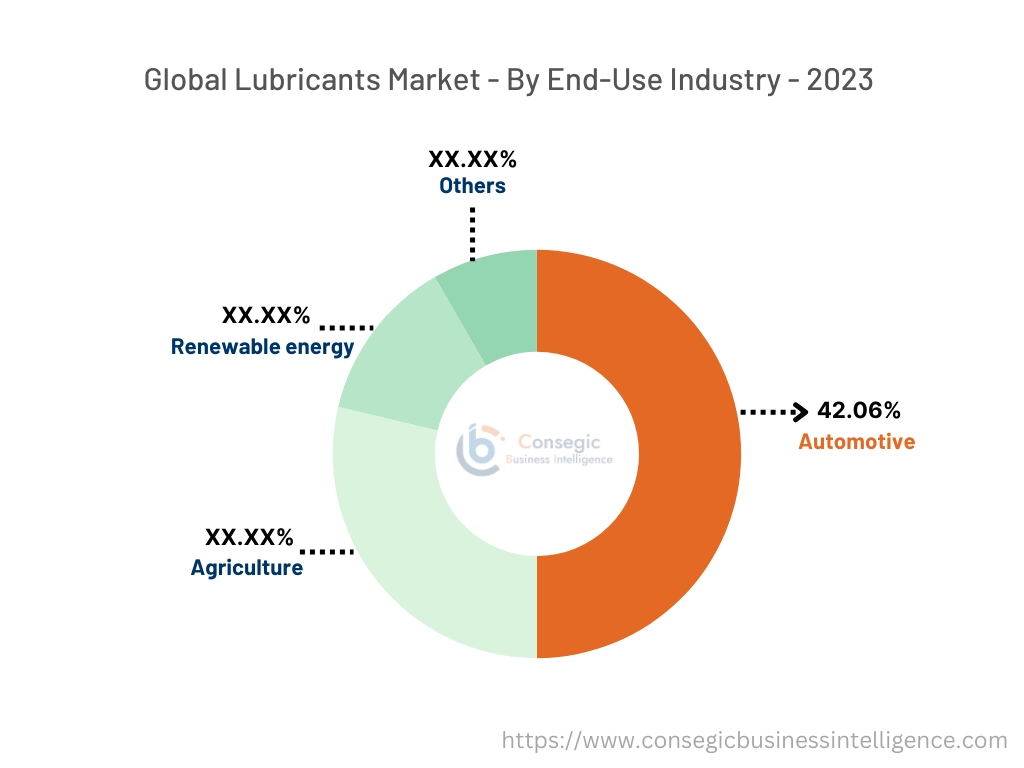
By end-use industry, the market is divided into automotive, agriculture, renewable energy, and others.
The automotive industry accounted for the largest market share of 42.06% in the year 2023.
- Lubricants play an important role in the automotive industry for the smooth functioning of a vehicle.
- It reduces corrosion, maintains running temperatures, and is vital in increasing the life of various engine components like wheel bearings, chassis components, and others.
- Proper lubrication ensures smooth operation and prevents power loss due to friction, resulting in a more responsive and powerful engine, making it widely used in the automotive industry.
- In 2024, Energizer and Assurance Intl launched a new product line of automotive lubricants in India. The product range includes engine oils, hydraulic oils, and others for the lubrication of engines. They are fortified with advanced additives to enhance protection against wear, wear, corrosion, and deposits, thereby improving fuel economy and prolonging engine life.
- Thus, lubricants are widely used in the automotive industry for smooth functioning and prolonging engine life as per lubricants market trends.
Renewable energy is expected to grow at the fastest CAGR over the forecast period.
- The use of lubricants in the renewable energy industry, particularly in wind turbines is increasing to ensure peak performance and long-term reliability of wind turbines.
- Lubrication is applied in various parts of wind turbines such as generator bearings, pitch bearings, and hydraulic systems.
- It will also help in the smooth operation of blades in the wind turbines, essential for generating electricity.
- Further, synthetic lubricants are typically preferred for wind turbine lubrication because they offer better performance at high temperatures and under heavy loads.
- They have a longer service life and provide better protection against wear and corrosion in wind turbines.
- Thus, the use of lubricants in the renewable energy industry is rising, due to the trend of sustainability and eco-friendly practices.
Regional Analysis:
The regional segment includes North America, Europe, Asia Pacific, the Middle East and Africa, and Latin America.
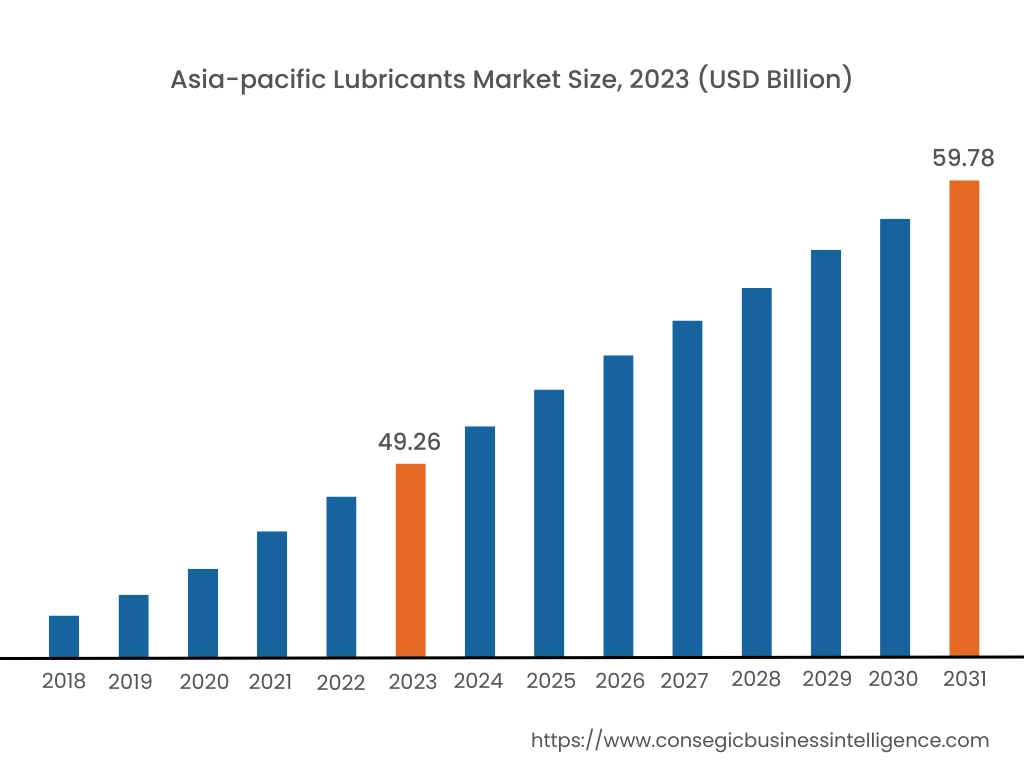
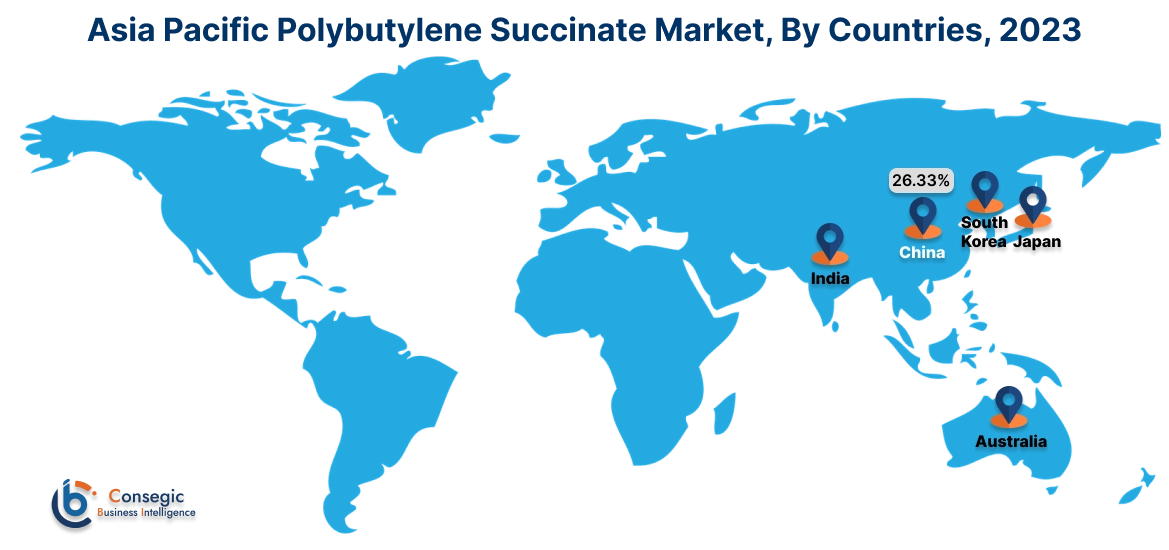
In 2023, Asia-Pacific accounted for the highest market share at 38.11% and was valued at USD 49.26 Billion and is expected to reach USD 59.78 Billion in 2031. In Asia-Pacific, China accounted for the highest market share of 26.33% during the base year of 2023. As per market analysis, the lubricants market share of the Asia-Pacific region is driven by rapid urbanization, economic growth, and industrial developments. Countries like China, India, and Japan are major automotive markets, driving the adoption of engine oils, transmission oils, and automotive oils. The region is leading in consumption as well as exportation of lubricants. Also, the region is a global manufacturing hub, with industries such as electronics, textiles, and machinery heavily relying on lubricants for efficient operations.
- In 2024, Autoz365 Lubricants, a division of Tesla Power India Pvt. Ltd., launched its range of lubricants in India. They are designed to enhance fuel efficiency and offer superior engine protection. It will further expand the market reach in the Asia-Pacific region.
Thus, the Asia-Pacific region is leading in the market due to well-established automotive infrastructure and wider consumption as per the analysis.
North America is expected to witness the fastest CAGR over the forecast period of 3.3% during 2024-2031. According to market analysis, North America’s lubricants market share is experiencing rapid growth in the market, driven by a mature and well-established automotive sector. The region benefits from a strong automotive sector, which remains a significant consumer of engine oils, hydraulic oils, and others. The growing emphasis on electric vehicles in the region is further accelerating the market. The region is a leader in advanced manufacturing processes, along with rapid proliferation in the renewable energy sector, boosting the adoption of bio-based and synthetic lubricants. The region is also experiencing rapid construction and industrial developments, which is further driving the need for lubrication to ensure smooth operation and longevity.
Thus, North America is experiencing lubricants market growth, driven by technological innovation and the presence of major manufacturers. According to the lubricants market analysis, the European region is growing significantly in the market due to well-established automotive and manufacturing sectors. The European countries are leading in the manufacturing of cars and other vehicles such as trucks, containers, and others, further fueling the market growth. Countries like France, the United Kingdom, and Russia are key contributors due to the major production of advanced lubrication formulations such as synthetic and bio-based lubricants. Moreover, European manufacturers are investing heavily in research and development of advanced lubricant formulations, further propelling the market.
The market is expanding in the Middle East and Africa region driven by rapid construction and the growing automotive sector. In countries like Dubai, UAE, and South Africa the market is propelling due to the rapid proliferation of industrial projects and exp manufacturing sector. It is fueling the adoption of engine oils, hydraulic oils, greases, and more. Oil and gas remain significant contributors in this region, as lubricants are critical for equipment maintenance and efficient operations. Also, the government in this region is implementing stringent environmental regulations driving the transition towards sustainable and eco-friendly lubricants.
According to market analysis, Latin America is witnessing moderate growth in the market, driven by expanding industrial activities, rising vehicle ownership, and infrastructure development. Key countries like Brazil, Mexico, and Argentina lead the market due to their strong automotive and industrial sectors. The growing automotive market is a significant contributor, with increasing demand for engine oils, hydraulic oils, and other automotive oils. Industrial lubricants are also high in demand, supported by the region’s mining, manufacturing, and construction industries. Additionally, renewable energy projects, especially in wind and solar power are fueling the adoption of lubricants, for smoother operation of engines. Environmental regulations are encouraging the adoption of bio-based and synthetic lubricants in the region, driving lubricants market opportunities in the region.
Lubricants Market Competitive Landscape:
The industry is highly competitive with major players providing precise measurements between objects to the national and international markets. Key players are adopting several strategies in research and development (R&D) and product innovation to hold a strong position in the global lubricants market. Key players in the lubricants industry include-
- Shell (United Kingdom)
- Chevron Corporation (United States)
- Indian Oil Corporation Ltd (India)
- LUKOIL (Russia)
- PetroChina (China)
- Exxon Mobil Corporation (United States)
- TotalEnergies (France)
- China National Petroleum Corporation (China)
- ENEOS Corporation (Japan)
- Idemitsu Kosan Co., Ltd (Japan)
Recent Industry Developments :
Partnerships and Collaborations:
- In 2024, TotalEnergies collaborated with TecDoc making all TotalEnergies lubricants products available on the TecDoc platform. By joining TecDoc, TotalEnergies is expanding its market reach making its products available to a wider range of automotive professionals worldwide, including spare parts distributors, workshops, and garages.
Launches:
- In 2024, Stellantis launched Quartz EV3R 10W-40 in Europe. It is the first sustainable engine lubricant made from 100% regenerated oil designed by TotalEnergies Lubrifiants. It has eco-friendly packaging with 1-liter and 5-liter bottles made from 50% recycled plastic and 100% recyclable themselves, introducing innovation in the market.
Mergers and Acquisition:
- In 2024, TotalEnergies acquired Tecoil to develop the circular economy for lubricants and meet customer’s demand. It will combine Tecoil’s base oil processing with TotalEnergies’ expertise in the production and distribution of lubricants, improving sustainability in the market.
Lubricants Market Report Insights :
| Report Attributes | Report Details |
| Study Timeline | 2021-2034 |
| Market Size in 2034 | USD 168.94 Billion |
| CAGR (2026-2034) | 2.60% |
| Base Year | 2025 |
| By Base Oil Type |
|
| By End-use Industry |
|
| By Region |
|
| Key Players |
|
| North America | U.S. Canada Mexico |
| Europe | U.K. Germany France Spain Italy Russia Benelux Rest of Europe |
| APAC | China South Korea Japan India Australia ASEAN Rest of Asia-Pacific |
| Middle East and Africa | GCC Turkey South Africa Rest of MEA |
| LATAM | Brazil Argentina Chile Rest of LATAM |
| Report Coverage |
|
Key Questions Answered in the Report
How big is the Lubricants market? −
Lubricants market size is estimated to reach over USD 156.42 Billion by 2031 from a value of USD 129.26 Billion in 2023, growing at a CAGR of 2.6% from 2024 to 2031.
What specific segmentation details are covered in the Lubricants market report? +
The Lubricants market report includes specific segmentation details for base oil type and end-use industry.
Which is the fastest-growing region in the Lubricants market? +
North America is the fastest-growing region in the Lubricants market.
Who are the major players in the Lubricants market? +
The key participants in the Lubricants market are Shell (United Kingdom), Chevron Corporation (United States), Exxon Mobil Corporation (United States), TotalEnergies (France), China National Petroleum Corporation (China), ENEOS Corporation (Japan), Idemitsu Kosan Co., Ltd (Japan), Indian Oil Corporation Ltd (India), LUKOIL (Russia), PetroChina (China)
Overview
Reputation & Certifications


Our Services
- Market Intelligence & Forecasting
- Custom Research Solutions
- Market Entry Strategy
- Competitive Intelligence
- Customer Insights
- Industry Innovation Analysis
- Investment Advisory