Jump to Content
2,4-Dichlorobenzyl Alcohol Market Size & Industry Share - Growth Trends & Forecasts (2026 - 2034)
2,4-Dichlorobenzyl Alcohol Market Size:
The 2,4-Dichlorobenzyl Alcohol Market is expected to expand from 34.06 (US$M) in 2025 to 35.69 (US$M) in 2026, and is forecast to surpass 51.93 (US$M) by 2034, growing at a CAGR of 4.8% between 2026 and 2034, according to a recent report from Consegic Business Intelligence.
2,4-Dichlorobenzyl Alcohol Market Scope & Overview:
2,4-dichlorobenzyl alcohol is a chemical compound commonly used as an antiseptic and preservative in pharmaceutical and personal care products. Known for its antimicrobial properties, it is frequently included in throat lozenges, mouthwashes, and nasal sprays to help prevent and treat infections. This compound is valued for its effectiveness in inhibiting bacterial growth, making it a popular choice in formulations designed to maintain hygiene and control microbial contamination. Pharmaceutical companies and manufacturers of hygiene products are key end-users, incorporating this compound in products aimed at enhancing consumer health and safety. The increasing awareness of hygiene and infection control in both medical and consumer settings supports steady market growth.

2,4-Dichlorobenzyl Alcohol Market Dynamics - (DRO) :
Key Drivers:
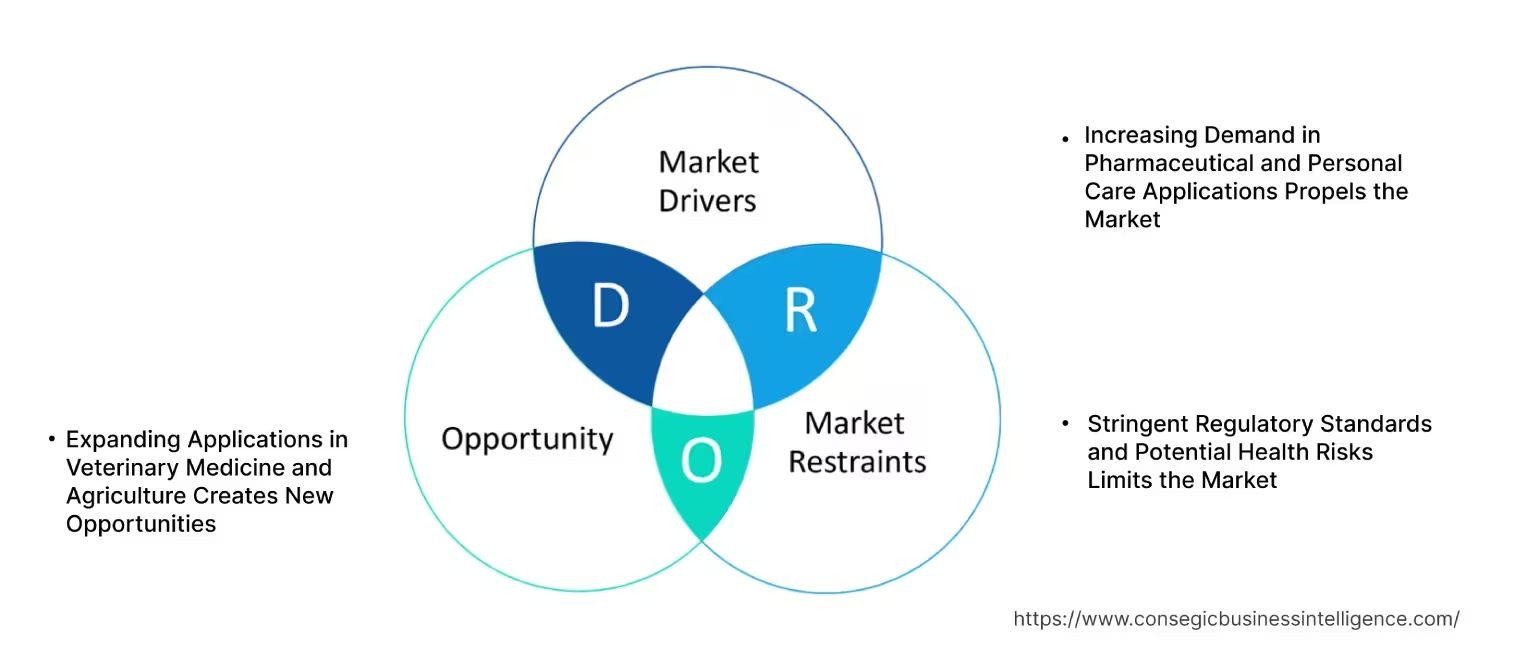
Increasing Demand in Pharmaceutical and Personal Care Applications Propels the Market
The 2,4-dichlorobenzyl alcohol is widely used as an antimicrobial agent, particularly in throat lozenges and sprays, to treat symptoms of sore throat and throat infections due to its bacteriostatic properties. The pharmaceutical industry relies on 2,4-dichlorobenzyl alcohol for its effectiveness in oral care products, while the personal care sector uses it in various formulations as a preservative to inhibit microbial growth. As consumer awareness regarding throat infections and personal hygiene grows, particularly in response to increased focus on health and wellness, the demand for antimicrobial agents like 2,4-dichlorobenzyl alcohol continues to rise, supporting the 2,4-dichlorobenzyl alcohol market expansion.
Key Restraints :
Stringent Regulatory Standards and Potential Health Risks Limits the Market
One of the primary restraints in the 2,4-dichlorobenzyl alcohol market growth is the stringent regulatory framework surrounding its use, particularly in pharmaceutical and personal care products. Regulatory agencies in regions like North America and Europe closely monitor and control the allowable concentrations of antimicrobial agents in consumer products due to potential health concerns. Excessive or prolonged exposure to 2,4-dichlorobenzyl alcohol can cause irritation or allergic reactions, limiting its use in certain applications. Additionally, the extensive testing and compliance requirements for safety and efficacy increase production costs, posing challenges for manufacturers, particularly when entering highly regulated markets.
Future Opportunities :
Expanding Applications in Veterinary Medicine and Agriculture Creates New Opportunities
The growing exploration of 2,4-dichlorobenzyl alcohol in veterinary medicine and agriculture presents a promising opportunity for market expansion. In veterinary care, it is being studied as an antimicrobial additive in topical applications for livestock to prevent infections and enhance animal health. In agriculture, its use as a preservative in plant treatment solutions is gaining interest, as it helps in controlling microbial growth on plants and during storage. The adoption of alcohol in these sectors not only broadens its market applications but also offers manufacturers 2,4-dichlorobenzyl alcohol market opportunities to diversify their product offerings in less saturated markets.
2,4-Dichlorobenzyl Alcohol Market Segmental Analysis :
By Purity:
Based on purity, the market is segmented into 98% purity, 99% purity, and other purities.
The 99% purity segment accounted for the largest revenue share of the total 2,4-dichlorobenzyl alcohol market share in 2023.
- The 99% purity level of the alcohol is widely adopted in high-standard applications, such as pharmaceutics and cosmetics, where purity directly impacts product efficacy and safety.
- This high-purity grade is essential for pharmaceutical formulations, including antiseptics and lozenges, as it offers consistency and minimal contamination risk.
- The increasing adoption of high-quality pharmaceutical and personal care products globally drives the dominance of the 99% purity segment in the market.
- Thus, as per the market trends analysis, the 99% purity segment leads the market, supported by its critical role in pharmaceutical and cosmetic applications where high purity is necessary for quality assurance, driving the 2,4-dichlorobenzyl alcohol market growth.
The 98% purity segment is anticipated to register the fastest CAGR during the forecast period.
- The 98% purity level is frequently used in agriculture and other industrial applications where a slight variance in purity does not significantly impact product performance.
- Its cost-effectiveness and adequate efficacy in formulations for insecticides and other agrochemical products make it an ideal choice for agricultural firms.
- The growing need for reliable pest control solutions and the focus on cost-efficient agricultural chemicals are fueling the adoption of the 98% purity level in this segment.
- Therefore, the analysis of segmental trends shows that the 98% purity segment is expected to grow rapidly, driven by rising demand from the agricultural industry for cost-effective and efficient insecticide formulations, boosting the 2,4-dichlorobenzyl alcohol market trends.
By Application:
Based on application, the market is segmented into preservatives, insecticides, chemical intermediates, and others.
The preservative segment accounted for the largest revenue share of the overall 2,4-dichlorobenzyl alcohol market share in 2023.
- 2,4-Dichlorobenzyl Alcohol is extensively used as a preservative, especially in pharmaceutical and cosmetic products, due to its antimicrobial properties.
- This application is critical for extending product shelf life and maintaining safety in antiseptics, lozenges, and personal care formulations.
- The growing need for effective preservatives in healthcare and cosmetics, particularly as regulatory standards become more stringent, has strengthened the preservative segment's leading position.
- Thus, the analysis of segmental trends depicts that the preservative segment leads the market, driven by its essential role in pharmaceuticals and cosmetics, where antimicrobial properties ensure product safety and longevity, boosting the 2,4-dichlorobenzyl alcohol market demand.
The insecticide segment is anticipated to register the fastest CAGR during the forecast period.
- The insecticidal properties of 2,4-Dichlorobenzyl Alcohol make it valuable in agricultural formulations for pest control.
- As agricultural productivity becomes increasingly important, the need for effective insecticides is rising, especially in regions with intensive crop cultivation.
- The segment's rapid rise is supported by the compound's effectiveness in pest control and compatibility with other active insecticidal ingredients, which enhances its versatility in agricultural products.
- The 2,4-dichlorobenzyl alcohol market analysis shows that the insecticide segment is set for rapid progress, driven by the rising demand for effective pest control solutions in agriculture, where reliable crop protection is essential, proliferating the 2,4-dichlorobenzyl alcohol market trends.
By End-User Industry:
Based on the end-user industry, the market is segmented into pharmaceutics, cosmetics, agriculture, food & beverage, and others.
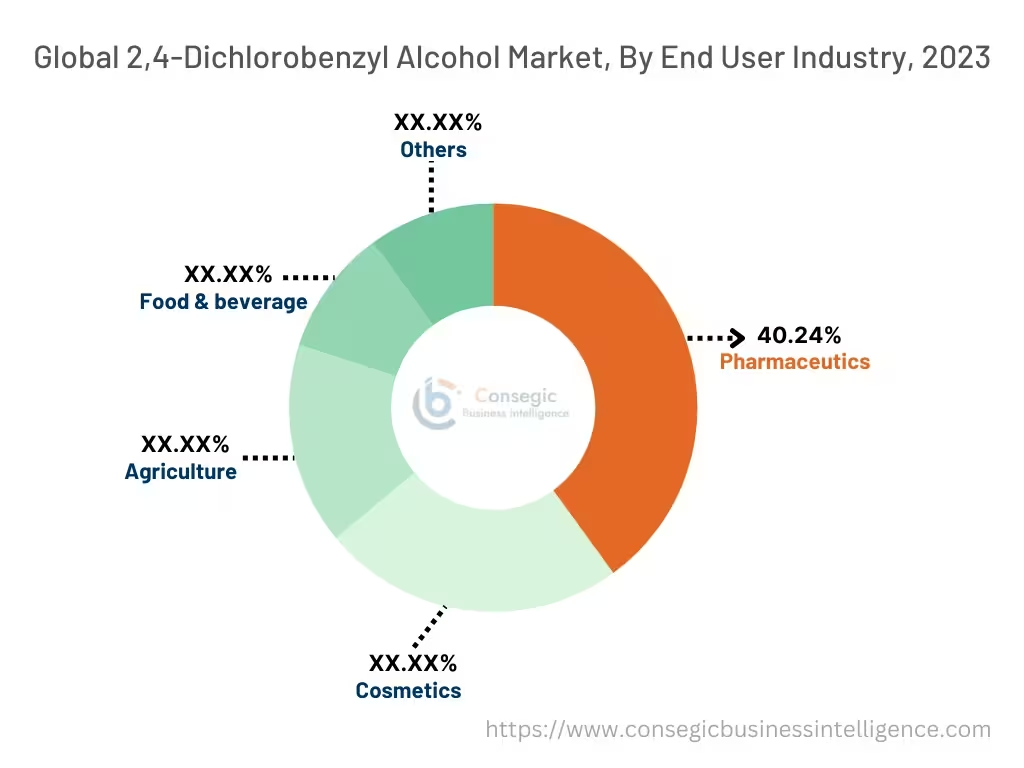
The pharmaceutics segment accounted for the largest revenue share of 40.24% in 2023.
- Pharmaceutical applications of 2,4-dichlorobenzyl alcohol include its use in antiseptics, throat lozenges, and other healthcare formulations that require strong antimicrobial effects.
- This compound's role in preventing microbial growth is vital in products that maintain patient safety and product longevity.
- The growing global demand for reliable antimicrobial agents, especially in response to health standards and infection control protocols, has contributed to the leading position of the pharmaceutics segment.
- Hence, the segmental trends show that the pharmaceutics segment leads the market as the primary consumer of alcohol, driven by its critical antimicrobial role in pharmaceutical formulations, driving the 2,4-dichlorobenzyl alcohol market expansion.
The agriculture segment is anticipated to register the fastest CAGR during the forecast period.
- In agriculture, 2,4-dichlorobenzyl alcohol is used in pest control products, where it serves as an effective insecticidal agent.
- The need for efficient, cost-effective pest control solutions in crop management drives its adoption in this segment.
- As sustainable and effective insecticides gain importance globally, agricultural firms are increasingly incorporating this compound to ensure crop protection and yield enhancement.
- Thus, the analysis portrays that the agriculture segment is expected to grow rapidly, fueled by the need for effective pest management solutions and the compound's insecticidal effectiveness in agricultural applications, creating the 2,4-dichlorobenzyl alcohol market opportunities.
Regional Analysis:
The regions covered are North America, Europe, Asia Pacific, the Middle East and Africa, and Latin America.
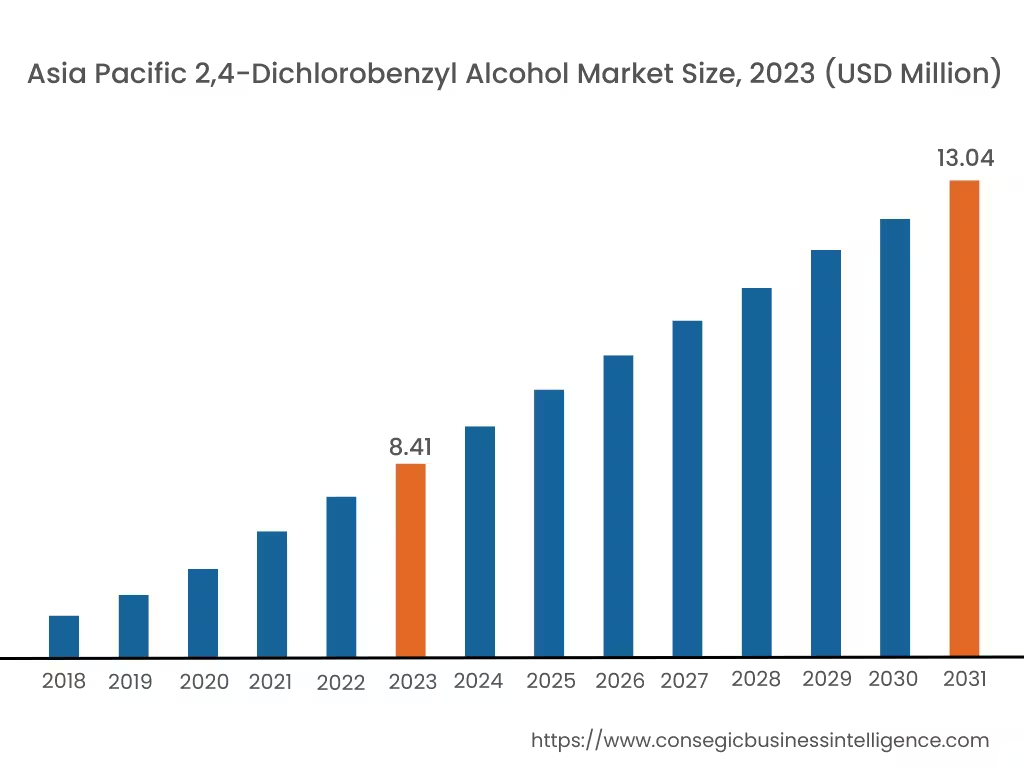
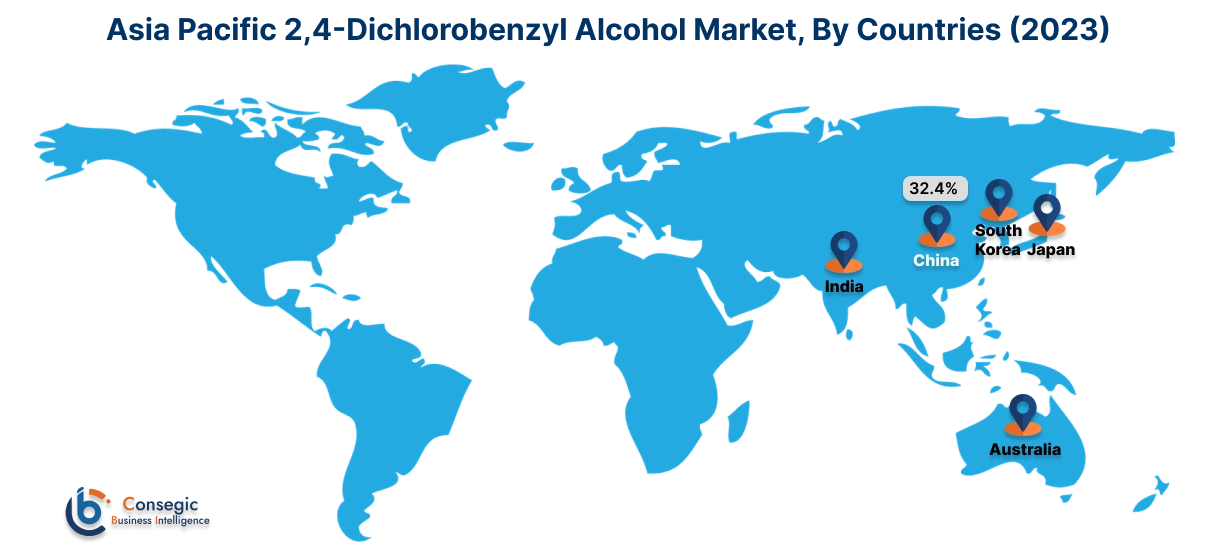
Asia Pacific region was valued at USD 8.41 Million in 2023. Moreover, it is projected to grow by USD 8.71 Million in 2024 and reach over USD 13.04 Million by 2031. Out of this, China accounted for 32.4% of the total market share. Growing awareness of hygiene and healthcare products and the increasing prevalence of throat infections in these countries are key drivers. China's and India's expanding pharmaceutical manufacturing capabilities also support the adoption of 2,4-Dichlorobenzyl Alcohol as an ingredient in medicinal products. However, regulatory challenges and variations in quality standards across countries may restrict market expansion.
North America holds a significant share of the 2,4-dichlorobenzyl alcohol market, primarily due to its extensive use in pharmaceuticals, specifically in throat lozenges and antiseptic products. The U.S. leads in the market, supported by a strong pharmaceutical industry and high awareness of healthcare and hygiene products. Increased incidence of respiratory infections drives the need for products containing alcohol. However, stringent FDA regulations on pharmaceutical ingredients may pose challenges to product approvals in the region.
Europe is a key market, with high demand from Germany, the UK, and France, where it is widely used in over-the-counter (OTC) cold and cough medications. The region's high incidence of seasonal flu and throat infections, combined with stringent quality standards for pharmaceuticals, drives the market. The European Union's focus on consumer safety and strict regulations on chemicals used in medicinal products also ensure the quality of products. However, compliance with EU regulations can increase production costs, affecting the 2,4-dichlorobenzyl alcohol market demand.
The regional trends analysis shows that the Middle East & Africa region shows steady development in the market, with demand primarily from Saudi Arabia, the UAE, and South Africa. The region's focus on improving healthcare infrastructure and rising awareness of personal hygiene products support market growth. Increases in respiratory illnesses and the need for OTC pharmaceuticals also contribute to the market. However, limited local production capabilities and reliance on imports for pharmaceutical ingredients may limit market progress.
As per the 2,4-dichlorobenzyl alcohol market analysis, Latin America is an emerging market, led by Brazil and Mexico. The region's market is fueled by a growing pharmaceutical sector and rising healthcare awareness, particularly in cold and throat-care products. Brazil's increasing focus on OTC medications and Mexico's expanding healthcare sector support market growth. However, economic fluctuations and limited access to advanced production facilities present challenges for consistent market advancement.
Top Key Players & Market Share Insights:
The 2,4-dichlorobenzyl alcohol market is highly competitive with major players providing treatments to the national and international markets. Key players are adopting several strategies in research and development (R&D), product innovation, and end-user launches to hold a strong position in the global 2,4-dichlorobenzyl alcohol market. Key players in the 2,4-dichlorobenzyl alcohol industry include -
- BASF SE (Germany)
- Lanxess AG (Germany)
- Nouryon (Netherlands)
- Merck KGaA (Germany)
- Thermo Fisher Scientific Inc. (USA)
- Toronto Research Chemicals Inc. (Canada)
- Alfa Aesar (USA)
- Tokyo Chemical Industry Co., Ltd. (Japan)
- Henan CoreyChem Co., Ltd. (China)
- Santa Cruz Biotechnology, Inc. (USA)
2,4-Dichlorobenzyl Alcohol Market Report Insights :
| Report Attributes | Report Details |
| Study Timeline | 2021-2034 |
| Market Size in 2034 | USD 51.93 Million |
| CAGR (2026-2034) | 4.80% |
| Base Year | 2025 |
| By Purity |
|
| By Application |
|
| By End-User Industry |
|
| By Region |
|
| Key Players |
|
| North America | U.S. Canada Mexico |
| Europe | U.K. Germany France Spain Italy Russia Benelux Rest of Europe |
| APAC | China South Korea Japan India Australia ASEAN Rest of Asia-Pacific |
| Middle East and Africa | GCC Turkey South Africa Rest of MEA |
| LATAM | Brazil Argentina Chile Rest of LATAM |
| Report Coverage |
|
Key Questions Answered in the Report
How big is the 2,4-dichlorobenzyl alcohol Market? −
In 2023, the 2,4-dichlorobenzyl alcohol market was USD 30.90 million.
What will be the potential market valuation for the 2,4-dichlorobenzyl alcohol by 2031? +
In 2031, the market size of 2,4-dichlorobenzyl alcohol is expected to reach USD 45.12 million.
What are the segments covered in the 2,4-dichlorobenzyl alcohol market report? +
Their purity, application, and end-user industry are the segments covered in this report.
Who are the major players in the 2,4-dichlorobenzyl alcohol market? +
BASF SE (Germany), Lanxess AG (Germany), Nouryon (Netherlands), Merck KGaA (Germany), Thermo Fisher Scientific Inc. (USA), Toronto Research Chemicals Inc. (Canada), Alfa Aesar (USA), Tokyo Chemical Industry Co., Ltd. (Japan), Henan CoreyChem Co., Ltd. (China), Santa Cruz Biotechnology, Inc. (USA) are the major players in the 2,4-dichlorobenzyl alcohol market.
Overview
Reputation & Certifications


Our Services
- Market Intelligence & Forecasting
- Custom Research Solutions
- Market Entry Strategy
- Competitive Intelligence
- Customer Insights
- Industry Innovation Analysis
- Investment Advisory