Jump to Content
3D Concrete Printing Market - Size, Share, Industry Trends, and Forecasts (2025-2035)
3D Concrete Printing Market Scope & Overview
The 3D concrete printing market is a transformative and quickly developing niche of the construction technology and high-technology manufacturing business sector, composed of automated additive manufacturing models based on computer-controlled gantry systems, robotic arms, and mobile platforms to deposit specially tailored cementitious material, layer-by-layer in accordance with digital architectural models, to create and assemble residential structures, commercial structures, infrastructure components, architecture, disaster relief shelters, and military bases, and to other specialized applications, which provide greater design freedom, lower material wasting, shorter construction schedules, lower labor needs. It is estimated at USD 720 Million in 2024, USD 825 Million in 2025 (base year) with a forecast that the market will experience massive growth to USD 4,250 Million in 2035. The growth curve is an indication of a compound annual growth rate (CAGR) of 18.5 percent through the forecast period of 2026 to 2035, attributed to increasing global housing crises warranting novel construction schemes, extreme labor shortages in the construction industry impacting 80 percent of the world construction industry, sustainability requirements targeting the 38 percent contribution of the construction sector to global CO2 emissions, successful pilot construction projects that supported commercial viability, groundbreaking development of printable concrete formulas that met the structural performance requirements, and increased usage of the structures beyond

3D concrete printing (also called 3DCP) is an extrusion-based deposition process of concreteitious materials designed so that their rheological properties can be printable, buildable, and structural. The wall construction per day through modern systems is 100-250 mm/s at the nozzle which is equivalent to 40-100 m2 per day in this instance with 50-70 percent reduction in construction waste, 40-60 percent faster construction schedules and 30-50 percent labor reduction and 20-30 percent material savings due to the optimization of structural topology with no unnecessary material waste, and does not compromise structural integrity.
The construction sector, an industry with an approximate USD 12,900,000 Million value every year, has the following basic challenges such as inadequate skilled labor supply due to 500,000-650,000 vacancies per annum in the United States alone, slowing down of project completion by 20 percent of the set schedules, cost overruns that are 15-25 percent above budgets, and 30-35 percent of material waste as construction debris. The high environmental footprint of the industry, of which cement manufacturing alone contributes 8% to the global CO2 emissions, demands urgent solution in the form of sustainable alternatives which 3DCP can offer thanks to optimization of materials and reduction of wastes.
Market Channel Distribution Analysis
The 3D concrete printing market has four service and delivery models serving different construction industries with differentiated needs and investment capacity and adoption. The overall market revenue breakdown indicates that there is a great deal of variance in the business model and method of customer engagement:
Breakdown of Distribution Channel (2025):
- Printing Services and Turnkey Construction: USD 371 Million (45.0% of the entire market value)
- Equipment Sales and Leasing Programs: USD 289 Million (35.0 of market revenue)
- Specialties: Materials and Consumables USD 124 Million (15.0% of market share)
- Software, Design Services, and Technical Support: USD 41 Million (5.0% of the total market value)
The development of 3D concrete printing technology, such as formulation of printable material, development of robotic systems, integration of digital design software, and structural validation research, had a world investment of USD 295 Million in 2024, with continued major construction technology companies, research institutes, and venture capital investors dedicating about 12-18% of construction technology budgets to advancing capabilities, such as multi-material printing systems to allow integrated utilities and insulation, combination of reinforcement strategies, faster curing technologies, real-time quality monitoring systems, and standardizing building
Fundamental transformation of the industry is underway, with more than 180 successful 3D printed building projects already implemented all over the world by 2024, comprising residential households, office buildings, pedestrian bridges, military barracks, and infrastructure, with technical feasibility established, and issues of implementing the technology and applying it in mainstream applications needing resolution to bring it to mainstream use.
3D Concrete Printing Market Dynamics (DRO)
Key Drivers:
International Housing Crisis and Building Construction Labor Shortages.
The greatest structural force is the surge in housing shortage around the world and extreme construction workforce scarcity that has led to a desperate need of automated construction solutions. The United Nations approximates one point six billion underprivileged individuals must have decent housing, and that by the year 2030, 96,000 more affordable housing units will be required daily to handle the population increase and urbanization. Conventional construction procedures are not able to tackle this requirement at the necessary pace and cost levels.
Concurrently, the construction sector has never had more workforce issues with 80 percent of the companies in the construction industry reporting that they have difficulty locating qualified workers, the U.S. construction sector alone has had to contend with 500,000-650,000 workers who do not fit their current workforce as opposed to the 4-6 months of construction timeline, and the simplification of construction work with 2-4 operators to manage the printing construction jobs as compared to the 8-15 workers to perform the same construction job traditionally.
Sustainability Requirements and Material Effectiveness.
The large environmental impact of the construction industry poses regulatory and market incentives towards the sustainable options and buildings and construction industry contributes 38% of the overall CO2-related energy consumption and cement manufacturing contributes 8% of the overall CO2 emissions worldwide. The global governments have endeavored to put in place tough carbon cut goals, something that has provided urgency to construction innovation.
3D concrete printing facilitates the improvement of sustainability with 50-70% waste reduction figures in building materials in comparison with 30-35% waste in conventional construction, better structural topology with material savings of 20-30 to improve cementitious material consumption by 30-50, and incorporation of additional cementitious materials like fly ash, ground granulated blast furnace slag, and alternative binders.
Technical Development and Market Testing.
The shift of experimental technology to commercially viable construction technique is a key catalyst in the market with successful projects using it in large scale proving that it is economically viable and technically feasible. The 100-home development of ICON in Austin, Texas, the multi-story apartment buildings of PERI in Germany, and the deployment of the technology by COBOD internationally are the best indications of the maturity of the technology and its acceptance in the market.
Contemporary 3DCP technologies provide comparable compressive levels of 35-60 Mpa to conventional concrete and allow complex geometries that could not be achieved through traditional formwork, combined utility channels that do not need post construction installations and personalized architectural facets without extra cost penalties, and provide strong value propositions to the developers and architects who need to differentiate the design with design differentiation.
Key Restraints:
Housing Regulations and Construction Code restrictions.
The lack of holistic building codes, standards, and regulatory frameworks specifically in the 3D printed concrete structures is still the biggest obstacle to their adoption. Current building code designed to suit traditional approaches to building has no consideration of layer-by-layer methods of construction, the directionally printing material properties, interface bonding between the layers, or quality control measures peculiar to additive manufacturing.
Approval procedures are lengthy with extensive paperwork that will show structural performance, durability and safety as good as in conventional construction and approval procedures take 12-36 months depending on jurisdiction and the complexity of the project. Creation of standardization such as the additive manufacturing terminology standard ASTM F3122 and the construction applications standard ISO/ASTM 52939 are moving in the right direction, although full regulatory frameworks are not yet developed in significant markets.
Large Capital Investment and Technology Integration Problems.
The cost of commercial-scale 3D concrete printing systems is high with capital investment USD 500,000-2,500,000 based on the capabilities of the system, build volume, and level of automation, making these systems financially inaccessible to construction firms considering use of technology. Specialized printable concrete materials are also priced at a premium of 20-60 promotion of conventional concrete because of the rheological modifiers, accelerators, and quality control measures necessary.
Technical Performance Limitations.
The existing technology of 3D concrete printing has a number of technical limitations that have to be developed further. Integration of reinforcement is a key issue because traditional methods of placing rebar are incompatible with continuous printing, requiring other methods such as post-installed reinforcement, printed reinforcement channel, fiber reinforcement integration, or topology optimization that removes the need of reinforcement altogether by means of structural geometry optimization.
Application size is limited by print size and existing gantry technologies are typically restricted to 10m x 10m x 3m print size, segmented construction techniques are necessary to build larger structures, and mobile robots with positioning accuracy issues are deployed.
Future Opportunities:
Multi-Material printing and Integrated Building Systems.
There is a high innovation potential of designing multi-material printing systems that would incorporate structural concrete, insulating materials, utility conduits, and finishing surfaces as part of integrated printing operations and do away with post-processing, and speed up construction schedules to a large extent. Studies have managed to demonstrate the printing of concrete with inbuilt foam insulation, utility channeling, and ornamentation surface treatments, and there have been commercial systems with these features that are expected to be available in 2027-2029.
Infrastructure Applications and Civil Engineer.
The 3D concrete printing has proven to have outstanding application in infrastructure elements such as pedestrian bridges, retaining walls, culverts, marine structures, and wind turbine foundations where complex shapes, customization, or remote installation is beneficial as compared to traditional precast or cast-in-place construction. The technology allows topology-optimal designs that minimize the use of material and preserve structural performance, which forms powerful economic and environmental advantages.
Rapid Deployment Construction and Disaster Relief.
The 3D concrete printing has the potential to change the approach of disaster relief efforts that need quick delivery of resilient shelters in the aftermath of a natural disaster, with systems able to manufacture simple housing constructs in 24-48 hours with locally sourced materials. Military uses encompass base rapid construction, tactical base, and unique facilities in austere or hostile settings where regular construction becomes difficult or time-sensitive.
Market Segmentation Analysis
By Construction Method: Technology Platform Analysis
Gantry-Based Systems: Dominant Technology
Gantry-based 3D concrete printing keeps dominating the market at USD 495 Million or 60.0% of the total market value in 2025 that is expected to hit USD 2,550 Million at 18.5% CAGR in 2035. These systems make use of large-scale frame construction that is stable and accurate to print whole buildings on-site with volumes of construction usually at 10m x 50m x 8m that allows construction of large residential and commercial buildings.
The most well-known gantry systems are BOD2 with scalable build volumes offered by COBOD, Vulcan construction system with proprietary material manipulation provided by ICON, and implementations of partnerships based on traditional construction experience and advanced printing offered by PERI.
Robotic Arm Systems: Precision and Flexibility
Robotic arm-based systems occupy USD 248 Million (30.0% of market value) of the market, with six axis movement ability, which allows complex geometries, overhangs, and multidirectional printing, which cannot be accomplished with gantry systems. These systems are especially useful in precast component production, architectural components and highly specialized needs where accuracy and design versatility are needed.
Mobile and Hybrid Systems
Mobile printing platforms and hybrid systems that integrate printing with traditional construction systems USD 82 Million (10.0% of market value) are used in special purposes such as infrastructure component, remote construction and integrated building methods that combine printed and conventional elements.
By Application: End-Use Market Analysis
Residential Construction: Largest Application Segment
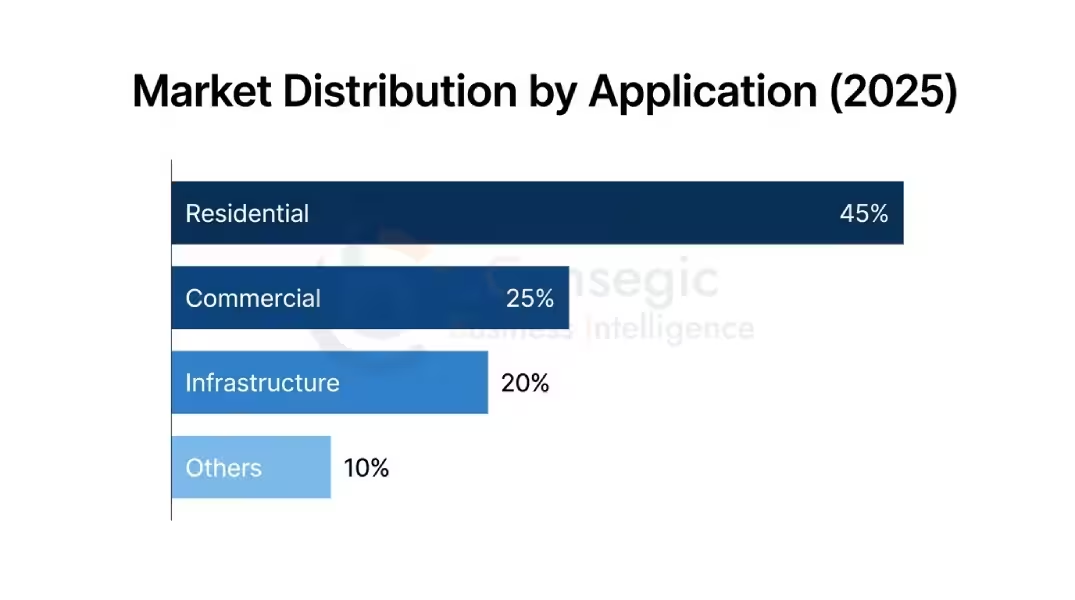
Residential construction USD 371 Million (45.0% of total market value) is a segment with single-family homes, multi-unit housing projects, affordable housing projects, and luxury custom construction speed, design flexibility, and cost optimization by using 3D printing. The case of successful projects shows that construction timelines are 1-3 days to structural shells versus 4-8 weeks to conventional construction, which generates strong value propositions to the developers to combat housing shortages.
Commercial and Industrial Buildings
Commercial uses amount to USD 206 Million (25.0% of market value) comprising office buildings, retail spaces, warehouses and special purpose facilities where quick construction, unique designs, or an operation in an area where typical construction is difficult or impossible.
Infrastructure Components
The Infrastructure applications are USD 165 Million (20.0% of market value) consisting of pedestrian bridges, retaining walls, marine structures, noise barriers, urban furniture, and utility structures where the complex geometries, customization, or quick deployment are beneficial compared to the traditional construction methods.
Other Applications
Other uses such as architectural use, disaster relief, military base and research facilities, among others, are collectively USD 83 Million (10.0% of market value), which are specialized uses and future opportunities.
Regional Market Analysis
Europe: Research Excellence and Technology Leadership.
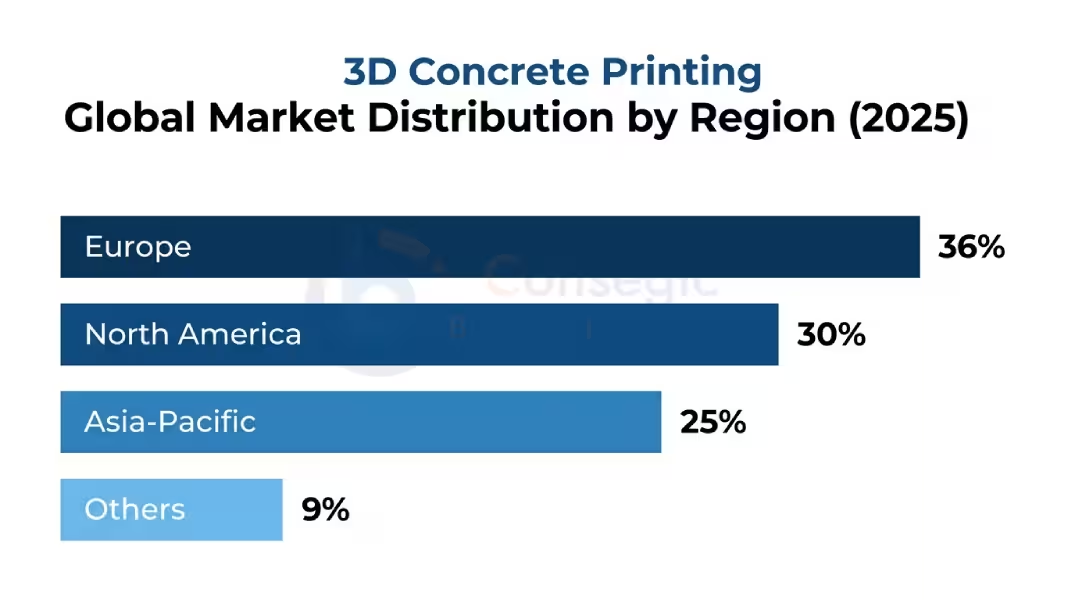
The European market of concrete printing in 3D commands USD 297 Million in 2025, which is 36.0% of the world market value and it is also projected to grow to USD 1,530 Million in 2035 with a growth rate of 18.5% CAGR. The Netherlands, Germany and Denmark are the top three to cover the 65 per cent of the regional market value due to high-quality research institutes, progressive building codes, and sustainability requirements and governmental support of construction innovation.
Europe is technologically ahead in institutions such as Eindhoven University of Technology pioneering concrete bridge and housing projects, ETH Zurich DFAB House incorporating robotic construction technologies and commercial projects by COBOD, CyBe Construction, XtreeE and PERI demonstrating the advancement of technology development and market uptake.
North America: Business Implementation and Euclipsis.
In 2025, the North American 3D concrete printing market will have a market value of USD 248 Million which is 30.0 percent of the global market value and is projected to increase to USD 1,275 Million in 2035 at a 18.5 percent CAGR. United States controls the regional demand at 90.0 of the market value, which is caused by the problem of housing affordability, labour shortage in the construction sector, extensive venture capital, and the effective commercialisation activities of major technology firms.
The market has been enjoying competitive commercialization practices such as ICON collaborating with major homebuilders, defense contracts, Mighty Buildings with factory-based production systems, and success of large scale residential developments with showcasing of technology maturity and market acceptance in various applications.
Asia-Pacific: New Adoption and Support by Governments.
The 3D A-P concrete printing market is valued at USD 206 Million in 2025, 25.0% of the global market value and has a strong growth opportunity of USD 1063 Million in 2035 at 18.8% CAGR, which is the highest growth rate in the area. China dominates 45.0 percent of regional market worth, with the government contribution made in Made in China 2025 program, Belt and Road infrastructure, and successful models such as multi story printed buildings by WinSun.
Singapore illustrates its leadership by having Singapore Centre for 3D Printing research excellence, Building and Construction Authority support of construction innovation and government targets of advanced construction technologies, whereas Australia, Japan and India are currently undertaking active research and pilot projects to investigate the application of technology in meeting housing demands and construction issues.
Other Regions
Other markets such as Latin America, Middle East and Africa combine USD 74 Million (9.0% of world market) in applications directed to affordable housing, disaster relief, and infrastructure development with technology benefits that are already especially compelling, despite the absence of infrastructure and technical expertise.
Competitive Landscape and Key Market Players
Strategic Positioning and Market Leadership.
COBOD International A/S (Denmark) - Leader Gantry System.
COBOD remains a leader in the large-scale gantry printing market worldwide with an estimated revenue of USD 65-75 Million in 2024, approximately 18-20% market share in the global market by its BOD2 modular gantry system with scalable build volumes and successful deployment in residential, commercial and infrastructure projects. The company has a competitive edge in the form of modular system design and thus efficient transport and assembly, full-fledged technical support programs, long-term successful track record on over 60 system deployments around the world, and strategic alliance with Holcim, CEMEX, and PERI as an integrated material and construction solution.
ICON Technology, Inc. (United States) - Construction Solutions.
ICON is the top integrated construction technology firm with an estimated 2024 revenues of USD 45-55 Million that provides Vulcan construction system, custom Lavacrete material formulations, far-reaching digital design solutions, and full-service construction solutions that support full 3D printed construction solutions. It has done several residential projects, military work and demonstration buildings as it tries to make bold applications such as NASA lunar construction systems and the massive affordable housing plans.
PERI Group (Germany) - Classic Construction Integration.
As the global formwork leader, PERI utilizes this status to adopt the 3D concrete printing features, with forecasted 3DCP-related revenues in 2024 hitting USD 25-35 Million via strategic alliances with COBOD and direct construction solutions. The company combines the construction knowledge of the past with the newest printing technologies and finishes the first multi-story 3D printed apartment tower in Europe and dozens of commercial projects.
Additional Key Market Participants:
- CyBe Construction B.V. (Netherlands)- Mobile robotic printing systems and proprietary materials
- XtreeE (France)- Large-scale robotic printing for architectural and infrastructure applications
- Apis Cor (United States)- Compact mobile printing systems for on-site construction
- WinSun (China)- Pioneer in large-scale building printing with government support
- Mighty Buildings (United States)- Factory-based prefabrication with Light Stone Material
- Sika AG (Switzerland)- Specialized material formulations and construction chemicals
Recent Industry Developments
The massive residential growth (2024-2025).
Large technology providers such as ICON and COBOD partners announced several mega 3D printed housing projects in United States, Europe, and Middle East market, with some of the projects having 50-400 homes of successful transition to demonstration projects in mainstream construction applications. These developments include streamlined designs, efficient permitting systems and low prices on traditional ways of construction.
Standardization and Development of Building Codes (2024-2025).
Organizations in the industry such as ASTM International Committee F42 on Additive Manufacturing Technologies and International Code Council (ICC) contributed to the creation of standardized testing procedures, material specifications, and quality assurance standards that could be used to achieve building code adoption and regulatory approval procedures. Various jurisdictions adopted the preliminary approval schemes on 3D printed structures to shorten approval procedures and compliance risks.
Advanced Breakthroughs on Material Formulation (2024-2025)
Top material suppliers such as Holcim, Sika and Heidelberg Materials introduced the next generation printable concrete designs with compressive strengths over 60 MPa, better durability properties, and increased sustainability with higher content of supplementary cementitious, as opposed to Portland cement by 40-50% without compromising printability and structural performance.
Military and Infrastructure Contract Awards (2024-2025)
Government agencies such as U.S. Department of Defense, NATO programs of infrastructure development and municipal governments awarded a range of contracts above USD 50 Million together on 3D printed barracks, training facilities, bridges, and other infrastructure elements, showing institutional belief in technology maturity and cost-effectiveness in specialized applications.
3D Concrete Printing Market Report Insights
| Report Attributes | Report Details |
|---|---|
| Study Timeline | 2022-2035 |
| Base Year | 2025 |
| Forecast Period | 2026-2035 |
| Market Size in 2025 | USD 825 Million |
| Market Size in 2035 | USD 4,250 Million |
| CAGR (2026-2035) | 18.5% |
| By Construction Method | Gantry Systems (60.0%), Robotic Arms (30.0%), Mobile/Hybrid (10.0%) |
| By Application | Residential (45.0%), Commercial (25.0%), Infrastructure (20.0%), Others (10.0%) |
| By Offering | Services (45.0%), Equipment (35.0%), Materials (15.0%), Software (5.0%) |
| By Region | Asia-Pacific, Europe, North America, Latin America, Middle East & Africa |
| Key Players | COBOD, ICON, PERI Group, CyBe Construction, XtreeE, Apis Cor, WinSun, Mighty Buildings, Sika |
| Report Coverage |
|
Key Questions Answered in the Report
What is the size of the 3D Concrete Printing market? −
The global market in 3D concrete printing shows outstanding growth opportunities with a valuation of USD 825 Million in 2025 and an expected growth of USD 4,250 Million in 2035 at 18.5 CAGR, indicating an impressive market growth rate of 96,000 new affordable housing units per day through 2030, labor shortages in the construction sector affecting 80% of firms around the world and creating demand of 500,000-650,000 more workers.
What is the most developing area in the 3D Concrete Printing market? +
This is shown by the highest regional growth rate of 18.8 percent CAGR in Asia-Pacific due to the governmental support on Made in China 2025 initiative and successful large scale demonstration in China, governmental support on research excellence and Building and Construction Authority of Singapore, rapid urbanization that generates significant housing and infrastructure demand, and government programs that promote advanced building technologies. Europe, however, has market leadership with 36.0 market share with technology leadership by having prime research institutions, advanced building codes to facilitate innovation, sustainability requirements creating favorable regulatory environment and commercial deployments by the best European companies such as COBOD, PERI, CyBe Construction, and XtreeE with technical maturity and market acceptance.
What are the main benefits of 3D concrete printing as compared to traditional construction? +
Its main benefits are rapid construction with times ranging between 24-72 hours to build simple residential structures compared to 4-6 months to traditionally erect the same structure, material savings of up to 50-70 percent of waste compared to 30-35 percent of waste in conventional construction, labor savings of up to 20-30 percent through topology optimization, labor savings of up to 40-60 percent through labor optimization which addresses the extreme shortages of workers in hazardous zones and construction, design freedom allowing complex geometries previously inaccessible with traditional construction.
What are the major technical and regulatory constraints to large-scale adoption? +
The major issues are regulatory frameworks that lack integrated building codes that specifically cover 3D printed structures that require 12-36 months approval procedures and extensive case-by-case documentation, difficulties integrating reinforcement where conventional rebar is in conflict with continuous printing which needs alternative solutions like post-installed reinforcement or topology optimization, size of print which are currently limited to 10m x 10m x 3m limits larger structures application, and costs of materials where 20-60% premiums of conventional concrete are undertaken due to specialized rheological modifiers and quality control.
What new applications and market opportunities are possible by 2035? +
The opportunities are substantial in terms of multi-material printing systems with structural concrete, insulation, utilities, and finishes, and no post-processing, infrastructure uses such as bridges, retaining walls, marine structures, and wind turbine foundations and complex geometries and topology optimization, disaster relief with rapid deployment shelters within 24-48 hours after a natural disaster, military infrastructure with rapid base construction and tactical facilities in remote environments, affordable housing development with a proven track record of 50-400 homes, extraterrestrial construction with NASA and space agencies investing in lunar.
Overview
Reputation & Certifications


Our Services
- Market Intelligence & Forecasting
- Custom Research Solutions
- Market Entry Strategy
- Competitive Intelligence
- Customer Insights
- Industry Innovation Analysis
- Investment Advisory