Jump to Content
Actuators Market - Size, Share, Industry Trends, and Forecasts (2025-2032)
Actuators Market Size:
Actuators Market size is estimated to reach over USD 136.10 billion by 2032 from a value of USD 72.45 billion in 2024 and is projected to grow by USD 77.10 billion in 2025, growing at a CAGR of 8.2% from 2025 to 2032.
Actuators Market Scope & Overview:
Actuators are mechanical devices designed to convert energy into motion, enabling the control or movement of systems, components, or mechanisms. These devices operate using hydraulic, pneumatic, electric, or mechanical energy sources, ensuring efficient performance in various environments.
Actuators are characterized by their precision, durability, and adaptability, offering reliable and consistent operation. They feature compact designs, high load-handling capacities, and low maintenance requirements, making them essential in automation and control systems. They enhance operational safety, reduce manual intervention, and improve the accuracy and efficiency of processes.
Applications of actuators span diverse sectors, including robotics, industrial automation, aerospace, automotive systems, and medical devices. They play a critical role in tasks such as positioning, clamping, controlling valves, and regulating flow or pressure. These devices are integral in processes requiring precise motion control and dynamic responses.
End-use industries benefiting from actuators include manufacturing, transportation, energy, healthcare, construction, and mining. They contribute to streamlined operations, optimized productivity, and advanced technology integration in these sectors. The adoption of actuators is driven by the need for automated systems to improve efficiency, safety, and reliability across various industrial and commercial applications.
How is AI Transforming the Actuators Market?
AI is significantly impacting the actuators market by enhancing performance, enabling predictive maintenance, and driving automation. AI-powered systems optimize actuator performance, improve reliability, and reduce downtime through predictive maintenance and real-time adjustments based on data analysis. This leads to increased efficiency, reduced costs, and greater adaptability in various applications such as automotive, aerospace, and robotics. Also, AI integration in manufacturing processes enhances precision, speed, and efficiency, driving the demand for automation solutions.

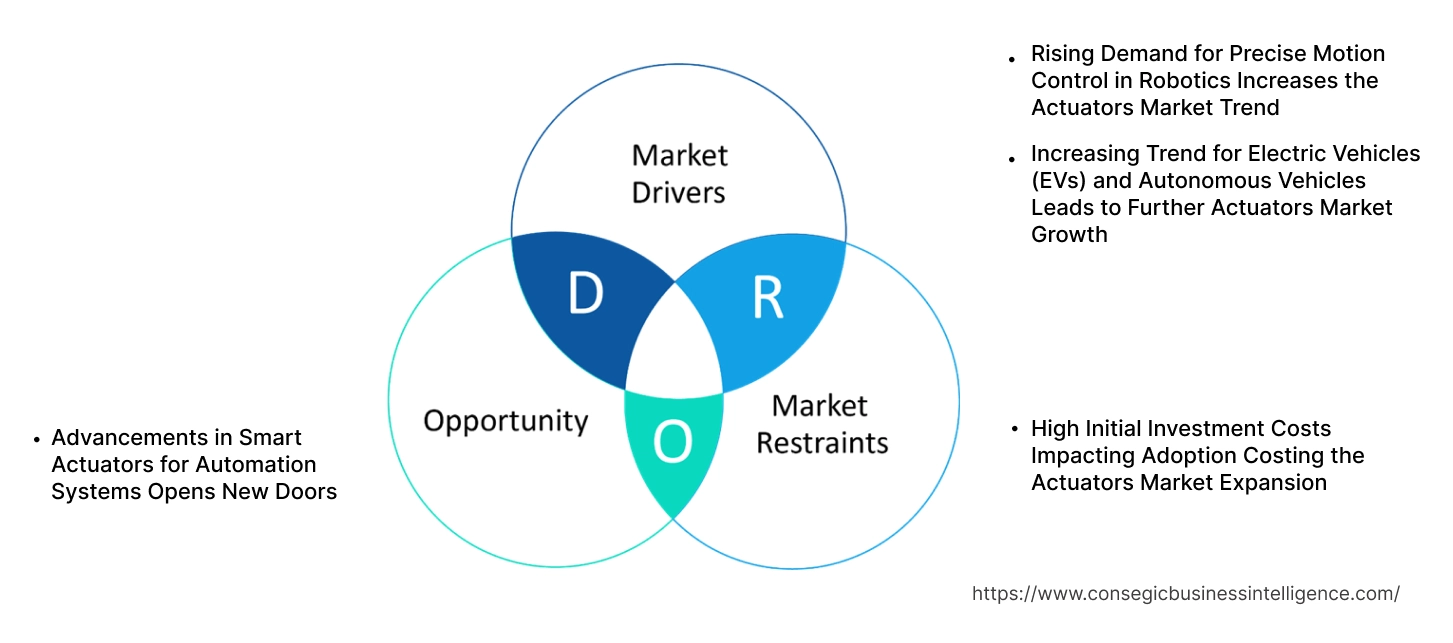
Actuators Market Dynamics - (DRO) :
Key Drivers:
Rising Demand for Precise Motion Control in Robotics Increases the Actuators Market Trend
The robotics industry relies heavily on actuators for precise movement control, especially in industrial robots used in assembly lines. Actuators provide the necessary force to position robotic arms and components accurately, ensuring high efficiency in manufacturing processes. Robotics applications require actuators with high reliability and precision, as these robots handle tasks like welding, packaging, and product assembly. For example, actuators in robotic arms are critical for performing intricate tasks, such as assembling small components or carrying out delicate welding processes. As the robotics sector continues to expand, especially in industries like automotive, electronics, and consumer goods, the trend for actuators is expected to rise. Robotics in warehouses and distribution centers is also experiencing significant growth, where actuators are used to automate material handling and sorting systems. The need for more advanced, reliable, and efficient motion control in robotics contributes significantly to the trending Actuators Market demand, thus boosting market.
Increasing Trend for Electric Vehicles (EVs) and Autonomous Vehicles Leads to Further Actuators Market Growth
Actuators are integral to the operation of electric vehicles (EVs) and autonomous vehicles. In EVs, actuators control various systems, such as electric power steering, brakes, and climate control, which require precise and reliable operation. In autonomous vehicles, actuators are essential for systems like automated driving, navigation, and sensing technologies. As the automotive industry transitions toward EVs and automated driving systems, the demand for high-performance actuators increases. These actuators allow for the smooth operation of vehicles, ensuring safety and reliability in crucial systems. The growing push for sustainable and autonomous transportation is accelerating the demand for actuators, providing a strong Actuators Market growth opportunity in the automotive sector.
Key Restraints:
High Initial Investment Costs Impacting Adoption Costing the Actuators Market Expansion
One of the key restraints in the actuators market is the high initial investment required for high-performance actuators. These actuators, especially those designed for heavy-duty applications in industries like aerospace, manufacturing, and defense, can be expensive. Additionally, the cost of integrating actuators into existing systems often involves further expenditures for customization, installation, and maintenance. Many companies, especially smaller enterprises, may find these costs prohibitive, hindering the expansion of advanced actuators. While the long-term benefits of actuators, such as increased efficiency and reduced manual labor, may outweigh the initial costs, the upfront financial burden remains a significant barrier for businesses with limited budgets. The high capital expenditure required for deploying actuators is a critical restraint limiting widespread market adoption, especially in emerging markets.
Future Opportunities :
Advancements in Smart Actuators for Automation Systems Opens New Doors
Advancements in smart actuators present a significant Actuators Market opportunity in the near future. Smart actuators, which are equipped with sensors, IoT connectivity, and advanced control systems, provide real-time data and enhanced functionality in automation systems. These actuators allow for more precise monitoring, fault detection, and remote control, significantly improving system efficiency and reducing downtime. Industries such as automotive, manufacturing, and healthcare are increasingly adopting smart actuators to enhance automation processes. For example, in automated assembly lines, smart actuators enable seamless coordination between different machines, improving production speed and accuracy. Furthermore, smart actuators are being integrated into robotics, smart homes, and industrial equipment to enhance their performance. The development of smart actuators will likely open new opportunities in automation across various sectors, offering improved flexibility, performance, and system integration. Therefore, advancements in smart actuators are poised to significantly expand market prospects in the coming years.
Actuators Market Segmental Analysis :
By Type:
Based on type, the actuators market is segmented into Electric actuators (AC Electric Actuators, DC Electric Actuators, Linear Electric Actuators, and Rotary Electric Actuators), Pneumatic actuators (Single-Acting Pneumatic actuators, Double-acting Pneumatic actuators, Pneumatic Linear actuators, and Pneumatic Rotary actuators), Hydraulic actuators (Linear Hydraulic Actuators and Rotary Hydraulic Actuators), Mechanical (Screw Actuators and Gear Actuators), and Smart actuators (Piezoelectric Actuators and Magnetic Actuators)
The electric actuators segment accounted for the largest revenue inActuators Market share in 2024.
- Electric actuators are widely adopted across various industries due to their ability to provide precise, reliable, and energy-efficient control.
- Electric actuators convert electrical energy into mechanical motion and are often used in applications requiring accurate positioning, high force, and minimal maintenance.
- AC electric actuators are typically employed in applications requiring high power, while DC actuators are preferred for applications requiring lower power and more precise control, such as in robotics and medical devices.
- The increasing trend for automation in industries like automotive, manufacturing, and robotics is driving the adoption of electric actuators.
- Furthermore, their ability to be integrated with smart control systems and their versatility in various environments contribute to their dominance in the market.
- Therefore, according to Actuators market analysis, the electric actuators segment continues to dominate the market due to technological advancements, growing automation trends, and the need for precise control in various industrial applications.
The smart actuators segmentis anticipated to register the fastest CAGR during the forecast period.
- Smart actuators include piezoelectric and magnetic actuators, which are gaining traction due to their ability to respond dynamically to varying conditions and their ability to offer enhanced performance in specialized applications.
- These actuators are embedded with sensors and control systems that provide real-time feedback, allowing them to adjust their output automatically based on external stimuli.
- They are highly sought after in industries such as robotics, aerospace, medical devices, and precision manufacturing, where the need for flexibility, efficiency, and adaptability is paramount.
- The integration of Internet of Things (IoT) and Artificial Intelligence (AI) technologies into these actuators is expected to significantly boost their demand, leading to their rapid growth.
- Thus, according to market analysis, the smart actuators segment is anticipated to experience the highest growth rate, driven by increasing automation in advanced technology sectors and the need for more intelligent and adaptable systems.
By Sales Channel:
Based on sales channels, the actuators market is segmented into original equipment manufacturers (OEMs) and aftermarket sales.
The OEMs accounted for the largest revenue share in 2024.
- OEMs play a significant role in the actuators market by providing these components as integral parts of various machinery and systems, including industrial equipment, robotics, automotive components, and aerospace systems.
- Actuators are supplied to manufacturers during the production of new equipment, ensuring that these systems function efficiently from the outset.
- The OEM segment is driven by the growing trend of advanced automation systems and high-performance machinery across sectors such as manufacturing, aerospace, and automotive.
- Actuators sourced through OEMs are designed to meet specific operational requirements, providing long-term reliability and performance.
- Therefore, according to market analysis, the OEM segment holds the largest market share, supported by the increasing demand for advanced actuator solutions in new manufacturing systems and equipment.
The aftermarket sales channelis anticipated to register the fastest CAGR during the forecast period.
- Aftermarket sales refer to the replacement, retrofitting, and upgrade of actuators in existing systems and equipment.
- This segment is growing rapidly due to the need for maintenance, system updates, and performance enhancements in industries where older equipment is still in operation.
- The demand for aftermarket actuators is also fueled by the need for spare parts, particularly in critical sectors such as oil & gas, power generation, and manufacturing.
- Companies are investing in upgrading their existing equipment with more efficient and technologically advanced actuators to improve system reliability, reduce downtime, and optimize performance.
- Thus, according to Actuators market analysis, the aftermarket segment is witnessing the fastest growth, driven by increased investment in system upgrades, maintenance, and the demand for efficient replacement actuators in older equipment.
By End-User Industry:
Based on the end-user industry, the actuators market is segmented into manufacturing, oil & gas, food & beverage, pharmaceuticals, automotive, aerospace, chemical processing, power generation, water treatment, mining, and others.
The manufacturing sector accounted for the largest revenue share by 29.75% in 2023.
- Actuators are essential components in manufacturing operations, particularly in automated systems used for assembly lines, robotic arms, material handling, and more.
- The increasing adoption of industrial automation has been a major driver for the actuators market, as these components are integral to improving the speed, precision, and efficiency of manufacturing processes.
- Industries like automotive, electronics, and consumer goods manufacturing require actuators for tasks like part assembly, material movement, packaging, and quality control.
- Furthermore, the growing trend for Industry 4.0 solutions, which combine automation, IoT, and data analytics, is pushing the demand for high-performance actuators that can integrate seamlessly into smart manufacturing systems.
- Therefore, according to market analysis, the manufacturing sector remains the largest contributor to the actuators market, driven by the continuing shift towards automation and smart manufacturing solutions.
The oil & gas sectoris anticipated to register the fastest CAGR during the forecast period.
- The oil & gas industry relies heavily on actuators for critical functions such as controlling valves, pumps, and safety systems, especially in exploration, extraction, refining, and transportation operations.
- Actuators in this sector must withstand extreme environmental conditions, such as high pressure, temperature fluctuations, and corrosive materials, which makes their reliability and durability crucial.
- The increasing focus on automation to enhance safety, efficiency, and reduce operational costs is driving the demand for actuators.
- Moreover, as oil and gas companies invest in digital technologies and automation for their operations, the market for actuators in this industry is expected to grow at a significant rate.
- Thus, according to market analysis, the oil & gas industry is expected to experience the highest growth due to its increasing reliance on automation to improve operational safety and reduce costs in challenging environments.

Regional Analysis:

In 2024, North America was valued at USD 24.03 Billion and is expected to reach USD 44.11 Billion in 2032. In North America, the U.S. accounted for the highest share of 71.75% during the base year of 2024. North America holds a significant share in the actuators market due to advanced industrial automation and a strong presence of key players. The demand for actuators in sectors like aerospace, automotive, and robotics fuels market performance. The U.S. and Canada focus on technological innovations, boosting the adoption of electric and smart actuators.

In Asia Pacific, the market is experiencing the fastest growth with a CAGR of 8.7% over the forecast period. Asia-Pacific is experiencing notable market expansion, led by increasing industrialization and infrastructure development in countries like China, Japan, and India. The rise in manufacturing activities, especially in automotive, consumer electronics, and robotics, intensifies the demand for actuators. Government support for smart manufacturing and automation further enhances market prospects.
Europe maintains a strong market presence with substantial demand from automotive, industrial automation, and renewable energy sectors. Countries like Germany, France, and the UK invest in innovative actuator technologies, particularly for electric vehicles and renewable energy systems. Strict environmental regulations and a focus on sustainability encourage the adoption of energy-efficient actuators.
The Middle East and Africa show growing interest in actuators, primarily driven by the oil and gas industry and increasing investments in infrastructure. Countries like Saudi Arabia and the UAE focus on expanding industrial automation in sectors like construction and energy. Limited industrial diversification and the reliance on oil and gas remain challenges for broader market adoption.
Latin America is witnessing steady growth in the actuators market, driven by manufacturing advancements and infrastructure projects in Brazil and Mexico. The automotive and industrial sectors demand more automation solutions. However, economic instability and uneven infrastructure development hinder the region’s full market potential.
Top Key Players & Market Share Insights:
The Global Actuators Market is highly competitive with major players providing FWA to the national and international markets. Key players are adopting several strategies in research and development (R&D), product innovation, and end-user launches to hold a strong position in the Global Actuators Market. Key players in the Actuators Market industry include-
- Siemens AG (Germany)
- Schneider Electric SE (France)
- Parker Hannifin Corporation (United States)
- Honeywell International Inc. (United States)
- Rotork Plc (United Kingdom)
- Emerson Electric Co. (United States)
- Moog Inc. (United States)
- Bosch Rexroth AG (Germany)
- SMC Corporation (Japan)
- Festo AG & Co. KG (Germany)
Recent Industry Developments :
Product Launches:
- In January, 2024, the Fisher easy-Drive 200R rotary actuator was launched. It is designed for throttling or on/off control with Modbus RTU, 4-20 mA, or dry contact signals. It features simple one-button calibration via the Fisher configurator and offers linear and rotary options with accessories like the RPU-100 backup.
Mergers and Acquisitions:
- In April 2023, Timken completed its acquisition of Italy-based Nadella Group, enhancing its industrial motion portfolio. Nadella, with €100 billion revenue in 2022, specializes in linear guides, actuators, and systems.
Actuators Market Report Insights:
| Report Attributes | Report Details |
| Study Timeline | 2019-2032 |
| Market Size in 2032 | USD 136.10 Billion |
| CAGR (2025-2032) | 8.2% |
| By Type |
|
| By Sales Channel |
|
| By End-User Industry |
|
| By Region |
|
| Key Players |
|
| North America | U.S. Canada Mexico |
| Europe | U.K. Germany France Spain Italy Russia Benelux Rest of Europe |
| APAC | China South Korea Japan India Australia ASEAN Rest of Asia-Pacific |
| Middle East and Africa | GCC Turkey South Africa Rest of MEA |
| LATAM | Brazil Argentina Chile Rest of LATAM |
| Report Coverage |
|
Key Questions Answered in the Report
How big is the Actuators Market? −
In 2024, the Actuators Market was USD 72.45 billion.
What will be the potential market valuation for the Actuators Market by 2032? +
In 2032, the market size of Actuators Market is expected to reach USD 136.10 billion.
What are the segments covered in the Actuators Market report? +
The Type, Sales Channel, and end-user industry are the segments covered in this report.
Who are the major players in the Actuators Market? +
Siemens AG (Germany), Schneider Electric SE (France), Parker Hannifin Corporation (United States), Honeywell International Inc. (United States), Emerson Electric Co. (United States), Moog Inc. (United States), Bosch Rexroth AG (Germany), SMC Corporation (Japan), Festo AG & Co. KG (Germany), Rotork Plc (United Kingdom) are the major players in the Actuators market.
Overview
Reputation & Certifications


Our Services
- Market Intelligence & Forecasting
- Custom Research Solutions
- Market Entry Strategy
- Competitive Intelligence
- Customer Insights
- Industry Innovation Analysis
- Investment Advisory