Jump to Content
Advanced Glass Market - Size, Share, Industry Trends, and Forecasts (2025-2032)
Advanced Glass Market Size:
Advanced Glass Market size is growing with a CAGR of 6.1% during the forecast period (2025-2032), and the market is projected to be valued at USD 118,300.75 Million by 2032 from USD 74,205.31 Million in 2024.
Advanced Glass Market Scope & Overview:
Advanced glass encompasses a diverse range of high-performance glass that surpasses the capabilities of traditional glass. These specialized glasses are prepared through advanced techniques and incorporate advanced materials. They exhibit enhanced properties tailored to specific applications such as scratch resistance, and dust resistance among others. Key product categories include tempered glass, known for its exceptional strength and durability, laminated glass, offering superior impact resistance and safety, and insulating glass, designed to optimize energy efficiency through reduced heat transfer.
These advanced materials find applications across a wide range of industries, including construction, automotive, electronics, aerospace & defense, and healthcare amongst others. In the construction sector, this type of glass contributes to the production of aesthetically pleasing and energy-efficient structures. The automotive sector utilizes this glass for windshields and windows that offer enhanced safety and visibility. The electronics sector leverages this glass for touchscreens and display devices, while the aerospace and defense sectors utilize it for specialized applications such as aircraft canopies and protective shields. Furthermore, the healthcare sector employs this glass in medical devices and equipment, benefiting from its precision and durability.
How is AI Impacting the Advanced Glass Market?
AI is significantly impacting the advanced glass market by improving production processes, enabling smart glass features, and enhancing predictive maintenance. AI-powered automation optimizes production schedules, reduces defects, and streamlines operations, while also enabling smart glass to respond to environmental changes for energy efficiency and user comfort. Additionally, AI facilitates predictive maintenance, minimizing downtime in manufacturing plants. Also, AI algorithms enable smart glass to dynamically adjust its tint, transparency, or color based on factors such as sunlight intensity, occupancy, or temperature.

Advanced Glass Market Dynamics - (DRO) :
Key Drivers:
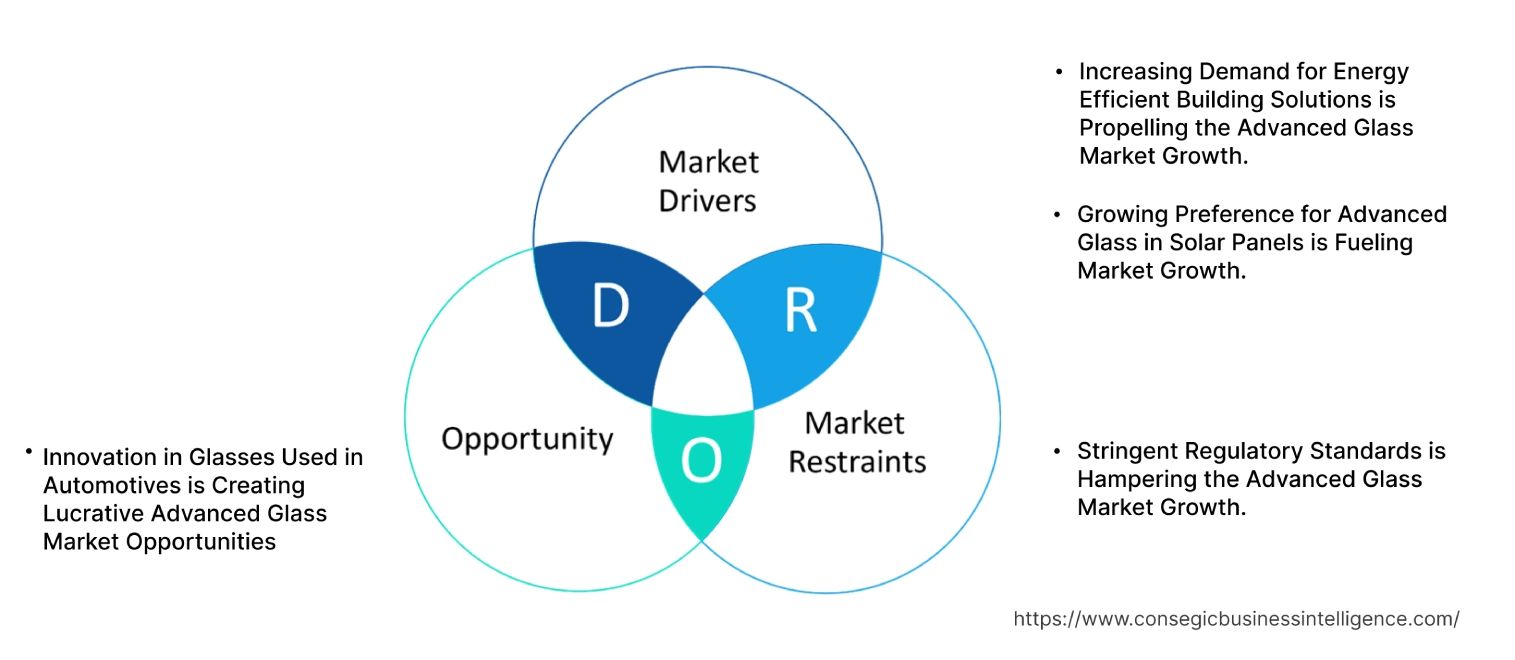
Increasing Demand for Energy Efficient Building Solutions is Propelling the Advanced Glass Market Growth.
The escalating demand for energy-efficient solutions is a primary driver propelling the growth of the market. As global concerns about climate change and energy consumption intensify, advanced glass, with its ability to optimize energy efficiency, has emerged as a crucial component in sustainable building design and construction. These innovative glass products, such as low-emissivity (low-E) glass and solar control glass, offer superior thermal performance, reducing heat gain in summer and heat loss in winter. This leads to significant energy savings, lower carbon emissions, and reduced operational costs for buildings. Various manufacturers are introducing novel glass solutions that offer lower carbon emissions further leading to energy efficiency.
- For instance, in September 2022, Saint-Gobain Glass introduced ORAÉ, which is a low-carbon glass aimed at reducing the environmental impact of the construction sector. By significantly lowering carbon emissions during the manufacturing process, ORAÉ offers a more sustainable and environmentally friendly option for architects and builders.
Additionally, the integration of this glass into architectural design enhances aesthetic appeal and occupant comfort, further driving advanced glass market demand.
Growing Preference for Advanced Glass in Solar Panels is Fueling Market Growth.
The growing preference for advanced glass in solar panels is a major driver of market growth. Advanced glass technologies, such as anti-reflective coatings and textured glass surfaces, significantly enhance solar cell efficiency by maximizing light absorption. Additionally, these specialized glasses improve the durability, weather resistance, and overall performance of solar panels. Manufacturers are utilizing this glass to enhance the efficiency of the solar panels.
- For instance, in September 2021, Goldi Solar launched its new HELOC̣ Pro module series, featuring advanced M10 technology. These high-efficiency, low-carbon modules are available in three variants, mainly white, transparent, and glass-to-glass, all housed in a premium silver frame. The half-cell structure, multi-busbar technology, and advanced glass and cell surface design contribute to higher conversion efficiency, lower resistance, and excellent low-light performance.
As the requirement for energy sources is rising, the adoption of advanced glass solutions is escalating, fueling advanced glass market expansion and contributing to a more sustainable future.
Key Restraints :
Stringent Regulatory Standards is Hampering the Advanced Glass Market Growth.
Stringent regulatory standards pose a significant hurdle to the growth of the advanced glass market. The complex and evolving regulatory landscape, particularly in sectors like automotive and construction, requires manufacturers to comply with rigorous safety, performance, and environmental standards. These rigorous regulatory processes, designed to ensure product safety and performance, mainly involve extensive testing, documentation, and third-party verification.
The time-consuming nature of these procedures delays product launches and increases costs for manufacturers. Moreover, the complexity of regulatory requirements varies across different regions and applications, further complicating the process. As a result, the adoption of advanced glass technologies, particularly innovative and novel products, complies with various regulations, thus hindering overall market growth.
Future Opportunities :
Innovation in Glasses Used in Automotives is Creating Lucrative Advanced Glass Market Opportunities
The automotive sector's increasing emphasis on safety, aesthetics, and energy efficiency is driving significant requirements for advanced solutions in the coming years. Innovative advancements in glass manufacturing have led to the development of cutting-edge glass products that offer enhanced performance and functionality. For example, laminated glass, with its multiple layers, provides superior impact resistance and safety. Additionally, advanced glass improves thermal insulation, reduces glare, and enhances visibility. Moreover, innovations in high-performance cover glass incorporate specialized technologies and materials to enhance its performance and functionality beyond traditional glass in automotive. As automotive manufacturers strive to incorporate novel technologies into their vehicles, the requirement for this type of glass is projected to surge substantially.
- For instance, in April 2024, AGC, a manufacturer of glass, developed advanced high-performance cover glass specifically designed for in-car displays. This specialized glass offers superior durability, optical clarity, and touch sensitivity, enhancing the user experience and safety of in-vehicle infotainment systems. By incorporating innovative technologies and materials, AGC's cover glass contributes to the automotive sector's drive towards advanced, user-centric, and visually appealing vehicle interiors.
Thus, the innovation in glasses is expected to create lucrative advanced glass market opportunities for manufacturers in this market.
Advanced Glass Market Segmental Analysis :
By Product Type:
Based on product type, the market is categorized into tempered glass, laminated glass, insulating glass, and others.
Trends in the Product Type:
- The trends for insulated glass to offer sustainability are influencing the segment.
- There is a growing demand for laminated glass as it consists of multiple layers of glass bonded together with a polymer interlayer, providing increased strength and safety.
The tempered glass segment accounted for the largest market share in 2024.
- Tempered glass is a type of safety glass that has been treated to increase its strength and durability.
- This process involves heating the glass to a high temperature and then rapidly cooling it, resulting in compressive stresses on the surface and tensile stresses in the interior.
- This unique stress distribution makes tempered glass significantly stronger than regular glass of the same thickness.
- This makes it ideal for applications where safety is a primary concern, such as automotive windshields, shower doors, and smartphone screens.
- These glasses provide advanced properties such as anti-scratch and anti-dust, which are beneficial for various applications.
- Manufacturers are introducing novel tempered glass solutions that offer enhanced properties and are beneficial for various applications.
- For instance, in July 2023, SOROO introduced its new THOR series. This innovative range of tempered glass products is designed to offer superior strength, durability, and safety. The THOR series utilizes advanced tempering techniques to enhance the glass's resistance to impact, making it suitable for smartphone screens.
- Thus, as per the market analysis, the use of tempered glass in various applications is influencing the advanced glass market trends.
The insulating glass segment is expected to grow at the fastest CAGR over the forecast period.
- Insulating glass, also known as double-pane or triple-pane glass, is a type of advanced glass designed to improve energy efficiency.
- It consists of two or more panes of glass separated by a space filled with a gas or vacuum. This gas or vacuum-filled space acts as an excellent insulator, reducing heat transfer between the interior and exterior environments.
- By minimizing heat loss in winter and heat gain in summer, insulating glass helps to maintain comfortable indoor temperatures while reducing energy consumption.
- This technology is widely used in residential and commercial buildings to improve energy efficiency, reduce heating and cooling costs, and enhance overall comfort.
- Thus, the advancements in insulating glasses are driving the advanced glass market expansion in the coming years.
By Application:
Based on applications, the market is categorized into aesthetically pleasing structures, windshields and windows, solar panels, touchscreens, medical devices, and others
Trends in Application:
- The increasing focus on aesthetically pleasing is propelling the segment.
- The rising trend of touchscreen smartphones is propelling the segment.
The windshield and windows segment accounted for the largest market share in the year 2024.
- Advanced glass has enhanced the automotive sector, particularly for windshields and windows. Laminated glass, a prominent example, consists of multiple layers of glass bonded together.
- This design significantly enhances safety by preventing the glass from shattering into dangerous shards upon impact, minimizing the risk of injury to occupants.
- Additionally, glass improves thermal insulation, reduces glare, and enhances visibility, contributing to a more comfortable and safer driving experience.
- These glass technology advancements have improved vehicle aesthetics and significantly enhanced overall vehicle safety and performance.
- Thus, based on the market analysis, these advancements enhance vehicle aesthetics and play a crucial role in improving overall vehicle safety and performance, thus driving the advanced glass market trends.
The medical devices segment is expected to grow at the fastest CAGR over the forecast period.
- Advanced glasses have developed the medical device sector, offering a range of benefits for patient care and surgical procedures.
- These specialized glasses are engineered with unique properties and used in various applications.
- For example, biocompatible glasses are used in implantable medical devices like bone and dental implants, promoting tissue integration and long-term stability.
- Optical glasses are employed in precision instruments like microscopes and endoscopes, enabling detailed visualization and minimally invasive procedures.
- Additionally, advanced glass fibers are utilized in fiber optic endoscopes, providing flexibility and high-resolution imaging.
- By leveraging the versatility and performance of advanced glasses, medical device manufacturers are developing innovative solutions that improve patient outcomes and enhance the quality of healthcare.
- For instance, in 2024, Kitea Health introduced a miniaturized brain implant that relies on the advanced glass encapsulation technology provided by SCHOTT Primoceler Oy. This specialized biocompatible glass offers exceptional properties such as hermetic sealing, biocompatibility, and durability, enabling the creation of smaller, safer, and more effective implantable devices.
- Thus, the use of these glasses in medical devices is influencing the advanced glass market demand in the coming years.
By End-Use Industry:
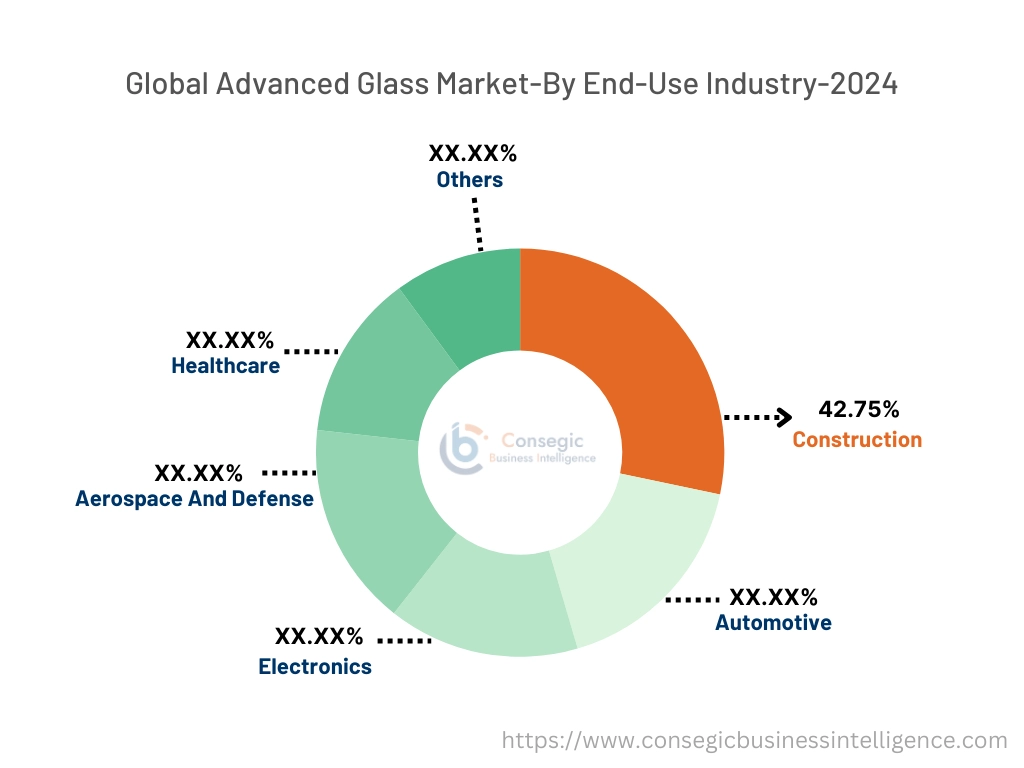
Based on end-use industry, the market is categorized into construction, automotive, electronics, aerospace and defense, healthcare, and others
Trends in the End-Use Industry:
- The trend for energy-efficient glass is fueling the segment.
- The growing demand for self-cleaning glass is influencing the segment.
The construction segment accounted for the largest advanced glass market share of 42.75% in the year 2024.
- Advanced glass has significantly transformed the construction sector, offering a range of benefits.
- Laminated glass, a prominent example, enhances building safety by preventing glass failures and reducing injury risks.
- Additionally, energy-efficient glass minimizes heat loss and gain, optimizing energy consumption and reducing carbon footprints.
- Smart glass, another innovation, dynamically adjusts its transparency to regulate light and heat transmission, enhancing comfort and energy efficiency.
- Moreover, self-cleaning glass reduces maintenance costs and improves the aesthetic appeal of buildings.
- These advanced glass solutions not only elevate building aesthetics but also contribute to sustainable and energy-efficient construction practices.
- Various manufacturers offer novel solutions catering to the sustainability requirements of the construction sector.
- For instance, in 2023, Saint-Gobain India took a significant step towards a sustainable future by launching the first production of a new, low-carbon glass. This innovative product, engineered to reduce the carbon footprint by approximately 40%, addresses the urgent need for eco-friendly building materials in India.
- Thus, as per the analysis, the rise in the use of these glasses for various building applications is driving the segment expansion.
The aerospace and defense segment is expected to grow at the fastest CAGR over the forecast period.
- Advanced glass plays a crucial role in the aerospace and defense sectors, providing essential components for aircraft, spacecraft, and military vehicles.
- High-strength glass is used in aircraft canopies and windshields, offering superior impact resistance and clarity.
- Optical glass is employed in advanced optical systems for imaging, targeting, and surveillance, enabling precise and reliable performance.
- Additionally, glass fibers are used in composite materials for lightweight and high-strength structures, enhancing the performance and efficiency of aerospace and defense vehicles.
- By leveraging the unique properties of advanced glass, these industries develop novel solutions for aerospace and defense applications.
- Thus, the aforementioned factors are influencing segment development in the coming years.
Regional Analysis:
The regional segment includes North America, Europe, Asia Pacific, the Middle East and Africa, and Latin America.
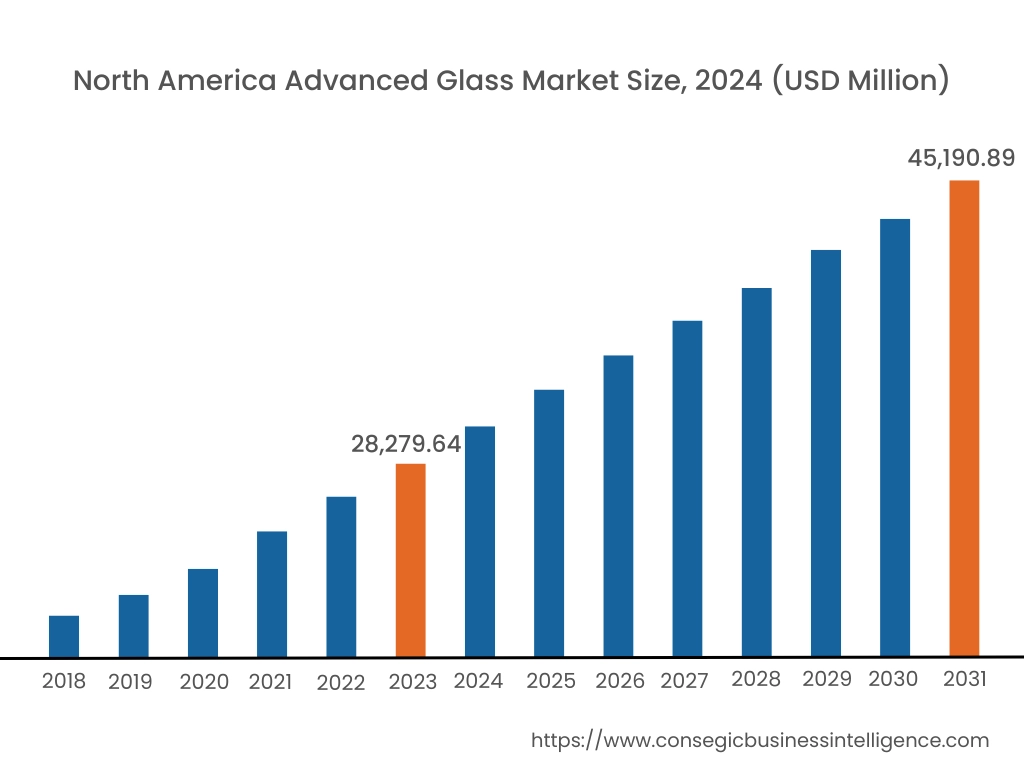
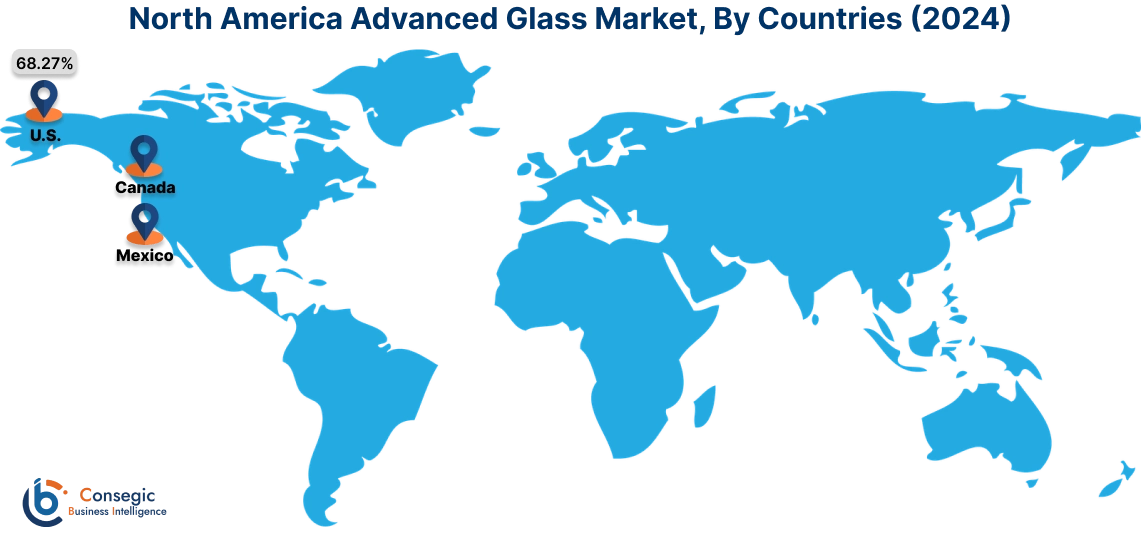
In 2024, North America accounted for the highest advanced glass market share at 38.11% and was valued at USD 28,279.64 Million and is expected to reach USD 45,190.89 Million in 2032. In North America, the U.S. accounted for the highest market share of 68.27% during the base year of 2024. As per the advanced glass market analysis, North America is a prominent player in the development and application of advanced glass technologies. This novel material enhances various sectors, from architecture and construction to automotive and electronics. In buildings, energy-efficient glass regulates heat gain and loss, reducing reliance on HVAC systems. In automotive, laminated glass enhances safety by preventing shattering upon impact. As manufacturers strive to produce safer, more comfortable, and environmentally friendly vehicles, the integration of advanced glass technologies is becoming increasingly essential. Additionally, the rise in the production of automobiles influences the use of advanced glasses.
- For instance, according to the data provided by TD Economics in April 2024, automotive production activity has grown significantly with 15.6 million vehicles produced in North America in 2023, a 9.6% gain relative to 2022. U.S. light vehicles sales in turn grew 12.7% in 2023. This analysis creates a higher requirement for advanced glasses in windows and windshields.
Additionally, touchscreens and displays made from advanced glass are ubiquitous in smartphones, tablets, and computers. These innovations demonstrate the versatility and transformative potential of advanced glass in shaping the future of North America.
The Asia-Pacific market for advanced glass is experiencing the fastest growth with a CAGR of 6.6% over the forecast period. The Asia-Pacific region is witnessing a surge in the adoption of advanced glass technologies. Countries like China, India, Japan, and South Korea are at the forefront of this trend. The construction sector is a major driver, with energy-efficient glass solutions being widely used in commercial and residential buildings to reduce energy consumption and improve indoor comfort. Additionally, the automotive sector is increasingly incorporating advanced glass into vehicles, enhancing safety, fuel efficiency, and aesthetic appeal. The electronics sector also benefits from advanced glass, as it finds applications in smartphones, tablets, and other devices. As per the market analysis, as the region continues to urbanize and industrialize, the requirement for advanced glass is expected to grow significantly, making it a key component of sustainable and technologically advanced societies.
Europe has been a pioneer in the adoption and innovation of advanced glass technologies. This versatile material enhances numerous industries across the region. In the construction sector, energy-efficient glass is widely used to optimize building performance, reducing energy consumption and carbon emissions. Additionally, soundproofing glass enhances comfort in residential and commercial spaces. The automotive sector leverages advanced glass for safety and aesthetics, with laminated windshields and side windows providing superior protection against impacts. Furthermore, the electronics sector relies on specialized glass for smartphone displays, tablets, and wearable devices, enabling sleek designs and improved functionality. Europe's commitment to sustainability and technological advancement drives the continuous development and integration of advanced glass solutions which is influencing various industries.
The Middle East and Africa are witnessing a surge in the adoption of advanced glass technologies. In the construction sector, energy-efficient glass is being widely used to regulate temperature and reduce energy consumption in buildings, especially in regions with extreme climatic conditions. Additionally, laminated glass is increasingly being used in commercial and residential buildings to enhance safety and security. Laminated windshields and side windows provide superior impact resistance, while solar control glass reduces heat buildup inside vehicles. Moreover, the growing popularity of smart cities and sustainable infrastructure projects is driving the requirement for advanced glass products, such as self-cleaning and electrochromic glass. Based on the advanced glass market analysis, as the region continues to develop and modernize, the use of advanced glass technologies is poised to play a vital role in shaping its urban landscape and improving the quality of life for its inhabitants.
Latin America is utilizing advanced glass to enhance various sectors. They are being widely adopted to regulate temperature and reduce energy consumption in buildings, particularly in regions with extreme climates. Additionally, laminated glass is increasingly used in automotive and architectural applications to improve safety and security. The electronics sector in Latin America is also benefiting from advanced glass, with the growing demand for smartphones and other digital devices driving the need for durable and scratch-resistant glass screens. As the region continues to modernize and urbanize, the requirement for advanced glass solutions is expected to grow significantly, driving innovation and economic development.
Top Key Players and Market Share Insights:
The global advanced glass market is highly competitive with major players providing precise products to the national and international markets. Key players are adopting several strategies in research and development (R&D) and product innovation to hold a strong position in the global advanced glass industry. Key players in the Advanced Glass industry include-
- Saint-Gobain Glass (France)
- Asahi Glass Co. Ltd. (Japan)
- Advanced Glass & Mirror Inc. (U.S.)
- NSG Group (Japan)
- Murata Manufacturing Co. Ltd (Japan)
- Corning Inc. (U.S.)
- Guardian Industries (S.)
- Nippon Sheet Glass Co. Ltd. (Japan)
- American Precision Glass Corp. (U.S.)
Recent Industry Developments :
Fundings:
- In November 2024, SKC's US-based affiliate, Absolics, received a significant boost in its research and development efforts. The company has been awarded a USD 100 million grant from the US Department of Commerce. This substantial funding will be utilized to advance the development of advanced glass substrate technology.
Product Launch:
- In June 2024, Corning launched its new Gorilla Glass 7i, specifically designed to enhance the durability of mid-range smartphones. Its enhanced scratch resistance ensures that the device's display remains new, even with daily wear and tear
Advanced Glass Market Report Insights :
| Report Attributes | Report Details |
| Study Timeline | 2019-2032 |
| Market Size in 2032 | USD 118,300.75 Million |
| CAGR (2025-2032) | 6.1% |
| By Product Type |
|
| By Application |
|
| By End-Use Industry |
|
| By Region |
|
| Key Players |
|
| North America | U.S. Canada Mexico |
| Europe | U.K. Germany France Spain Italy Russia Benelux Rest of Europe |
| APAC | China South Korea Japan India Australia ASEAN Rest of Asia-Pacific |
| Middle East and Africa | GCC Turkey South Africa Rest of MEA |
| LATAM | Brazil Argentina Chile Rest of LATAM |
| Report Coverage |
|
Key Questions Answered in the Report
How big is the Advanced Glass market? −
In 2024, the Advanced Glass market is USD 74,205.31 Million.
Which is the fastest-growing region in the Advanced Glass market? +
Asia Pacific is the fastest-growing region in the Advanced Glass market.
What specific segmentation details are covered in the Advanced Glass market? +
Product Type, Application, and End-Use Industry segmentation details are covered in the Advanced Glass market.
Who are the major players in the Advanced Glass market? +
Saint-Gobain Glass (France), Asahi Glass Co. Ltd. (Japan), and Corning Inc. (U.S.) are some of the major players in the market.
Overview
Reputation & Certifications


Our Services
- Market Intelligence & Forecasting
- Custom Research Solutions
- Market Entry Strategy
- Competitive Intelligence
- Customer Insights
- Industry Innovation Analysis
- Investment Advisory