Jump to Content
Aero Wing Market Size & Industry Share - Growth Trends & Forecasts (2026 - 2034)
Aero Wing Market Size:
Aero Wing Market size is estimated to reach over 32.55 (US$B) by 2034 from a value of 16.96 (US$B) in 2025 and is projected to grow by 18.24 (US$B) in 2026, growing at a CAGR of 7.5% from 2026 to 2034, according to a recent report from Consegic Business Intelligence.
Aero Wing Market Scope & Overview:
The aero wing is a crucial component of an aircraft, and the wings are designed using aerodynamic principles to generate lift, enabling flight by manipulating airflow over its specially curved shape. Also, the main components include main wings, flaps, ailerons, and winglets among others that are working together to optimize aerodynamic performance is driving the aero wing market growth. Moreover, these wings create lower pressure above and higher pressure below which allows upward force against gravity as well as offering stability and maneuvering. Further, the key material used in the manufacturing of aero wing are alloys and composites which offer strength and durability under various flight conditions and reduce weight, fueling the aero wing market demand in the aerospace and defense sector. Furthermore, the proliferation of modern manufacturing technologies enhances the performance, reliability, and longevity of these critical components.
How is AI Impacting the Aero Wing Market?
The artificial intelligence (AI) helps in optimizing manufacturing via computer vision for quality control and enhancing performance through predictive maintenance. Also, AI helps in enhancing digital twins and advanced flight path optimization technology which in turn leads to lighter, more efficient, safer, and cost-effective wings with faster development cycles. Additionally, AI has the ability to analyze sensor data to forecast potential component failures in wings and related systems which drive the aero wing industry. Further, the AI-powered system can automate quality checks, detect surface defects and ensure higher accuracy that boosts consistency.

Aero Wing Market Dynamics - (DRO) :
Key Drivers:
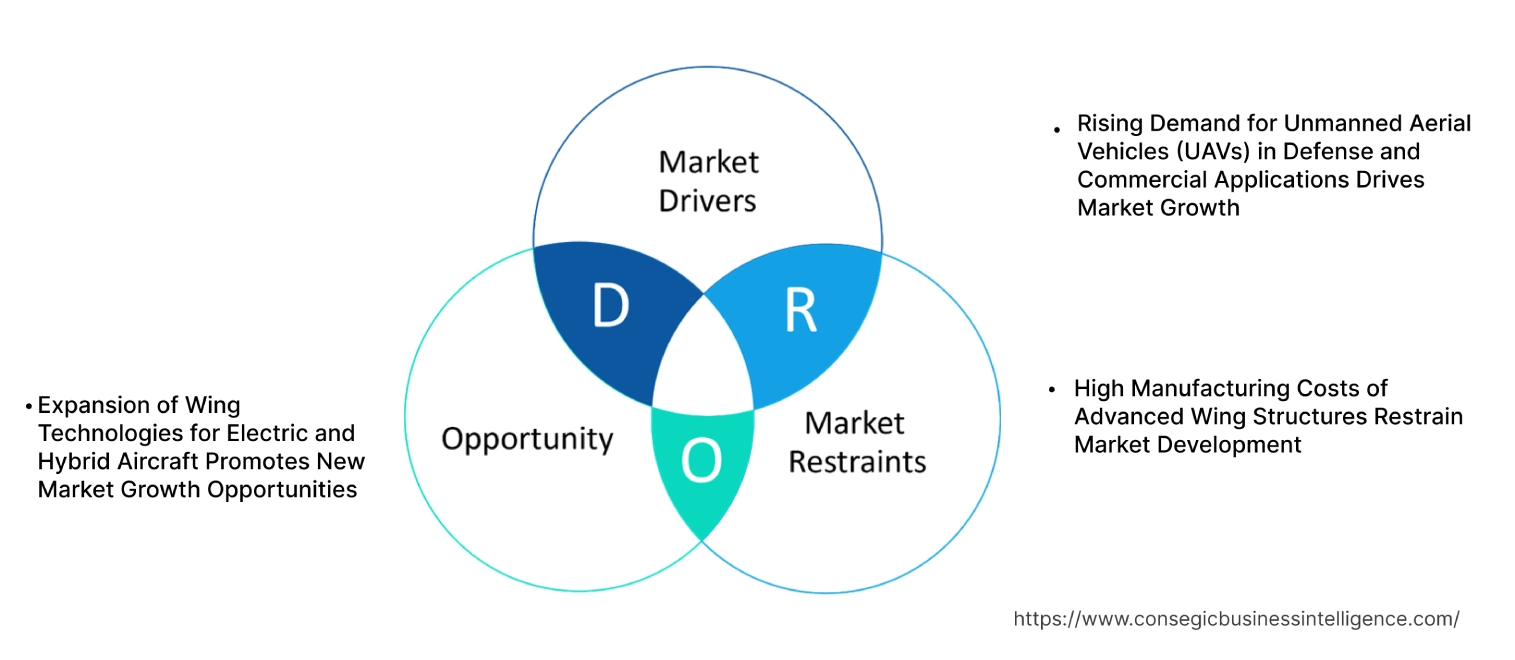
Increased air traffic and fleet growth are boosting market demand for aero wing
The global aviation industry is experiencing unique growth, due to rising passenger numbers along with expanding airline fleets which is directly increasing the need for aircraft components. Also, the increased aircraft traffic due to economic development and increased disposable incomes is driving the aero wing market demand. Moreover, Airlines are rapidly ordering new planes to meet capacity needs which in turn is fueling the aero wing market growth. Further, the need for lighter, more fuel-efficient wings to improve performance and lower emissions is boosting the market progress.
- For instance, according to Indian Brand Equity Foundation (IBEF), India’s airport network has increased from 74 airports in 2014 to 162 airports as of September 2025. Also, total freight traffic increased from 2.70 MMT to 3.71 MMT between FY16 and FY24.
Therefore, the proliferation of aviation industry is driving the need for wings, in turn proliferating the market progress.
Key Restraints :
High cost of manufacturing is restraining the market growth
The advanced materials used for lightweight, high-strength wings are expensive, and their processing increases costs, significantly hindering the aero wing market expansion. Also, the development of a new wing design increased the R&D and implementation costs to overcome complex aeroelastic challenges. Moreover, the high cost is pushing buyers towards traditional, cheaper metal alternatives, which significantly impacts the quality and performance of wings.
Therefore, the high costs of manufacturing is restraining the aero wing market expansion.
Future Opportunities :
Rising adoption of unmanned aerial vehicles is expected to promote potential opportunities for market growth
The rising need for advanced, lightweight, high-performance wings for applications in defense, agriculture, logistics, and surveillance is driving the market progress. Also, the rising defence budget to increase the adoption of unmanned aerial vehicles to boost nations surveillance, strike, and indigenous capabilities creates aero wing market opportunities. Further, the modernization of defence equipment is paving the way for market evolution. Further, the innovations in composite materials enhance UAV efficiency, fueling the need for specialized wings.
- For instance, in June 2025, according to PIB India, the defence budget has increased by 2.6% from 2013-14 to 2025–26, showcasing a strong boost for defence spending with an aim to build a strong, secure and self-sufficient nation.
Hence, the rising defence budget is anticipated to increase the utilization of unmanned aerial vehicles in turn promoting prospects for aero wing market opportunities during the forecast period.
Aero Wing Market Segmental Analysis :
By Platform:
Based on the platform, the market is segmented into commercial aviation, military aviation, general aviation, and unmanned aerial vehicles (UAVs).
Trends in the Platform:
- The proliferation of AI and automation in general aviation is driving the adoption of advanced wings which in turn is fueling the aero wing market trends.
- The development of stealthy, multi-role fighters with hypersonic capabilities for military aviation is driving the adoption of advanced wings which in turn is fueling the aero wing market trends.
The commercial aviation accounted for the largest revenue share in the year 2024.
- The commercial aviation sector utilizes advanced aero wings with a focus on fuel efficiency via lightweight composites and aerodynamic designs, which is driving the market adoption in commercial aviation.
- Also, the lower operational costs and better performance fuels high-lift, low-drag for commercial aviation is driving the aero wing market share.
- The key advantages of adopting advanced wings in commercial aviation include increased fuel efficiency, reduced emissions, enhanced structural integrity, and reduced noise pollution is boosting the aero wing market size.
- Further, the rising air traffic is pushing for lighter, more aerodynamic designs to cut fuel burns and costs is driving the market adoption in commercial aviation.
- For instance, in 2024, according to U.S. Bureau of Transportation Statistics, the total number of domestic passengers increased by 3.65%, outbound international passengers increased by 8.85% and inbound international passengers increased by 8.45% from the previous year.
- Thus, as per the market analysis, the rising air traffic is driving the adoption of commercial aviation which in turn is boosting the market progress.
The unmanned aerial vehicles (UAVs) is anticipated to register the fastest CAGR during the forecast period.
- The unmanned aerial vehicles utilize aerodynamic wings to generate lift that enables flight for applications in military surveillance, agricultural monitoring, infrastructure inspection, and others.
- Also, the UAVs offer cost-efficiency and access to dangerous areas where manned aircraft cannot reach by leveraging wings for lift and propulsion for movement.
- Moreover, the key advantages include longer flight times, greater range, higher speed, and better energy efficiency is driving the aero wing market share.
- Further, the key factors driving the adoption of UAVs include the needs for surveillance, logistics, and military advantage which in turn fuels the aero wing market size.
- Furthermore, the higher mobility, longer endurance, and greater payload capacity are driving the adoption of UAVs, which is boosting the market progress.
- Therefore, as per the market analysis, the aforementioned factors are anticipated to boost the market during the forecast period.
By Wing Type:
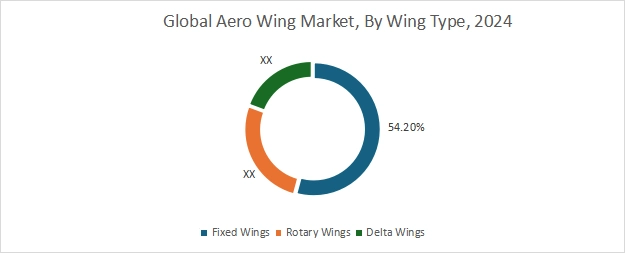
Based on the wing type, the market is segmented into fixed wings, rotary wings, and delta wings.
Trends in the Wing Type:
- The trend towards increasing focus onblade shape to optimize performance in different flight phases is driving the advancement of rotary wings.
- The shift towards advanced composites and additive manufacturing for lighter, stronger, and fuel-efficient wings is driving the market trends.
The fixed wings accounted for the largest revenue share of 54.20% in the year 2024.
- The fixed wings on an aircraft generate lift from forward motion, enabling passenger transport, cargo, surveillance, and others by providing efficient, stable flight, contrasting with helicopters.
- Also, the fixed wings are mainly used in commercial planes, military jets, and UAVs for providing superior flight stability and performance.
- Further, the growing passenger traffic and tourism boost demand for new and efficient fixed-wing aircraft.
- Furthermore, the rising military budgets drive R&D for advanced, multi-role fighters along with frequent maintenance, repairs, and upgrades boost the market progress.
- Thus, as per the aero wing market analysis, the aforementioned factors are driving the adoption of fixed wings.
The delta wings is anticipated to register the fastest CAGR during the forecast period.
- The delta wings are triangular aircraft wings designed to offer supersonic flight with low drag at high speeds, along with structural strength.
- Also, the key advantages of adopting delta wings include superior structural strength, high fuel capacity, and excellent supersonic performance, among others.
- Moreover, the military and defence sector is mainly dependent on delta wings for jets, combat aircraft due to their agility and optimal performance.
- Further, the increasing number of next-generation fighter jets is paving the way for the adoption of advanced delta wings.
- Furthermore, the increasing investment in the development of supersonic aircraft along with the adoption of materials such as composites and alloys for enhancing the durability and performance of delta wings is driving the market progress.
- Therefore, as per the market analysis, the increasing number of next-generation fighter jets and increasing investment in development of supersonic aircraft are anticipated to boost the market during the forecast period.
By Material Type:
Based on the material type, the market is segmented into metals, alloys, and composites.
Trends in the Material Type:
- The trend towards rising adoption of titanium alloys due to high strength, corrosion resistance, and heat tolerance among others is driving the market progress.
- The trend towards rising adoption of lightweight, high-strength carbon fiber reinforced polymers due to better fuel efficiency, reduced emissions, and enhanced performance is driving the market progress.
The composite material accounted for the largest revenue share in the year 2024.
- The composite material is revolutionizing aerodynamic wings by offering superior strength-to-weight, corrosion resistance, and design flexibility.
- Also, the composite materials are mainly used in modern wing structures to reduce weight which in turn fuels the adoption of composite materials.
- Further, the rising need for superior performance characteristics and compatibility is driving the adoption of composite materials.
- Furthermore, the rising emphasis on lightweight materials to optimize fuel consumption and enhance aircraft performance is driving the adoption of composite materials in the market.
- Thus, as per the aero wing market analysis, the aforementioned factors are driving the market progress.
Alloys is anticipated to register the fastest CAGR during the forecast period.
- The alloy materials, such as light aluminum, titanium, and other materials, are mainly used for the manufacturing of wings due to the high strength-to-weight ratio as well as failure resistance.
- Also, the strength-to-weight ratio and durability against environmental factors are the key factors driving the adoption of alloys for the manufacturing of wings.
- Further, the commercial aviation sector adopts alloy wings due to lightweight structures, cost-effective solutions, and titanium alloys are primarily used in military aviation which in turn is fueling the market progress.
- Therefore, as per the market analysis, the aforementioned factors are anticipated to boost the market during the forecast period.
Regional Analysis:
The regions covered are North America, Europe, Asia Pacific, Middle East and Africa, and Latin America.
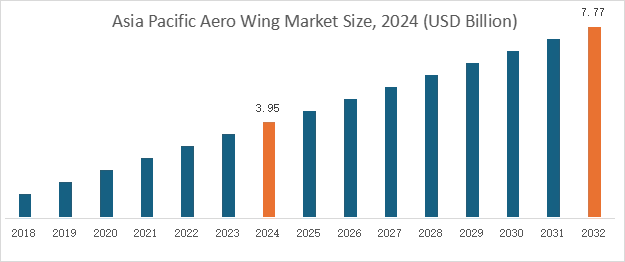
Asia Pacific region was valued at USD 3.95 Billion in 2024. Moreover, it is projected to grow by USD 4.23 Billion in 2025 and reach over USD 7.77 Billion by 2032. Out of this, China accounted for the maximum revenue share of 31.10%. The market progress is mainly driven by strong economic growth in China, India, and other countries. Furthermore, factors including the surging passenger demand, expanding middle class, and government infrastructure investment are projected to drive the market progress in Asia Pacific region during the forecast period.
- For instance, according to IBEF, the aircraft movement has increased from 2.05 million to 2.87 million from 2017 to 2025, which in turn showcases a strong development potential for the aviation sector development in India.

North America is estimated to reach over USD 9.17 Billion by 2032 from a value of USD 4.77 Billion in 2024 and is projected to grow by USD 5.10 Billion in 2025. The North American region's growing focus on high R&D and defense spending offers lucrative growth prospects for the market. Additionally, the strong, established aerospace infrastructure is driving the market progress.
- For instance, inAugust 2024, Alaska Airlines invested in JetZero with an aim to advance the development of innovative aircraft technology. Also, the aim of the investment is to design a wing to reduce carbon emissions.
The regional analysis depicts that the growing passenger numbers, as well as strict emission norms and green goals, are driving the market in Europe. Additionally, the key factor driving the market is the expanding Gulf hub, as well as economic diversification is propelling the market adoption in the Middle East and African region. Further, the increasing air travel requirements and investments in infrastructure, and government support are paving the way for the progress of the market in Latin America region.
Top Key Players & Market Share Insights:
The global aero wing market is highly competitive with major players providing aero wing to the national and international markets. Key players are adopting several strategies in research and development (R&D), product innovation, and end user launches to hold a strong position in the aero wing industry. Key players in the aero wing market include-
- Airbus S.A.S.(France)
- The Boeing Company(USA)
- Lockheed Martin Corporation(USA)
- Northrop Grumman Corporation (USA)
- General Electric Company (USA)
- Safran S.A. (France)
- Rolls-Royce Holdings plc (UK)
- Leonardo S.p.A. (Italy)
- Thales Group (France)
- Embraer S.A. (Brazil)
Aero Wing Market Report Insights:
| Report Attributes | Report Details |
| Study Timeline | 2021-2034 |
| Market Size in 2034 | USD 32.55 Billion |
| CAGR (2026-2034) | 7.51% |
| Base Year | 2025 |
| By Platform |
|
| By Wing Type |
|
| By Material Type |
|
| By Region |
|
| Key Players |
|
| North America | U.S. Canada Mexico |
| Europe | U.K. Germany France Spain Italy Russia Benelux Rest of Europe |
| APAC | China South Korea Japan India Australia ASEAN Rest of Asia-Pacific |
| Middle East and Africa | GCC Turkey South Africa Rest of MEA |
| LATAM | Brazil Argentina Chile Rest of LATAM |
| Report Coverage |
|
Key Questions Answered in the Report
How big is the aero wing market? −
The aero wing market size is estimated to reach over USD 28.16 Billion by 2032 from a value of USD 14.77 Billion in 2024 and is projected to grow by USD 15.77 Billion in 2025, growing at a CAGR of 7.51% from 2025 to 2032.
Which segmentation details are covered in the aero wing report? +
The aero wing report includes specific segmentation details for platform, wing type, material type and regions.
What are the key trends in the aero wing market? +
The aero wing market is being shaped by several key trends including proliferation of AI and automation in general aviation as well as development of stealthy, multi-role fighters with hypersonic capabilities for military aviation are the key trends driving the market.
Which is the fastest segment anticipated to impact the market growth? +
In the aero wing market, the delta wings is the fastest-growing segment during the forecast period due to increasing numbers of next-generation fighter jets and increasing investment in development of supersonic aircraft.
Who are the major players in the aero wing market? +
The key participants in the aero wing market are Airbus S.A.S. (France), The Boeing Company (USA), Lockheed Martin Corporation (USA), Northrop Grumman Corporation (USA), General Electric Company (USA), Safran S.A. (France), Rolls-Royce Holdings plc (UK), Leonardo S.p.A. (Italy), Thales Group (France), Embraer S.A. (Brazil) and others.
Overview
Reputation & Certifications


Our Services
- Market Intelligence & Forecasting
- Custom Research Solutions
- Market Entry Strategy
- Competitive Intelligence
- Customer Insights
- Industry Innovation Analysis
- Investment Advisory