Jump to Content
Aesthetic Medicine Market - Size, Share, Growth, Top Trends & Global Demand (2026 - 2034)
Aesthetic Medicine Market Size:
According to Consegic Business Intelligence, the 3D Printing Metal Market size was valued at USD 143,579.04 Million in 2025, and it is projected to grow from USD 160,521.37 Million in 2026 to USD 391,802.58 Million by 2034, with a CAGR of 11.8% during the forecast period (2026-2034).
How is AI Transforming the Aesthetic Medicine Market?
AI is being increasingly used in aesthetic medicine sector, particularly to enhance various aspects of the field, including diagnosis, treatment planning, and streamlining procedures. AI-powered systems are transforming how patients are diagnosed, treated, and monitored, in turn leading to more effective and efficient care.
Additionally, the use of AI-powered systems enables 3D facial reconstruction and simulations, which allows patients to visualize potential outcomes before undergoing procedures, thereby improving informed decision-making and managing patient expectations. Further, AI-powered tools can guide treatments such as laser resurfacing and injectables, ensuring precise targeting and minimizing errors. Thus, the above factors are projected to drive the market growth during the forecast period.

Aesthetic Medicine Market Dynamics - (DRO) :
What are the primary growth factors for the aesthetic medicine market?
The growing demand for aesthetic procedures is fueling the expansion of the market
Aesthetic treatments are designed to enhance a person's appearance by addressing concerns related to skin, hair, and body. These procedures aim to improve skin aging, blemishes, and dissatisfaction with physical features amongst others. Common treatments include injectables like Botox and dermal fillers, laser therapies for skin rejuvenation and hair removal, chemical peels, microdermabrasion, and surgical procedures such as rhinoplasty or breast augmentation.
Medical professionals, including dermatologists and plastic surgeons, offer safe and effective treatments. These procedures address issues like wrinkles, fine lines, acne scars, uneven skin tone, sun damage, and others. Injectables restore volume loss, lift sagging features, and refine facial contours, resulting in a youthful and radiant complexion. Body contouring techniques like liposuction or fat transfer help sculpt the body and boost self-confidence. Additionally, as per the analysis, treatments like chemical peels and laser resurfacing promote healthier, younger-looking skin by stimulating collagen production and cellular renewal. The benefits of these medicines along with the global competitive environment are driving individuals to prioritize their appearance for success. This leads to a heightened emphasis on physical attractiveness, leading to the rise in surgical and non-surgical procedures.
- For instance, According to the data published by ISAPS, it states that in 2023 there is a 5.5% increase in surgical procedures, with plastic surgeons performing over 15.8 million surgical procedures and 19.1 million non-surgical procedures. This represents 40% over the last four years. This increase showcases the requirement for various surgical procedures including cosmetic procedures.
Thus, the growing focus on the appearance of an individual along with the availability of various aesthetic solutions is influencing the aesthetic medicine market growth.
The growing utilization of minimally invasive procedures is driving the market.
Minimally invasive procedures refer to surgical procedures that are performed using small incisions or entry points, with the assistance of specialized instruments and imaging technology. Minimally invasive procedures utilize specialized tools to access surgical sites, unlike traditional open surgery.
The rising popularity of aesthetic medicine is driven by the increasing requirement for minimally invasive and non-invasive procedures. As per the analysis, these procedures offer numerous advantages, including reduced complications, shorter recovery times, minimal downtime, affordability, long-lasting results, and reduced pain.
- For instance, the data published in the Plastic Surgery report, states that in 2023, the total minimally invasive procedures in cosmetic settings were observed to be 23,672,269 in 2022 and 25,442,640 in 2023. The number shows a rise of 7%. This significant rise underscores the increasing popularity of minimally invasive procedures within the field of aesthetic procedures.
Overall, aesthetic medicine market demand is booming due to the growing adoption of minimally invasive and non-invasive procedures, as they provide faster recovery, affordability, and minimal downtime to attract patients.
What are the major restraints impacting the market?
The high cost of aesthetic procedures is hampering the aesthetic medicine industry expansion.
The cost of aesthetic procedures can vary significantly, often making them inaccessible to many. Factors such as the specific treatment, its complexity, the provider's expertise, and the clinic's location drastically influence the final price. High-end clinics and renowned practitioners typically charge premium prices, further limiting access to these procedures. This economic barrier, especially for individuals from lower socioeconomic backgrounds, hinders their ability to enhance their appearance and self-esteem through aesthetic treatments.
Overall, the financial implications associated with aesthetic treatments pose a significant barrier to access for many individuals, making these procedures more of a luxury than a necessity. This financial strain limits accessibility to care, exacerbates socioeconomic inequalities, and influences patient choices, thus hindering the market.
What are the future opportunities for the aesthetic medicine market?:
The rise in medical spas is Expected to Create Potential Opportunities.
The growing popularity of medical spas has created opportunities for the rise of the market for aesthetic medicine. As consumers increasingly seek non-invasive and minimally invasive options for aesthetic enhancements, medical spas offer a compelling blend of medical expertise and a relaxing, spa-like atmosphere. This unique combination makes them ideal venues for the use of aesthetic procedures.
The rising awareness of the benefits of these treatments and the use of aesthetic procedures, including their ability to deliver natural-looking results with minimal downtime, has further fueled the requirement for aesthetic procedures in medical spa settings.
As a result, medical spas play a pivotal role in expanding the reach and accessibility of these innovative procedures. The combination of skilled practitioners, innovative techniques, and a comfortable environment positions medical spas as ideal settings for aesthetic procedures. Additionally, ongoing marketing efforts through social media platforms play a crucial role in promoting these services.
- For instance, According to the data published by the American MedSpa Association , in 2024, The medical aesthetics industry has continued its steady rise trajectory, expanding from 8,899 locations in 2022 to 10,488 in 2023. This consistent rise reflects the enduring consumer requirement for medical aesthetic treatments. Social media has played a significant role in driving this rise, influencing consumer preferences and awareness of aesthetic procedures.
Overall, based on the analysis, medical spas are well-positioned to benefit from the growing requirement for aesthetic procedures. As the market continues to evolve, medical spas that effectively leverage these advantages will likely experience significant rise and success in the coming years.
Aesthetic Medicine Market Segmental Insights :
Procedures Insights:
Based on procedures, the market is bifurcated into invasive procedures and non-invasive procedures.
Trends in the Procedures:
- The trend for invasive procedures, skin tightening & lifting using energy-based devices.
- Social media influencers raise public awareness of aesthetic procedures, thus influencing aesthetic medicine industry trends.
The invasive segment accounted for the largest market share in 2023
The segment is further categorized into breast augmentation, liposuction, eyelid surgery, and others.
- Invasive aesthetic procedures penetrate the skin or manipulate underlying tissues to address cosmetic concerns like wrinkles, sagging skin, or excess fat. These procedures typically require incisions and anesthesia, offering more long-lasting results compared to non-invasive options.
- They are ideal for individuals seeking significant aesthetic transformations.
- Additionally, these procedures offer a high degree of customization to address specific anatomical concerns and achieve desired aesthetic goals.
- Common invasive aesthetic procedures include facelifts to tighten sagging skin and address wrinkles, rhinoplasty to reshape the nose, liposuction to remove excess fat, breast augmentation to enhance breast size and shape, and tummy tucks to remove excess skin and fat from the abdomen.
- The advantages offered by these procedures, such as improved self-esteem, enhanced physical appearance, and boosted confidence, significantly influence the requirement for these procedures.
- For instance, according to the data published by the American Society of Plastic Surgeons states that the total number of invasive procedures is 1,498,361 in 2022 and 1,575,244 in 2023. This shows a rise of 5% in the invasive procedures. This rise highlights the continued popularity of invasive procedures within the field of aesthetic procedures.
- Thus, as per the analysis, the desire for long-lasting improvements and societal pressures for a youthful look is driving the requirement for invasive aesthetic procedures, as they offer a higher degree of desired results.
The non-invasive procedure segment is expected to grow at the fastest CAGR over the forecast period.
- Non-invasive aesthetic procedures offer a less invasive approach to enhancing appearance.
- These treatments, which often require multiple sessions for optimal results, utilize technologies like lasers, radiofrequency, and others to target concerns such as wrinkles, fine lines, and unwanted fat.
- Unlike surgical procedures, non-invasive treatments typically involve minimal downtime, allowing patients to resume their daily activities immediately.
- Advancements in lasers, radiofrequency, and other non-invasive modalities offer a wider range of safe and effective treatment options covered in minimal time, appealing to busy individuals.
- Moreover, there is growing consumer interest in non-invasive aesthetic procedures owing to increased awareness of their multiple benefits.
- Advancements in technology and a growing preference for less downtime have fueled the popularity of minimally invasive treatments.
- Neuromodulators like Botox and dermal fillers have become staples in aesthetic maintenance, offering immediate results and minimal recovery time.
- For instance, according to the data published by the American Society of Plastic Surgeons in 2023, there was a 6% increase in botulinum toxin type A procedures (including Botox, Dysport, and Xeomin), reaching a total of 4,715,716. Similarly, dermal filler procedures saw a 4% increase, with 3,441,534 procedures performed in 2022.
- Overall, individuals seeking to maintain a youthful appearance without disrupting their hectic schedules are driving the requirement for non-invasive aesthetic procedures in the country, as they require minimal downtime and offer gradual improvements.
Gender Insights:
Based on age group, the market is categorized into men and women.
Trends in the Age Group:
- Growing trends for minimally invasive procedures in women.
The women segment accounted for the largest aesthetic medicine market share of xx in 2023.
- The dominance of the female segment in the market is attributed to a combination of cultural, societal, economic, and psychological factors that shape women's attitudes toward beauty and self-care.
- Many societies have deeply ingrained cultural norms and expectations regarding gender roles and appearance.
- From a young age, girls are socialized to prioritize grooming, fashion, and beauty as integral components of femininity and social acceptance. This cultural conditioning influences women to place a higher value on their appearance and invest more time and resources into maintaining it.
- Consequently, women are more likely than men to seek out aesthetic procedures to enhance their physical attractiveness and address perceived flaws.
- Moreover, the constant exposure to celebrities and influencers promoting non-invasive aesthetic procedures through social media fuels the desire for similar enhancements, impacting the requirement of aesthetic procedures among women.
- For instance, according to the data published by the American Society of Plastic Surgeons states that in 2023, total cosmetic procedures included in aesthetic procedures performed on women are 22,690,868.
- Overall, female dominance in aesthetic procedures from cultural pressures on appearance, social media influence promoting procedures, and a focus on beauty from a young age, thus driving the segment.
The male segment is expected to grow at the fastest CAGR over the forecast period.
- The requirement for aesthetic procedures among males is growing due to several factors. Traditionally, cosmetic procedures were predominantly associated with women, but societal attitudes have shifted, leading to a more inclusive approach to aesthetics.
- Men are now more open to exploring aesthetic treatments to enhance their appearance, boost their confidence, and maintain a youthful look.
- Moreover, the increasing emphasis on personal grooming and wellness has led to a growing requirement for aesthetic procedures among men. Men are now more invested in skincare routines and overall self-care practices, leading them to explore options beyond traditional grooming products.
- Aesthetic treatments such as laser hair removal, botox injections to relax muscles and smooth wrinkles, particularly frown lines, forehead lines, and crow's feet, dermal fillers to add volume and definition to facial features such as the cheeks, jawline, and temples, microdermabrasion and chemical peels for exfoliation and rejuvenation.
- These processes address concerns such as acne scars, uneven skin tone, and sun damage and have appealed to men looking to maintain a polished appearance, making a noticeable increase in the requirement for services.
- Factors such as increased self-awareness, aging concerns, career aspirations, social media influence, and the desire for a more youthful and confident appearance drive the requirement of aesthetic procedures in men.
- Overall, shifting societal norms, the rise of personal grooming trends, and competitiveness have led to increased demand for aesthetic procedures among men, as they benefit in self-improvement, confidence, and a youthful appearance, thus driving the segment.
End User Analysis :
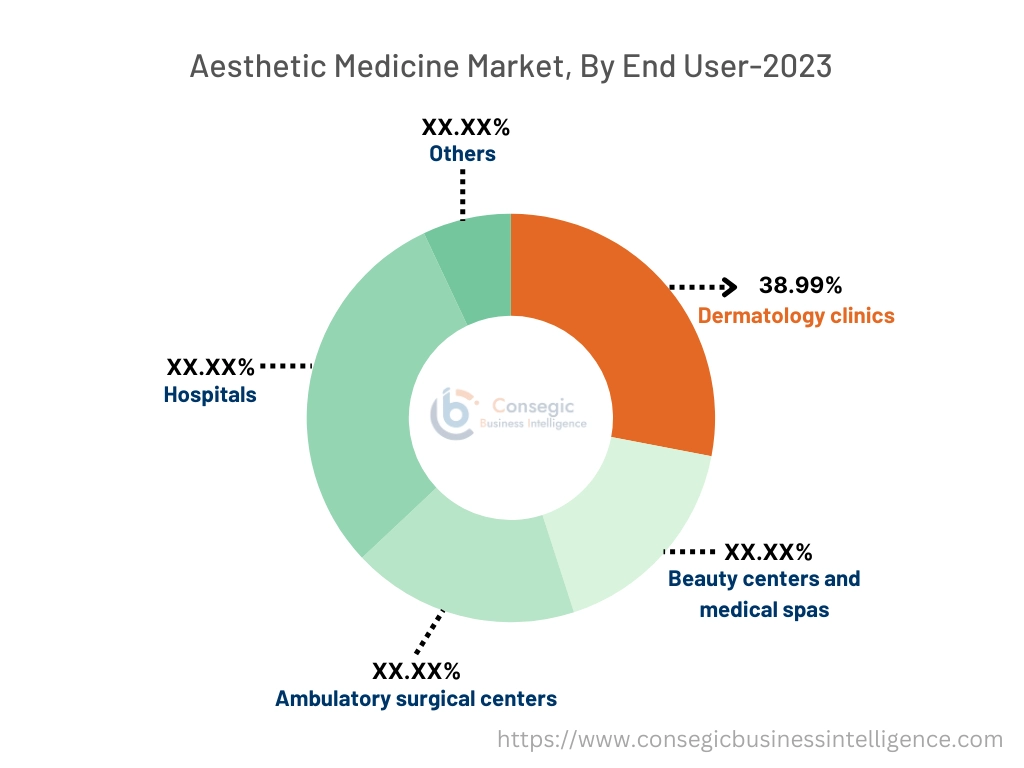
Based on end users, the market is categorized into hospitals, ambulatory surgical centers, beauty centers and medical spas, dermatology clinics, and others.
Trends in the End-User:
- The rising trend for same-day surgeries.
- The growing trends for beauty spas and medical spas.
The dermatology clinics segment accounted for the largest market share of 38.99% in the year 2023.
- Dermatology clinics are healthcare facilities focused on providing treatments and solutions for skin-related issues. These settings offer a convenient and cost-effective alternative to traditional hospitals for a variety of skin procedures.
- Dermatology clinics offer a wide range of aesthetic procedures to enhance appearance and address skin concerns.
- These clinics provide non-invasive treatments like laser therapy, chemical peels, and microdermabrasion for skin rejuvenation and hair removal.
- They also offer minimally invasive procedures such as Botox and fillers for wrinkle reduction and volume enhancement among others.
- Additionally, dermatology clinics perform surgical procedures like Mohs surgery for skin cancer removal and excisions for benign skin lesions.
- By offering a comprehensive range of aesthetic services, dermatology clinics help individuals achieve their desired aesthetic goals and improve their overall skin health.
- Various novel dermatology clinics are being introduced with cutting-edge technologies.
- For instance, in 2024, the Aesthetics Club is set to open its new clinic in Stockbridge, offering a wide range of aesthetic and skincare treatments.
- Thus, the rise in the number of dermatology clinics coupled with novel technologies is driving the growth of the segment.
The Beauty Centers & Medical spa segment is expected to grow at the fastest CAGR over the forecast period.
- Beauty centers and medical spas offer a range of aesthetic treatments, from non-invasive procedures like facials and massages to more advanced techniques like Botox and dermal fillers.
- These establishments often collaborate with dermatologists and medical professionals to ensure safe and effective treatment.
- While beauty centers primarily focus on relaxation and rejuvenation, medical spas offer a blend of medical expertise and aesthetic services, providing a comprehensive approach to beauty and wellness.
- These facilities cater to a diverse clientele, offering customized treatments to address various concerns, from aging skin to body contouring.
- Thus, the aforementioned factors are driving the growth of the segment in the coming years.
Regional Insights:
The regional segment includes North America, Europe, Asia Pacific, the Middle East and Africa, and Latin America.
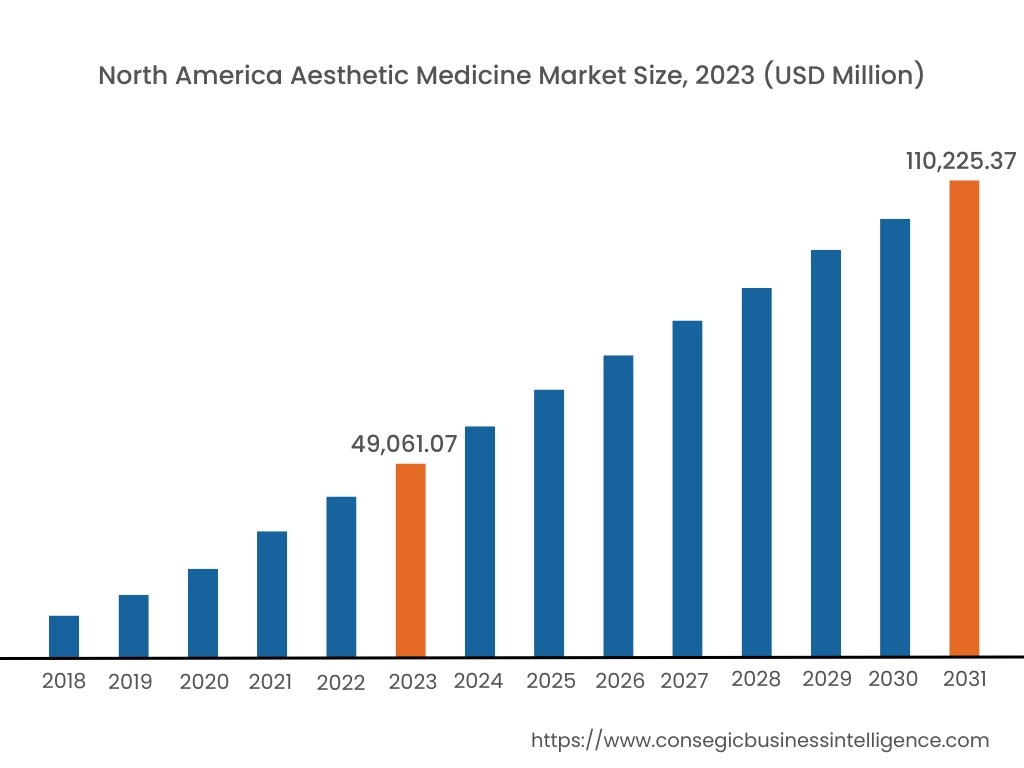
North America: Most Dominating Region with Market Share of 42.71%
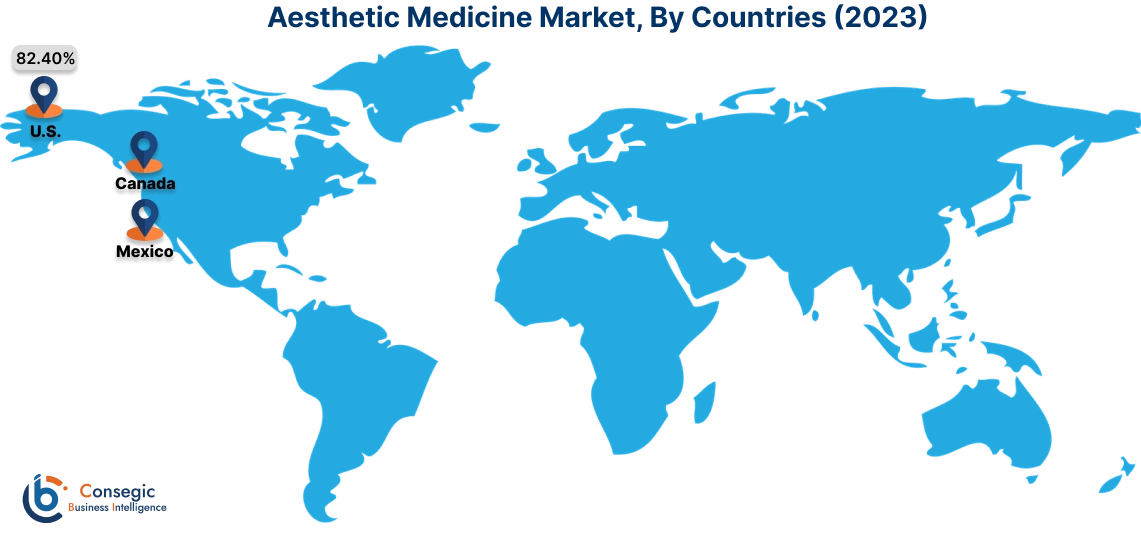
In 2025, North America accounted for the highest market share at 42.71% and was valued at USD 49,061.07 Million and is expected to reach USD 110,225.37 Million in 2034. In North America, the U.S. accounted for the highest market share of 82.40% during the base year of 2023.
North America's aesthetic medicine industry is thriving, driven by factors such as a cultural emphasis on youth and beauty, increasing disposable income, and advancements in technology. The region boasts a wide range of aesthetic procedures, from minimally invasive treatments like Botox and fillers to surgical procedures like facelifts and liposuction. The need for natural-looking results and shorter recovery times has led to the popularity of minimally invasive and non-surgical options. Additionally, a growing number of medical spas and clinics offer a variety of aesthetic services, catering to diverse needs and preferences, thus influencing the rise in procedures.
For instance, According to the data published by ISAPS, in 2023, the US led the world in aesthetic procedures, with over 6.1 million procedures performed.
Thus, based on the aesthetic medicine market analysis, the increasing requirement for natural-looking results and minimal downtime has driven the popularity of minimally invasive and non-invasive procedures. As the industry continues to evolve, North America is expected to remain at the forefront of aesthetic innovation.
Asia-Pacific: Fastest Growing Market With a CAGR of 14.1%
The Asia Pacific market is experiencing the fastest growth with a CAGR of 14.1% over the forecast period.
The Asia Pacific region is experiencing significant growth in the market for aesthetic medicine, driven by factors such as increasing disposable income, a rising middle class, and a growing awareness of beauty and wellness. Countries like South Korea, China, Japan, and India are leading, with a strong requirement for both surgical and non-surgical procedures. The region is known for its advanced technology and skilled practitioners, attracting medical tourists from around the world. Popular procedures include minimally invasive treatments like Botox and fillers, as well as surgical procedures like facelifts and liposuction. Additionally, the increasing popularity of K-beauty and C-beauty has further fueled the requirement for aesthetic treatments in the region, thus creating lucrative aesthetic medicine market opportunities.
Europe has emerged as a significant player in the global market. Countries like Germany, France, the UK, Italy, and Spain lead the way in terms of procedure numbers and technological advancements. The region has a strong emphasis on natural-looking results and patient safety, driving the requirement for non-invasive and minimally invasive procedures. European clinics often offer a wide range of treatments, including Botox, fillers, laser therapy, and surgical procedures. Additionally, the increasing popularity of medical spas and wellness centers has contributed to the growth of industry in Europe. Thus, the aforementioned factors influence aesthetic medicines in Europe.
The Middle East and Africa (MEA) regions are witnessing a surge in the popularity of aesthetic procedures. Factors driving this growth include increasing disposable income, a growing middle class, a cultural emphasis on beauty and youth, and advancements in technology. Countries like the UAE, and South Africa have emerged as major hubs for aesthetic procedures, offering a wide range of treatments, from minimally invasive procedures like Botox and fillers to surgical interventions like facelifts and liposuction. The demand for natural-looking results and minimal downtime has fueled the popularity of non-surgical options. Additionally, the region's diverse cultural and ethnic backgrounds present unique aesthetic needs, leading to tailored treatments and specialized techniques.
Latin America has emerged as a significant player in the global aesthetic medicine market. Countries like Brazil and Argentina, are known for their high demand for aesthetic procedures. This surge in popularity is attributed to factors such as cultural emphasis on beauty, rising disposable incomes, and advancements in technology. The region offers a wide range of treatments, from minimally invasive procedures like Botox and fillers to surgical interventions like liposuction and facelifts. The growing number of medical spas and clinics, coupled with skilled professionals, has further contributed to the thriving industry in Latin America.
Leading Key Players in the Aesthetic Medicine Industry
The Aesthetic Medicine market is highly competitive with major players providing precise measurements between objects to the national and international markets. Key players are adopting several strategies in research and development (R&D) and product innovation to hold a strong position in the global market. Key players in the Global Aesthetic Medicine industry include-
- GALDERMA (Switzerland)
- Hironic Co., Ltd. (South Korea)
- Abbvie Inc. (United States)
- Merz Pharma (Germany)
- Solta Medical (United States)
- Sinclair (United States)
- CLASSYS Inc. (South Korea)
- Fotona (United States)
- IBSA Institut Biochimique SA (Switzerland)
Recent Industry Developments :
Partnership:
- In July 2024, Sirnaomics Ltd. and Gore Range Capital LLC announced a strategic partnership to establish Sagesse Bio, Inc., a joint venture dedicated to developing innovative RNAi therapeutics for body contouring and fat reduction.
Launches:
- In June 2024, Singclean, a leading Chinese medical aesthetics company, announced the launch of Singfiller and Singderm HA fillers in Thailand at IMCAS Asia.
- In May 2024, Elevai Labs announced the launch of two new subsidiaries, Elevai Biosciences and Elevai Skincare, to advance the future of aesthetic medicines and exosome skincare.
- In March 2024, L'Oréal Canada expanded its LDB division by launching SkinBetter Science, a medical aesthetic skincare brand.
Aesthetic Medicine Market Report Insights :
- Male
- Female
| Report Attributes | Report Details |
| Study Timeline | 2021-2034 |
| Market Size in 2034 | USD 391,802.58 Million |
| CAGR (2026-2034) | 11.8% |
| By Procedure |
|
| By Gender | |
| By End-User |
|
| By Region |
|
| Key Players |
|
| North America | U.S. Canada Mexico |
| Europe | U.K. Germany France Spain Italy Russia Benelux Rest of Europe |
| APAC | China South Korea Japan India Australia ASEAN Rest of Asia-Pacific |
| Middle East and Africa | GCC Turkey South Africa Rest of MEA |
| LATAM | Brazil Argentina Chile Rest of LATAM |
| Report Coverage |
|
Key Questions Answered in the Report
How big is the Aesthetic Medicine market? −
According to Consegic Business Intelligence, the 3D Printing Metal Market size was valued at USD 143,579.04 Million in 2025, and it is projected to grow from USD 160,521.37 Million in 2026 to USD 391,802.58 Million by 2034, with a CAGR of 11.8% during the forecast period (2026-2034)
Which is the fastest-growing region in the Aesthetic Medicine market? +
Europe is the fastest-growing region in the Aesthetic Medicine market.
What specific segmentation details are covered in the Aesthetic Medicine market? +
Procedure, Gender, and End-user segmentation details are covered in the Aesthetic Medicine market.
Who are the major players in the Aesthetic Medicine market? +
GALDERMA (Switzerland), Hironic Co., Ltd. (South Korea), Abbvie Inc. (United States), Merz Pharma (Germany), Solta Medical (United States), Sinclair (United States), CLASSYS Inc.(South Korea), Fotona (United States), IBSA Institut Biochimique SA (Switzerland).
Overview
Reputation & Certifications


Our Services
- Market Intelligence & Forecasting
- Custom Research Solutions
- Market Entry Strategy
- Competitive Intelligence
- Customer Insights
- Industry Innovation Analysis
- Investment Advisory