Jump to Content
Agricultural Enzymes Market - Size, Share, Industry Trends, and Forecasts (2025-2032)
Agricultural Enzymes Market Size:
The Agricultural Enzymes Market size is growing with a CAGR of 9.5% during the forecast period (2025-2032), and the market is projected to be valued at USD 969.93 Million by 2032 from USD 471.28 Million in 2024.
Agricultural Enzymes Market Scope & Overview:
Agricultural enzymes are defined as catalysts that are biological in nature. It contains proteins. These proteins help in expediting the biochemical reactions in animals, plants and soil. These enzymes are used due to their functionality such as to improve several agricultural processes by increasing yield of the crop, enhancing the condition of soil health amongst others. Common types of enzymes used for agricultural sector are proteases, sulfatases, phosphatases, dehydrogenases, and others. As there is increasing development towards sustainable agriculture methods, focus on finding new enzymes, aim towards precision agriculture amongst others has increased. Thus, as per the market analysis, these factors, amongst others, are having a positive impact in the market development.
How is AI Transforming the Agricultural Enzymes Market?
AI is increasingly being integrated into agricultural enzymes sector, particularly to accelerate enzyme discovery, optimize manufacturing processes, improve their performance, and facilitate customizations for specific applications such as crop protection and soil health. This primarily involves using AI to analyze vast datasets and predict enzyme functions, in turn leading to more efficient and cost-effective development of enhanced enzymes.
Additionally, AI-powered solutions can analyze vast amounts of data to predict enzyme structures and functions, which further enables rapid design of tailored enzymes for specific agricultural needs. Consequently, the above factors are projected to boost the market growth in upcoming years.

Agricultural Enzymes Market Dynamics - (DRO) :
Key Drivers:
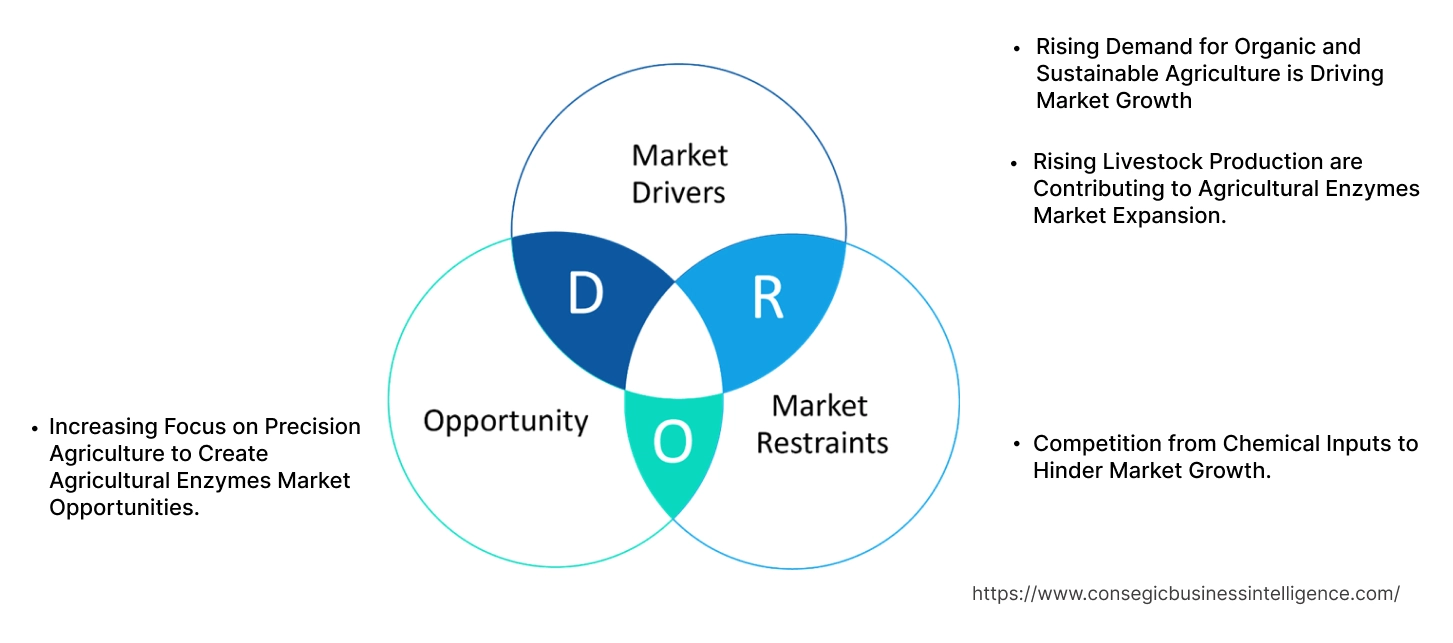
Rising Demand for Organic and Sustainable Agriculture is Driving Market Growth
One of the key factors impacting the market development of agricultural enzymes is the demand for sustainable and organic agriculture practices. Adding to this, the rise in consumer awareness with respect to the harmful effects caused by synthetic chemicals. As this awareness increases, a considerate shift towards organic agricultural methods is observed. This makes farmers incline toward the use of agricultural enzymes, an ecofriendly method.
- For Instance, According to Saudi Journal of Economics and Finance, there was 1.71 million ha of land that was registered for organic certification process in 2023-2024. This showcases the prevalence of organic and sustainable agriculture that in turn implements environmentally friendly methods. Agricultural enzymes are one of those environment friendly methods
These enzymes offer a sustainable alternative to conventional chemical fertilizers and pesticides. Additionally, they improve the soil health thus increasing the availability of nutrients for plants amongst others. These factors collectively state that the increasing preference for sustainable and organic agriculture drives the agricultural enzyme market growth.
Rising Livestock Production are Contributing to Agricultural Enzymes Market Expansion.
The growing need for need for dairy, meat products amongst others is contributing to the agricultural enzymes market expansion. This in turn has increased the requirement and production of animal feed. Animal feed helps in sustaining development and health for animals including common as well as rare species.
- For instance, in 2024, according to S. Department of Agriculture (USDA), India’s national cattle herd was observed to be about 307.6 million head compared to its prior year. This shows an increase of roughly 0.04% on a yearly basis.
Traditional feed has shown digestibility issues for a majority of animals. This leads to an increase in wastage of feeding. Incorporation of agricultural enzymes in these feeds helps to improve the feed digestibility. This is done when the carbohydrates are broken down and in turn releasing nutrients that are bound to those. Few of the primary enzymes are phosphatases, proteases amongst others. Hence, as per the market analysis, due to the aforementioned factors the requirement for these enzymes within the livestock sector is increasing.
Key Restraints:
Competition from Chemical Inputs to Hinder Market Growth.
The wide commercialization of alternatives for agricultural enzymes is hindering market development. A few of the major alternatives are fertilizers and pesticides amongst others. From the past decades, fertilizers and pesticides have been the most preferred solution due to its cost effectiveness. Fertilizers and pesticides have been considered as chemical inputs in the agriculture industry. Additionally, the high initial investment for development of agricultural enzymes has been adding to the preference for fertilizers and pesticides. Furthermore, the application of these chemical inputs is established as a simpler method with less skilled labor when compared with these enzymes. Based on the agricultural enzymes market analysis, as a vast number of farmers still prefer cost effectives when compared to long-term benefits of agriculture enzymes, the market development is expected to be restrained.
Future Opportunities :
Increasing Focus on Precision Agriculture to Create Agricultural Enzymes Market Opportunities.
Precision farming involves utilizing technologies for a specific desired outcome. A few of the technologies that have been focused on are remote sensing, GPS-guided applications amongst others. These technologies are utilized to optimize agricultural practices. This helps the farmers to target the application of enzymes to certain areas. These certain areas are focused on soil condition, nutrients, amongst others. This has helped farmers to improve the efficiency and effective allocation of resources along with a reduction in wastage.
- For instance, Helena Agri-Enterprises introduced the expansion of Zypro soil amendment. Zypro soil is an enzyme technology that will also include fertilizer-based applications from 2024.
Hence, by incorporating this approach, there is growing need for agriculture enzymes for precision agriculture in turn creating lucrative agricultural enzymes market opportunities over the forecast period
Agricultural Enzymes Market Segmental Analysis :
By Product Type:
Based on Product Type, the market is categorized into carbohydrases, proteases, sulfatases, phosphatases, dehydrogenases, and others
Trends in the Product Type:
- There is an increased trend for amylases, a carbohydrases in starch-rich feed for livestock and in bioethanol production.
- Phosphatases is gaining high development rate due to their role in improving the availability of phosphorus in soils.
The carbohydrases segment accounted for the largest market share in 2024 and is expected to be the fastest growing segment over the forecast period.
- Carbohydrases are defined as a group of enzymes that are used for breaking down carbodyrates of complex nature. Major enzymes in this group are xylanase and glucanase amongst others.
- These enzymes help in improving the digestibility of animal feed. It is obtained by utilizing the nutrients that are enclosed before its breakdown.
- These enzymes also contribute to reduction in cost of feed, enhancement in development of the animals amongst others. This in turn leads to farmers’s profitability.
- For instance, according to study published on Springer, it stated that carbohydrases activity is beneficial for animal feed. It also states its potential application in aquafeed by enhancing the nutritional value of sustainable and low-cost ingredients.
- Therefore, as per the market analysis, due to the above-mentioned factors, the carbohydrases segment is dominating the market
By Crop Type:
The crop type segment is categorized into cereals & grains, oilseeds & pulses, fruits & vegetables, forage crops, and others
Trends in the Crop Type:
- Growing focuses on enzymes to improve the digestibility of forage crops like alfalfa and grasses.
- Application of enzymes in order to enhance uptake of nutrients by plants from cereals and grains.
The cereals and grains segment accounted for the largest market share in 2024.
- The cereals and grains segment are currently prominent in the market. A few of the factors contributing to its prominence are the vast cultivation of crops. Wheat, corn and rice are the major crops that are grown globally.
- These crops serve as a primary source of food for both humans and livestock.
- For instance, according to the Food Agriculture Organization, the global production of cereal for FY 2024 was about 2,841 million tons. This output is roughly 0.6% less when compared to the previous year.
- Incorporation of enzymes enhances these crops’ feed digestibility and also reduces the cost of the feed. Enzymes such as xylanase have shown to be a prominent one for the breakdown of carbohydrates in grain.
- Furthermore, enzymes contribute to enhanced nutrient uptake by plants cultivated for human consumption, boosting crop yields and improving overall agricultural productivity.
- Thus, due to the above-mentioned factors, the cereals and grains segment dominates the market.
The forage crop is expected to grow at the fastest CAGR over the forecast period.
- The forage crop segment is expected to grow at the fastest CAGR due to several factors. One of the primary factors is the growing trend for animal protein. This has led to a high increase in production of forage crops in order to sustain production of livestock.
- In addition to this, the growing focus on production of livestock that is sustainable is contributing to the requirement for enzymes tailored specifically for forage crops. These enzymes help to reduce the environmental impact on livestock production
- This positions itself with the global focus on environmentally friendly and sustainable agricultural practices for forage crops.
- As per the market analysis, these factors contribute to the several opportunities provided by forage crops segment in the Market.
By Application:
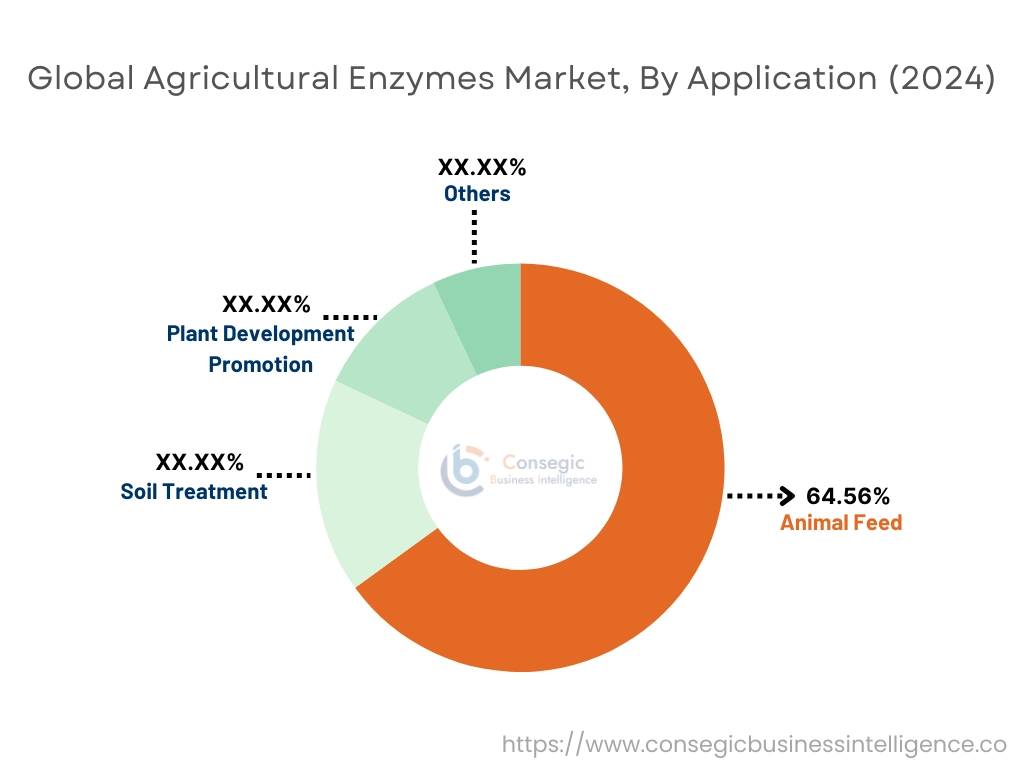
Based on applications, the market is categorized into soil treatment, animal feed, plant development promotion, and others
Trends in the Application:
- Growing focus of enzymes for improvement of soil treatment by advancing microbial activity
The animal feed segment accounted for the largest market share of 64.56% in 2024.
- The primary application of agricultural enzymes is to improve the efficiency of feed. The primary factor fueling this is functionality is the rising requirement for animal protein
- This growing requirement requires the optimal utilization of feed. This is to ensure the profitable and sustainable production of livestock.
- Enzymes such as xylanase, phytase, and cellulase are primarily included when breakdown of carbohydrates is required for feed digestibility. These enzymes effectively break down complex components within the feed. It releases nutrients that were previously inaccessible to animals.
- For instance, according to DuPont, most widely used enzyme for feed across the globe is phytase. Approximately 70% of phytase enzymes are incorporated into pig diets and 90% for poultry.
- Therefore, as per the agricultural enzymes market analysis, the strong reliance on these enzymes for feed digestibility contributes to their prominence in the market.
The soil treatment segment is expected to grow at the fastest CAGR over the forecast period.
- The soil treatment is expected to grow at the fastest CAGR over the forecast period due to several factors. One of the primary factors contributing is the awareness related to the degradation of soil and the growing need for management practices for sustainable soil.
- Agricultural enzymes are employed by enhancing the availability of nutrients for the development of the plant, by expediting organic matter decomposition, amongst others.
- This leads to significant improvements in soil structure, increased crop yields and others.
- Furthermore, the increasing focus on sustainable and organic agriculture is contributing to market development over the forecast period. Thes enzyme provides a wide sustainable approach towards enhancement of soil fertility amongst others.
- These factors contribute to the fastest CAGR for soil treatment segment in the market
Regional Analysis:
The regional segment includes North America, Europe, Asia Pacific, the Middle East and Africa, and Latin America.
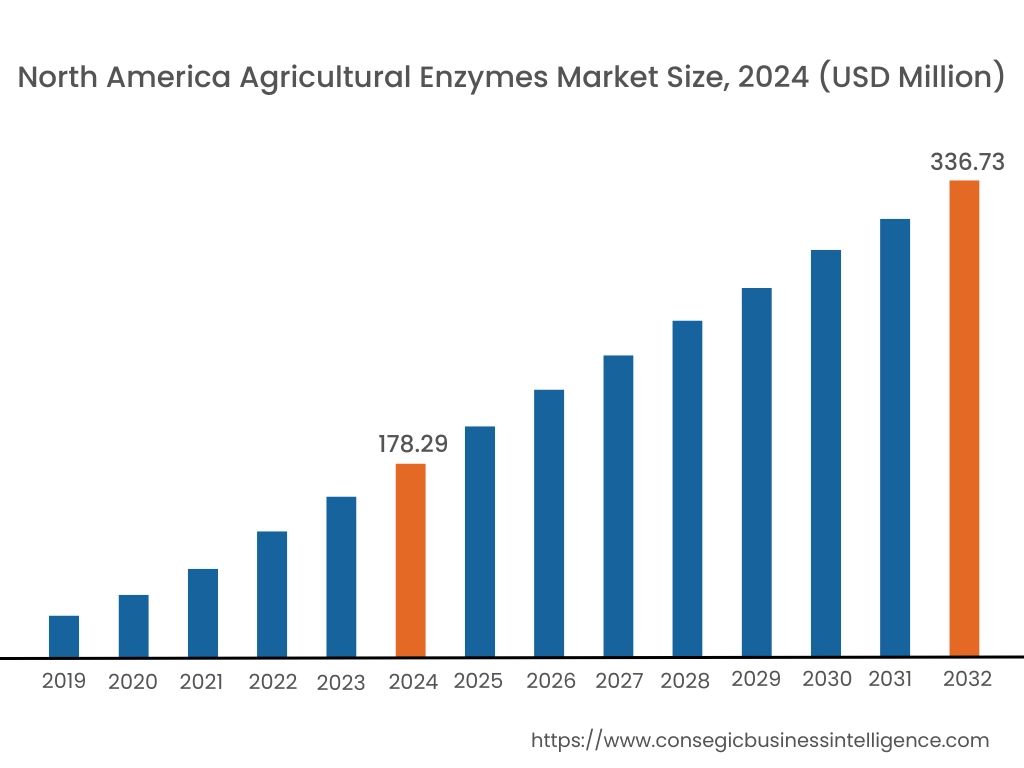
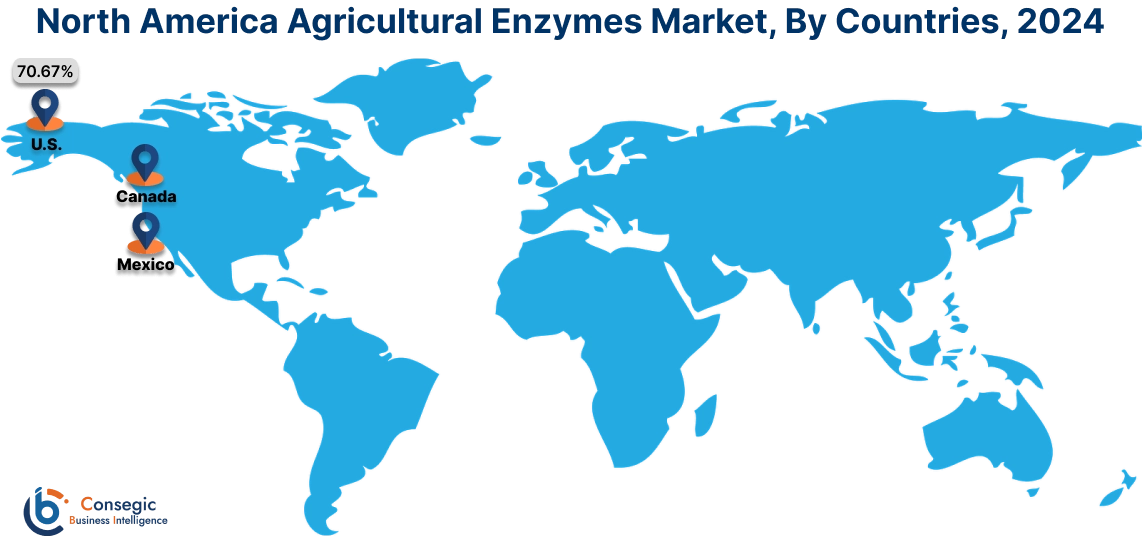
In 2024, North America accounted for the highest agricultural enzymes market share at 37.84% and was valued at USD 178.29 Million and is expected to reach USD 336.73 Million in 2032. In North America, the U.S. accounted for the agricultural enzymes market share of 70.67% during the base year of 2024. North America currently holds a dominant position in the agricultural enzymes industry, driven by several key factors. The region has a strong consumer base inclining toward the preference for sustainable and organically produced food. This has increased the trend for eco-friendly solutions for the agriculture sector. These enzymes effectively enhance soil health, control pests, amongst others. These factors also contribute by aligning with the organic and sustainable agriculture standards.
- For instance, in 2024, Organics International stated that there are approximately a total of 23,957 organic producers including U.S and Canada. U.S. contributing roughly 75% of these producers.
Additionally, North America has an established biotechnology sector. This sector has experienced significant investments out of which development of tailor specific enzyme in agriculture sector is also included. Combing these major factors told state the dominance of North America and lead to the agriculture enzymes market trends.
In Asia Pacific, the agricultural enzymes market is experiencing the fastest growth with a CAGR of 11.7% over the forecast period. A significant contributor for the expedited development is the focus of key players on developing tailor specific enzyme formulations in the agriculture sector. These formulations are related to crop varieties that are prevalent with respect to countries and others. Additionally, the increased focus of localized solutions makes sure that these enzymes are effective and efficient. This has led to the increase in their widespread adoption among the farmers. Furthermore, the rising demand for environmentally friendly solutions is leading to the development of biopesticides that are enzyme based. They act as an alternative for conventional pesticides and simultaneously align with the sustainable initiative. These factors coupled with increasing demand for food and others are expected to create potential for agricultural enzymes market demand.
The European region contributes significantly to the market. The region has experienced significant development in the production of livestock in order to meet the increasing trend for animal protein. This increase has led to the use of agriculture enzymes for better digestibility of feed in the market. Phytase is one of the primary enzymes used in European countries for feed digestibility. It is also used for minimizing waste and improving the nutrient value of the feed. Additionally, the farmers and players that are operating in the market have to take into consideration the regulations while utilizing agriculture enzymes for specific applications. These regulations are focused on reducing the use of chemical fertilizers and pesticides. This adherence to these regulatory frameworks leads to the increasing adoption of enzyme-based solutions within the European agricultural sector, thus driving the agricultural enzymes market demand.
The Middle East and Africa regions are experiencing a major hurdle with respect to degradation of soil, and depletion in the nutrient content is impacting agricultural production. Agricultural enzymes cater to these issues by improving the activity, specificity and stability that contribute to the development of new enzymes that are tailors specific to the agriculture industry. In addition to this, factors such as the growing population, increase in requirement for food and expected to contribute to the market development in Middle East and African Market, thus driving the agricultural enzymes market trends.
The Latin America region is experiencing an increase in the rate of adoption for precision agriculture technologies. A few of the key technologies included are GPS-guided applications and data analytics. These technologies help the farmers to precisely target the application of enzymes. This in turn optimizes their use and potentially increases their impact. These factors along with favorable government policies are impacting agricultural enzymes market growth. Favorable government policies such as initiative towards sustainable agriculture and supporting the adoption of eco-friendly technologies are creating potential for the growth of the agricultural enzymes market. In conclusion, the above-mentioned factors within Latin America are contributing to the agricultural enzymes market growth.
Top Key Players and Market Share Insights:
The Global Agricultural Enzymes Market is highly competitive with major players providing products to the national and international markets. Key players are adopting several strategies in research and development (R&D) and product innovation to hold a strong position in the global Agricultural Enzymes market. Key players in the Agricultural Enzymes industry include-
- Novozymes A/S (Denmark)
- Creative Enzymes (U.S.)
- Advanced Enzyme Technologies (India)
- Amano Enzymes Inc. (U.S.)
- Antozyme Biotech Pvt Ltd. (India)
- Biolaxi Enzymes Pvt Ltd. (India)
- Elemental Enzymes, Inc. (UK)
- Field International UK Limited (UK)
- Infinita Biotech Private Limited (India)
- Kemin Industries, Inc. (U.S.)
- AB Enzymes (Germany)
Agricultural Enzymes Market Report Insights :
| Report Attributes | Report Details |
| Study Timeline | 2019-2032 |
| Market Size in 2032 | USD 969.93 Million |
| CAGR (2025-2032) | 9.5% |
| By Type |
|
| By Crop Type |
|
| By Application |
|
| By Region |
|
| Key Players |
|
| North America | U.S. Canada Mexico |
| Europe | U.K. Germany France Spain Italy Russia Benelux Rest of Europe |
| APAC | China South Korea Japan India Australia ASEAN Rest of Asia-Pacific |
| Middle East and Africa | GCC Turkey South Africa Rest of MEA |
| LATAM | Brazil Argentina Chile Rest of LATAM |
| Report Coverage |
|
Key Questions Answered in the Report
How big is the Agricultural Enzymes market? −
In 2024, the Agricultural Enzymes market is USD 471.28 Million.
Which is the fastest-growing region in the Agricultural Enzymes market? +
Asia Pacific is the fastest-growing region in the Agricultural Enzymes market.
What specific segmentation details are covered in the Agricultural Enzymes market? +
By Type, Crop Type and Application segmentation details are covered in the Agricultural Enzymes market.
Who are the major players in the Agricultural Enzymes market? +
Infinita Biotech Private Limited (India), Kemin Industries, Inc. (U.S.), AB Enzymes (Germany), Advanced Enzyme Technologies (India) are some of the major players in the market.
Overview
Reputation & Certifications


Our Services
- Market Intelligence & Forecasting
- Custom Research Solutions
- Market Entry Strategy
- Competitive Intelligence
- Customer Insights
- Industry Innovation Analysis
- Investment Advisory