Jump to Content
Acaricides Market - Size, Share, Industry Trends, and Forecasts (2025-2032)
Acaricides Market Size:
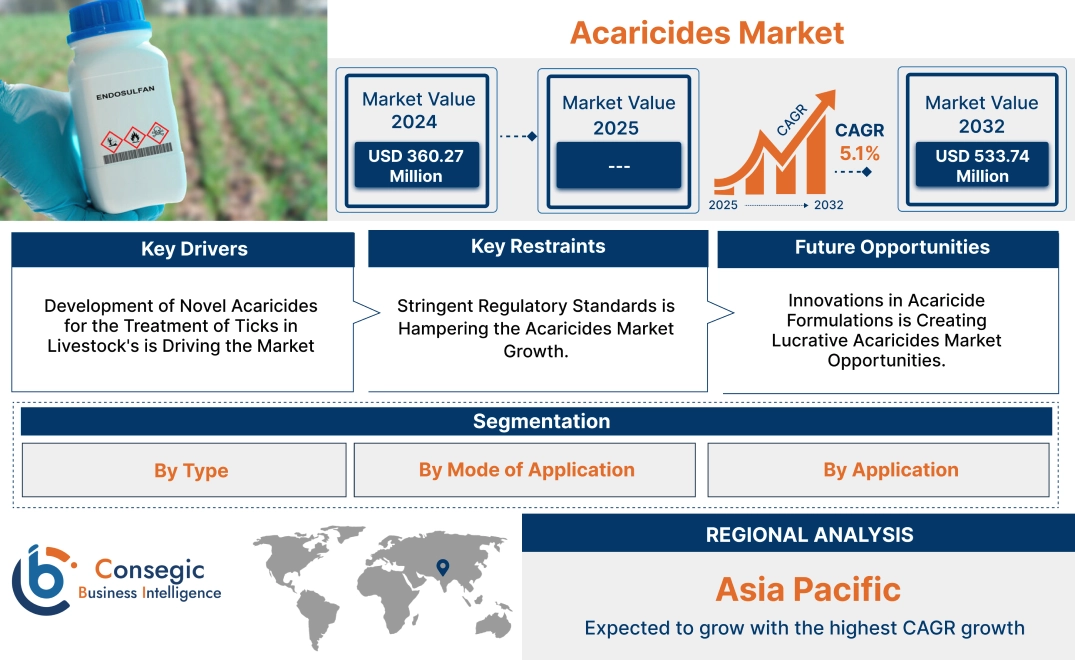
Acaricides Market size is growing with a CAGR of 5.1% during the forecast period (2025-2032), and the market is projected to be valued at USD 533.74 Million by 2032 from USD 360.27 Million in 2024.
Acaricides Market Scope & Overview:
Acaricide is a chemical or biological agent that is mainly developed to control and eradicate ticks and mites. The chemical offers enhanced properties that consists of systematic action where these agents are absorbed by the plants and eventually kills mites that are feeding on it, contact toxicity, and ovicidal activity. The advantages offered by these agents include protection of crops from the loss of yield, improving livestock health, and preventing the spread of tick-borne diseases. The type of the agents mainly consists of synthetic and biobased. The mode of application for these agents are spraying, injections, and others. These agents find their applications in agriculture, wood preservation, veterinary medicine, and others.
Acaricides Market Dynamics - (DRO) :
Key Drivers:
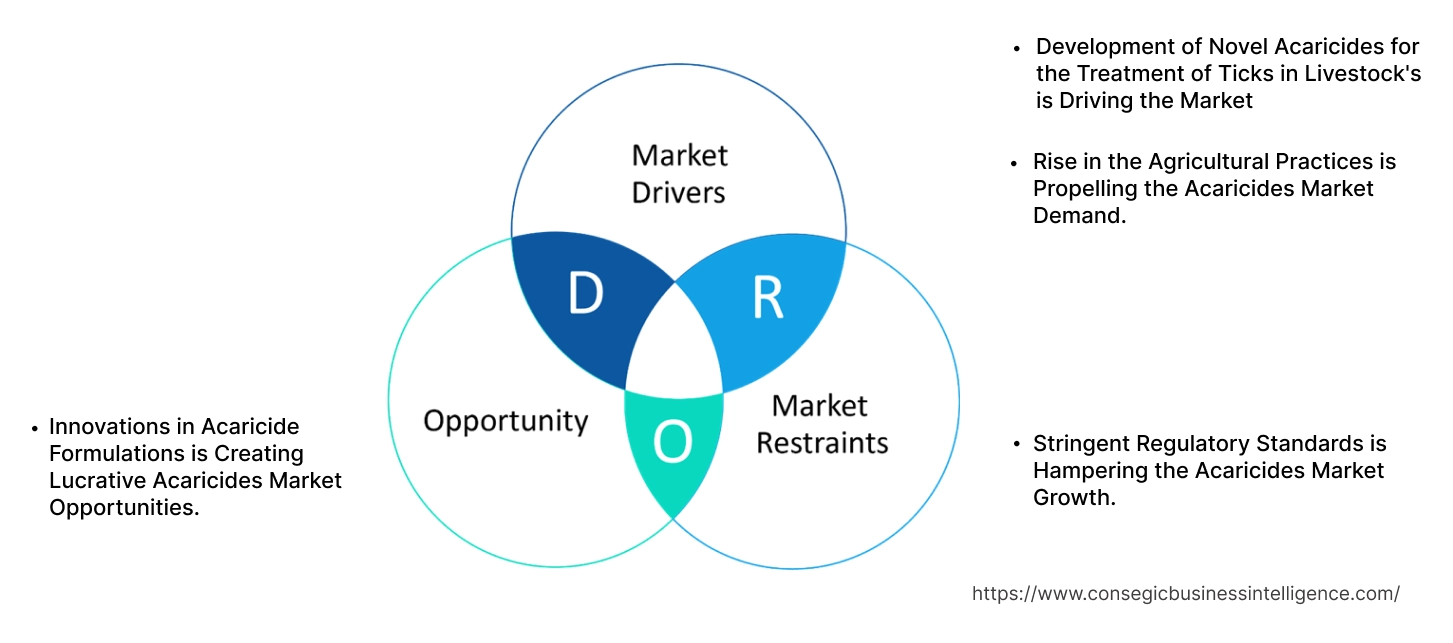
Development of Novel Acaricides for the Treatment of Ticks in Livestock's is Driving the Market
Organisms such as ticks majorly cause irritation and blood loss in animals. They serve as a vector for serious conditions such as Lyme disease, babesiosis, theileriosis, and anaplasmosis, and others. Acaricides are majorly used for protection of livestock from the infestation of ticks, mainly by direct application of the agent. These agents effectively control tick infestation which helps to maintain the health of the animal and improve productivity. Additionally, various manufacturers and researchers are developing novel acaricides with enhanced formulations that effectively eradicate ticks.
For instance,
- In September 2023, ICAR- Central Island Agricultural Research Institute, Port Blair received a patent for the development of novel acaricide. This development mainly consists of an oil-based herbal topical formulation as an acaricide that is used for the treatment of tick infestation in livestock.
Thus, as per the market analysis, the development of enhanced formulations for the treatment of tick infestation in livestock is driving the acaricides market growth.
Rise in the Agricultural Practices is Propelling the Acaricides Market Demand.
The rise in the expansion of agricultural land has led to the rise of crop production and various agricultural practices. This rise poses higher risk of infestation of pests which generally includes mites and ticks that cause substantial damage to crop. The rise in the total cropped area has led to the incorporation of acaricides to protect the crops from tick and mites and ensure higher yield.
For instance,
- According to the data published in the Agriwelfare report, in 2023, states that the total area where there is high adoption for cultivation of crops in India has increased by 66.1% in 2021-2022 compared to the previous years.
Thus, the rise in agricultural practices and cropped areas leads to market growth.
Key Restraints:
Stringent Regulatory Standards is Hampering the Acaricides Market Growth.
Stringent regulatory standards imposed by government bodies worldwide pose significant constraints in the Acaricides market. These regulations, designed to protect the environment and public health, increase production costs and slow down product development. They aim at ensuring the safe and responsible use of these agents, which eventually minimizes the risk to human health and the environment. Compliance with these regulations increases the cost of product development and testing. Moreover, evolving federal regulations speed up annual compliance and operating costs throughout agricultural industry supply chains. This deters the innovation and limit the availability of effective and affordable products. Thus, based on the market analysis, the impact of these stringent regulations on the acaricides market expansion is multifaceted.
Future Opportunities :
Innovations in Acaricide Formulations is Creating Lucrative Acaricides Market Opportunities.
Traditional acaricides requires regular reapplications which is necessary because of their short residual activity. This causes inconvenience and leads to the rise in the risk of contamination in the environment. Advancements and innovations in the delivery and formulation of these agents have led to the development of product that offers enhanced residual activity. These long-residual agents provide effective and long protection against ticks and mites. They reduce the frequency of application which minimizes the negative impact on the environment.
For instance,
- In November 2024, Alfa Defensivos, introduced a novel product called acaricide Vilora. It is a long residual product that is developed to offer effective management and control of pests such as mites and ticks, without affecting the environment.
Thus, innovations in the formulations are creating lucrative acaricides market opportunities.
Acaricides Market Segmental Analysis :
By Type:
Based on type, the market is categorized into synthetic and biobased.
Trends in the Type:
- Rise in the trend for products that are derived from natural sources is influencing the segment.
- Adoption of fungal or bacterial agent is increasing because of their eco-friendly nature.
The synthetic segment accounted for the largest acaricides market share in 2024.
The synthetic segment is further classified into organophosphates, pyrethroids, neonicotinoids, organochlorines, and others.
- Synthetic acaricides is one of the primary segments that consists of chemical compounds.
- They are designed to kill and control the infestation of mites.
- Synthetic agents such as organophosphates mainly work by inhibiting the action of the enzyme which is crucial for the nerve function.
- Pyrethroids act by disrupting the nerve impulse of the pests and mites. Neonicotinoids affect the nervous system of insects.
- These synthetic agents are widely used in various horticultural and agricultural applications mainly because of their ease of application and their enhanced efficiency.
- Thus, the rise in the use of synthetic acaricides is influencing the acaricides market trends.
The biobased segment is expected to grow at the fastest CAGR over the forecast period.
The biobased segment is categorized into microbial, botanical, and others.
- Biobased acaricides are the agents that are derived from natural sources.
- The microbial acaricides are derived from sources that include fungi, bacteria, and viruses.
- Botanical acaricides are sourced from plants such as rotenone, pyrethrum, and neem oil
- Pheromones, and insect growth regulators among others are utilized as they offer specific action and have a minimal impact on the non-target organisms.
- These agents offer numerous advantages such as low toxicity, specificity of action, and environmental friendliness.
- Manufacturers are introducing novel products that offer higher efficiency and eco-friendly alternatives that readily kill these ticks and mites.
- For instance, Certis Belchim, in 2023, developed a broad spectrum acaricide of natural origin. These are used for ornamental plants to protect them from ticks and mites.
- Thus, the growing use of biobased agents is influencing the acaricides market expansion in the coming years.
By Mode of Application:
Based on the mode of application, the market is categorized into spraying, injection, others
Trends in Mode of Application:
- The growing trend for controlled release formulations reduces the frequency of application and minimizes the environmental exposure
- Rise in the trend of acaricide injections offer long lasting protection with single application.
The spraying segment accounted for the largest market share in the year 2024.
- Spraying mode of application mainly involves dispersing the acaricide agent in a fine mist form.
- This application allows for precise application to exact areas, which reduces the amount of agent used.
- This minimizes the environmental impact because of the precise application.
- Spraying also provides a large coverage and ensures effective control on mites and ticks.
- Manufacturers are introducing novel formulations that are available for spraying.
- For instance, BASF SE developed Nealta that consists of the main active ingredient called cyflumetofen which effectively eradicates mites. It is useful for effective spraying applications.
- Thus, the rise in spraying acaricide is influencing the growth of the segment.
The injection segment is expected to grow at the fastest CAGR over the forecast period.
- Injections are emerging as a major mode of application mainly for the management of livestock.
- The method involves the administration of acaricides directly in the bloodstream of the animal through intramuscular route.
- This ensures consistent delivery of the agent directly to the target area.
- It bypasses the issues such as uneven distribution.
- They generally provide long-lasting protection, which leads to controlled treatment.
- This reduces constant exposure of this agent to animals as well as the handler.
- Thus, injectable acaricide applications offer parasite control in livestock, and offer improved efficacy, enhanced worker safety, and reduced environmental impact, making them a valuable tool in the management of livestock.
By Application:
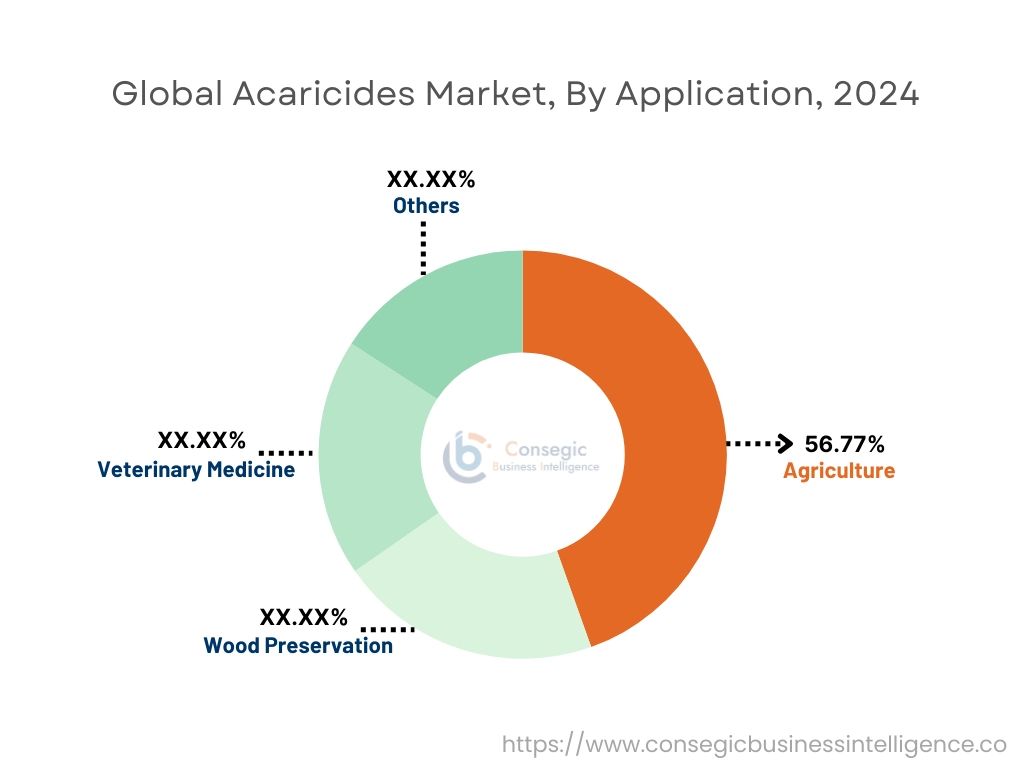
Based on applications, the market is categorized into agriculture, wood preservation, veterinary medicine, and others
Trends in the Application:
- Rise in the trend for preservation of wood products from ticks and mites is influencing the segment
- Rise in the animal husbandry industry is influencing the acaricide use in management of ticks.
The agriculture segment accounted for the largest market share of 56.77% in the year 2024.
- Acaricide is being used in agricultural practices to protect the crops from the damage caused because of mites and ticks.
- These organisms generally feed on the sap of the plants, which causes damage to the leaf’s, flowers and fruits.
- The rise in the crop area influences the use of acaricides to protect the crops from pests such as ticks and mites.
- For instance, according to the data published by the agriwelfare report in 2023, states that the cropped area in India is observed to be 158 million ha, which shows an increase than the previous year.
- Thus, the rise in the use of acaricide agents influences the growth of the segment.
The veterinary medicine segment is expected to grow at the fastest CAGR over the forecast period.
- In veterinary medicine acaricide is used for the proper control and management of ectoparasites such as ticks and mites.
- These parasites generally cause health problems in animals.
- They include conditions such as irritation of the skin, blood related conditions and the transmission of various diseases.
- These agents are administered through numerous routes in the animals such as pour-on, dips, injections, oral medication and sprays.
- They are useful for the management of animal health, preventing the spread of zoonotic diseases, and other conditions caused because of ectoparasites.
- Thus, the rise in the use of acaricides in the management of animal health is propelling the acaricides market trends in the coming years.
Regional Analysis:
The regional segment includes North America, Europe, Asia Pacific, the Middle East and Africa, and Latin America.
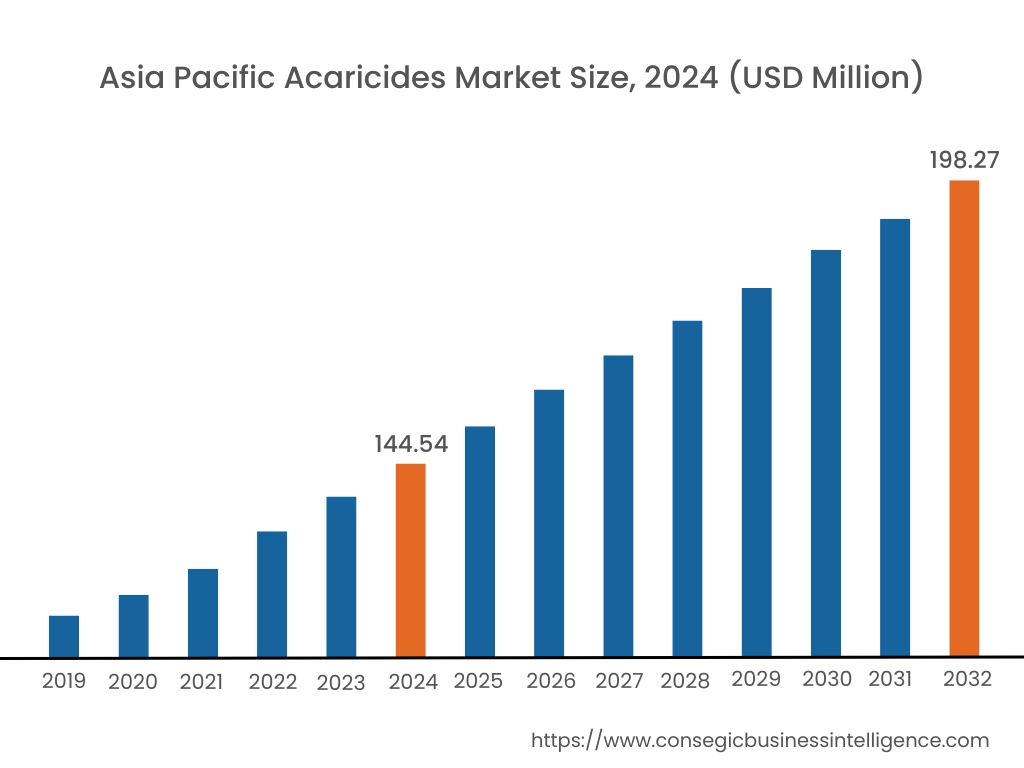
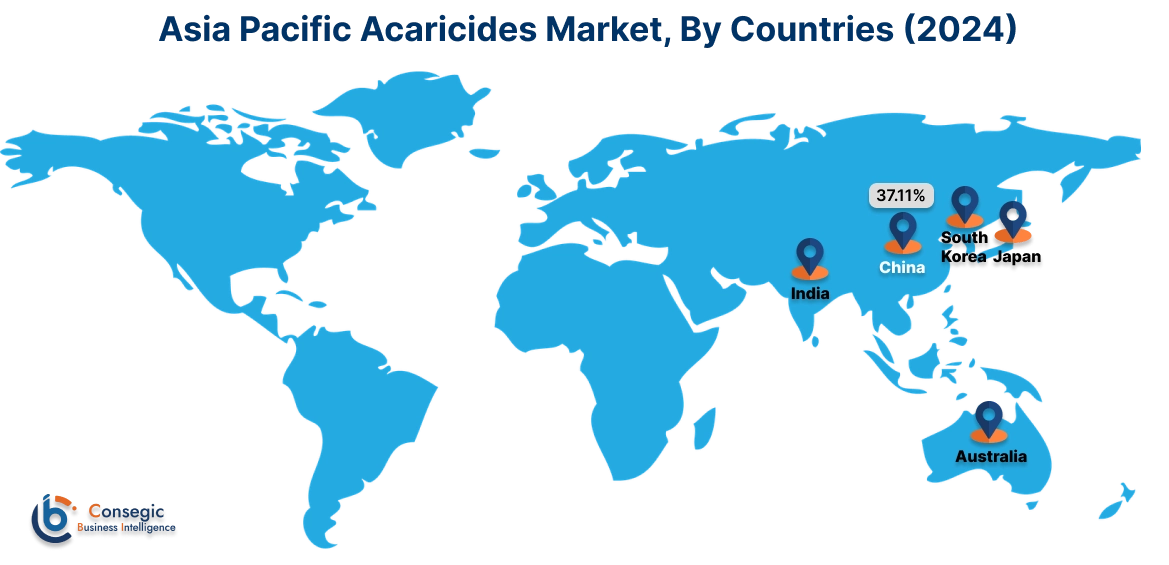
In 2024, Aisa Pacific accounted for the highest market share at 40.12% and was valued at USD 144.54 Million and is expected to reach USD 198.27 Million in 2032. In Asia Pacific, China accounted for the highest market share of 37.11% during the base year of 2024. Asia Pacific dominates the global acaricides market, primarily due to the rapidly accelerating agricultural practices in countries such as China, India, and South Korea. The increasing livestock populations leads to a rise in concerns related to the spread of diseases that are caused because of the infestation of ticks.
The regions consist of a landscape that is favorable for agricultural practices and climatic conditions that makes the crops susceptible to various mite and tick infestations. Manufacturers are developing novel solutions that effectively eradicate infestation of pests.
For instance,
- Arysta LifeScience India, developed PALLID-X which is a novel acaricide solution, that affectively controls various species of mites in India.
Thus, based on the acaricides market analysis, this in turn, is driving the demand for effective acaricide solutions in this region.
North America is experiencing the fastest growth with a CAGR of 6.9% over the forecast period. The use of acaricides in the North America region is characterized by the focus on sustainable solutions and innovation. The market in this region is influenced by the rise in the prevalence of tick-borne disease in animals. Additionally, the rise in the demand for organic and sustainable agricultural practices is influencing the use of acaricides in this region. The Key player present in the North America region mainly includes numerous multinational companies and smaller regional players that focus on the research and development of novel solutions that offer effective solutions against ticks and mites.
Europe presents a significant contribution to the Acaricides market analysis. The European agricultural market is mature, creating constant requirements for agricultural solutions. Additionally, factors that include stringent environmental regulations increase focus on agricultural efficiency. European consumers are environmentally conscious, which is driving requirements for sustainable products. Agricultural manufacturers are responding by incorporating sustainable practices into their production processes, including the use of eco-friendly solutions. European manufacturers and suppliers are at the forefront of technological advancements in preparation of insecticides which further drive the marker trajectory across the region. The regulatory landscape creates potential for the development of sustainable and innovative solutions that adhere to the stringent requirements presented by the government present in this region.
The Middle East and Africa (MEA) region is witnessing notable Acaricides market demand characterized by significant potential. The MEA regions are experiencing rapid industrialization and urbanization, driving significant rises in the agricultural sector. The region is experiencing major development which is driven by awareness about the zoonotic diseases and expanding agricultural activities. Additionally, innovation in spray technology in this region enhances efficacy and reduces the environmental impact of acaricide solutions. In Africa, the focus on the preservation of wood is widely used to protect timber wood from decay and infestation of pests. Thus, as per the market analysis, the aforementioned factors are influencing the acaricides market in the coming years.
Latin America is an emerging region in the Acaricides market share, with significant potential for innovation. The Latin American agriculture sector is experiencing a significant trajectory, driven by increasing disposable incomes, government initiatives, and rising requirements for sustainable solutions. This trend has led to a corresponding increase in the need for these agents that are naturally sourced. Additionally, rapid urbanization and infrastructure development are driving the need for efficient acaricide solutions. The rise in livestock management leads to the requirement of veterinary medicine. This analysis presents a substantial potential for manufacturers and suppliers to capitalize on this burgeoning market and contribute to the region's market demand.
Top Key Players and Market Share Insights:
The Acaricides market is highly competitive with major players providing precise products to the national and international markets. Key players are adopting several strategies in research and development (R&D) and product innovation to hold a strong position in the global Acaricides market. Key players in the Acaricides industry include-
- BASF SE (Germany)
- Bayer AG (Germany)
- NuFarm (Malaysia)
- NIPPON SODA CO., LTD (Japan)
- Nissan Chemical Corporation (Japan)
- CERTIS BELCHIM (United States)
- Sumitomo Chemical Ltd. (Japan)
- Arysta LifeScience (Japan)
- Peptech Biosciences Ltd. (Australia)
- Corteva (United States)
Recent Industry Developments :
Product Launch:
- In November 2024, Alfa Defensivos, introduced a novel product called acaricide Vilora. It is a long residual product that is developed to offer effective management and control of pests such as mites and ticks, without affecting the environment.
- In September 2023, ICAR- Central Island Agricultural Research Institute, Port Blair received a patent for the development of novel acaricide. This development mainly consists of an oil-based herbal topical formulation as an acaricide that is used for the treatment of tick infestation in livestock.
Acaricides Market Report Insights :
| Report Attributes | Report Details |
| Study Timeline | 2019-2032 |
| Market Size in 2032 | USD 533.74 million |
| CAGR (2025-2032) | 5.1% |
| By Type |
|
| By Mode of Application |
|
| By Application |
|
| By Region |
|
| Key Players |
|
| North America | U.S. Canada Mexico |
| Europe | U.K. Germany France Spain Italy Russia Benelux Rest of Europe |
| APAC | China South Korea Japan India Australia ASEAN Rest of Asia-Pacific |
| Middle East and Africa | GCC Turkey South Africa Rest of MEA |
| LATAM | Brazil Argentina Chile Rest of LATAM |
| Report Coverage |
|
Key Questions Answered in the Report
How big is the Acaricides market? −
In 2024, the Acaricides market is USD 360.27 Million.
Which is the fastest-growing region in the Acaricides market? +
North America is the fastest-growing region in the Acaricides market.
What specific segmentation details are covered in the Acaricides market? +
Type, Mode of application, and Application segmentation details are covered in the Acaricides market.
Who are the major players in the Acaricides market? +
BASF SE (Germany), Bayer AG (Germany), and CERTIS BELCHIM (United States) are some of the major players in the market.
Overview
Reputation & Certifications


Our Services
- Market Intelligence & Forecasting
- Custom Research Solutions
- Market Entry Strategy
- Competitive Intelligence
- Customer Insights
- Industry Innovation Analysis
- Investment Advisory