Jump to Content
ISOBUS Component Market - Size, Share, Industry Trends, and Forecasts (2025-2032)
ISOBUS Component Market Size:
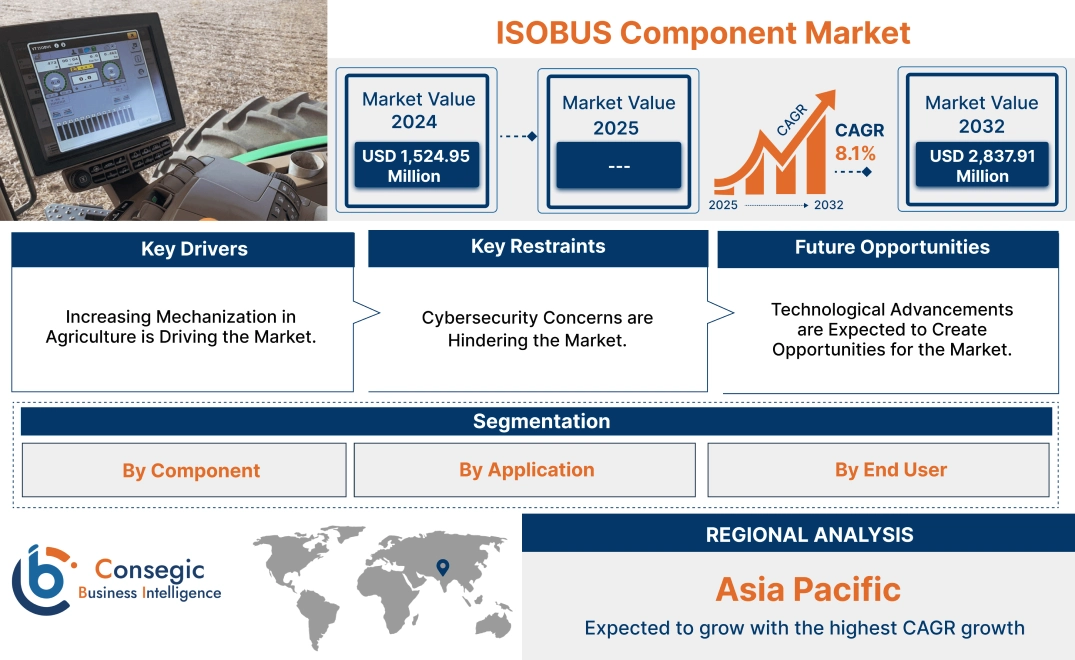
The ISOBUS Component Market size is growing with a CAGR of 8.1% during the forecast period (2025-2032), and the market is projected to be valued at USD 2,837.91 Million by 2032 from USD 1,524.95 Million in 2024.
ISOBUS Component Market Scope & Overview:
ISOBUS is an international standard communication system designed specifically for data interchange between agricultural machinery and implements made by different manufacturers. It is an open standard where data is exchanged between tractors and implements using one single control console. It acts as a serial control and communication data network. ISOBUS falls under the category of ISO 11783 standard intended for agricultural and forestry machinery. ISOBUS includes software and hardware. This communication system is used across various domains such as precision agriculture, crop management, livestock management, etc. The market is influenced by trends in mechanization of agriculture, adoption of precision agriculture, and advancement in technology.
ISOBUS Component Market Dynamics - (DRO) :
Key Drivers:
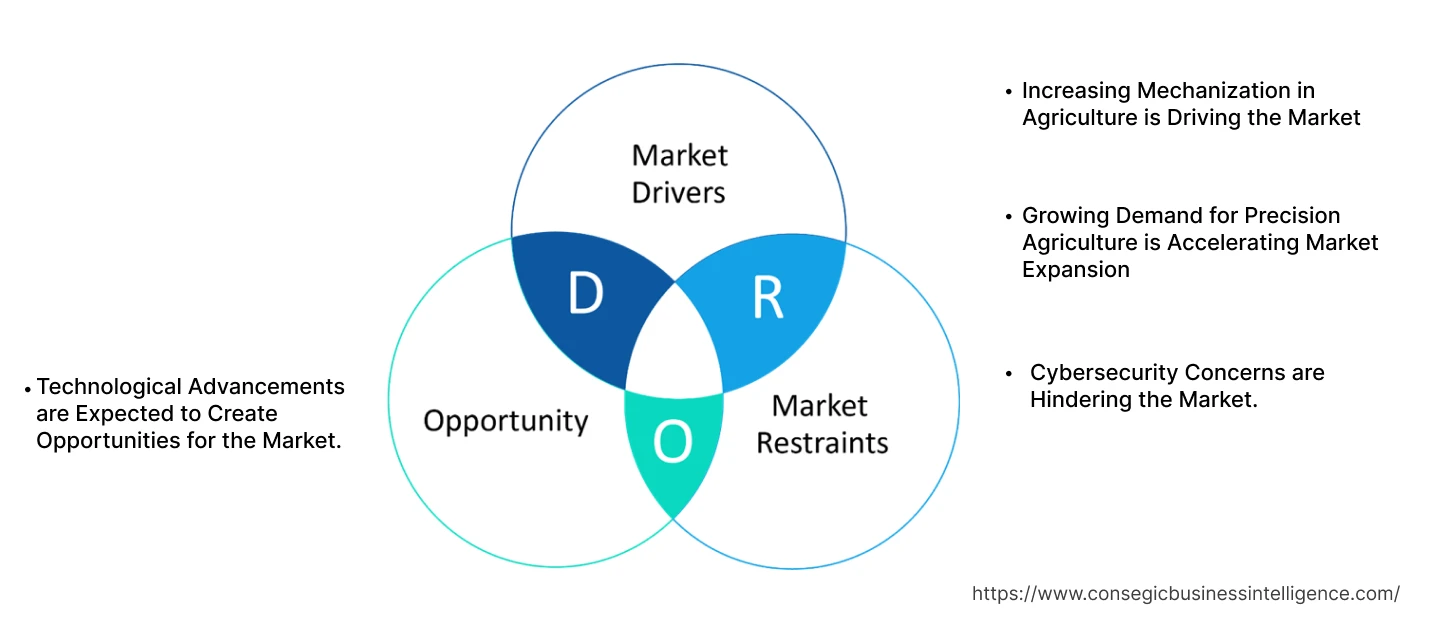
Increasing Mechanization in Agriculture is Driving the Market.
One of the major factors ISOBUS components market growth is influenced is the increasing mechanization of agriculture. Mechanization is the application of machines, tools, and equipment in agriculture. This concept supports the improvement of efficiency in agricultural operations. The adoption of machinery in farming operations raises the need for communication and control components. Hence, automation in agriculture operations is creating a need for ISOBUS components, driven by the increase in mechanization.
- For instance, according to the data published by Government of India Ministry of Agriculture in March 2023, it is stated that, the level of farm mechanization across the India is around 47%.
In summary, due to aforementioned factors ISOBUS component market growth is fuelled by increasing mechanization in agricultural practices.
Growing Demand for Precision Agriculture is Accelerating Market Expansion.
To increase yields and improve resource utilization, farmers are increasingly adopting good agricultural practices. Precision agriculture is based on the ISOBUS system. These applications include resource management, process guidance, strategic planning, variable costing, and more. The ISOBUS option supports efficient and profitable operations through precision agriculture. The market is also being stimulated by the introduction of new precision farming technologies.
- For instance, in September 2024, AGCO Corporation presented launch of PTx, a new brand for its precision ag portfolio. PTx combines precision ag technologies from the cornerstones of AGCO's tech stack: Precision Planting and its newest joint venture (JV), PTx Trimble.
As a result, the market is fueled by the increasing demand for precision agriculture.
Key Restraints:
Cybersecurity Concerns are Hindering the Market.
The timeframe for the introduction of ISOBUS is impacted due to cybersecurity concerns. The ISOBUS system involves the collection and transmission of large amounts of data. This data includes information such as field maps, yield data, and application fees, making it vulnerable to cyberattacks.
Data breaches result in sensitive information being stolen and used by competitors. Equipment used in precision farming is also at risk of theft. In addition, cyber-attacks disrupt the operation of agricultural machinery, harming crop production, equipment failures and security. A cyber-attack causes loss of communication between the tractor and the application and cause the system to malfunction. This leads to equipment failures and poor performance. Therefore, these cyber risks delay the use of ISOBUS products and prevent the widespread use of ISOBUS products. Therefore, these cyberattack risks delay the adoption of ISOBUS component thus hindering the ISOBUS component market expansion.
Future Opportunities :
Technological Advancements are Expected to Create Opportunities for the Market.
Technological advancements are incorporated due to their ability to enhance flexibility and efficiency of the system components. Wireless ISOBUS allows remote monitoring of operations, while the integration of artificial intelligence supports faster decision-making. An advanced user interface makes it easy to use. In addition, the ability of these products to connect to other systems, such as farm management software and cloud platforms, facilitates data sharing and analysis.
- For instance, in March 2024, LEMKEN integrated the complete control of a hoeing machine, including the camera image and width sections into an ISOBUS system for the first time. This supports the provision of convenient and inexpensive solutions to the users.
Hence, considering the aforementioned factors technological advancements present great potential for market trajectory.
ISOBUS Component Market Segmental Analysis :
By Component:
Based on component, the market is categorized into software and hardware.
Trends in the Component:
- The requirements towards the integration of cloud-based software solutions.
- The miniaturization of hardware components is supporting the market trajectory.
The hardware segment accounted for the largest market share in 2024.
- Tangible requirement for ISOBUS systems serves as a major factor for the hardware components. As a result, hardware currently dominates the ISOBUS component market demand.
- Primary hardware components in the ISOBUS systems include universal terminals, electronic control units, connectors, actuators, input devices, and others. The increasing mechanization of farming is creating higher demand for hardware components.
- For instance, as per analysis published in Journal Elsevier in May 2024, mechanization in crop growing, including land cultivation, sowing and harvesting, reached 72.03 % in China in 2021, mechanization in wheat, rice and corn production was as high as 97.29%, 85.59% and 90%, respectively.
- Additionally, automation in agriculture including autonomous tractors and implements creates the requirement for these components.
- Therefore, above-mentioned factors position the hardware segment as a dominant one in the ISOBUS component market share.
The software segment is expected to grow at the fastest CAGR over the forecast period.
- Software components comprise of communication protocols, operating systems, and application software.
- The software segment is expected to grow at a higher rate due to several key factors. One of the prominent factors supporting the supporting segment trajectory is the advancements in software features.
- Additionally, software’s provide improved data collection. The growth in the connectivity of ISOBUS with help software components is creating trajectory for the segment in the coming years.
- Moreover, awareness related to the significance of precision farming creates the demand for software solutions for automation in tasks. Therefore, these advancements in ISOBUS components are expected to support the market trajectory.
By Application:
The application segment is categorized into precision agriculture, crop management, livestock management, and others.
Trends in the Application
- Increasing trends towards sustainability in agricultural practices drives adoption.
- Automation in feeding systems for precise feed delivery based on animal needs.
The precision agriculture segment accounted for the largest market share of 41.23% in 2024.
- Precision agriculture holds the dominant position in the ISOBUS component market. This includes a diverse range of precision agriculture applications such as guidance systems, variable rate application (VRA), and section control for exchange of data and control.
- VRA adopted with ISOBUS supports increased accuracy via sensor integration whereas section control minimizes gaps and overlaps. Additionally, guidance systems help automation in steering with advancements in GPS technology.
- Several factors are driving the trajectory for the segment. Government support for precision farming is a prominent factor.
- For instance, in February 2022, Minister of Agriculture and Agri-Food, announced funding of USD 875,000 to Ukko Agro Inc. for precision agriculture to enhance competitiveness and efficiency.
- Thus, due to the widespread adoption of precision farming technologies, the precision agriculture segment is the dominating one.
Crop management segment is expected to grow at the fastest CAGR over the forecast period.
- The crop management segment is expected to experience fastest growth rate in the forecast period, fueled by necessity for efficient crop production.
- ISOBUS components are used in several crop management activities. This includes planting, harvesting, tillage, and weed control amongst others.
- In planting, this system helps seed placement and row spacing, whereas in harvesting it allows grain uploading.
- Additionally, ISOBUS supports in the control of tillage depth and implement settings. In weed control applications, these components help in the automated weed detection and targeted herbicide applications.
- Collectively, several factors such as growing emphasis on sustainable farming practices are expected to create ISOBUS component market opportunities.

By End User:
Based on end user, the market is categorized into OEM and aftermarket suppliers.
Trends in the End User:
- The OEMs are heavily involved in integrating ISOBUS technology into their new tractor and implement models as a standard feature.
The OEM segment accounted for the largest market share in 2024 and is expected to grow at the fastest CAGR in the forecast period.
- Original equipment manufacturers (OEM) are among the primary users of ISOBUS components. OEMs hold large portion in ISOBUS component market due to their dominance in agricultural equipment.
- OEMs are involved in the manufacturing of tractors and implements. Hence, they are majorly involved in ISOBUS technology for incorporation of compliant electronic component units and connectors into their manufacturing processes.
- Growing agricultural production creates higher requirements for standard protocols in agriculture equipment.
- For instance, according to the data published by the Food and Agriculture Organization global production of primary crops reached 9.9 billion tonnes in 2023, increasing by 3% since 2022.
- Furthermore, OEMs are also involved in the adoption technological advancements in ISOBUS. They invest heavily in research and development to integrate advanced technologies in turn driving the ISOBUS Component market trends.
Regional Analysis:
The regions covered are North America, Europe, Asia Pacific, the Middle East and Africa, and Latin America.
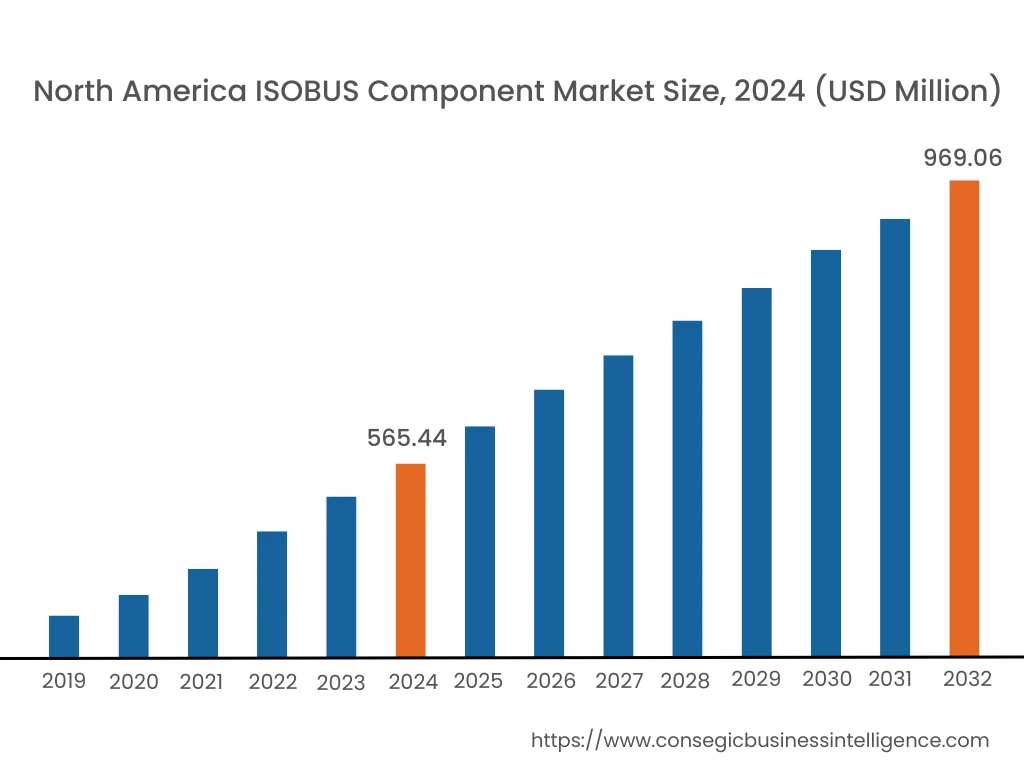
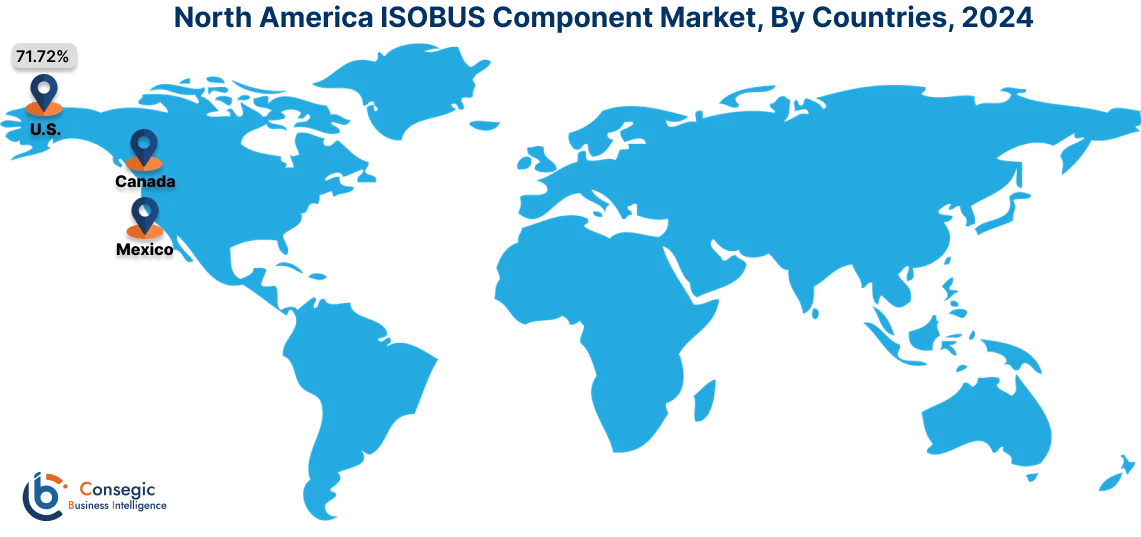
In 2024, North America accounted for the highest market share at 37.08% and was valued at USD 565.44 Million and is expected to reach USD 969.06 Million in 2032. In North America, the U.S. accounted for the highest market share of 71.72% during the base year of 2024. The North America region serves as a major region across the global ISOBUS component market. The market trajectory across the region is attributed to the adoption of advanced agricultural practices. The countries across North America present high level of mechanization in agriculture industry. The mechanization in farming creates a high requirement for ISOBUS. The region also presents technological progress in agriculture, which encompasses innovations in processes, and systems supports. Additionally, the adoption of advanced farming practices such as precision agriculture supports the market.
- For instance, in May 2024, The US Department of Agriculture partnered with the University of Nebraska-Lincoln to collaborate on precision agriculture research center.
Hence, the analysis of the aforementioned factors and trends is driving growth in the North America ISOBUS component market trend.
Asia Pacific is experiencing the fastest growth with a CAGR of 9.96% over the forecast period. The ISOBUS component market across the region is driven by factors such as the region's large agricultural sector. Countries including China and India are large agricultural economies. This makes them prominent consumers of these components. Additionally, the region is increasingly focusing on the adoption of mechanization in agriculture. Moreover, there is increasing emphasis on sustainable farming practices across the region. The combination of the aforementioned factors and trends is driving substantial growth in ISOBUS component market expansion.
The European market is characterized by high emphasis on sustainable agriculture. Europe presents a well-established contribution to the ISOBUS component market analysis. The region has a diverse agricultural landscape, including horticulture, and specialty crops. European consumers are increasingly demanding sustainably produced food, and this is driving farmers to adopt more environmentally friendly farming methods. This has driven the development of more sustainable and environmentally friendly agricultural mechanization solutions including ISOBUS component. Moreover, the European Union’s presents stringent regulations. Furthermore, the focus on improving agricultural practices contributes to the market.
The Middle East and Africa (MEA) region is experiencing high ISOBUS component market demand characterized by significant potential. The government bodies across the region are promoting investments in agricultural industry development and production. Additionally, the region is also witnessing adoption of modern farming practices. This includes mechanization and precision agriculture. Collectively, this analysis creates ISOBUS component market opportunities.
Latin America presents an agricultural landscape, characterized by diverse crops and climatic conditions. The favorable climate across the region and vast arable land makes it an appropriate environment for the agriculture industry. This drives the requirement for effective agricultural solutions. Many countries across the region are focusing on expanding agricultural exports. This requires increased productivity and efficiency in farming operations. Hence, it drives the adoption of modern technologies further contributing to ISOBUS component market analysis.
Top Key Players and Market Share Insights:
The global ISOBUS Component Market is highly competitive with major players providing products to the national and international markets. Key players are adopting several strategies in research and development (R&D) and product innovation to hold a strong position in the global ISOBUS Component market. Key players in the ISOBUS Component industry include-
- AMAZONEN-WERKE H. DREYER SE & Co. KG (Germany)
- Hexagon AB (Sweden)
- Trimble Inc. (U.S.)
- PÖTTINGER Landtechnik GmbH (Austria)
- John Deere (U.S.)
- Promwad (Germany)
- B&R (U.S.)
- Farmscan Ag Ltd (Australia)
- KUHN SAS (France)
- Topcon (Japan)
ISOBUS Component Market Report Insights :
| Report Attributes | Report Details |
| Study Timeline | 2018-2032 |
| Market Size in 2032 | USD 2,837.91 Million |
| CAGR (2025-2032) | 8.1% |
| By Component |
|
| By Application |
|
| By End User |
|
| By Region |
|
| Key Players |
|
| North America | U.S. Canada Mexico |
| Europe | U.K. Germany France Spain Italy Russia Benelux Rest of Europe |
| APAC | China South Korea Japan India Australia ASEAN Rest of Asia-Pacific |
| Middle East and Africa | GCC Turkey South Africa Rest of MEA |
| LATAM | Brazil Argentina Chile Rest of LATAM |
| Report Coverage |
|
Key Questions Answered in the Report
How big is the ISOBUS Component market? −
In 2024, the ISOBUS Component market is USD 1,524.95 Million.
Which is the fastest-growing region in the ISOBUS Component market? +
Asia Pacific is the fastest-growing region in the ISOBUS Component market.
What specific segmentation details are covered in the ISOBUS Component market? +
By Component, Application, and End User segmentation details are covered in the ISOBUS Component market.
Who are the major players in the ISOBUS Component market? +
AMAZONEN-WERKE H. DREYER SE & Co. KG (Germany), Hexagon AB (Sweden), Trimble Inc. (U.S.), PÖTTINGER Landtechnik GmbH (Austria) are some of the major players in the market.
Overview
Reputation & Certifications


Our Services
- Market Intelligence & Forecasting
- Custom Research Solutions
- Market Entry Strategy
- Competitive Intelligence
- Customer Insights
- Industry Innovation Analysis
- Investment Advisory