Jump to Content
Aquaculture Equipment Market - Size, Share, Industry Trends, and Forecasts (2025-2032)
Aquaculture Equipment Market Size:
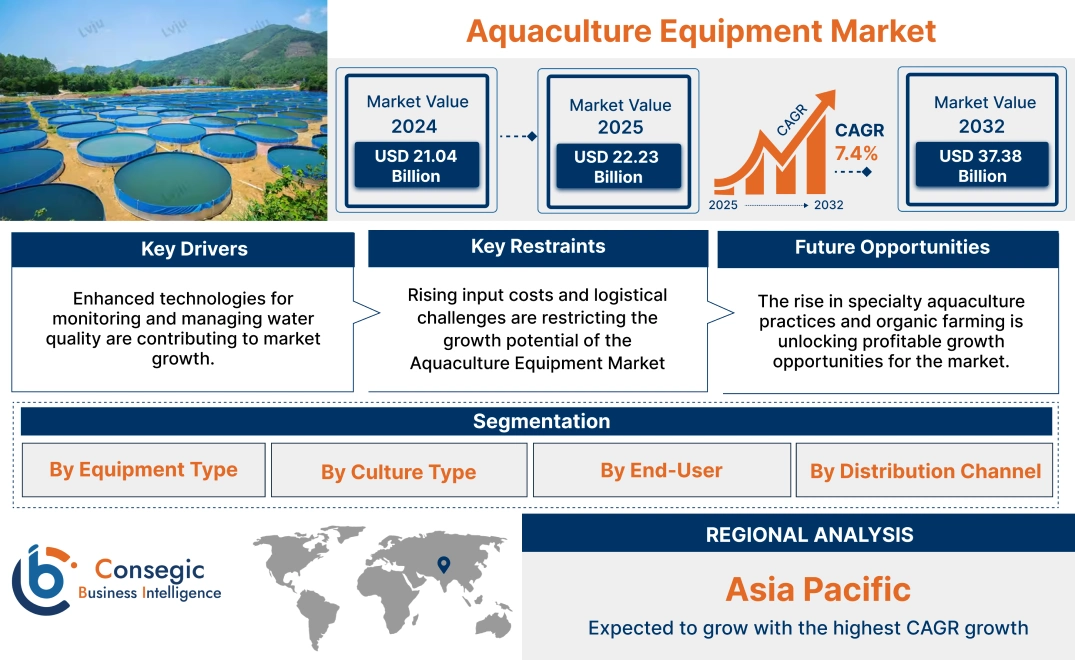
Aquaculture Equipment Market size is estimated to reach over USD 37.38 Billion by 2032 from a value of USD 21.04 Billion in 2024 and is projected to grow by USD 22.23 Billion in 2025, growing at a CAGR of 7.4% from 2025 to 2032.
Aquaculture Equipment Market Scope & Overview:
Aquaculture equipment includes a wide range of specialized tools and systems designed to support the controlled cultivation of aquatic species such as fish, crustaceans, and mollusks in marine or freshwater environments. These systems are tailored to ensure optimal water quality, feeding, containment, and health monitoring across various production settings including open-net pens, recirculating aquaculture systems (RAS), and pond-based operations.
Common equipment includes aerators to increase oxygen in the water, automatic feeders, filters to clean the water, protective net cages, sorting devices, and sensors that track water conditions like pH, temperature, and ammonia. Some setups also use automated cleaning systems and digital controllers to reduce manual work and improve accuracy. The materials used vary depending on the purpose, with options like rust-resistant plastics or food-grade stainless steel for areas needing high hygiene standards.
This equipment helps maintain a stable environment, supports high-density operations, and ensures proper care of stock in managed farming systems. End-users include fish farms, hatcheries, land-based aquaculture sites, and research centers that need dependable equipment for raising aquatic species.
Key Regional Insights
- Asia Pacific market valued at USD 7.00 billion (2024) and expected to reach USD 12.60 billion by 2032, led by China (36.4% share)
- Growth driven by high seafood demand in China, India, and Thailand, along with advanced aquaculture technologies
- North America growing due to adoption of precision aquaculture technologies in United States and Canada
- Europe, Middle East & Africa, and Latin America driven by sustainability, water management, and modernization of aquaculture practices
Aquaculture Equipment Market Dynamics - (DRO) :
Key Drivers:
Enhanced technologies for monitoring and managing water quality are contributing to market growth.
Water is the key component of aquaculture and improving the water quality have made innovations in filtration, oxygenation, and monitoring systems essential in the aquaculture market. Ensuring optimal water conditions is critical for fish health and development, positioning water quality management as a primary focus for farmers. In response to this, manufacturers are developing advanced sensors and filtration technologies that enable continuous, real-time monitoring of key water parameters including pH, temperature, and dissolved oxygen levels. Additionally, these technologies provide valuable insights, enabling farmers to manage water quality more effectively and adjust conditions as needed. This leads to healthier fish stocks, improved yields, and reduced mortality rates.
- For instance, in December 2024, Xylem announced that it has acquired majority of the stakes of Idrica, a water data management and analytics leader. The partnership combines Xylem’s water technology expertise with Idrica’s software and analytics capabilities, enabling utilities to optimize performance, improve resilience, and enhance service. The collaboration will also expand the global availability of GoAigua, which integrates data from across water utility systems to support smarter operations.
As the industry moves towards more data-driven, precision farming techniques, the integration of real-time monitoring solutions is becoming a standard practice in aquaculture. This growing reliance on technology to manage water quality majorly drives the aquaculture equipment market growth.
Key Restraints:
Rising input costs and logistical challenges are restricting the growth potential of the Aquaculture Equipment Market
Limited availability of high-grade materials required for advanced aquaculture systems is emerging as a bottleneck, restricting timely production and deployment of essential equipment. These materials are critical for the construction of durable and effective equipment, but fluctuations in their availability and cost are creating challenges for manufacturers. Moreover, when raw material shortages or price hikes occur, production delays are common, which leads to higher equipment costs for producers and, ultimately, increases prices for farmers. In regions with limited budgets or small-scale farms, these rising costs can be a significant barrier to adopting advanced equipment. This issue further exacerbates the affordability and accessibility of high-quality solutions for aquaculture, particularly in emerging markets or countries where financial constraints prevent farmers from upgrading to modern equipment subsequently impeding market progress.
Future Opportunities :
The rise in specialty aquaculture practices and organic farming is unlocking profitable growth opportunities for the market.
Consumer preferences are increasingly favoring healthier and more sustainable food choices, driving a notable rise in the demand for organically farmed seafood. As consumers increasingly seek pesticide-free, hormone-free, and non-GMO seafood, aquaculture farms are shifting their focus toward organic production practices. This opens a specialized market for equipment manufacturers to develop innovative solutions tailored to the unique needs of organic aquaculture. Additionally, there is a growing need for systems that reduce environmental impact, eliminate chemical usage, and meet strict organic certification standards while ensuring optimal production efficiency. As the global organic food market continues to expand, the need for advanced, sustainable aquaculture technologies is expected to grow in parallel. This creates a valuable opportunity for manufacturers to invest in product development that supports ethical and environmentally responsible farming practices, significantly boosting aquaculture equipment market opportunities.
Aquaculture Equipment Market Segmental Analysis :
By Equipment Type:
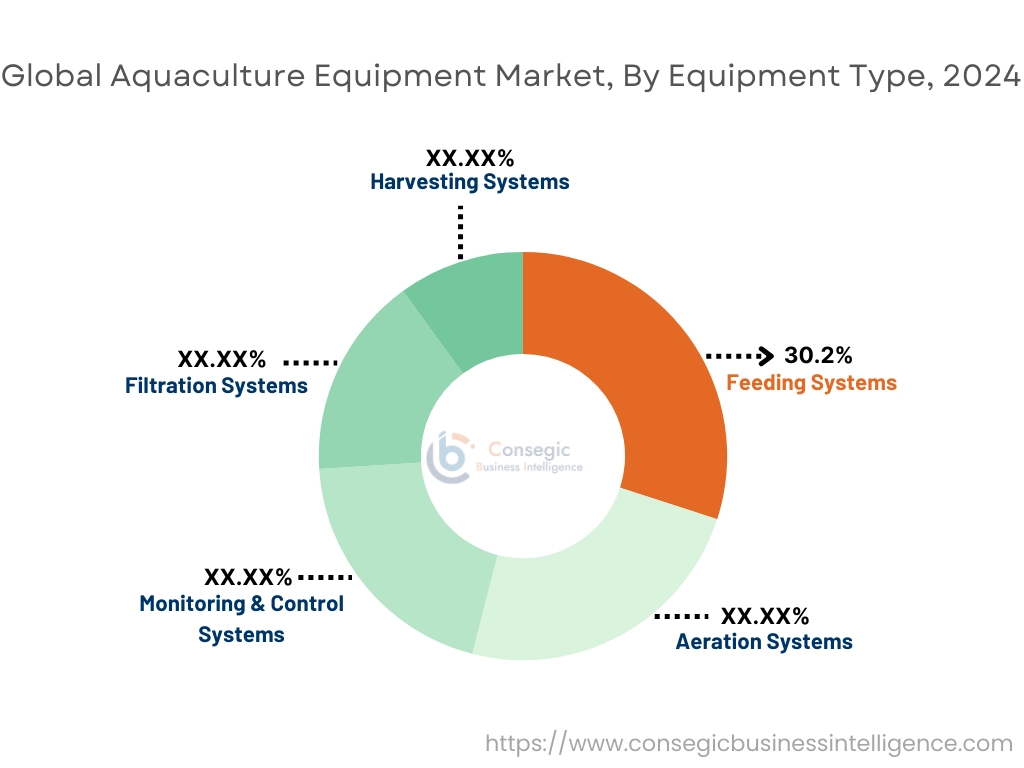
Based on Equipment Type, the market is categorized into feeding systems, aeration systems, monitoring & control systems, filtration systems, and harvesting systems.
The Feeding Systems segment holds the largest revenue of the overall Aquaculture Equipment Market share of 30.2% in the year 2024.
- Feeding accounts for 50–60% of operational costs in aquaculture, making efficient feeding systems a top priority for ROI and biomass yield.
- Automatic feeders reduce labor costs, improve feed conversion ratios, and prevent overfeeding-induced water degradation.
- Additionally, OEMs offer programmable feeders with timers, vibration-based distribution, and solar integration for intensive pond farms and cage-based salmon production, where uniform feed delivery is critical.
- According to the aquaculture equipment market analysis, the operational significance of feeding systems and large-scale deployment make it the largest segment, fueling the aquaculture equipment market trends.
The Monitoring & Control Systems segment is expected to grow at the fastest CAGR during the forecast period.
- This segment includes centralized data loggers, mobile-accessible dashboards, and sensor-actuator integrations for aquaculture automation.
- These systems are used in both RAS and open systems, these technologies provide feedback loops for adjusting aeration, feeding, and waste filtration in real time.
- Additionally, advanced systems leverage AI for trend prediction and anomaly detection to mitigate disease and mortality risk.
- As per the market analysis, efficient monitoring and rising advances in aquaculture farming techniques, fuel the global aquaculture equipment market trends.
By Culture Type:
Based on Culture Type, the market is categorized into freshwater aquaculture, marine aquaculture, and brackish water aquaculture.
The Freshwater Aquaculture segment holds the largest revenue of the overall Aquaculture Equipment Market share in the year 2024.
- Freshwater aquaculture dominates global production volumes, particularly in Asia, which accounts for over 80% of global fish farming, mainly of species like carp, catfish, and tilapia.
- Equipment used in this segment includes earthen pond systems, paddlewheel aerators, cage netting, and low-cost feeders adapted for inland use.
- Due to lower capital requirements and established farming techniques, freshwater aquaculture consistently maintains the highest demand for infrastructure and operational equipment.
- According to the aquaculture equipment market analysis, due to the growing need in regions with high freshwater supply, freshwater aquaculture contribute to the largest market share, significantly fueling the market growth.
The Marine Aquaculture segment is expected to grow at the fastest CAGR during the forecast period.
- Marine aquaculture involves the cultivation of high-value species like salmon, seabass, mussels, and shrimp in coastal or open ocean environments.
- Adoption of marine aquaculture is driven by rising seafood need, stagnant wild fish capture, and government support for offshore production capacity expansion.
- Technologically advanced systems including floating cages, RAS integration, and remote environmental control units are increasingly deployed in coastal regions.
- For instance, in August 2023, AKVA group Sperre ROV Technology, based in Notodden, Norway, announced their new remotely operated vehicle (ROV) lineup. It is a mini-fighter, a lightweight and a hand-operated ROV, complementing the existing ROV portfolio. With this cost effective solution, the group aims in providing marine fish farmers when it comes to replacing and servicing thrusters.
- The rising technological advancements and growing seafood consumption have substantially driven the global aquaculture equipment market demand.
By End-User:
Based on End-User, the market is categorized into commercial fish farms, hatcheries & nurseries, aquaculture cooperatives, research & academic institutions, and others.
The Commercial Fish Farms segment holds the largest revenue share of the overall Aquaculture Equipment Market in the year 2024.
- Commercial fish farms are the largest buyers of aquaculture equipment due to their scale, frequency of replacement, and consistent infrastructure investment cycles.
- These farms utilize a range of systems, from aerators and feeders to sensors and cage structures for efficient and scalable production of species like tilapia, carp, salmon, and catfish.
- Investments in semi-automated feeding systems and water quality monitoring are common, particularly as farms adopt more data-driven operations.
- Thus, the high demand in commercial aquaculture farms and consistent revenue flow in these farms significantly drives the market.
The Hatcheries & Nurseries segment is expected to grow at the fastest CAGR during the forecast period.
- Hatcheries and nurseries are growing rapidly due to the rising need for high-quality fingerlings and improved breeding success rates.
- These facilities require specialized tanks, water treatment systems, temperature regulators, and gentle flow control devices to maintain sensitive early-life-stage environments.
- Increasing emphasis on genetic selection and pathogen-free stock is leading to expanded investments in controlled hatchery environments.
- For instance, in March 2024, INVE Aquaculture announced that their collaboration with Sustainable Shrimp Partnership (SSP) and the National Chamber of Aquaculture (CNA) , they have launched the new Scale Up Programme for Shrimp Hatcheries from SSP.
- According to the market analysis, the shifting emphasis toward bio-secure, climate-controlled fish production in hatcheries is significantly fueling the global aquaculture equipment market expansion.
By Distribution Channel:
Based on Distribution Channel, the market is categorized into direct sales, distributors, online retail, and government procurement.
The Direct Sales segment holds the largest revenue share of the overall Aquaculture Equipment Market in the year 2024.
- Most medium-to-large aquaculture businesses procure equipment directly from manufacturers or OEM partners to ensure product compatibility and after-sales support.
- Direct sales offer customized solutions, including system design, site integration, and bundled service packages, which are valued by commercial operations.
- With the growing complexity of aquaculture systems like RAS and IoT-integrated monitoring, direct sales provide critical consulting and technical guidance.
- Thus, the market analysis shows that high demand among mid to large-scale farmers and growing technological advances in the equipment, significantly drives the market trends.
The Online Retail segment is expected to grow at the fastest CAGR during the forecast period.
- Online platforms are emerging rapidly for procurement of smaller-scale, modular, and portable aquaculture tools and components.
- Online platforms allow direct-to-farm delivery in rural and semi-urban areas, reducing lead times and overhead.
- Additionally, independent operators, cooperatives, and emerging hatchery businesses increasingly use e-commerce to access cost-effective aerators, feeders, and water analyzers.
- According to the market analysis, the shifting trend towards online retail shopping and digital transformation is significantly fueling the global aquaculture equipment market expansion.
Regional Analysis:
The regions covered are North America, Europe, Asia Pacific, Middle East and Africa, and Latin America.
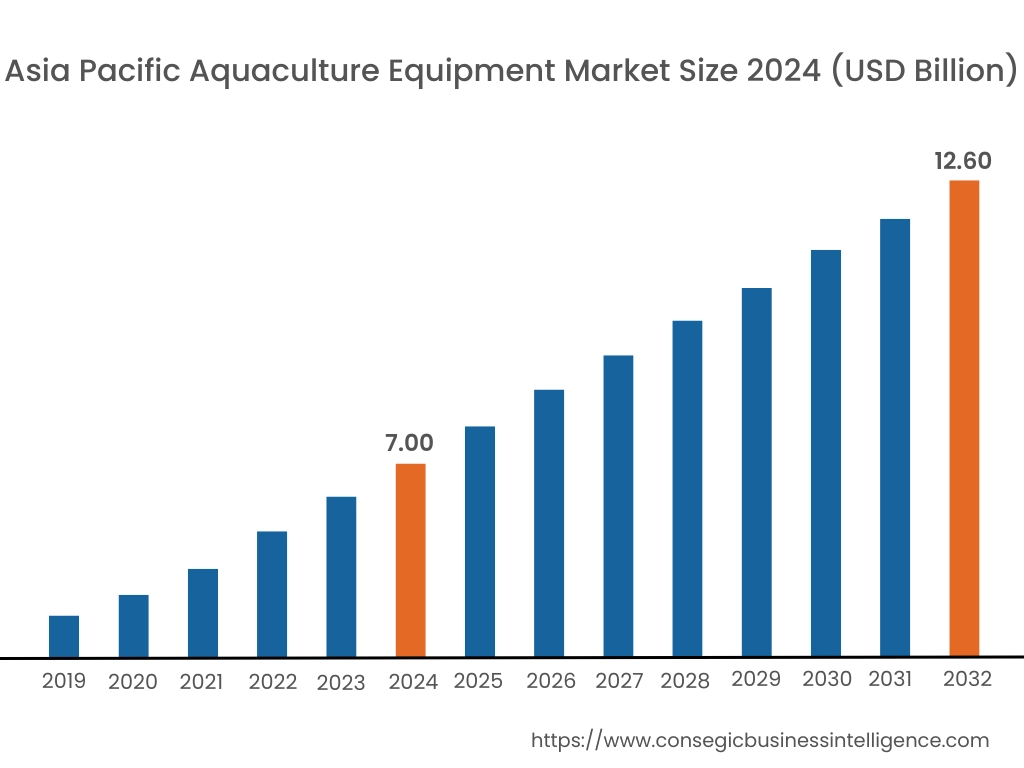
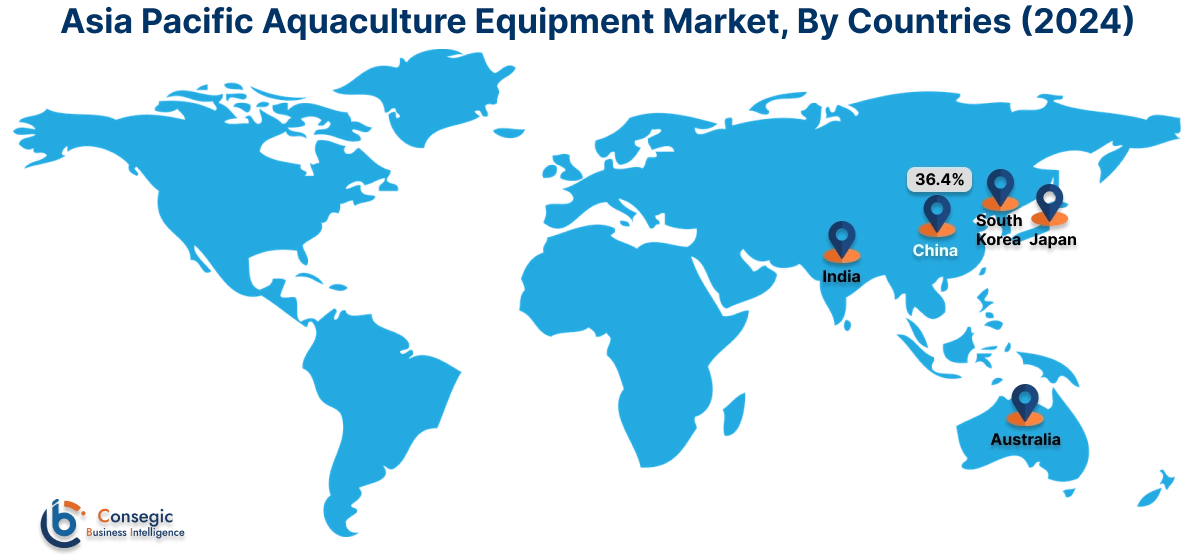
Asia Pacific region was valued at USD 7.00 Billion in 2024. Moreover, it is projected to grow by USD 7.41 Billion in 2025 and reach over USD 12.60 Billion by 2032. Out of this, China accounted for the maximum revenue share of 36.4%.
Asia-Pacific region is predominated by high demand for seafood in countries like China, India and Thailand leading to the growing interest for smart, technology‑driven solutions. The development of locally adapted systems that combine advanced sensors with automated control to optimize irrigation and nutrient management across diverse climatic zones is propelling the market. Additionally, the deployment of sophisticated data analytics to fine‑tune production processes in high‑intensity farming favors market growth.
- For instance, in June 2024, according to a report published by FAO , Asia contributed 167.1 million tonnes to global fisheries and aquaculture production, representing 75 percent of the total worldwide output. The region dominates production, accounting for 70 percent of the world’s aquatic animal supply and 97 percent of global algae output.
Furthermore, the proactive government initiatives and strategic collaborations between international tech providers and local aquaculture communities have significantly driven the aquaculture equipment market demand.
North America is estimated to reach over USD 11.02 Billion by 2032 from a value of USD 6.18 Billion in 2024 and is projected to grow by USD 6.53 Billion in 2025.
In North America, the market is influenced by the shift toward high‑precision equipment that improves water quality management, feed distribution, and overall harvest efficiency in leading countries like United States and Canada. Notable trends like the use of integrated sensor networks that monitor environmental factors in real time and the incorporation of modular equipment designed to be adaptable to different farming setups are boosting the market.
- For instance, in July 2024, INVE Aquaculture announced a strategic partnership with Reed Mariculture Inc. for the U.S. and Canadian markets. This collaboration aims to enhance access to INVE’s full product portfolio, including early-stage nutrition, health, and environmental solutions for hatcheries and nurseries.
Furthermore, the strong emphasis on sustainability and regulatory compliance have significantly driven the aquaculture equipment industry in this region.
Europe exhibits a strong presence in the market due to the robust focus on modernizing aquaculture with advanced equipment tailored to both marine and freshwater systems. Additionally, the adoption of energy‑efficient and eco‑friendly systems that enhance production while preserving environmental quality drives market development. Furthermore, analysis of the market showed that stringent environmental regulations and industry-wide commitment to sustainable practices have significantly boosted the aquaculture equipment market in this region.
The aquaculture equipment market in the Middle East and Africa experiences steady growth mainly due to the challenges posed by arid climates and water scarcity. An emerging trend is the design of robust equipment that can withstand harsh environmental conditions while ensuring efficient water management, and the customization of technology to suit smaller-scale, community-focused aquaculture practices propels market progress. Furthermore, targeted policy support and strategic investments in modern water management infrastructure have fueled the aquaculture equipment market in this region.
In Latin America, the shifting trend for transforming aquaculture operations by adopting advanced equipment tailored to diverse agricultural settings in countries like Brazil and Chile fuels market progress. Prominent use of sensor‑integrated systems that offer real‑time insights into water conditions and the development of user‑friendly, robust technologies designed for varied climatic conditions is further propelling the market. Analysis of the market showed that initiatives to modernize aquaculture practices and improved resource management drives aquaculture equipment market growth in this region.
Top Key Players and Market Share Insights:
The Aquaculture Equipment Market is highly competitive with major players providing products and services to the national and international markets. Key players are adopting several strategies in research and development (R&D), product innovation, and end-user launches to hold a strong position in the global Aquaculture Equipment Market. Key players in the Aquaculture Equipment industry include -
- AKVA Group (Norway)
- ScaleAQ (Norway)
- AquaMaof Aquaculture Technologies (Israel)
- OysterGro (Canada)
- Global Aquaculture Supply (United States)
- Innovasea (United States)
- Pentair Aquatic Eco-Systems (United States)
- Xylem Inc. (United States)
- Aquaculture Equipment Ltd. (United Kingdom)
- INVE Aquaculture (Belgium)
Recent Industry Developments :
Partnerships:
- In November 2024, ScaleAQ signed a service agreement with KSS , an established company in maritime and aquaculture industries, which will allow the storage of essential spare parts and maintenance services for ScaleAQ products. This partnership will strengthen ScaleAQ’s presence in the Faroe Islands by providing faster operations and reliable support.
Aquaculture Equipment Market Report Insights:
| Report Attributes | Report Details |
| Study Timeline | 2019-2032 |
| Market Size in 2032 | USD 37.38 Billion |
| CAGR (2025-2032) | 7.4% |
| By Equipment Type |
|
| By Culture Type |
|
| By End-User |
|
| By Distribution Channel |
|
| By Region |
|
| Key Players |
|
| North America | U.S. Canada Mexico |
| Europe | U.K. Germany France Spain Italy Russia Benelux Rest of Europe |
| APAC | China South Korea Japan India Australia ASEAN Rest of Asia-Pacific |
| Middle East and Africa | GCC Turkey South Africa Rest of MEA |
| LATAM | Brazil Argentina Chile Rest of LATAM |
| Report Coverage |
|
Key Questions Answered in the Report
How big is the Aquaculture Equipment Market? −
Aquaculture Equipment Market size is estimated to reach over USD 37.38 Billion by 2032 from a value of USD 21.04 Billion in 2024 and is projected to grow by USD 22.23 Billion in 2025, growing at a CAGR of 7.4% from 2025 to 2032.
What specific segments are covered in the Aquaculture Equipment Market? +
The Aquaculture Equipment Market specific segments for Equipment Type, Culture Type, End-Users, Distribution Channel, and Region.
Which is the fastest-growing region in the Aquaculture Equipment Market? +
Asia pacific is the fastest growing region in the Aquaculture Equipment Market.
What are the major players in the Aquaculture Equipment Market? +
The key players in the Aquaculture Equipment Market are AKVA Group (Norway), ScaleAQ (Norway), AquaMaof Aquaculture Technologies (Israel), Innovasea (United States), Pentair Aquatic Eco-Systems (United States), Xylem Inc. (United States), Aquaculture Equipment Ltd. (United Kingdom), INVE Aquaculture (Belgium), OysterGro (Canada), Global Aquaculture Supply (United States), and others.
Overview
Reputation & Certifications


Our Services
- Market Intelligence & Forecasting
- Custom Research Solutions
- Market Entry Strategy
- Competitive Intelligence
- Customer Insights
- Industry Innovation Analysis
- Investment Advisory