Jump to Content
Aquaculture Fertilizer Market - Size, Share, Industry Trends, and Forecasts (2025-2032)
Aquaculture Fertilizer Market Size:
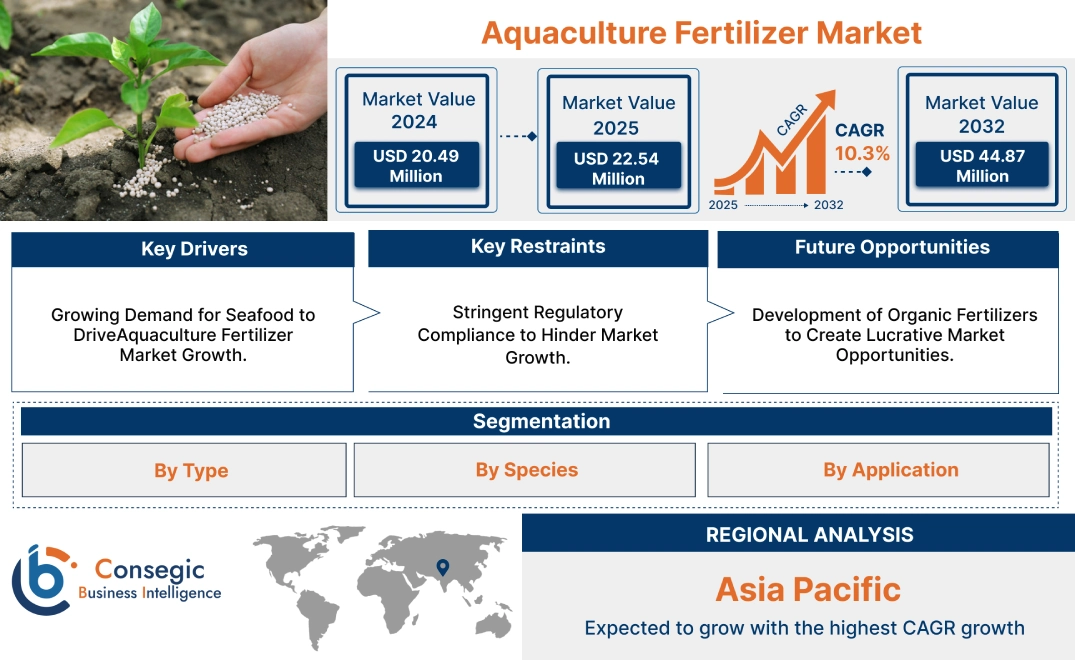
The Aquaculture Fertilizer Market size is growing with a CAGR of 10.3% during the forecast period (2025-2032), and the market is projected to be valued at USD 44.87 Million by 2032 from USD 20.49 Million in 2024. Additionally, the market value for 2025 attributed to USD 22.54 Million.
Aquaculture Fertilizer Market Scope & Overview:
Aquaculture fertilizers are substances added to aquaculture systems to enhance the growth of phytoplankton and zooplankton. This stimulates the food web that leads to the production of fishes, crustaceans, molluscs, and other species. There are several types of aquaculture fertilizers, including nitrogen fertilizers, phosphate fertilizers, potassium fertilizers, and others. Aquaculture fertilizers provide both macronutrients including nitrogen, phosphorus, potassium and micronutrients such as calcium, magnesium, sulfur, iron, and zinc necessary for healthy growth. The benefits of using these fertilizers include increased productivity, enhanced growth rates, improved water quality through phytoplankton growth and oxygenation, and cost-effectiveness compared to relying on formulated feeds.
Aquaculture Fertilizer Market Dynamics - (DRO) :
Key Drivers:
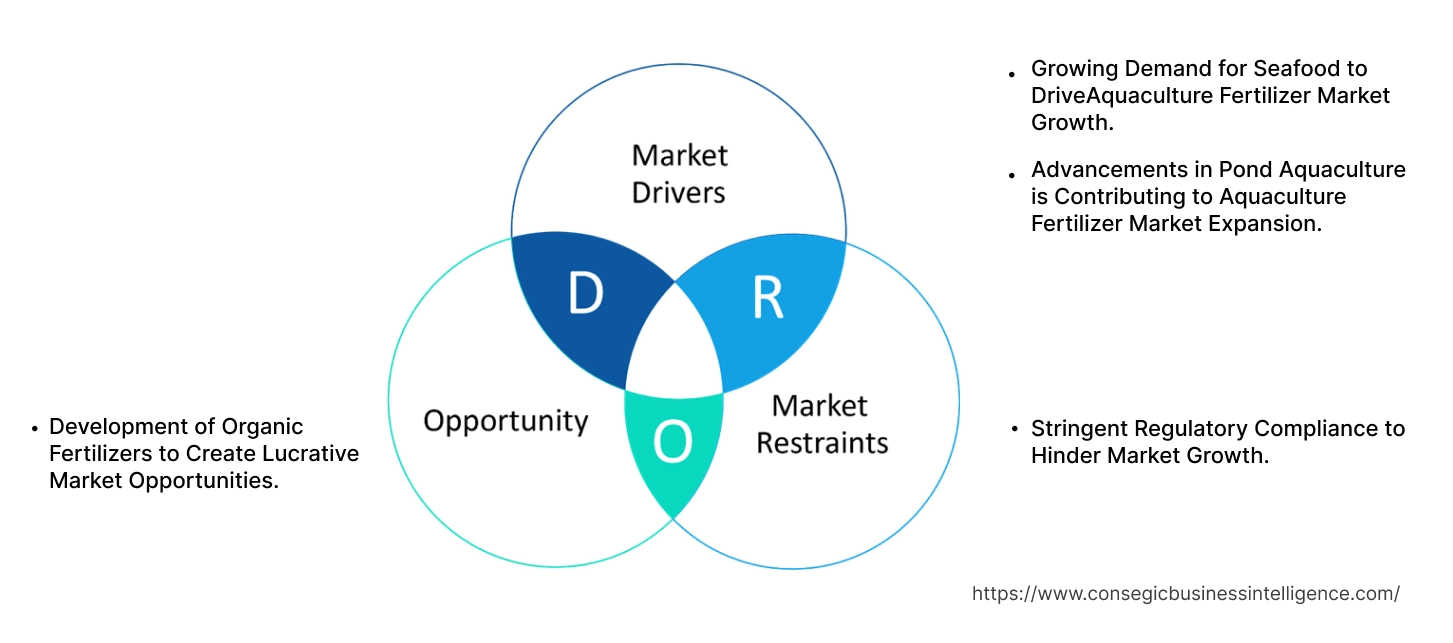
Growing Demand for Seafood to Drive Aquaculture Fertilizer Market Growth.
Seafood encompasses all commercially obtained freshwater and saltwater fish, molluscan shellfish, and crustaceans. Seafood is recognized for its health benefits. It serves as a good source of omega-3 fatty acids, vitamins, and minerals. This nutritional profile, combined with increasing awareness of its positive impact on health, has contributed significantly to the growing popularity of seafood consumption globally.
- For instance, according to the data published by the S. Department of Agriculture, per capita seafood consumption grew 30% from 1990 to 2021. Rise in fresh and frozen seafood consumption per capita increased from about 63 % in 1990 to 80% in 2021.
To meet the rising need for seafood, aquaculture production is rising. Aquaculture fertilizers play a crucial role in enhancing the productivity of aquaculture systems. They provide essential nutrients that stimulate the growth of phytoplankton and zooplankton, which form the base of the food web for many farmed species. This directly impacts the upward market trajectory.
Advancements in Pond Aquaculture is Contributing to Aquaculture Fertilizer Market Expansion.
Pond aquaculture, also known as pond culture, is the practice of raising aquatic animals in ponds. Modern pond aquaculture techniques, including improved pond design, better water management, and optimized feeding, drive higher yields and more intensive production. This necessitates greater fertilizer use to maintain nutrient levels and support food sources. Advanced pond management emphasizes efficient nutrient cycling and waste reduction, often strategically using fertilizers. Precision aquaculture, incorporating technologies such as water quality monitoring, allows for targeted fertilizer application. As a result, the advancements in pond aquaculture supports the market expansion.
- For instance, in 2022, Vietnamese aquaculture farmers adopted the U.S. Soybean Export Council's In-Pond Raceway System (IPRS). This super-intensive aquaculture technology features high levels of water aeration, mixing, and circulation. IPRS extracts solid waste and dissolved nutrients. The collected waste is used as fertilizer, creating a potential additional revenue stream.
Thus, due to the above-mentioned factors, advancements in pond aquaculture is contributing to aquaculture fertilizer market expansion.
Key Restraints:
Stringent Regulatory Compliance to Hinder Market Growth.
Stringent regulatory standards imposed by government agencies and international organizations worldwide cause barriers in the market. These regulations focus on limiting nutrient runoff, preventing water pollution, and protecting aquatic ecosystems. Compliance with these regulations becomes complex and costly for aquaculture farmers. In addition to this, introduction of new fertiliser in the market involves extensive testing, lengthy documentation, product safety assessment, and rigorous quality control procedures. It leads to increase production costs and slow down product development. Moreover, aquaculture fertilizers are subject to strict labelling requirements, including information on nutrient content, application instructions, and potential environmental hazards. Additionally, varying regulations across regions create further complexities. Thus, the impact of these stringent regulations on the aquaculture fertilizer market is multifaceted.
Future Opportunities :
Development of Organic Fertilizers to Create Lucrative Market Opportunities.
The rise in developments towards organic fertilizer for aquaculture is creating upward market trajectory over the forecast period. Organic fertilizers are derived from natural sources such as animal manure, compost, and plant waste. They provide a slower release of nutrients and also contribute organic matter to the system. Consumer concerns about food safety and environmental sustainability sipports adoption of organic fertilizers in aquaculture. These natural fertilizers offer an eco-friendly alternative to chemical fertilizers. Aligning with sustainable aquaculture practices, organic options contribute to balanced ecosystems, reducing reliance on synthetic fertilizers. Considering these advantages, manufacturers are increasingly focusing on the development of organic fertilizers.
- For instance, in 2024, Gauhati University's Department of Zoology, in collaboration with the ICAR-Central Institute of Brackishwater Aquaculture, Chennai, launched Plankton Plus Technology in the Northeastern region of India. This innovative organic fertilizer, derived from fish waste, offers an alternative to urea for pond fertilization.
Thus, developments towards organic fertilizer for aquaculture are creating market trajectory over the upcoming period.
Aquaculture Fertilizer Market Segmental Analysis :
By Type:
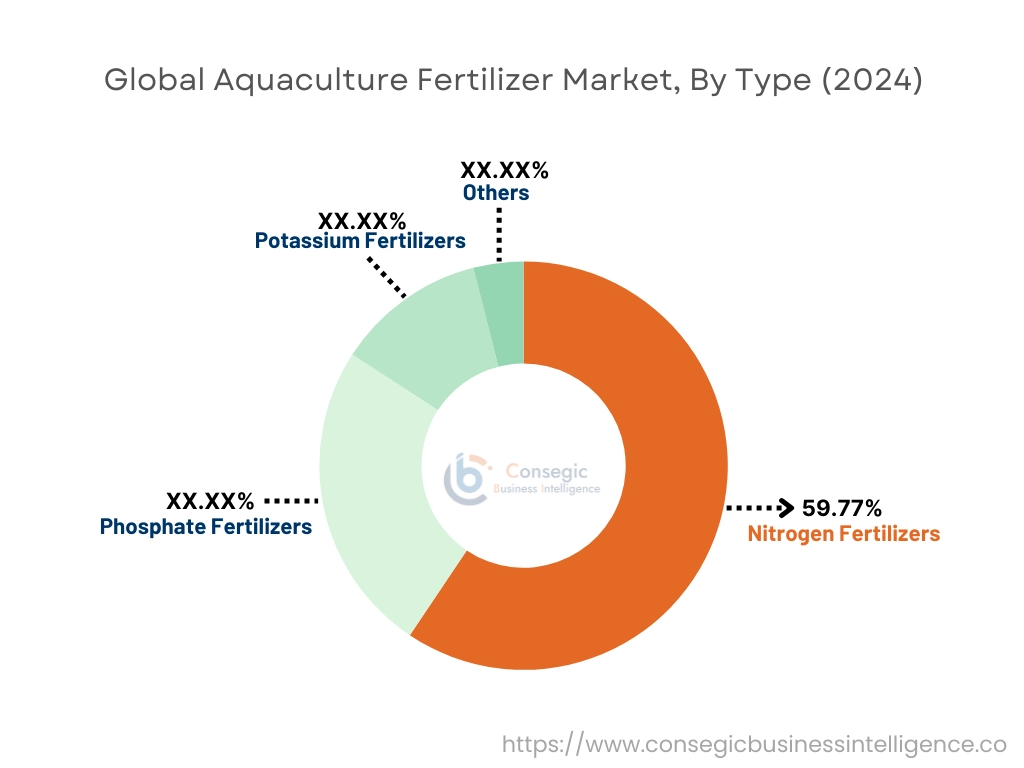
Based on type, the market is categorized into nitrogen fertilizers, phosphate fertilizers, potassium fertilizers, and others.
Trends in the Type:
- Advancements in precision farming and nutrient management are enabling more targeted application of inorganic fertilizers, minimizing waste and reducing potential environmental impacts.
- There's a shift towards using inorganic fertilizers in combination with biofertilizers, to achieve a balanced and environmentally conscious approach to nutrient management in aquaculture.
The nitrogen fertilizers segment accounted for the largest market share of 59.77% in 2024.
- Nitrogen is a crucial nutrient for aquatic organisms, particularly for protein synthesis. Nitrogen fertilizers are used to supplement natural nitrogen sources and enhance productivity in aquaculture systems.
- Urea is a highly concentrated nitrogen fertilizer readily soluble in water, and relatively inexpensive. It's a common choice for aquaculture due to its high nitrogen content and ease of application. Urea promotes proliferation of phytoplankton, which forms the base of the food web in many aquaculture systems.
- Ammonium nitrate is another concentrated fast-acting nitrogen source. As aquaculture operations intensify to meet rising seafood need, the need for efficient nutrient management increases.
- For instance, according to the data published by the Food and Agriculture Organization, global fisheries and aquaculture production in 2022 increased 4.4% from the year 2020 globally.
- Collectively, aforementioned factors support segment trajectory in the overall aquaculture fertilizer market trend.
The phosphate fertilizers segment is expected to grow at the fastest CAGR in the forecast period.
- Phosphorus is a crucial nutrient for the growth of phytoplankton. Phosphate fertilizers are used to supplement natural phosphorus sources and enhance productivity.
- Triple superphosphate is a highly concentrated phosphate fertilizer that is popular due to its high phosphorus content and low cost.
- Ammonium phosphates provide both phosphorus and nitrogen, offering a balanced nutrient supply.
- Ongoing research and development are leading to improved phosphate fertilizer formulations with enhanced nutrient availability, reduced environmental impact, and greater efficiency.
- Thus, considering these factors, the other segment is expected to experience greater CAGR in the forecast years.
By Species:
The species segment is categorized into fishes, crustaceans, molluscs, and others.
Trends in the Species:
- The trend of precision aquaculture is positively impacting targeted fertilizer application for fishes, crustaceans, molluscs, and others.
The fishes segment accounted for the largest aquaculture fertilizer market share in 2024.
- The fish segment represents the largest contribution to the aquaculture fertilizer market analysis due to the widespread global practice of fish farming.
- Numerous fish species rely heavily on plankton and other naturally occurring food sources within their environments.
- These food sources rely on the addition of fertilizers. Commonly farmed fish species benefiting from this fertilization include tilapia, carp, catfish, salmon, trout, sea bass, and a diverse range of other finfish.
- Fertilizers are used to stimulate the development of both phytoplankton and zooplankton.
- The growing consumption of fish significantly boosts the adoption of fertilizers, as high volume of fish produced requires substantial inputs, including fertilizers.
- For instance, according to NCAER, it is observed that consumption of the fish-eating population has grown significantly to over 13 kg per capita per annum in 2022 from 7kg in 2011.
- Owing to the above-mentioned factors, the fishes segment is dominating in the overall aquaculture fertilizer market demand.
The crustaceans segment is expected to grow at the fastest CAGR over the forecast period.
- The requirement of fertilizers for crustaceans is expected to grow due to the rise in shrimp farming.
- Intensive farming practices rely heavily on fertilizers to stimulate the development of algae and other food sources for shrimp.
- Furthermore, shrimp have specific nutritional needs that target fertilization strategies effectively address, driving requirement for specialized fertilizer formulations.
- In addition to this, technological advancements aimed at improving shrimp farming practices, including optimized fertilizer use, also contribute to upward trajectory of the segment.
- Thus, due to the above-mentioned factors, the crustacean segment is expected to register the fastest CAGR over the forecast period in the overall aquaculture fertilizer market demand.
By Application:
Based on application, the market is categorized into pond culture, reservoir culture, lake culture, and others
Trends in the Application:
- There is a growing trend of sustainable fertilization practices to minimize environmental impacts and ensure the long-term health of aquaculture systems.
- The use of technology and data-driven insights is enabling more precise fertilizer application, reducing waste and optimizing nutrient utilization in pond culture, reservoir culture, and lake culture.
The pond culture segment accounted for the largest market share in 2024 and is also expected to grow at the fastest CAGR in forecast years.
- Pond culture remains the most traditional and prevalent method in aquaculture. It involves the raising of aquatic organisms within enclosed ponds.
- Fertilizers play a vital role in stimulating the growth of phytoplankton in ponds. Due to its widespread adoption across diverse aquaculture operations and its reliance on fertilizer-driven food webs, pond culture represents the largest segment of the overall aquaculture fertilizer market.
- Technological advancements, such as improved pond designs, better water management practices, and more efficient fertilization strategies, further increasing support the upward segment trajectory.
- For instance, in July 2024, Indian Institute of Agricultural Research announced launch of the SMART Pond developed under the ICAR Net Work Project on Precision Agriculture. This new, high-tech fish farming system is designed to produce 20 tons of fish per hectare annually. This project is part of a larger precision agriculture initiative.
- This analysis positions the pond culture as a key application segment within the dynamic aquaculture fertilizer market opportunities.
Regional Analysis:
The regional segment includes North America, Europe, Asia Pacific, the Middle East and Africa, and Latin America.
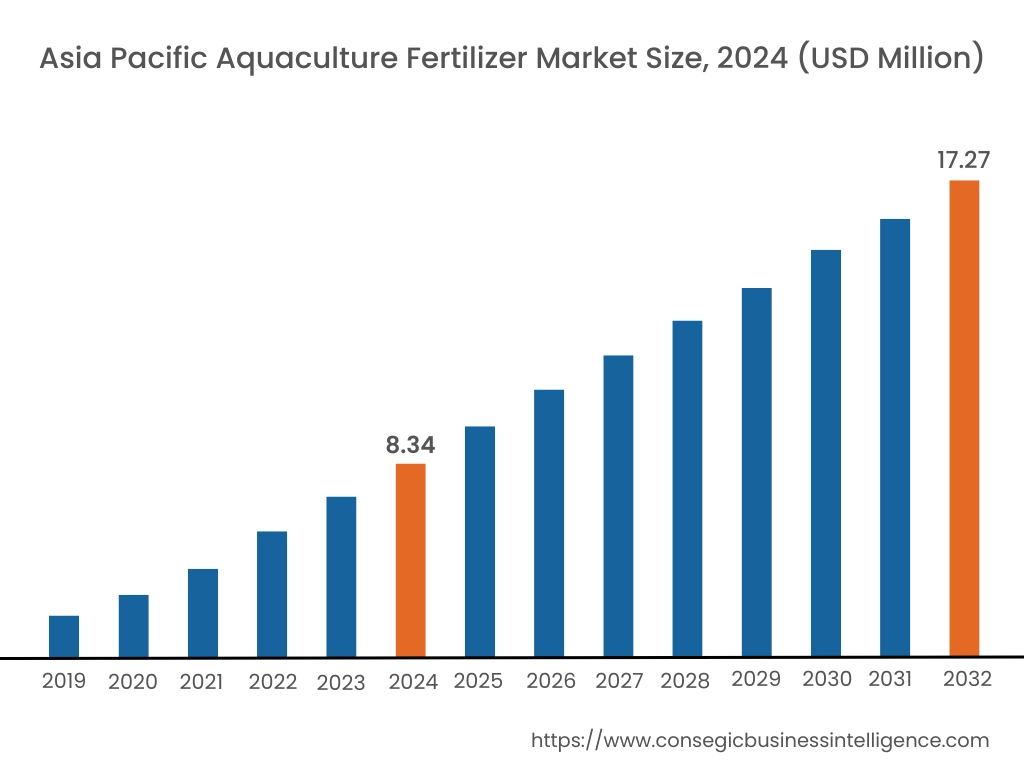
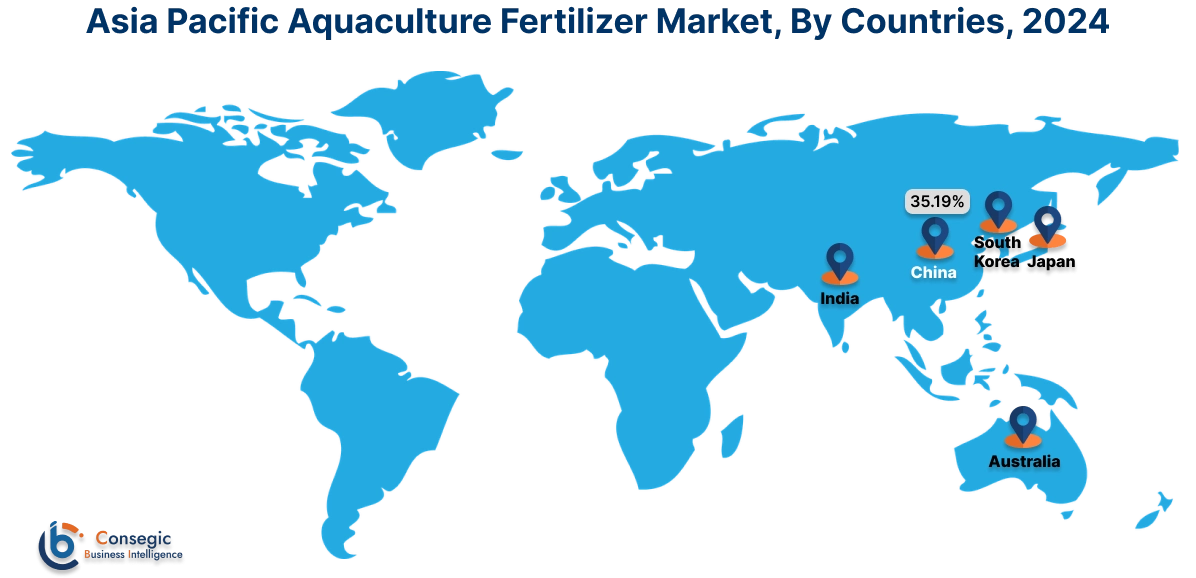
In 2024, Asia Pacific accounted for the highest Aquaculture Fertilizer market share at 40.69% and was valued at USD 8.34 Million and is expected to reach USD 17.27 Million in 2032. In Asia Pacific, the China accounted for the largest share of 35.19% during the base year of 2024.
Asia Pacific holds the largest share of the global aquaculture fertilizer market. The region is one of the key regions in aquaculture production. Countries including China, India, Vietnam, and Indonesia serves as key producers of fish and shrimp. This high volume of aquaculture activity creates high necessity for fertilizers.
- For instance, according to the data published by S Department of Agriculture, China served as the world's largest seafood producer in 2023, with production 71 million metric tons, up 3.5% from 2022.
In addition to this, Pond culture, a traditional and widely used method in many Asian countries is heavily reliant on fertilizers. Fish and shrimp farming is a significant and rapidly expanding sector within aquaculture. Moreover, many governments in the Asia Pacific region are actively promoting aquaculture through various initiatives, including providing support for fertilizer use and sustainable aquaculture practices. Collectively, as per analysis, aforementioned factors support aquaculture fertilizer market trend in Asia Pacific region.
In Europe the Aquaculture Fertilizer market analysis is experiencing the fastest growth with a CAGR of 11.8% over the forecast period. Shift towards adoption of organic fertilizer in aquaculture serves a prominent role aquaculture fertilizer market growth in Europe. There is a growing awareness of the environmental impacts of conventional aquaculture practices, including the use of chemical fertilizers. European consumers have a strong preference for organic food products including seafood creating a robust market for organic aquaculture products. Additionally, the European Union has some of the stringent environmental regulations. These regulations are influencing aquaculture farmers to adopt more sustainable practices, including the use of organic fertilizers, to minimize their environmental footprint. The European Union and various member states have implemented policies and incentives to promote organic farming and aquaculture further supporting aquaculture fertilizer market opportunities in Europe.
The increasing adoption of advanced pond culture systems is one of the primary factors creating an upward market trajectory across North America. The region is focusing on developing and implementing advanced aquaculture technologies. These technologies, such as recirculating aquaculture systems and precision aquaculture, require specific fertilizer formulations and management strategies to optimize production and maintain water quality. Additionally, there is a growing trend towards integrating aquaculture with other agricultural practices, such as crop farming or livestock rearing. Fertilizers used in aquaculture contribute to the overall nutrient management of these integrated systems, further driving demand. Collectively, the combination of the aforementioned factors creates market demand across North America.
Latin America's aquaculture sector is undergoing significant rise. This is supported by increasing domestic demand for seafood, as well as the region's abundant natural resources suitable for aquaculture. This rising demand necessitates increased aquaculture production further supporting the need for fertilizers. In addition to this, there are growing investments in the Latin American aquaculture sector, both from domestic and international sources. These investments support the development of new aquaculture farms, the adoption of advanced technologies, and the increased use of inputs such as fertilizers. Consequently, the above-mentioned factors support the market in Latin America.
Aquaculture is being recognized as vital for food security and economic development in the Middle East and Africa. This is promoting governments and investors to prioritize its upward trajectory. This growing sector requires increased use of fertilizers. There's a growing adoption of modern aquaculture technologies in the MEA region, including improved system designs, water management systems, and precision agriculture techniques. These advancements often require optimized fertilizer use to achieve their full potential, contributing to upward market trajectory. Owing to these factors, the market for aquaculture fertilizer in the Middle East and Africa is growing at a considerate rate.
Top Key Players & Market Share Insights:
The global Aquaculture Fertilizer Market is highly competitive with major players providing products to the national and international markets. Key players are adopting several strategies in research and development (R&D) and product innovation to hold a strong position in the global Aquaculture Fertilizer market. Key players in the Aquaculture Fertilizer industry include-
- Kemin Industries, Inc. (United States)
- PhosAgro Group (Russia)
- Mosaic (United States)
- CF Industries Holdings, Inc. (United States)
- Florida Reef Labs (United States)
- Reefphyto Ltd (United Kingdom)
- Yara (Norway)
- Nutrien (Canada)
Aquaculture Fertilizer Market Report Insights :
| Report Attributes | Report Details |
| Study Timeline | 2019-2032 |
| Market Size in 2032 | USD 44.87 Million |
| CAGR (2025-2032) | 10.3% |
| By Type |
|
| By Species |
|
| By Application |
|
| By Region |
|
| Key Players |
|
| North America | U.S. Canada Mexico |
| Europe | U.K. Germany France Spain Italy Russia Benelux Rest of Europe |
| APAC | China South Korea Japan India Australia ASEAN Rest of Asia-Pacific |
| Middle East and Africa | GCC Turkey South Africa Rest of MEA |
| LATAM | Brazil Argentina Chile Rest of LATAM |
| Report Coverage |
|
Key Questions Answered in the Report
How big is the Aquaculture Fertilizer market? −
In 2024, the Aquaculture Fertilizer market is USD 20.49 Million.
Which is the fastest-growing region in the Aquaculture Fertilizer market? +
Europe is the fastest-growing region in the Aquaculture Fertilizer market.
What specific segmentation details are covered in the Aquaculture Fertilizer market? +
By Type, Species, and Application segmentation details are covered in the Aquaculture Fertilizer market.
Who are the major players in the Aquaculture Fertilizer market? +
Kemin Industries, Inc. (United States), PhosAgro Group (Russia), Florida Reef Labs (United States) are some of the major players in the market.
Overview
Reputation & Certifications


Our Services
- Market Intelligence & Forecasting
- Custom Research Solutions
- Market Entry Strategy
- Competitive Intelligence
- Customer Insights
- Industry Innovation Analysis
- Investment Advisory