Jump to Content
AI in Healthcare Market - Size, Share, Industry Trends, and Forecasts (2024 - 2031)
AI in Healthcare Market Size:
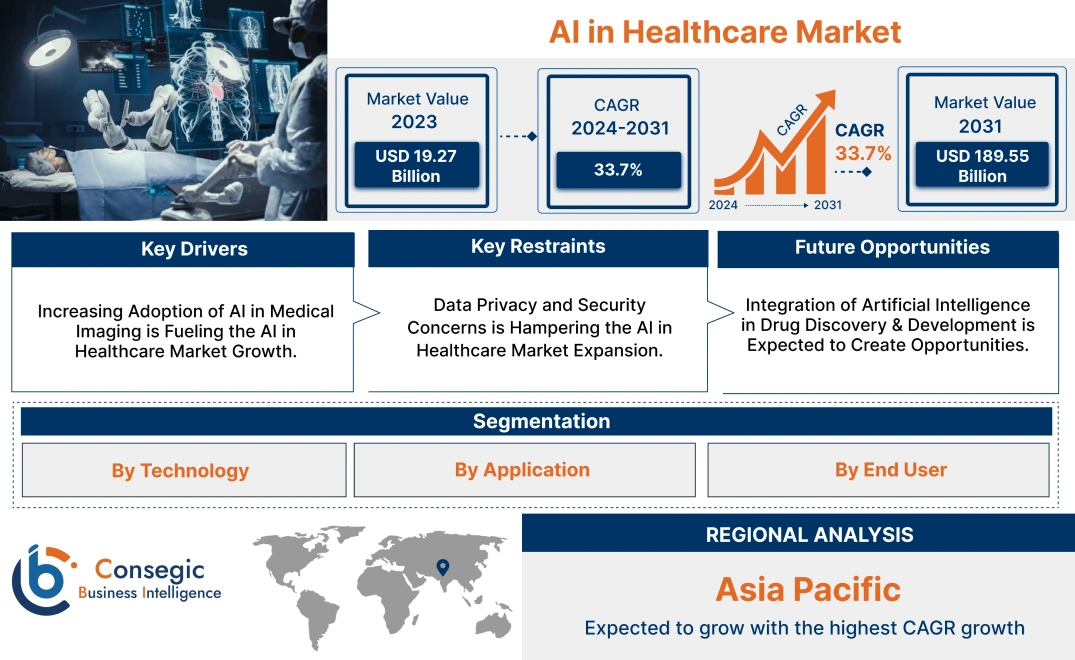
The AI in healthcare market is valued at USD 46.06 Billion in 2026 and is on track to reach USD 453.03 Billion by 2034, growing at a CAGR of 33.7% between 2027 and 2034.
How big is the AI in healthcare market right now?
It's valued at USD 46.06 Billion in 2026, up from USD 19.27 Billion just three years earlier in 2023.
Which region leads the AI in healthcare market?
North America, worth an estimated USD 182.44 Billion by 2034 on the strength of mature infrastructure and heavy R&D spend.
Which application holds the largest share?
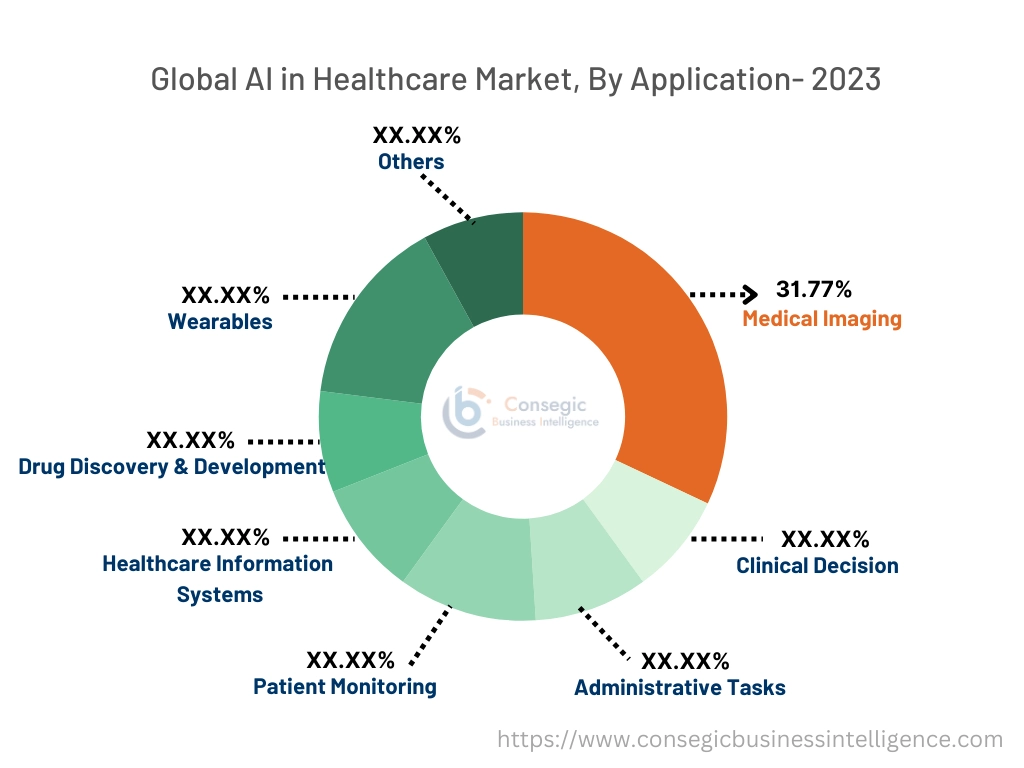
Medical imaging, at roughly 31.77% of total revenue, thanks to faster and more accurate diagnostic support.
AI in Healthcare Market Scope & Overview:
Artificial intelligence gives computers and machines a way to approximate human learning, comprehension, problem-solving, decision-making, creativity, and a degree of autonomy. Applied to healthcare, that means machine learning, natural language processing, deep learning, and related AI techniques being put to work to support patient care and smooth out how healthcare systems actually run.
Across the industry, AI already touches a wide range of jobs – drug discovery and development, medical imaging, clinical decision support, administrative work, patient monitoring, healthcare information systems, and wearables, among others. That breadth is exactly why it's become such a critical technology for pharmaceutical and biotech companies, healthcare providers, and research institutions alike. Rising use of AI in medical imaging, growing IoT adoption in clinical settings, mounting demand for better patient data management, and steady improvements in the underlying AI tools are the main forces behind the market's growth.
AI in Healthcare MarketDynamics - (DRO) :
Key Drivers:
Wider Use of AI in Medical Imaging is Fueling AI in Healthcare Market Growth.
Medical imaging is one of the clearest places AI is changing clinical practice. The tools involved are reshaping how images get read and interpreted, pushing diagnoses to be more accurate, faster, and better timed.
AI models scan X-rays, CT scans, and MRIs looking for the patterns and anomalies that flag disease, giving radiologists a head start on catching problems earlier and treating them sooner. On top of that, these systems can automatically segment tissues and organs within an image, which makes it easier for a radiologist to measure and analyze abnormalities with more precision. AI is also behind entirely new imaging approaches – AI-enhanced ultrasound and AI-powered PET scans among them – that pull more detailed, more accurate information out of the human body than older methods could.
- Samsung Medison, a Samsung Electronics affiliate, is a good illustration – back in October 2023 it demonstrated AI-driven measurement tools called BiometryAssist and ViewAssist that automatically measure and annotate fetal growth indicators during ultrasound: Samsung Medison.
Between sharper accuracy, faster turnaround, and broader accessibility, AI's growing footprint in medical imaging is a genuine driver behind the market's expansion.
Growing IoT Adoption in Healthcare is Fueling AI in Healthcare Market Growth.
The rapid spread of IoT across healthcare marks a real shift in how the sector operates, and it's a big part of why the AI in healthcare market keeps expanding. IoT, at its core, is the network of connected devices and the underlying tech that lets them talk to the cloud and to each other.
What's fueling IoT adoption in healthcare is straightforward – more connected medical devices, smarter sensors, and monitoring systems capable of tracking patients in real time, all of which improves outcomes, patient experience, and day-to-day operations. Health organizations are folding IoT into patient monitoring, asset tracking, and facility optimization, and all of that generates exactly the kind of data AI algorithms are built to analyze, spot patterns in, and turn into predictions.
- T-Mobile USA's April 2022 report put a number on the trend: roughly 3.2 million IoMT (Internet of Medical Things) devices were deployed worldwide as of 2021, underscoring just how much technology – AI included – is being leaned on to improve healthcare: T‑Mobile USA, Inc.
As IoT infrastructure keeps maturing and connected device counts keep climbing, the runway for AI-driven healthcare solutions keeps getting longer.
Key Restraints :
Data Privacy and Security Concerns are Hampering AI in Healthcare Market Expansion.
Data privacy and security sit at the top of the list of reasons AI adoption in healthcare hasn't moved faster. Healthcare data is about as sensitive as data gets – personal, medical, and potentially damaging if it falls into the wrong hands. Data breaches are the clearest risk: healthcare organizations are a frequent target for cyberattacks, and a breach can expose patient information to unauthorized access, leading to identity theft, financial fraud, and lasting reputational harm for everyone involved.
Algorithmic bias is the other concern that keeps coming up. AI models learn from the data they're trained on, and when that data carries bias, the model tends to carry it forward – showing up as skewed diagnoses or treatment recommendations. Add in how quickly AI systems and the threats against them are evolving, and it's genuinely hard for healthcare organizations to keep security practices current, which leaves gaps that attackers can exploit. Put together, privacy and security concerns remain one of the bigger brakes on AI's spread through healthcare.
Future Opportunities :
AI in Drug Discovery & Development is Expected to Open Up New Opportunities.
Drug discovery is one area where AI genuinely changes the economics, not just the speed. By working through enormous volumes of biological and chemical data, AI tools help teams zero in on promising drug targets and design new molecules faster than traditional methods allow. They also help predict how a compound will behave and what side effects it might carry, which sharpens drug design and cuts down on downstream risk. On the clinical trial side, AI narrows in on the right patient populations, tightens trial design, and forecasts outcomes – all of which makes trials more efficient. Automating the routine parts of the process, from data analysis to reporting, trims costs across the board.
- Exscientia, a technology-driven drug design and development company, expanded its work with Amazon Web Services in July 2024 to run more of its end-to-end drug discovery platform on AWS's AI services: Exscientia plc.
As AI capability keeps advancing, its role in drug discovery and development looks set to grow with it, pulling in more investment toward AI-powered healthcare tools and adding further lift to the market.
AI in Healthcare Market Segmental Analysis :
By Technology:
By technology, the market splits into machine learning, natural language processing, computer vision, and others.
Trends in the Technology:
- Machine learning is increasingly used to forecast disease outbreaks and patient outcomes with sharper accuracy.
- Voice-activated systems are emerging for patient interaction, medical record updates, and prescription management.
Machine learning held the largest share of the AI in healthcare market in 2026.
- Machine learning is the branch of AI that lets systems learn and improve from data on their own, without being handed explicit rules – instead, algorithms and statistical models pick out patterns from whatever data they're exposed to.
- ML is a major reason AI has taken hold in healthcare, largely because it can chew through massive volumes of clinical data and surface patterns that predict medical outcomes with real accuracy.
- ML algorithms comb through patient records and medical imaging, and even help surface new therapies, ultimately leading to more precise diagnoses, personalized treatment plans, and earlier detection of health issues.
- Precision medicine is arguably the standout use case – supervised learning lets ML models analyze patient-specific data and predict which treatment options are likely to work best.
- All told, machine learning's ability to learn from data and turn it into accurate predictions is why it holds such a significant share of the healthcare sector.
Natural language processing is set to post the fastest CAGR over the forecast period.
- NLP is the branch of AI focused on getting computers to understand and work with human language, blending computational linguistics with statistical modeling so machines can recognize, interpret, and generate text and speech.
- In healthcare specifically, NLP supports patient care and medical research by pulling structured information – history, symptoms, diagnoses, medications – out of unstructured medical records.
- Scanning large volumes of records this way helps surface patterns that lead to earlier disease detection, better outcomes, and more effective treatment strategies.
- NLP-powered virtual health assistants can also field patient questions, share reliable health information, and handle appointment scheduling.
- HCA Healthcare and Augmedix are a good example – their April 2023 partnership built AI-enabled ambient documentation that uses speech recognition and NLP to turn clinician-patient conversations into medical notes, reviewed by care teams before landing in the EHR: HCA Healthcare and Augmedix.
- As NLP keeps improving, its footprint in healthcare keeps widening too, opening up fresh opportunities across patient care and medical research.
By Application:
By application, the market spans drug discovery & development, medical imaging, clinical decision support, administrative tasks, patient monitoring, healthcare information systems, wearables, and others.
Trends in the Application:
- Robotic-assisted surgery is getting more precise and lower-risk with AI support.
- AI is increasingly used to diagnose and treat mental health conditions.
- AI-powered wearables and remote monitoring are enabling continuous patient tracking and earlier intervention.
- Precision medicine is leaning more heavily on AI.
Medical imaging held the largest application share, at roughly 31.77%, in 2026.
- AI plays a central role in medical imaging by pulling useful insight out of scans, sharpening diagnostic accuracy, catching disease earlier, and improving treatment planning.
- AI models scan X-rays, CT scans, MRIs, and ultrasounds for patterns and details a physician might miss.
- Key uses include image segmentation, where AI precisely outlines structures within an image, and disease detection, where it flags likely abnormalities.
- AI also sharpens image quality for better visualization, and by combining imaging data with other clinical information, it can forecast disease progression and treatment response – a building block for personalized medicine.
- The impact shows up across modalities: mammography for breast cancer detection, CT for lung disease, MRI for brain and spinal cord conditions, and ultrasound for fetal development and abdominal imaging.
- Between sharper accuracy, greater efficiency, and rising demand for diagnostics, AI's role in medical imaging keeps growing.
Drug discovery & development is projected to grow at the fastest CAGR over the forecast period.
- AI speeds up drug discovery and development by working through vast biological and chemical datasets to identify potential drug targets.
- AI tools generate novel molecular structures, accelerating the search for new drug candidates, while virtual screening quickly narrows the field of viable options.
- In clinical trials, AI optimizes patient recruitment and trial design while cutting costs, and it automates data analysis and reporting to keep trials compliant.
- The payoff is significant – shorter timelines to identify and develop new drugs, higher success rates from better efficacy and safety predictions, and lower costs from fewer physical experiments. That combination is why so many new AI solutions keep entering this space.
- SoftServe's December 2024 launch is a good example – its Generative AI Drug Discovery solution, built with NVIDIA BioNeMo Blueprints, helps researchers, developers, and pharma companies generate novel drug candidates: SoftServe.
- Given all of this, AI in drug discovery and development is expected to be one of the market's biggest opportunity areas in the years ahead.
By End User:
By end user, the market covers pharmaceutical and biotechnology companies, healthcare providers, research institutions, and others.
Trends in the End User:
- Growing focus on patient engagement and communication tools is shaping AI adoption.
- Rising demand for personalized healthcare continues to support AI uptake.
Healthcare providers held the largest AI in healthcare market share in 2026.
- Hospitals and clinics are the primary end-users of AI in healthcare.
- They lean on AI for hospital system implementation, remote patient care, medical imaging, administrative work, and clinical decision support, among other uses.
- AI-powered tools help providers read medical images with more accuracy, catching disease earlier and sharpening diagnoses.
- AI also feeds clinicians evidence-based recommendations that improve decision-making, while automating record analysis and scheduling cuts down on administrative load.
- AI-powered wearables and remote monitoring extend that reach further, enabling continuous tracking that supports earlier intervention and better outcomes.
- The prospect of better outcomes and leaner operations is what's pushing healthcare organizations to keep investing in AI.
- Chi-Mei is a real-world example – in July 2024 it deployed AI copilots built on Microsoft's Azure OpenAI Service to ease workloads for doctors, nurses, and pharmacists: Chi-Mei.
- Altogether, healthcare providers remain the primary users driving AI adoption.
Pharmaceutical and biotechnology companies are expected to post the fastest CAGR over the forecast period.
- Pharma and biotech firms are pouring investment into AI to support drug discovery and development, using algorithms to sift through huge biological and chemical datasets and identify promising drug targets faster.
- By optimizing trial design, patient recruitment, and data analysis, AI is streamlining clinical trials and speeding up development timelines.
- AI also supports personalized medicine by analyzing patient-specific data – genetics, medical history – to shape tailored treatment plans and better outcomes.
- Taken together, AI is reshaping the pharmaceutical and biotech industry around faster development, more personalized medicine, and stronger patient outcomes.
Regional Analysis:
The regional split covers North America, Europe, Asia Pacific, the Middle East and Africa, and Latin America.
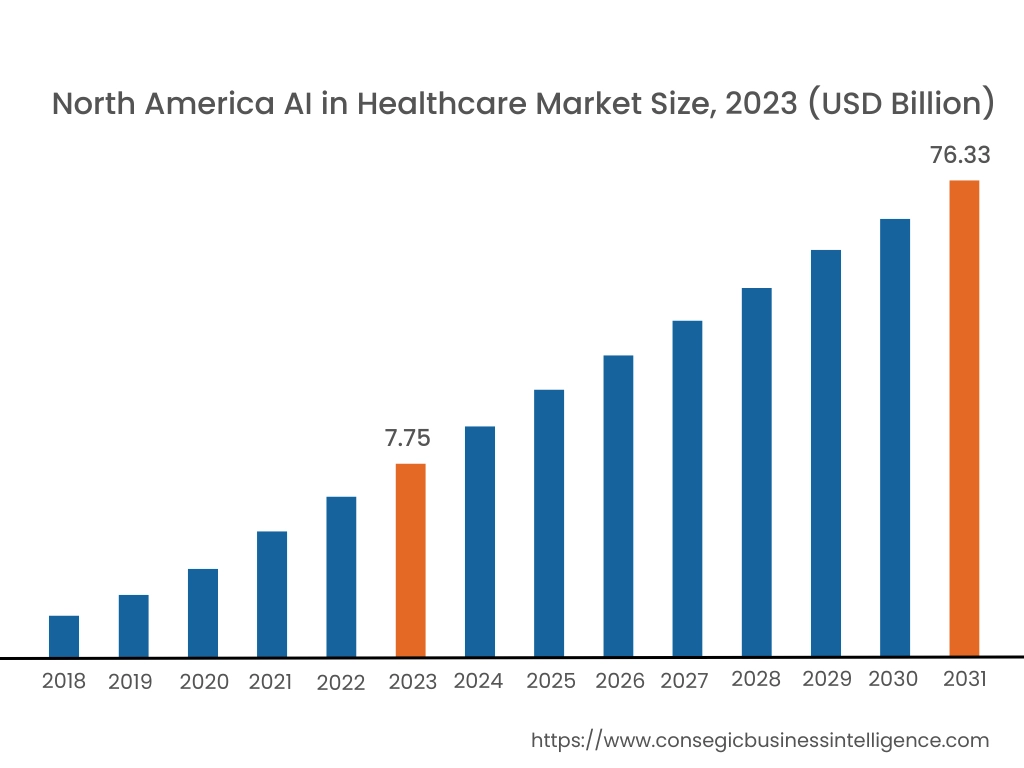
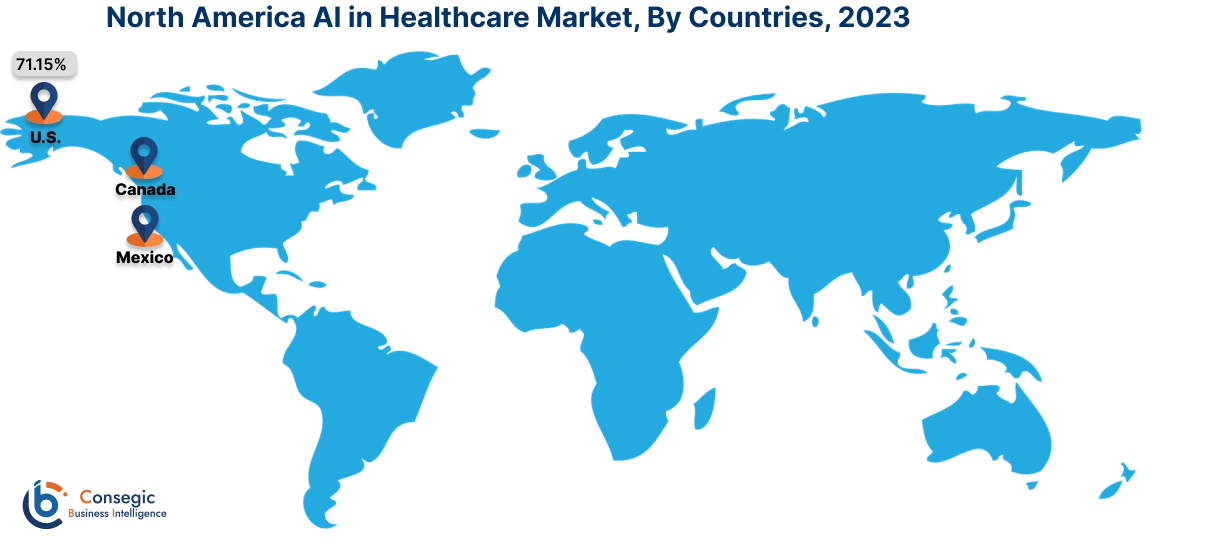
North America held the largest share of the market at 40.20% in 2026, valued at USD 18.53 Billion, and is projected to reach USD 182.44 Billion by 2034. Within the region, the U.S. accounted for 71.15% of North American revenue. A handful of factors explain the region's lead – faster digitalization across healthcare services, a well-developed base of hospitals, clinics, and research institutions, and a general tendency to adopt new technology, AI included, ahead of other regions. Providers and researchers across North America keep folding AI-powered tools into patient care and research, and government backing for AI adoption is adding further momentum.
- The U.S. Department of Health and Human Services (HHS) is a good example – in April 2024 it published its plan for promoting responsible AI use in automated and algorithmic systems across state, local, tribal, and territorial governments administering public benefits: U.S. Department of Health and Human Services.
North America's advanced diagnostic and treatment infrastructure keeps generating fresh demand for AI solutions, and the region's dense cluster of leading healthcare providers, technology companies, and research institutions continues to fund AI-enabled healthcare innovation.
Asia Pacific is the fastest-growing region in the market, posting a CAGR of 34.2% over the forecast period. Rising healthcare spending and steady improvements to healthcare infrastructure are behind that growth – as infrastructure matures, awareness of what AI can offer grows alongside it. Governments, healthcare organizations, and providers across the region are actively pushing AI adoption, including investment in AI-powered solutions spanning medical imaging, drug discovery, and personalized medicine.
Europe is expanding at a healthy clip too, driven by rising use of AI-powered solutions to improve outcomes and streamline healthcare processes. The region's well-established healthcare systems, already focused on innovation and patient care, are a natural fit for AI integration, and growing investment in digital health – digital health records, wearables, AI-powered tools – is reinforcing that trend across medical imaging, drug discovery, personalized medicine, and remote patient monitoring.
The Middle East and Africa region is seeing a notable pickup in AI in healthcare demand, with a fast-growing healthcare sector playing a central role. Rising disposable incomes, aging populations, and a growing burden of chronic disease are pushing countries across the MEA region to invest more in healthcare infrastructure, which in turn is fueling demand for AI-powered technologies. Efforts to modernize healthcare systems, expand access to care, and improve outcomes – alongside rising interest in preventative care and a general openness to new technology – are adding further momentum.
Latin America is still an early-stage market for AI in healthcare. Rising costs and inefficiencies in traditional healthcare delivery are pushing the region toward AI-based solutions like remote patient monitoring, telemedicine, and real-time data exchange. A growing middle class is driving demand for better healthcare services, and rising health awareness is adding to the pull toward more advanced medical treatment – a combination that's expected to keep shaping the region's AI in healthcare trends.
Top Key Players & Market Share Insights:
The AI in healthcare industry is a genuinely crowded field, with major players competing across both domestic and international markets. Most are leaning on product innovation to hold their ground. Key players in the AI in healthcare industry include-
- IBM (U.S.)
- NVIDIA Corporation (U.S.)
- Intel Corporation (U.S.)
- Itrex Group (U.S.)
- Oracle (U.S.)
- Microsoft (U.S.)
- Amazon Web Services, Inc. (U.S.)
- Google (U.S.)
- Clarius (Canada)
- Oxipit (Lithuania)
Recent Industry Developments :
New Launches:
- In 2026, NVIDIA launched a healthcare robotics platform combining Open-H (a surgical video dataset), Cosmos-H (synthetic data generation for robotics), GR00T-H (a vision-language-action model for clinical tasks), and Rheo (a hospital digital twin blueprint).
- Mount Sinai Health System signed an enterprise AI deal with OpenEvidence in 2026, integrating its AI clinical decision support platform directly into the Epic EHR across all seven of its hospitals.
- In October 2024, Microsoft rolled out a set of AI enhancements to Microsoft Cloud for Healthcare, including new healthcare AI models on Azure AI Studio, expanded healthcare data capabilities in Microsoft Fabric, and developer tools on Copilot Studio.
- In October 2024, Oracle announced plans for a new AI-powered electronic health record system, built around voice-command navigation and Oracle's clinical AI agent for data analysis and patient flow tracking.
Partnerships:
- Mayo Clinic and Bayesian Health codeveloped an enterprise AI solution in May 2026 that identifies hospitalized patients likely to benefit from palliative care earlier in their stay, surfacing eligible patients in real time.
- In April 2023, HCA Healthcare and Augmedix partnered to build AI-enabled ambient documentation for acute care providers, using speech recognition and NLP to turn clinician-patient conversations into EHR-ready medical notes.
AI in Healthcare Market Report Insights :
| Report Attributes | Report Details |
| Study Timeline | 2021-2034 |
| Market Size in 2034 | USD 453.03 Billion |
| CAGR (2027-2034) | 33.7% |
| By Technology |
|
| By Application |
|
| By End User |
|
| By Region |
|
| Key Players |
|
| North America | U.S. Canada Mexico |
| Europe | U.K. Germany France Spain Italy Russia Benelux Rest of Europe |
| APAC | China South Korea Japan India Australia ASEAN Rest of Asia-Pacific |
| Middle East and Africa | GCC Turkey South Africa Rest of MEA |
| LATAM | Brazil Argentina Chile Rest of LATAM |
| Report Coverage |
|
Key Questions Answered in the Report
How big is the AI in healthcare market right now? −
It's valued at USD 46.06 Billion in 2026 and is growing at a CAGR of 33.7% through 2034.
How large will the AI in healthcare market be by 2034? +
The market is projected to reach USD 453.03 Billion by 2034, up from USD 46.06 Billion in 2026.
Which region currently leads the AI in healthcare market? +
North America leads, worth an estimated USD 182.44 Billion by 2034 on the back of mature infrastructure and heavy R&D investment.
Which region is growing the fastest? +
Asia Pacific, posting a CAGR of 34.2% as healthcare spending and infrastructure improve across the region.
Overview
Reputation & Certifications


Our Services
- Market Intelligence & Forecasting
- Custom Research Solutions
- Market Entry Strategy
- Competitive Intelligence
- Customer Insights
- Industry Innovation Analysis
- Investment Advisory