Jump to Content
3D Cell Culture Market - Size, Share, Industry Trends, and Forecasts (2025-2032)
3D Cell Culture Market Size:
3D Cell Culture Market is estimated to reach over USD 4.18 Billion by 2032 from a value of USD 1.56 Billion in 2024 and is projected to grow by USD 1.75 Billion in 2025, growing at a CAGR of 11.5% from 2025 to 2032.
3D Cell Culture Market Scope & Overview:
3D cell culture refers to a technique which allows cells to grow in a three-dimensional environment, imitating how they grow in living tissues, unlike traditional 2D cultures where cells are mainly grown in a flat layer. This method uses scaffolds like hydrogels or low-adhesion plates or allows cells to self-assemble into spheroids or organoids. Moreover, it offers a more physiologically relevant model for studying cell behavior, drug responses, as well as diseases. Also, 3D cell culture offers the ability to better represent complex cellular structures like tumors, which in turn helps in offering more reliable models for testing drug efficiency and toxicity, while also facilitating long-term studies of disease progression and cell differentiation.
How is AI Transforming the 3D Cell Culture Market?
The integration of AI is considerably transforming the cell culture market. AI incorporation helps in enhancing cell culture through automation, improved data analysis, while also facilitating more accurate modeling for drug discovery as well as personalized medicine. Moreover, AI-powered systems are capable of automating cell culture tasks, like feeding and passaging, along with evaluating complex data, predicting drug responses, and improving the reliability of experiments. This in turn, helps in accelerating research and development by decreasing human error, lowering costs, along with speeding up the process of creating more physiologically relevant tissue models. Hence, the above factors are expected to positively impact the market growth in the upcoming years.

3D Cell Culture Market Dynamics - (DRO) :
Key Drivers:
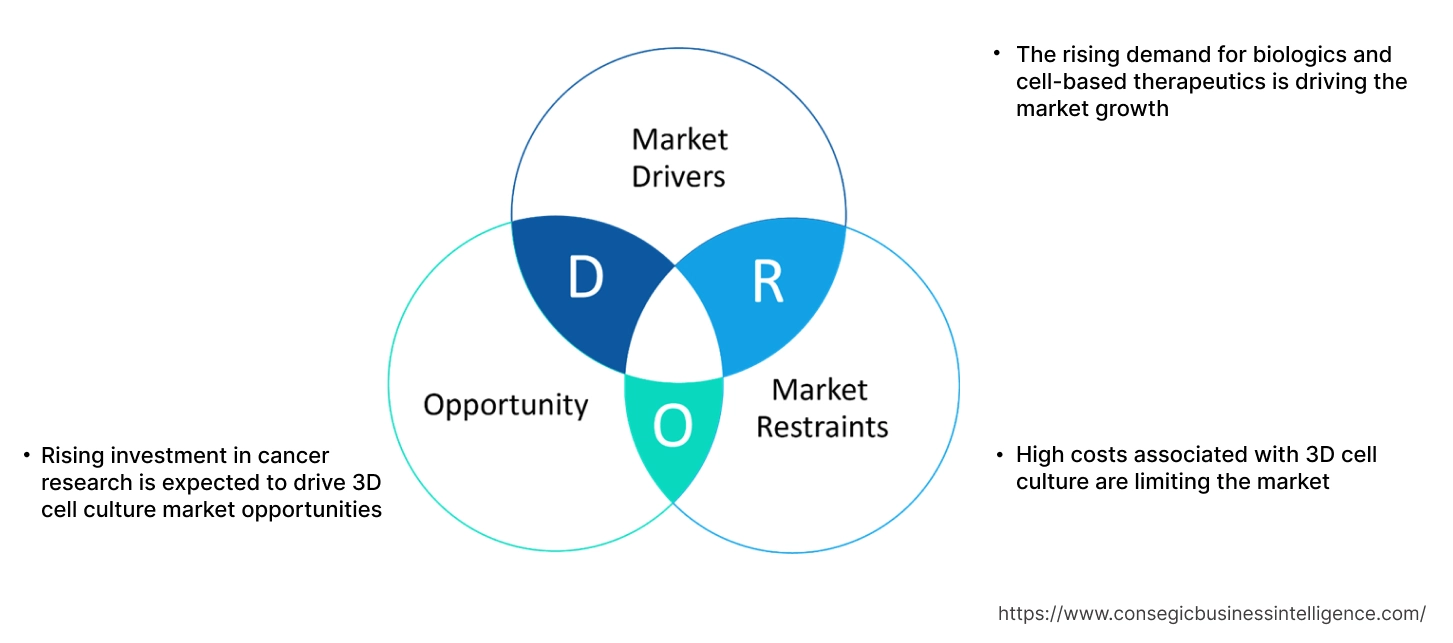
The rising demand for biologics and cell-based therapeutics is driving the market growth
As pharmaceutical companies increasingly shift toward developing complex biologic drugs, including monoclonal antibodies, vaccines, gene therapies, and cell therapies, the need for reliable as well as scalable cell culture systems is also increasing considerably. Also, biologics require living cells for their development as well as manufacturing, which in turn makes high-quality media, reagents, and advanced culture technologies essential for ensuring product safety, efficacy, and consistency. Moreover, the rise of regenerative medicine and personalized therapies such as CAR-T cell treatments is also increasing the need for advanced culture platforms, which are capable of supporting large-scale, high-precision cell expansion. This growing therapeutic demand is further driving innovations in cell culture technologies while expanding the market across pharmaceutical, biotechnology, and clinical research areas.
- For instance, in March 2025, PHC Corporation announced the development of a new production technology associated with the field of regenerative and cell therapy. Moreover, the new production technology is capable of facilitating real-time monitoring of the quality of 3D cell products for supporting improved quality and stability of 3D cell products during cultivation.
Therefore, the aforementioned factors are further propelling the 3D cell culture market size.
Key Restraints:
High costs associated with 3D cell culture are limiting the market
The initial cost of setting up cell culture facilities is considerably high as it requires acquisition of specialized and high-value equipment such as bioreactors, microfluidic devices, bioprinters, advanced imaging systems, and others. Moreover, the ongoing operational costs associated with specialized media, reagents, scaffolds, and cell lines are also considerably high.
In addition, maintaining 3D cultures requires advanced infrastructure as well as technical expertise, which in turn adds to the overall operational costs. The above cost barriers can affect its widespread adoption, particularly among small to mid-sized research institutions, academic labs, and startups operating on limited budgets. Consequently, the above factors restrain the market growth.
Future Opportunities :
Rising investment in cancer research is expected to drive 3D cell culture market opportunities
Rising investment in cancer research is expected to offer lucrative aspects for market growth. The rise in global fundings for research & development (R&D) from governments, private foundations, and pharmaceutical companies is increasing the need for highly predictive, human-relevant research models. Cell cultures, which include spheroids, organoids, and bioprinted tissues, help in offering physiologically accurate platforms for understanding cancer biology, disease progression, as well as therapeutic responses. Its utilization enables researchers to screen new oncology drugs with greater accuracy, which in turn helps in improving R&D efficiency while facilitating innovation in personalized medicine approaches along with novel drug discovery.
- For instance, the American Cancer Society announced that it invested more than 132 million in new cancer research in 2024, which represents a substantial investment in cancer research being done in the United States. Also, the investment aims at funding studies, ranging from basic molecular research to interventional trials associated with cancer therapies.
Thus, rising investments in cancer research are projected to drive the 3D cell culture market opportunities.
3D Cell Culture Market Segmental Analysis :
By Type:
Based on type, the market is segmented into scaffold-based, scaffold-free, and others.
Trends in the Type:
- Increasing use of magnetic levitation techniques for gaining traction due to its ability to form uniform spheroids quickly and enable easy handling and high-content imaging which in turn drives the 3D cell culture market trends.
- Increasing need for robust, quantitative data and the ability to track long-term cellular behaviors in real-time is expected to drive 3D cell culture market size.
Scaffold-based accounted for the largest revenue share in the year 2024 and is anticipated to register the fastest CAGR during the forecast period.
- Increasing trend of shifting away from animal-derived matrices towards synthetic hydrogels which is driving the 3D cell culture market share.
- Further, increased use of nanofiber-based scaffolds as these structures, promote better cell-matrix interaction, migration, and tissue-like organization.
- Furthermore, growing requirement for long-term, functional cultures that demand both structural integrity and biological signaling drives the 3D cell culture market trends.
- For instance, in January 2025, CytoNest announced the introduction of their proprietary CytoNest 3D scaffolds specifically designed for bioreactor applications. This launch indicates CytoNest's move to provide a specialized matrix solution for scaling up 3D cell culture.
- Thus, as per analysis, incorporation of nanofiber technology, rise of synthetic & tunable hydrogels, and hybrid & composite scaffolds are driving the market.
By Application:
Based on application, the market is segmented into cancer research, drug discovery, stem cell research, and tissue engineering.
Trends in the Application:
- There's a growing use of 3D hepatocyte cultures and liver-on-a-chip models for predicting drug-induced liver injury which in turn drives the 3D cell culture market expansion.
- Increasing use of organoids to study complex human processes like embryogenesis, neurological development, and developmental disorders in a way that animal models cannot which subsequently propels the 3D cell culture market demand.
Cancer research accounted for the largest revenue share in the year 2024
- There is increased generation and use of Patient-Derived Tumor Organoids (PDTOs) directly from biopsy samples.
- Further, need to accurately model immuno-oncology mechanisms and the influence of the tumor microenvironment on metastasis and drug response drives the 3D cell culture market growth.
- Furthermore, increasing utilization of automated 3D platforms for rapid and large-scale screening of compound libraries drives 3D cell culture market growth.
- Thus, as per 3D cell culture market analysis, rise of patient-derived organoids, co-culture of immune, and high-throughput drug resistance is driving the market.
Tissue engineering is anticipated to register the fastest CAGR during the forecast period.
- There is a growing use of bioprinting to precisely deposit cells and bioinks layer-by-layer, creating architecturally accurate scaffolds and functional tissue constructs
- Further, growing emphasis to embed functional microvascular networks within large 3D constructs to ensure nutrient and oxygen delivery and tissue survival, propels the 3D cell culture market expansion.
- Furthermore, innovation in biomaterials to create smart bioinks that are not only biocompatible and printable but also dynamically respond to external stimuli is expected to drive the 3D cell culture market share.
- Therefore, based on analysis, 3D bioprinting, vascularization of engineered tissues, and development of next generation bioinks are anticipated to boost the market during the forecast period.
By End-User:
Based on end-user, the market is segmented into biotechnology and pharmaceutical companies, academic and research institutes, and hospitals and diagnostic centers.
Trends in the End User:
- There is rising use of patient-derived organoids (PDOs) in a clinical or near-clinical setting for drug sensitivity testing to inform oncologists' decisions for cancer patients which in turn drives the 3D cell culture market.
- Hospitals are establishing living biobanks of patient-derived 3D tissues/tumoroids which are expected to drive the market.
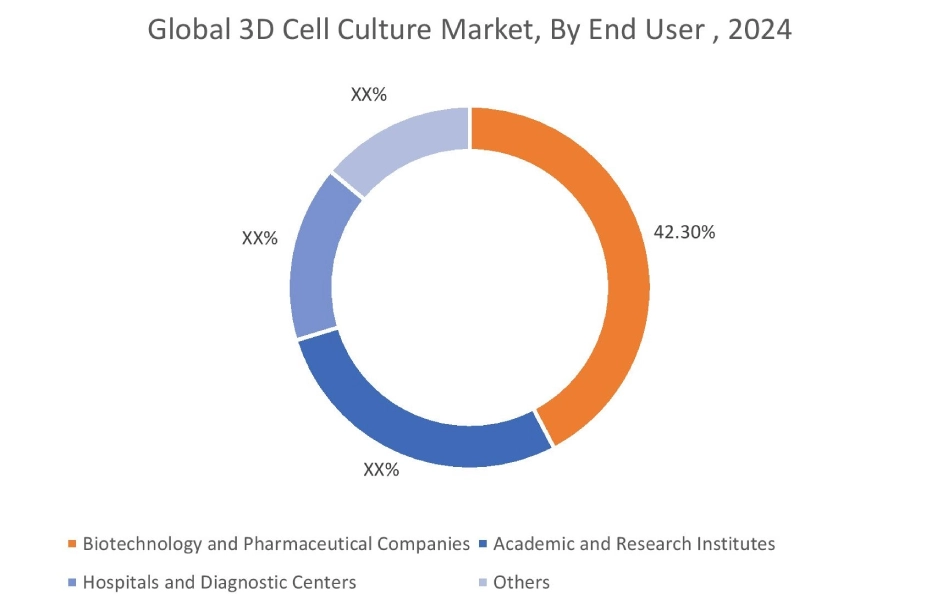
Biotechnology and pharmaceutical companies accounted for the largest revenue share of 42.30% in the year 2024.
- A major trend is the complete integration of 3D models (spheroids, organoids) into fully automated, High-Throughput Screening (HTS) platforms to screen thousands of compounds rapidly.
- Further, pharma companies are prioritizing 3D liver, kidney, and heart models to perform predictive toxicology screening which drives the market growth.
- Furthermore, there is a sharp increase in utilizing Patient-Derived Organoids (PDOs) to test drug which in turn drives the 3D cell culture market demand.
- Thus, as per 3D cell culture market analysis, personalized medicine adoption predictive toxicology focus, and high-throughput automation integration are driving the market.
Academic and research institutes is anticipated to register the fastest CAGR during the forecast period.
- Academic labs are focusing on validating and refining highly complex, cutting-edge models like multi-organ-on-a-chip systems and sophisticated vascularized tissues to push the boundaries of in vitro human physiology.
- Further, there is a surge in collaboration between biology labs, engineering departments, and computer science groups to develop customized bioprinting bioinks and microfluidic devices which propel the 3d cell culture market.
- Therefore, based on analysis, complex model validation and interdisciplinary collaboration are anticipated to boost the market during the forecast period.
Regional Analysis:
The regions covered are North America, Europe, Asia Pacific, Middle East and Africa, and Latin America.
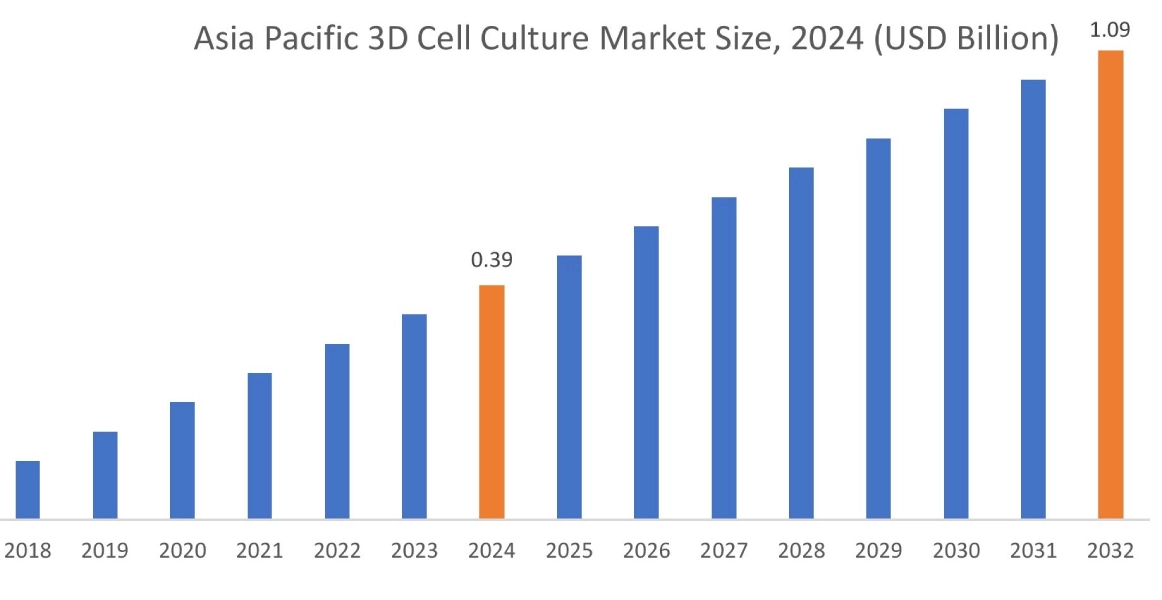
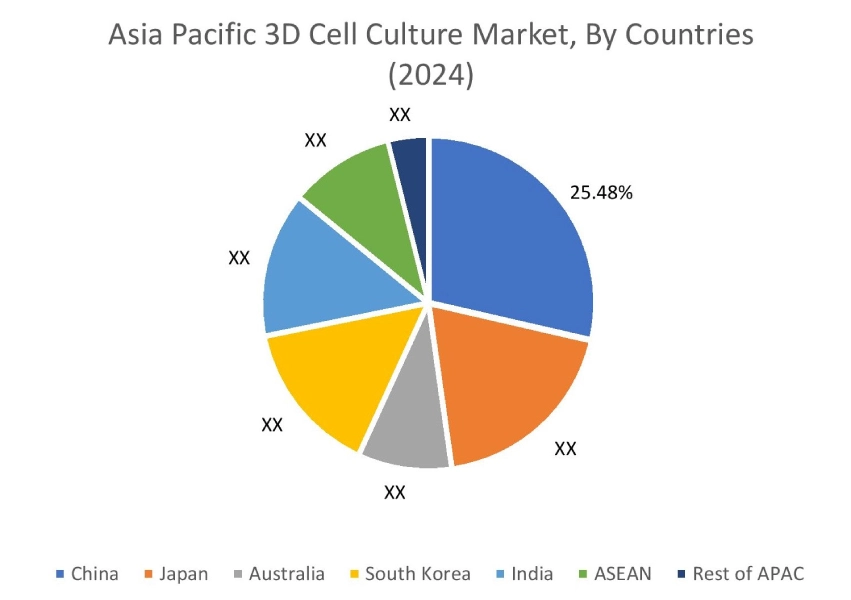
Asia Pacific region was valued at USD 0.39 Billion in 2024. Moreover, it is projected to grow by USD 0.44 Billion in 2025 and reach over USD 1.09 Billion by 2032. Out of this, China accounted for the maximum revenue share of 25.48%. The market for cell culture is mainly driven by increasing government and industry investments in biotechnology and life science research, particularly in China, Japan, and India. This funding supports the growing demand for physiologically relevant in vitro models for cancer research, personalized medicine, and large-scale drug toxicity screening.
- For instance, in October 2022, Corning Incorporated launched the Elplasia 12K Flask, a new product for 3D cell culture that significantly advances drug screening and cancer research. The flask uses a unique microcavity geometry to easily form approximately 12,000 uniform spheroids per flask, offering a yield that is 125 times higher than conventional 96-well spheroid plates.
North America is estimated to reach over USD 1.54 Billion by 2032 from a value of USD 0.57 Billion in 2024 and is projected to grow by USD 0.64 Billion in 2025. The North American market is primarily driven by high concentration of leading biotechnology and pharmaceutical companies and a robust R&D ecosystem with substantial funding for drug discovery and personalized medicine initiatives.
- For instance, in September 2023, Curi Bio has commercially launched two new platforms, Nautilus and Stingray, to advance preclinical drug discovery using human stem cell models. Nautilus enables researchers to easily measure the electrophysiology of 2D or 3D cell cultures using advanced optical techniques.
The regional analysis depicts that strict regulatory pressures to reduce and replace animal testing (3Rs), coupled with robust government and private funding in Europe is driving the market. Additionally, the factors driving the market in the Middle East and African region are substantial government investment and rising prevalence of chronic diseases. Further, increasing government and international investment to modernize academic and biomedical research infrastructure is paving the way for the progress of market trends in Latin America region.
Major Key Players:
The 3D cell culture industry is highly competitive with major players providing solutions to the national and international markets. Key players are adopting several strategies in research and development (R&D), product innovation, and end-user launches to hold a strong position in the 3D cell culture industry. Key players in the global 3D cell culture market include-
- Thermo Fisher Scientific Inc. (US)
- Lonza Group AG (Switzerland)
- Kuraray Co., Ltd. (Japan)
- Greiner Bio-One International GmbH (Austria)
- ReproCELL Inc. (Japan)
- Corning Incorporated (US)
- 3D Biotek LLC (US)
- Avantor, Inc. (US)
- Tecan Trading AG (Switzerland)
- Merck KGaA (Germany)
Recent Industry Developments :
- In October 2024, Univercells Technologies launched the scale-X nexo bioreactor, a miniaturized fixed-bed system. This new addition to the scale-X portfolio is designed to enhance the efficiency and cost-effectiveness of cell culture process development across various therapeutic modalities.
3D Cell Culture Market Report Insights :
| Report Attributes | Report Details |
| Study Timeline | 2019-2032 |
| Market Size in 2032 | USD 4.18 Billion |
| CAGR (2025-2032) | 11.5% |
| By Type |
|
| By Application |
|
| By End-User |
|
| By Region |
|
| Key Players |
|
| North America | U.S. Canada Mexico |
| Europe | U.K. Germany France Spain Italy Russia Benelux Rest of Europe |
| APAC | China South Korea Japan India Australia ASEAN Rest of Asia-Pacific |
| Middle East and Africa | GCC Turkey South Africa Rest of MEA |
| LATAM | Brazil Argentina Chile Rest of LATAM |
| Report Coverage |
|
Key Questions Answered in the Report
How big is the 3D Cell Culture market? −
The 3D Cell Culture market is estimated to reach over USD 4.18 Billion by 2032 from a value of USD 1.56 Billion in 2024 and is projected to grow by USD 1.75 Billion in 2025, growing at a CAGR of 11.5% from 2025 to 2032.
What specific segmentation details are covered in the 3D Cell Culture report? +
The 3D Cell Culture report includes specific segmentation details for type, application, end user, and regions.
Which is the fastest segment anticipated to impact the market growth? +
In the 3D Cell Culture market, tissue engineering is the fastest-growing segment during the forecast period.
Who are the major players in the 3D Cell Culture market? +
The key participants in the 3D Cell Culture market are Thermo Fisher Scientific Inc. (US), Corning Incorporated (US), 3D Biotek LLC (US), Avantor, Inc. (US), Tecan Trading AG (Switzerland), Merck KGaA (Germany), Lonza Group AG (Switzerland), Kuraray Co., Ltd. (Japan), Greiner Bio-One International GmbH (Austria), ReproCELL Inc. (Japan), and others.
What are the key trends in the 3D Cell Culture market? +
The 3D Cell Culture market is being shaped by several key trends including rapid advancement and commercialization of organoids and Organ-on-a-Chip (OoC) technology, increasing regulatory pressure, and automation and integration of artificial intelligence.
Overview
Reputation & Certifications


Our Services
- Market Intelligence & Forecasting
- Custom Research Solutions
- Market Entry Strategy
- Competitive Intelligence
- Customer Insights
- Industry Innovation Analysis
- Investment Advisory