Jump to Content
Leprosy Treatment Market - Size, Share, Industry Trends, and Forecasts (2025-2032)
Leprosy Treatment Market Size:
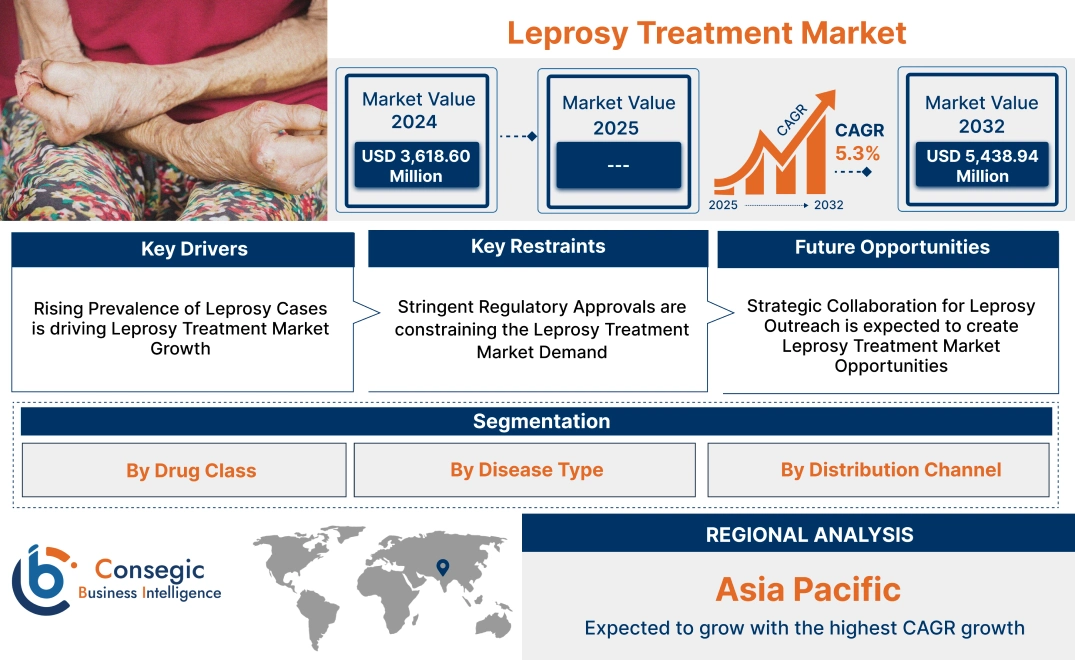
Leprosy treatment market size is estimated to reach over USD 5,438.94 Million by 2032 from a value of USD 3,618.60 Million in 2024, growing at a CAGR of 5.3% from 2025 to 2032.
Leprosy Treatment Market Scope & Overview:
Leprosy is a chronic infectious disease caused by a type of bacteria, mycobacterium leprae. Leprosy treatment refers to the medical approach used to manage and cure leprosy. Based on the drug class, it is divided into sulfone, phenazine, derivative, anti-tubercular drugs, and others. Leprosy treatment is used to cure both multibacillary leprosy and paucibacillary leprosy patients through prevention of bacteria growth and spread of disease. It is widely distributed through various channels such as hospital pharmacies, retail pharmacies, drug stores, and online pharmacies. Government initiatives, collaboration between non-profit organization and international health organizations for leprosy outreach is further driving leprosy treatment market.
Leprosy Treatment Market Dynamics - (DRO) :
Key Drivers:
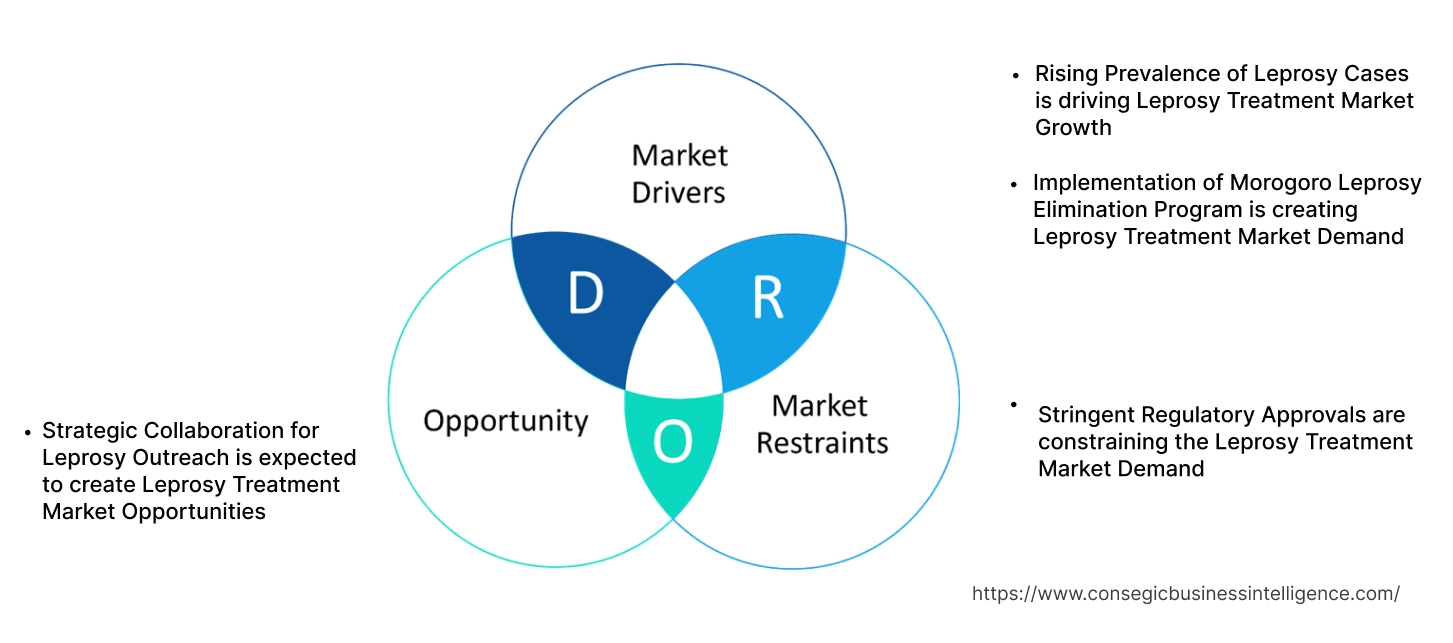
Rising Prevalence of Leprosy Cases is driving Leprosy Treatment Market Growth
Leprosy is a chronic infectious disease caused by a type of bacteria, Mycobacterium leprae. The disease predominantly affects the skin and peripheral nerves. It is treated mainly with the multidrug therapy involving dapsone, rifampicin and clofazimine. The cases of leprosy is rising due to several factors such as genetic modifications, challenges in eradication programme, antimicrobial resistance, and late diagnosis, further driving the market.
- In 2023, according to World Health Organization, a total of 1,82,815 new leprosy cases were reported globally and it is 5% higher than the cases detected in 2022. Leprosy treatment is widely used to cure leprosy patients involving drugs such as sulfone, phenazine, and others.
Thus, rising cases of leprosy cases is leading to leprosy treatment market demand for the effective treatment and management in leprosy patients.
Implementation of Morogoro Leprosy Elimination Program is creating Leprosy Treatment Market Demand
The Morogoro Leprosy Elimination Program is an initiative launched to demonstrate the feasibility of interrupting leprosy transmission through comprehensive interventions. It involves the interruption of transmission through systematic case detection, treatment, contact tracing and single dose rifampicin post-exposure prophylaxis in leprosy patients.
- In 2021, Novartis launched the Morogoro Leprosy Elimination Program (MoLEP) in Tanzania along with the Swiss TPH and country implementing partners. It focused on implementing evidence-based strategies such as single dose rifampicin and post-exposure prophylaxis to prevent leprosy among individuals at risk, further driving the leprosy treatment market.
Thus, implementation of Morogoro Leprosy Elimination Program is leading to leprosy treatment market expansion through interventions and providing single dose rifampicin in the patients.
Key Restraints:
Stringent Regulatory Approvals are constraining the Leprosy Treatment Market Demand
Regulatory approvals are significant restrain in the market due to stringent requirements for the approval of new drugs and therapies. The lengthy and complex approval processes for new medications delays the introduction of innovative treatments, limiting treatment options for patients. Regulatory agencies like United States Food and Drug Administration, European Medicines Agency, and others require extensive clinical trials and data before granting approval, which is time-consuming and costly. Additionally, some countries in low-income region such as Africa face problems with regulatory frameworks, resulting in delays in drug availability or inconsistent access to approved treatments. The process of importing and distributing essential drugs like dapsone, rifampicin and clofazimine is hindered by local regulations, causing disruptions in the supply chain of medications.
Thus, regulatory approvals are constraining leprosy treatment market growth by increasing the time and expense needed to bring treatment to the patients.
Future Opportunities :
Strategic Collaboration for Leprosy Outreach is expected to create Leprosy Treatment Market Opportunities
ALERT-INDIA is an organization which provides free treatment across India while Riyo Adverting is an advertising agency which is a leader in Indian newspaper advertising. The collaboration between ALERT-INDIA and Riyo Adverting is expected to create market opportunities though public outreach and education regarding leprosy. This collaboration also aims to enhance awareness about early symptoms of leprosy among larger population and providing early treatment to prevent further transmission.
- In 2024, ALERT-INDIA collaborated with Riyo Advertising to strengthen outreach for leprosy treatment and stigma reduction in India. It also focuses on importance of early medical intervention and addressing the stigma around the leprosy among the patients.
Thus, collaboration between ALERT-INDIA and Riyo Adverting is creating leprosy treatment market opportunities through public outreach and early interventions among leprosy patients.
Leprosy Treatment Market Segmental Analysis :
By Drug Class:
By drug class, the market is divided into sulfone, phenazine, derivative, anti-tubercular drugs, and others.
Trends in Drug Class
- According to leprosy treatment market trends, sulfone is widely used in the treatment of leprosy due to its efficacy and ability to prevent bacterial growth.
- Incorporation of anti-bacterial drugs in leprosy treatment is rising due to their anti-bacterial and nerve protection properties as per market trends.
The sulfone accounted for the largest market share in the year 2024.
- Sulfone drugs are a class of anti-microbial agents that contains sulfonyl group in their chemical structure.
- They are widely used in the leprosy treatment due to their efficacy and ability to prevent bacterial growth.
- Dapsone, a sulfone derivative is used in both multibacillary and paucibacillary patients to inhibit folic acid synthesis in mycobacterium leprae, thus preventing bacterial growth.
- Dapsone is a primary drug component used in the multidrug therapy of leprosy treatment and governments are largely incorporating dapsone in the multi-drug therapy for effective treatment.
- For instance, in 2024, Government of India, launched new treatment regimen for leprosy under Ministry of Health Affairs. It includes dapsone, rifampicin and clofazimine for paucibacillary cases treatment for six months.
- Thus, sulfone drugs are widely used in the market, due to their efficacy and role in the multidrug therapy.
The anti-bacterial drugs is expected to grow at the fastest CAGR over the forecast period.
- Anti-tubercular drugs are class of drugs that are used in the treatment of tuberculosis due to its ability to prevent the growth of the Mycobacterium tuberculosis bacteria.
- The use of anti-tubercular drugs particularly rifampicin is rising due to its efficacy against mycobacterium leprae.
- Rifampicin inhibits bacterial DNA-dependent RNA synthesis by inhibiting bacterial DNA-dependent RNA polymerase.
- Rifampicin is a key anti-tubercular drug which is essential part of multidrug therapy regimen due to its ability of killing mycobacterium leprae rapidly which reduces risk of transmission and further nerve damage.
- Apart of rifampicin, ethionamide and clofazimine are widely used anti-tubercular drugs with other combinations in the treatment of leprosy.
- Thus, use of anti-tubercular drugs is growing in the leprosy treatment due to anti-bacterial and nerve protection properties.
By Disease Type:
By disease type, the market is divided into multibacillary leprosy and paucibacillary leprosy.
Trends in Disease Type
- According to leprosy treatment market trends, multibacillary leprosy is severe form of leprosy in which extensive leprosy treatment is used.
- Leprosy treatment is growing in paucibacillary leprosy cases due to early detection and better awareness as per market trends.
The multibacillary leprosy accounted for the largest market share in the year 2024.
- Multibacillary leprosy is severe type of leprosy when there are six or more skin patches and/or two or more nerves affected in the patients.
- Multidrug therapy regimen involving dapsone, rifampicin and clofazimine is widely used in the treatment of multibacillary leprosy to reduce bacterial growth and further nerve damage in the patients.
- It is recommended for 12 months leprosy treatment in the patients to prevent the emergence of resistance.
- Further, rising incidence of multibacillary leprosy among leprosy patients is driving the market.
- In 2023, according to World Health Organization, among new leprosy cases founded globally, 8% were reported to be multibacillary cases.
- Thus, multibacillary leprosy is significant as well as growing in the market due to its long treatment duration and high number of cases.
The paucibacillary leprosy is expected to grow at the fastest CAGR over the forecast period.
- Paucibacillary leprosy is a milder form of leprosy characterized by less than five skin lesions and a low bacterial growth with minimal nerve involvement.
- The treatment for paucibacillary leprosy involves multidrug therapy combining drugs such as dapsone, rifampicin and clofazimine for a period of six months.
- The treatment for paucibacillary leprosy is growing due to improvements in early detection and diagnosis methods, which have led to the increase in the number of reported cases.
- With better awareness and access to healthcare, more mild cases are being identified, contributing to the rise in paucibacillary leprosy cases.
- Thus, paucibacillary leprosy is growing in terms of leprosy treatment due to early detection and advanced diagnosis.
By Distribution Channel:
By distribution channel, the market is divided into hospital pharmacies, retail pharmacies, drug stores, and online pharmacies.
Trends in Distribution Channel:
- As per market trends, hospital pharmacies are widely used drugs such as dapsone, rifampicin and clofazimine for the treatment of leprosy in patients.
- Proliferation of online pharmacies is leading to easy and wider accessibility of leprosy treatment as per market trends.
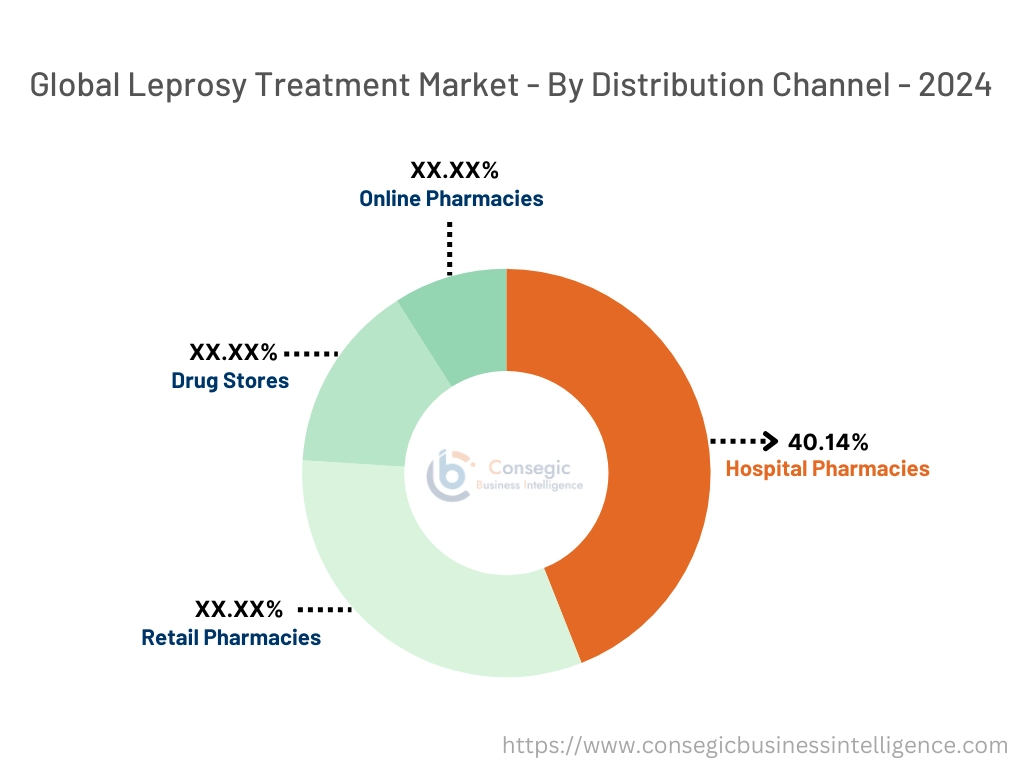
The hospital pharmacies accounted for the largest market share of 40.14% in the year 2024.
- A hospital pharmacy is a department within a hospital that prepares, compounds, stocks and dispenses inpatient medications.
- Hospital pharmacies play a crucial role in the distribution of leprosy treatment ensuring access to essential drugs for patients.
- They facilitate access to the treatment for the patients diagnosed within the hospital settings, offering both in-patient and out-patient services.
- Hospital pharmacies collaborate with governments and non-profit organizations to distribute free or subsidized multi-drug therapy to reduce the burden of leprosy patients.
- They play an integral part in the leprosy treatment within large hospitals and specialized leprosy patient units due to their large distribution of drugs.
- Thus, hospital pharmacies are widely used in the market due to their effective distribution and easy access to the leprosy patients.
The online pharmacies are expected to grow at the fastest CAGR over the forecast period.
- Online pharmacies refer to digital platforms that allow customers to purchase medications and health-related products via the internet.
- In the distribution of leprosy treatment, adoption of online pharmacies is rising due to convenience, lower prices of drugs and quick access to medications.
- Online pharmacies include direct-to-consumer services, telemedicine consultation, and delivery of prescribed medications for the leprosy patients.
- Further, expanding online pharmacies market in countries is driving the market in terms of distribution.
- For instance, in 2023, according to India Brand Equity Foundation, the online pharmacies market in India is expected to increase at a compounded annual rate of 44% by the year 2025. Online pharmacies distribute the drugs such as dapsone, rifampicin, and others which are used in the treatment of leprosy.
- Thus, adoption of online pharmacies is growing in the distribution of drugs for leprosy treatment due to their convenience and direct-to-consumer services.
Regional Analysis:
The regional segment includes North America, Europe, Asia Pacific, the Middle East and Africa, and Latin America.
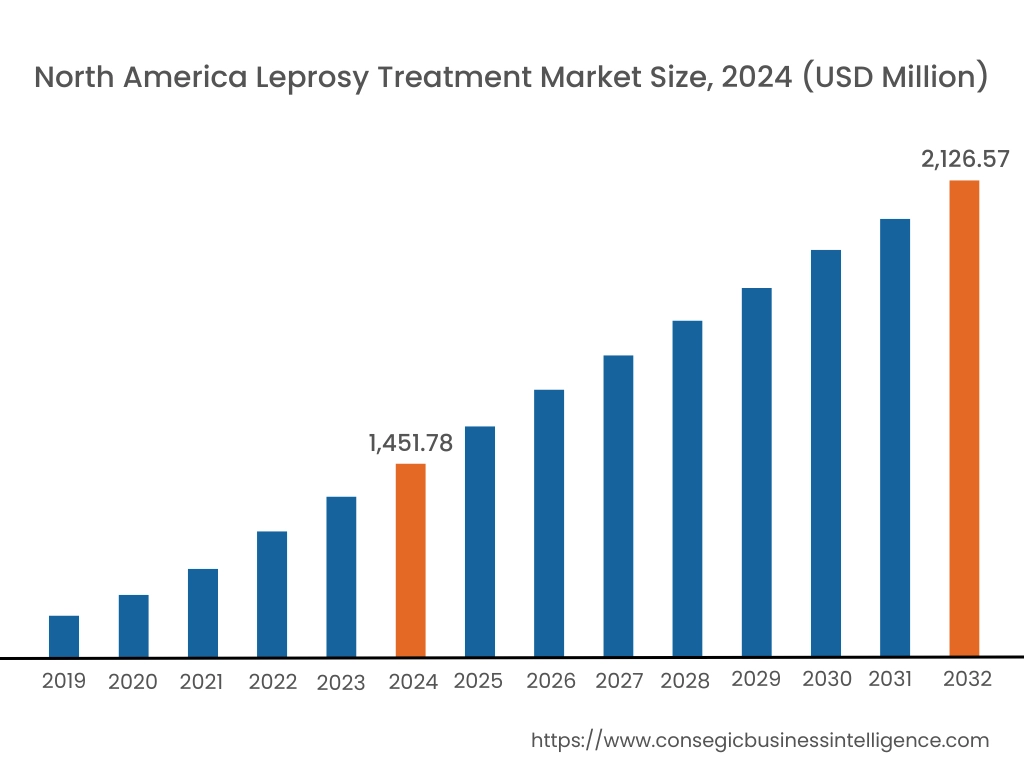
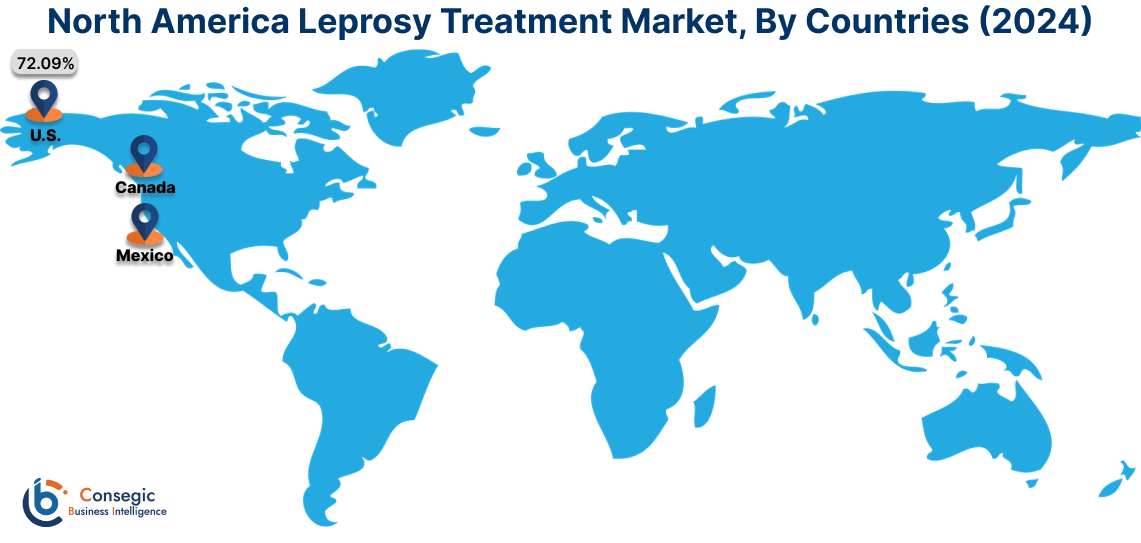
In 2024, North America accounted for the highest market share at 40.12% and was valued at USD 1,451.78 Million and is expected to reach USD 2,126.57 Million in 2032. In North America, United States accounted for the highest market share of 72.09% during the base year of 2024. The leprosy treatment market share of North America is significant due to well-established healthcare infrastructure and rising government initiatives. The region benefits form advanced healthcare technology and growing adoption of telemedicine services. Governments and non-profit organizations such as Centers for Disease Control & Prevention and World Health Organization is raising awareness and providing free multi-drug therapy treatments to the leprosy patients. Moreover, the rising prevalence of leprosy cases in the region is driving the market.
- In 2023, according to Health Resources and Services Administration, 225 new leprosy cases were reported in the U.S. in 2023 presenting 65% increase from the year 2022. Leprosy treatment like multi-drug therapy is widely used in the treatment to prevent transmission and further nerve damage in the patients.
Thus, North America is leading in the market due to rising healthcare investments and growing adoption of telemedicine services as per market analysis.
Asia-pacific is expected to witness the fastest CAGR of 6.0% over the forecast period of during 2025-2032. As per leprosy treatment market analysis, Asia-Pacific region is experiencing rapid proliferation driven by high burden of leprosy diseases in countries like India, Bangladesh, Indonesia, and Nepal. The region’ s growing population and urbanization also contribute to increased healthcare demand, including leprosy treatment. The market in the region is dominated by multidrug therapy regimen including dapsone, rifampicin and clofazimine with a growing focus towards online pharmacies. Governments in this region are partnering with non-profit organizations to facilitate drug accessibility and early detection of leprosy patients. Additionally, the advancement in healthcare technology and improved accessibility in both rural and urban areas is expanding the market. Thus, leprosy treatment market share of Asia-Pacific is expanding due to rising prevalence of leprosy and improved healthcare infrastructure as per market analysis.
According to leprosy treatment market analysis, Europe region is experiencing steady proliferation in the market driven by leprosy cases and ongoing efforts to eradicate the disease. The region remains an important player in the global leprosy control efforts though funding, research, and provision of treatment resources. Online pharmacies and digital health platforms in the region are playing important role in making leprosy treatment accessible, particularly for patients in remote areas or with mobility issues. Research and developments in the region are focused on improving drug formulations and reducing side effects associated with long-term use of leprosy treatment. The region also collaborates with international health organization to ensure equitable access to treatment, further boosting the market in the region.
The Middle East and Africa region is experiencing gradual expansion in the market, driven by increasing awareness, improving healthcare infrastructure and efforts to eliminate the disease. The region includes countries with both low and high incidence rates, such as parts of East Africa, which contribute to the growing demand for effective leprosy treatment. The online pharmacy industry has emerged as a key distributor channel in the region, helping address barriers like limited healthcare access in remote areas. The availability of essential drugs like dapsone, rifampicin and clofazimine is improving through public health programs and private sector involvement. Further, enhanced government initiatives, increased collaboration with international organizations, and telemedicine advancements is further accelerating leprosy treatment market expansion as per analysis.
As per market analysis, the market is driven by ongoing efforts to control and eliminate the disease, particularly in countries with higher prevalence rates such as Brazil, Mexico, and Columbia. The market is primarily driven by the availability of multi-drug therapy, which is provided through public health initiatives and partnerships with global health organizations like World Health Organization. The rise of online pharmacies and digital health platforms has significantly impacted the distribution of leprosy treatment, making medications more accessible, especially in remote areas. Additionally, the growing awareness of leprosy, alongside government and non-profit organization initiatives, is expected to drive the market in the region.
Top Key Players and Market Share Insights:
The leprosy treatment industry is highly competitive with major players providing products to the national and international markets. Key players are adopting several strategies in research and development (R&D) and product innovation to hold a strong position in the global leprosy treatment market. Key players in the leprosy treatment industry include-
- Glaxo Smithcline Pharmaceuticals Ltd (United Kingdom)
- Novartis AG (Switzerland)
- Sanofi (France)
- Bayer (Germany)
- Macleods Pharmaceuticals (United States)
- Cadila Pharmaceuticals (United States)
- Janssen Global Services, LLC (United States)
- AstraZeneca (United Kingdom)
- Eli lily (United States)
- Genetic Pharma (India)
Recent Industry Developments :
Launches:
- In 2023, Government of India has launched National Strategic Plan (NSP) & Roadmap for Leprosy (2023-27) to achieve zero transmission of leprosy by 2027. It focuses on awareness for zero stigma & discrimination, free of cost leprosy treatment roll out of web-based information portal (Nikusth 2.0) for reporting of leprosy cases.
Leprosy Treatment Market Report Insights :
| Report Attributes | Report Details |
| Study Timeline | 2019-2032 |
| Market Size in 2032 | USD 5,438.94 Million |
| CAGR (2025-2032) | 5.3% |
| By Drug Class |
|
| By Disease Type |
|
| By Distribution Channel |
|
| By Region |
|
| Key Players |
|
| North America | U.S. Canada Mexico |
| Europe | U.K. Germany France Spain Italy Russia Benelux Rest of Europe |
| APAC | China South Korea Japan India Australia ASEAN Rest of Asia-Pacific |
| Middle East and Africa | GCC Turkey South Africa Rest of MEA |
| LATAM | Brazil Argentina Chile Rest of LATAM |
| Report Coverage |
|
Key Questions Answered in the Report
How big is the leprosy treatment market? −
In 2024, the leprosy treatment market is USD 3,618.60 million.
Which is the fastest-growing region in the leprosy treatment market? +
Asia-Pacific is the fastest-growing region in the leprosy treatment market.
What specific segmentation details are covered in the leprosy treatment market? +
Drug class, disease type, and distribution channel are covered in the leprosy treatment market.
Who are the major players in the leprosy treatment market? +
Glaxo Smithcline Pharmaceuticals Ltd (United Kingdom), Novartis AG (Switzerland), and Cadila Pharmaceuticals (United States) are some of the major players in the market.
Overview
Reputation & Certifications


Our Services
- Market Intelligence & Forecasting
- Custom Research Solutions
- Market Entry Strategy
- Competitive Intelligence
- Customer Insights
- Industry Innovation Analysis
- Investment Advisory