Jump to Content
Ascites Market - Size, Share, Industry Trends, and Forecasts (2025-2032)
Ascites Market Size:
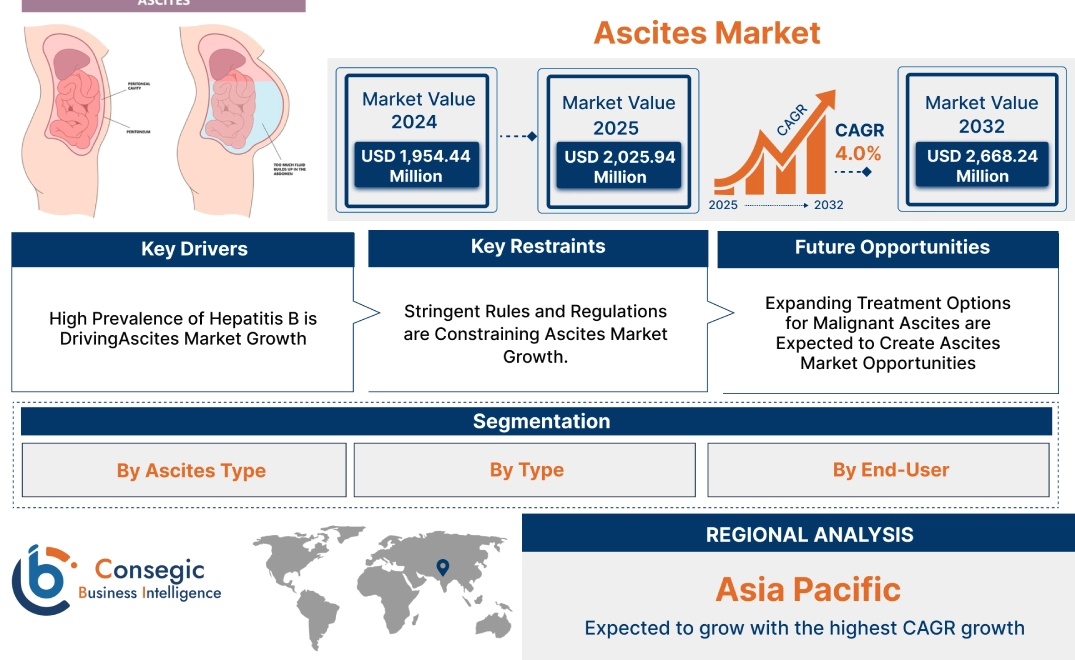
The ascites market size is growing with a CAGR of 4.0% during the forecast period (2025-2032), and the market is projected to be valued at USD 2,668.24 Million by 2032 from USD 1,954.44 Million in 2024. Additionally, the market value for 2025 attributes to USD 2,025.94 Million.
Ascites Market Scope & Overview:
Ascites is the medical condition that refers to the abnormal accumulation of fluid in the peritoneal cavity. It is commonly caused by liver cirrhosis, liver cancer, infections or heart diseases. The symptom in this condition includes abdominal swelling, discomfort, difficulty breathing, and weight gain. There are two types of this condition- transudative and exudative. The diagnostic methods include computed tomography (CT) scan, blood test, laparoscopy, and others. There are different treatment options for ascitic patients such as diuretics, paracentesis, surgery, and others. Ascites is diagnosed and treated by hospitals, ambulatory surgical centers, specialty clinics and others. Further, advancement in minimally invasive treatment options is enhancing the management of ascetic fluid among the patients thereby driving the market demand.
How is AI Impacting the Ascites Market?
AI is significantly impacting the ascites market by enhancing diagnostic accuracy and treatment planning. Through the use of deep learning models, AI can analyze medical images like CT scans and ultrasounds to detect the presence and quantify the volume of ascitic fluid with high precision, often exceeding the capabilities of manual analysis. This technology also helps pathologists more accurately differentiate between benign and malignant ascites, which is crucial for diagnosing underlying conditions like metastatic cancer. Furthermore, AI assists in predicting disease progression and patient outcomes, enabling a more personalized approach to treatment and helping to identify the most effective therapeutic strategies.
Ascites Market Dynamics - (DRO) :
Key Drivers:
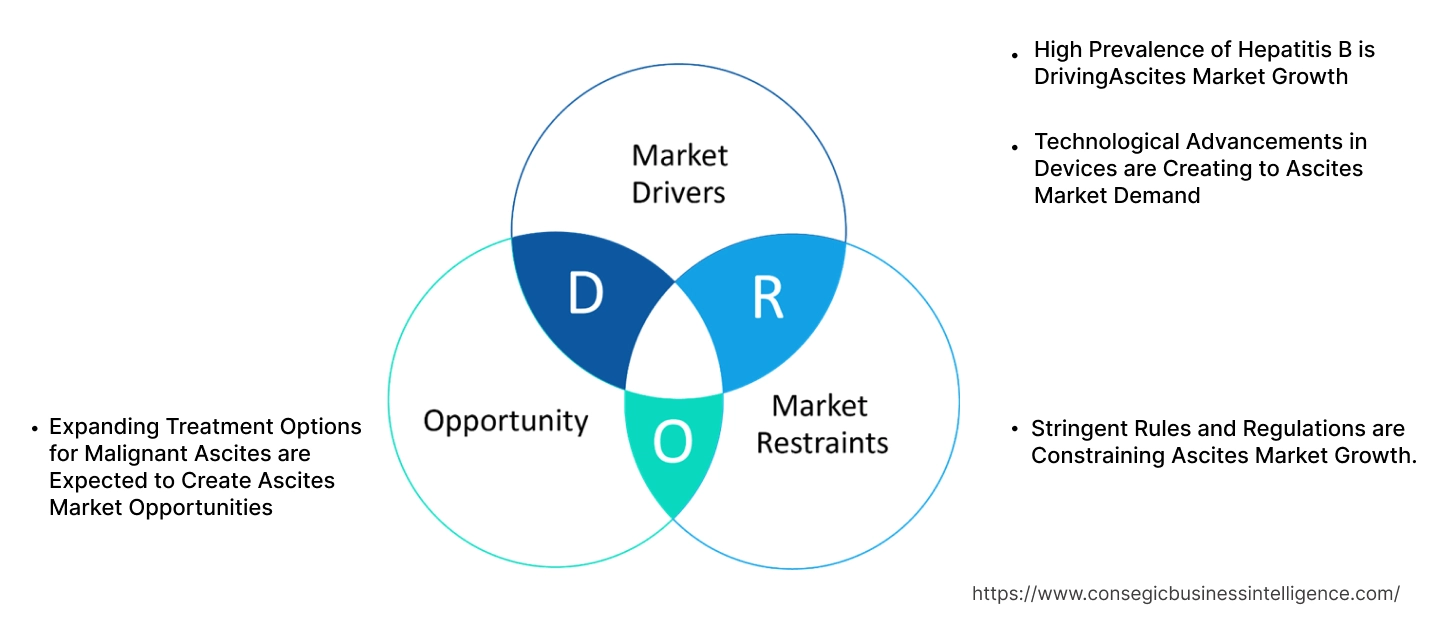
High Prevalence of Hepatitis B is Driving Ascites Market Growth
Chronic Hepatitis B is a long-term infection with the Hepatitis B virus disease that persists for deterioration of liver functions for more than six months leading to inflammation and impaired liver function over time. It causes increased pressure in the portal vein which leads to fluid leakage in the abdomen causing ascites. The cases of chronic hepatitis B are growing due to high transmission rates, lack of early symptoms, and rising population, further driving the market.
- In 2022, according to World Health Organization, global prevalence of chronic hepatitis B is 254 million cases. These high cases of chronic hepatitis B resulted in the greater number of ascitic patients due to low levels of albumin production and retention of fluid in the abdominal cavity.
Thus, the high global prevalence of chronic hepatitis B is leading to ascites market demand.
Technological Advancements in Devices are Creating to Ascites Market Demand
Technological advancements of devices in management of ascites are major driver in the market. It includes a peritoneal catheter system and large volume paracentesis. Peritoneal dialysis catheters continuously drainage the ascetic fluid while large volume paracentesis is useful for severe and resistant ascites. Moreover, companies are developing implantable medical devices for the management of this condition.
- In 2024, Sequana Medical launched alfapump for the treatment of ascites. It is an active implantable medical device that automatically and continuously removes ascetic fluid from the abdomen into the bladder, where it is naturally eliminated through urination. Further, it facilitates the management of ascitic patients by reducing the need for therapeutic fluid removal.
Hence, technological advancements in treatment are leading to ascites market expansion.
Key Restraints:
Stringent Rules and Regulations are Constraining Ascites Market Growth.
Rules and regulations are significantly restraining the market due to stringent requirements for the approval of diagnostics tools and new drug medications. There are lengthy and complex approval processes for new medications and implantable medical devices. This involves multiple stages, including preclinical trials, testing, and biocompatibility evaluations, which are time-intensive and costly. It delays the introduction of innovative treatments, limiting treatment options for ascitic patients. Regulatory agencies such as United States Food and Drug Administration, European Medicines Agency, and others require extensive clinical trials and data before granting approval to drug medications and medical devices. Thus, rules and regulations are constraining market growth due to regulatory standards and complex approval processes for new medications.
Future Opportunities :
Expanding Treatment Options for Malignant Ascites are Expected to Create Ascites Market Opportunities
Malignant ascites is an abnormal buildup of fluids in the abdominal cavity due to cancer spreads. It has limited treatment options such as paracentesis, diuretics, and shunt placement. The malignant ascites cases are growing due to rising cancer incidence and lack of early symptoms. Due to this, companies are expanding treatment options for this condition.
- In 2024, Pharmanovia Signs agreement with Lindis Biotech for the commercialization of Catumaxomab in Europe. It is monoclonal antibody which is used as target drug therapy for tumor cell destruction, further reducing fluid accumulation in ascitic patients. This will create market opportunities due to rising demand for targeted drug therapy in the treatment.
Hence, expanding treatment options for malignant ascites is expected to create ascites market opportunities
Ascites Market Segmental Analysis :
By Ascites Type:
Based on ascites type, the market is categorized as transudative and exudative.
Trends in Ascites Type:
- According to ascites market trends, advanced diagnostic techniques such as B-mode gray-scale ultrasound histogram analysis helps in early detection of transudative type.
- Growing prevalence of peritoneal carcinomatosis is leading to exudative type as per market trends.
The transudative segment accounted for the largest market share in the year 2024.
- Transudative ascites is a medical condition characterized by the accumulation of fluid with low protein content (<2.5g/dL) and low-serum albumin gradient (SAAG ≥ 1.1g/dL).
- It is most commonly caused by portal hypertension due to fluid-buildup in the peritoneal cavity.
- Transudative ascites is growing among the patients due to high cases of cirrhosis, heart failure, and nephrotic syndrome.
- For instance, according to Centers for Disease Control and Prevention, 6.7 million cases of heart failure are diagnosed in the United States in 2022. These high cases of heart failure are leading to transudative ascites, where fluid leaks into the peritoneal cavity due to portal hypertension on venous congestion.
- Moreover, advanced non-invasive techniques such as B-mode gray-scale ultrasound histogram analysis are used in the diagnosis of this condition.
- Hence, transudative ascites segment is dominating in the market due to high cases of heart failure and advanced diagnostic techniques.
The exudative segment is expected to grow at the fastest CAGR over the forecast period.
- Exudative ascites is a medical condition that occurs when fluid accumulations in the peritoneal cavity is due to inflammatory, infectious or malignant conditions.
- It contains high protein content (>2.5g/dL) and elevated lactate dehydrogenase levels in the patients.
- Malignancies such as peritoneal carcinomatosis, ovarian and pancreatic cancer are major causes for this condition.
- Advancements in biomarkers, imaging, and genetic profiling have improved the detection rates in this condition.
- Further, growing development of advanced immunotherapy and novel anti-inflammatory drugs have enhanced the testament options.
- Thus, rising prevalence of malignancies and early detection techniques are helping in the management of exudative ascites thereby driving the growth of the segment.
By Type:
Based on type, the market is categorized into diagnosis and treatment.
Trends in Type:
- As per the ascites market trends, advancements in abdominal ultrasound are improving early and confirm diagnosis of the condition.
- Use of drug medications is growing in the treatment as per market trends.
The diagnosis segment accounted for the largest market share in the year 2024.
- Diagnosis is further categorized into ultrasound, CT scan, blood test, laparoscopy, and others.
- In ultrasound, an abnormal amount of intraperitoneal fluid is visible which confirms the presence of ascites.
- While ascites is seen as low-density collection surrounding the bowel in CT scan imaging technique.
- Further, blood tests such as liver function test and complete blood count show low levels of albumin, elevated total protein content, and platelet count in the blood among the patients.
- Hence, diagnosis segment is dominating in the market due to early and confirm diagnosis of ascites through ultrasound and computed tomography.
The treatment segment is expected to grow at the fastest CAGR over the forecast period.
- Treatment is further categorized into diuretics, paracentesis, surgery, and others.
- Diuretics such as furosemide, spironolactone reduces excess fluid accumulation inn the abdominal cavity by increasing urine output and decreasing sodium retention.
- Further, demand for novel drug medications for treatment is growing. To cater this, companies are developing drug which is used to lower complications such as vasoconstriction.
- In 2023, Ocelot Bio developed OCE-205 for the treatment of ascitic patients. It is a therapeutic peptide which prevents fluid retention and overload in ascitic patients.
- Therefore, development of novel drug medication is lowering complications in the patients thereby driving the growth of the segment.
By End User:
Based on end-user, the market is categorized into hospitals, ambulatory surgical centers, specialty clinics and others.
Trends in End-User:
- As per market trends, hospitals are adopting advanced diagnostic and specialized treatment options for providing comprehensive care to the ascitic
- Preference for ambulatory surgical centers is growing due to cost effectiveness and accessibility as per market trends.
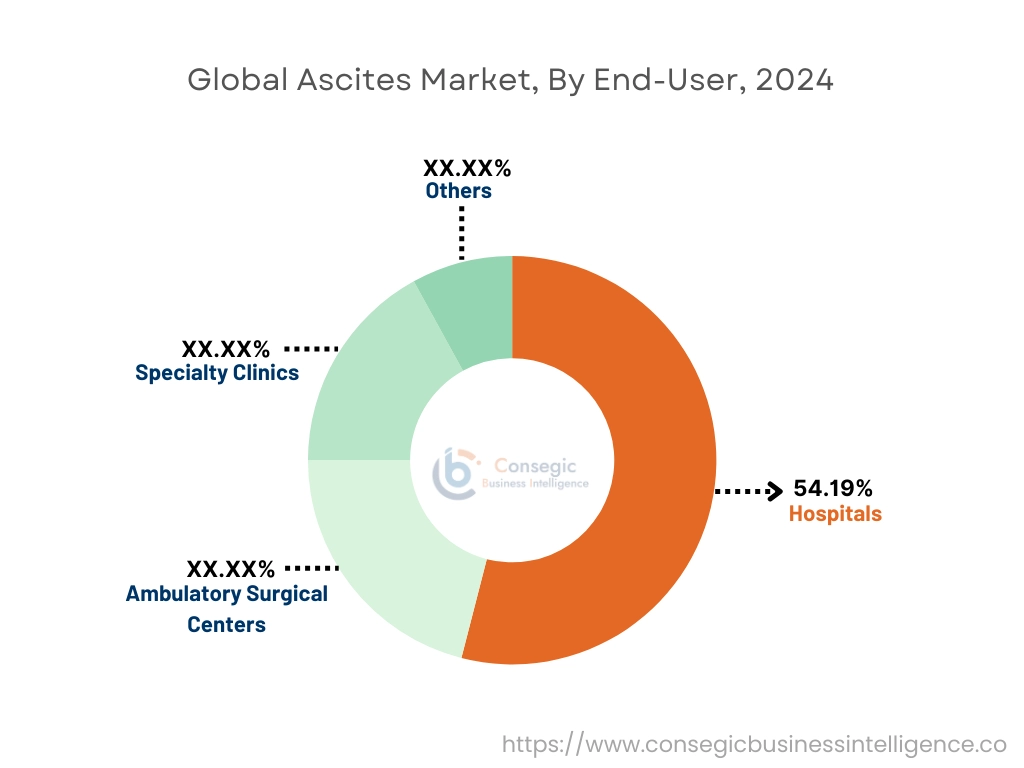
The hospitals segment accounted for the largest market share of 54.19% in the year 2024.
- Hospitals play a major role in the management of ascitic patients through advanced diagnosis methods and treatment options.
- They are widely preferred by the patients due to advanced technology, well-developed infrastructure and skilled healthcare professionals.
- Further, the hospitals are incorporating new procedures for the treatment of ascitic patients.
- For instance, in 2022, Apollo Hospitals performed Transjugular Intrahepatic Porto Systemic Shunt (TIPSS) procedure in the ascitic This procedure creates an artificial channel between the inflow portal vein and the outflow hepatic vein thereby reducing fluid accumulation in the patients.
- Hence, the hospitals segment is dominating in the market due to advanced diagnosis methods and wide treatment options.
The ambulatory surgical centers segment is expected to grow at the fastest CAGR over the forecast period.
- An ambulatory surgical center is a healthcare facility that provides same day surgical care, including diagnostic and preventive procedures.
- The adoption of an ambulatory surgical center is growing due to its ability to handle a wide range of diagnostic methods such as ultrasound, CT scan, and minimally invasive surgeries for fluid removal.
- The shift towards outpatient setting is growing driven by advancements in surgical techniques and imaging technology.
- This has contributed to the growing role of ambulatory surgical centers in the treatment of ascitic patients.
- Thus, adoption of ambulatory surgical centers is rising in the management of ascitic patients supported by advanced surgical techniques and improved clinical outcomes, thereby driving the growth of the segment.
Regional Analysis:
The regional segment includes North America, Europe, Asia Pacific, the Middle East and Africa, and Latin America.
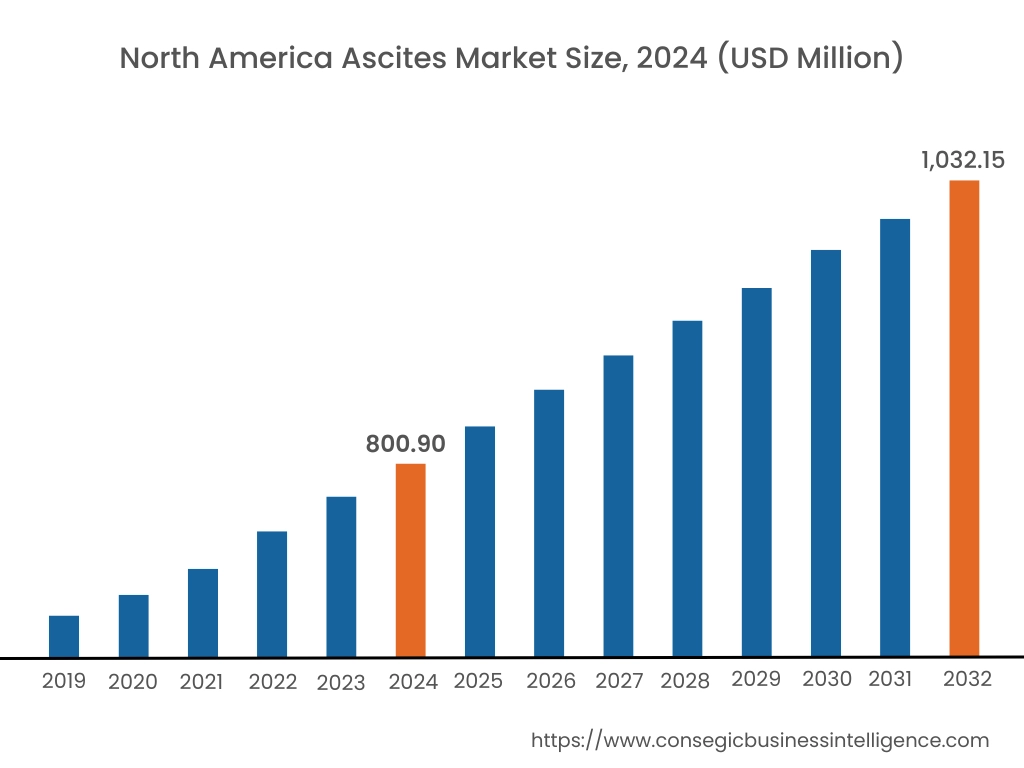
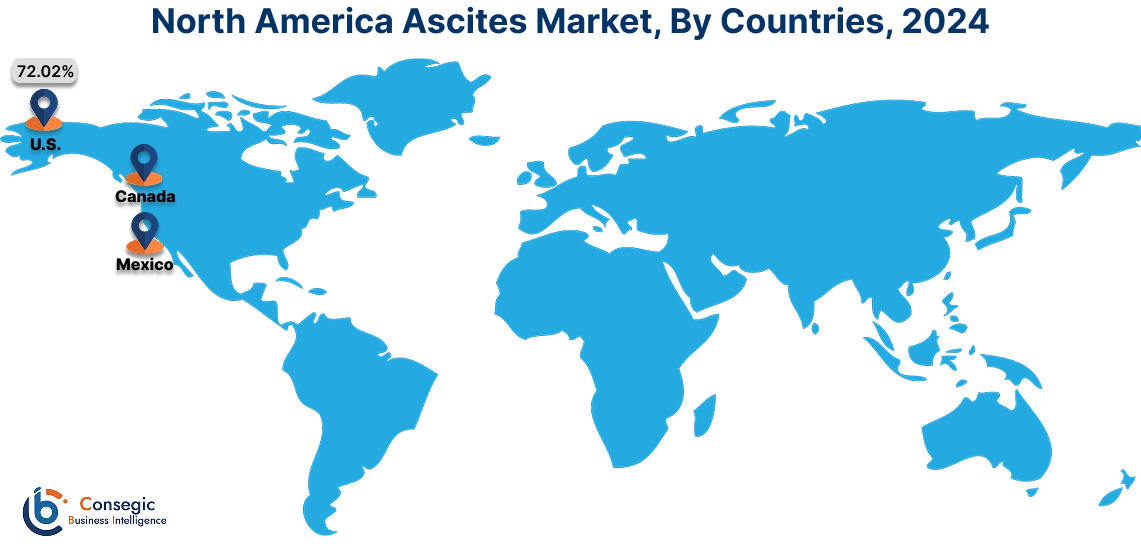
In 2024, North America accounted for the highest market share at 40.98% and was valued at USD 800.90 Million and is expected to reach USD 1,032.15 Million in 2032. In North America, United States accounted for the highest ascites market share of 72.02% during the base year of 2024. As per market analysis, North America holds a dominant position in the market due to growing cases of liver cancer. Countries such as United States, Canada, and Mexico are major contributors in the market due to growing cases of liver cancer.
- According to World Cancer Research Fund, 43,492 new cases of liver cancer is diagnosed in the United States in 2022. These high cases of liver cancer has resulted in the ascites through liver damage and fluid leakage in the abdominal cavity.
Thus, North America is leading in the market due to growing cases of liver cancer per analysis.
Asia-pacific is expected to witness the fastest CAGR of 5.5% over the forecast period of 2025-2032. According to Ascites market analysis, the Asia Pacific region is growing rapidly driven by in the market due to government initiatives. The governments in the region are collaborating with research institutes for the development of effective treatment for ascitic patients. The increasing number of hospitals and specialty clinics is further driving the adoption of advanced ultrasound and paracentesis in the management of ascitic patients. Hence, the ascites market share of Asia Pacific is experiencing rapid growth through rising government initiatives.
According to ascites market analysis, Europe region is experiencing steady growth in the market driven by advanced ambulatory surgical centers. The region is well developed with modern diagnostic technology and skilled oncologists along with digital healthcare infrastructure. Also, the governments in the region are investing in research and development of drug therapy for treatment in ascitic patients. It is further leading to ascites market expansion in the region.
The Middle East and Africa regions are experiencing gradual demand in the market, driven by increasing awareness about rare diseases and improving healthcare industry. Countries such as Dubai, UAE, and South Arica are major contributors in the market where advanced hospitals and government organizations provide access to advanced diagnosis and treatment options for ascitic patients. Further, the cancer centers in the region are offering advanced treatment for liver cancer thereby reducing fluid accumulation in the patients as per analysis.
As per analysis, the market in Latin America is driven by economic developments and partnerships with international health organizations. Countries such as Brazil, Mexico and Argentina are major contributors in the region due to modern healthcare industry. The rise of ambulatory surgical centers has significantly impacted on the availability of advanced diagnosis and treatment options for rare diseases. Additionally, ascitic patients in the region prefer laparoscopic minimal invasive surgery for the treatment due to its fewer side effects.
Top Key Players & Market Share Insights:
The ascites industry is highly competitive with major players providing products to the national and international markets. Key players are adopting several strategies in research and development (R&D) and product innovation to hold a strong position in the global ascites market. Key players in industry include-
- Hoffmann-La Roche Ltd. (Switzerland)
- Sequana Medical NV (Belgium)
- Novartis AG (Switzerland)
- AstraZeneca (United Kingdom)
- Sanofi (France)
- BioVie Inc (United States)
- Mylan N.V (United States)
- Fresenius SE & Co. KGaA (Germany)
- Johnson & Johnson Private Limited (United States)
- PharmaCyte Biotech Inc. (United States)
Ascites Market Report Insights:
| Report Attributes | Report Details |
| Study Timeline | 2019-2032 |
| Market Size in 2032 | USD 2,668.24 Million |
| CAGR (2025-2032) | 4.0% |
| By Ascites Type |
|
| By Type |
|
| By End-User |
|
| By Region |
|
| Key Players |
|
| North America | U.S. Canada Mexico |
| Europe | U.K. Germany France Spain Italy Russia Benelux Rest of Europe |
| APAC | China South Korea Japan India Australia ASEAN Rest of Asia-Pacific |
| Middle East and Africa | GCC Turkey South Africa Rest of MEA |
| LATAM | Brazil Argentina Chile Rest of LATAM |
| Report Coverage |
|
Key Questions Answered in the Report
How big is the ascites market? −
In 2024, the ascites market is USD 1,954.44 million.
Which is the fastest-growing region in the ascites market? +
Asia Pacific is the fastest-growing region in the ascites market.
What specific segmentation details are covered in the ascites market? +
Ascites Type, Type and End-User are covered in the ascites market.
Who are the major players in the ascites market? +
F. Hoffmann-La Roche Ltd. (Switzerland), Sequana Medical NV (Belgium), and BioVie Inc (United States) are some of the major players in the market.
Overview
Reputation & Certifications


Our Services
- Market Intelligence & Forecasting
- Custom Research Solutions
- Market Entry Strategy
- Competitive Intelligence
- Customer Insights
- Industry Innovation Analysis
- Investment Advisory