Jump to Content
Surgical Robot Market - Size, Share, Industry Trends, and Forecasts (2025 - 2035)
Surgical Robot Market 2025 - 2035:
- The Global Surgical Robot Market recorded a valuation of USD 9.31 billion in 2025.
- The market is expected to grow at a CAGR of 9.98% during 2025-2035.
- The global market size is projected to reach USD 24.10 billion by 2035.
- North America held the dominant share of the Surgical Robot Market in 2024.
Surgical Robot Market Scope & Overview:
Surgical robots are computer assisted systems designed to support surgeons during minimally invasive procedures with enhanced precision, visualization, and instrument control. The industry includes robotic platforms, surgical instruments, imaging integration, software systems, and service support. These systems are used across procedures such as urology, gynecology, general surgery, orthopedics, and cardiothoracic interventions. The major end-users of this technology include hospitals, specialty surgical centers, and academic medical institutions.
The surgical robot market is growing due to the increasing need for minimally invasive procedures and the need for increased accuracy in surgical procedures. Hospitals are increasing investments in robotic platforms to improve clinical outcomes and reduce patient recovery time. Continuous product development from medical device companies and the expansion of robotic surgery training programs are strengthening adoption. Regulatory clearances in the US, Europe, and Asia are also supporting wider clinical deployment.
Market Size & Forecast
- 2024 Market Size : USD 8.46 Billion
- 2025 Market Size : USD 9.31 Billion
- 2035 Projected Market Size : USD 24.10 Billion
- CAGR (2025-2035) : 9.98%
- Largest Market in 2025: North America
How is the Surgical Robot Market Affected by AI?
AI is improving surgical robotic systems through better imaging analysis and procedural guidance. AI algorithms assist surgeons in identifying anatomical structures and support precise instrument movement during minimally invasive procedures. This helps to ensure greater accuracy in the procedures, reducing the chances of any adverse effects occurring during the procedure.
There is also increased support from AI for surgical planning and training through the use of simulations and data analysis tools. The hospitals make use of this to analyze the results of the procedures and then enhance the procedures accordingly.

Surgical Robot Market Dynamics - (DRO):
Key Drivers:
Increasing incidence of chronic disorders requiring complex surgical interventions drives the market growth
The burden of chronic health conditions, including cancer, cardiovascular, and orthopedic diseases, is increasing globally in the US, European countries, and Asia. These health conditions require accurate and complex surgical interventions. To achieve this, hospitals are using robotic surgery techniques to ensure precision in minimally invasive surgeries, reducing complications. Advanced robotic surgery techniques are helpful in performing complex surgeries, especially delicate ones, with better visualization.
- For instance, in September 2025, WHO estimated that 43 million deaths from chronic diseases in 2021, or 75% of all non-pandemic deaths worldwide, occurred due to chronic health conditions. Of these, 18 million deaths occurred prematurely before age 70, with 82% of these premature deaths happening in low and middle-income countries.
Therefore, it is seen that the growing incidence of chronic conditions is resulting in an increase in the demand for robotic-assisted surgical procedures.
Key Restraints:
High capital cost associated with surgical robotic systems and installation restrains the market growth
Surgical robotic systems require substantial investment for procurement, installation, and operating room integration. There are also extra costs associated with system upkeep, disposable instruments, and staff training. Budgetary constraints in medium-sized hospitals and healthcare centers in developing countries are another factor hindering the adoption of technology. Insufficient reimbursement for robotic surgery is another factor that could affect some healthcare systems.
Therefore, it is evident that the high capital cost is a factor hindering the use of surgical robotic systems.
Future Opportunities:
Integration of artificial intelligence for surgical planning and decision support creates growth avenues
The technologies used in artificial intelligence are helping to improve the quality of surgical robotics systems by analyzing images in more efficient ways. AI-based systems are assisting surgeons in identifying the anatomy of patients' bodies and determining the best ways to perform surgeries. Hospitals are using AI-based systems to evaluate the success of surgeries and improve the quality of their surgical procedures. AI-based systems are helping to integrate robotics systems with more efficient workflows in the operating rooms of hospitals.
- For instance, in November 2025, Advita Ortho formally launched as a medical device company with a focus on the global market, acquiring Exactech orthopedic products such as the Equinoxe shoulder system, Vantage ankle system, Alteon hip system, Truliant knee system, and GPS systems.
Therefore, the integration of artificial intelligence is opening up growth prospects in the surgical robot sector.
Surgical Robot Market Segmental Analysis:
By Application:
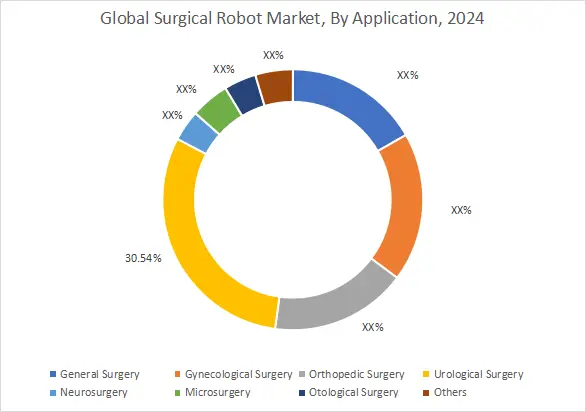
On the basis of application, the surgical robot market is segmented into general surgery, gynecological surgery, orthopedic surgery, urological surgery, neurosurgery, microsurgery, otological surgery, and others.
Trends in the Application:
- Increasing adoption of robotic assistance in minimally invasive procedures is expanding application scope.
- Hospitals are integrating robotic systems across multiple surgical specialties.
The urological surgery was responsible for the highest revenue share of 30.54% in 2024.
- Robotic systems are widely used for procedures such as prostatectomy.
- Moreover, improved precision supports better outcomes in delicate urological procedures.
- In addition, surgeons prefer robotic assistance for complex pelvic surgeries.
- Further, established clinical experience supports continued procedure volumes.
- Therefore, higher adoption in prostate and kidney surgeries is supporting dominance of the urological surgery segment.
It is anticipated that the orthopedic surgery will exhibit the highest compound annual growth rate (CAGR) during the forecast period.
- Robotic systems assist surgeons in improving implant positioning accuracy.
- Also, increasing number of joint replacement procedures is expanding adoption.
- In addition, hospitals are integrating robotic platforms into orthopedic operating rooms.
- Moreover, technology advancements are improving procedural planning and alignment accuracy.
- Therefore, growing demand for robotic assisted joint replacement procedures is driving growth of the orthopedic surgery segment.
By End User:
On the basis of end user, the surgical robot market is divided into hospitals, specialty clinics, and ambulatory surgery centers.
Trends in the End User:
- Hospitals are expanding robotic surgery programs across major surgical departments.
- Increasing shift toward outpatient procedures is supporting robotic adoption in ambulatory settings.
Hospitals accounted for the largest revenue share in the year 2024.
- Hospitals have the financial capacity to invest in high-cost robotic systems.
- Moreover, higher surgical procedure volumes support system utilization.
- In addition, availability of trained surgeons strengthens robotic surgery programs.
- Further, hospitals serve as primary centers for complex surgical interventions.
- Therefore, large scale infrastructure and higher patient inflow are supporting dominance of the hospitals segment.
Ambulatory surgery centers is anticipated to register the fastest CAGR during the forecast period.
- Ambulatory centers are expanding minimally invasive surgical services.
- Also, demand for shorter hospital stays is increasing outpatient procedures.
- In addition, compact robotic systems are supporting adoption in outpatient facilities.
- Moreover, healthcare systems are focusing on cost efficient surgical care models.
- Therefore, increasing outpatient surgical volumes are driving growth of the ambulatory surgery centers segment.
Regional Analysis:
North America, Europe, Asia Pacific, the Middle East and Africa, and Latin America are the regions of coverage.
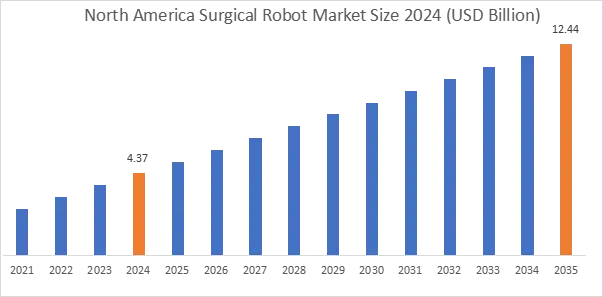
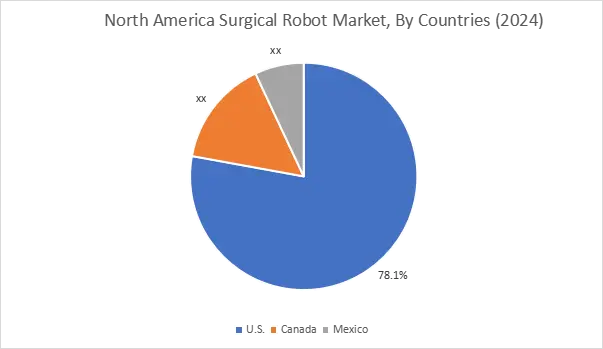
In 2024, North America accounted for the highest market share at 51.63% and was valued at USD 4.37 Billion, and is expected to reach USD 12.44 Billion by 2035. In North America, the U.S. accounted for the highest market share of 78.1% during the base year of 2024. Market growth is driven by high healthcare spending and early adoption of advanced surgical technologies. Large hospitals are expanding robotic surgery programs across urology, gynecology, and general surgery procedures. Continuous product launches from medical device manufacturers are also strengthening the regional market.
- For example, the U.S. National health expenditures reported that the spending in the US for the year 2024 was 5.3 trillion US dollars, which translates into 15,474 US dollars per individual. This indicates an increase of 7.2%. Therefore, the expenditure in the US for healthcare is opening up prospects in the surgical robot sector.
Asia Pacific is expected to grow the fastest during the forecast period. China is building hospital infrastructure and procuring more robotic surgical systems in large urban hospitals. Japan is using robots in the development of advanced surgical capabilities, owing to the presence of a strong medical technology ecosystem. India is witnessing the adoption of robots in the country, primarily through the expansion of the country’s private hospital sector, which is providing minimally invasive robotic surgeries. Medical tourism in Southeast Asia is also boosting the demand for robotic surgeries.
- For example, In July 2025, Aster MIMS Hospital in Calicut, India, introduced the first "Da Vinci Xi Robotic Surgical System," which enabled the hospital to develop an "Advanced Centre for Robotic Surgery," which covers urology, gynecology, general surgery, and oncology.
The Europe market for surgical robots is driven by increasing acceptance of minimally invasive procedures in Germany, France, and the UK. Additionally, government initiatives to upgrade the medical infrastructure are boosting demand for surgical robots in public sector hospitals.
The Latin American market for surgical robots is driven by the growth of private medical facilities in Brazil and Mexico, where private hospitals are investing in robotic surgery solutions for complex procedures in their large medical facilities.
Middle East and Africa surgical robot market is growing due to healthcare infrastructure investment in the UAE, Saudi Arabia and South Africa. Hospitals are investing in advanced medical equipment for providing specialized services.
Top Key Players & Market Share Insights:
The surgical robot industry is moderately concentrated with players across the entire spectrum of the robot, surgical instrument, and service support segments. Medical device manufacturers are focusing on system innovation and increasing product breadth to enhance clinical acceptance. Partnerships with hospitals and surgical training centers are also boosting the adoption of surgical robot procedures. The competition is also rising with the entry of new players in the industry, offering specialized surgical robot systems in various surgical procedures. Key participants in the market for surgical robot include:
- Intuitive Surgical – US
- Stryker Corporation – US
- Zimmer Biomet – US
- Medtronic Plc – US
- Johnson & Johnson – US
- CMR Surgical – UK
- Asensus Surgical – US
- Distalmotion – Switzerland
- Titan Medical Group – US
- Medicaroid – Japan
Recent Industry Developments:
- In January 2026, Johnson & Johnson has submitted their OTTAVA Robotic Surgical System for De Novo classification by the FDA, using IDE study data for upper abdominal procedures like gastric bypass, gastric sleeve, small bowel resection, and hiatal hernia repair.
- In December 2025, Medtronic has obtained FDA clearance for their Hugo Robotic-Assisted Surgery (RAS) platform for urologic procedures like prostatectomy, nephrectomy, and cystectomy, using the Expand URO study and their digital ecosystem with Touch Surgery™ for training, tele-proctoring, and AI insights.
Surgical Robot Market Report Insights:
| Report Attributes | Report Details |
|---|---|
| Study Timeline | 2019-2035 |
| Market Size in 2035 (USD Billion) | USD 24.10 Billion |
| CAGR (2025-2035) | 9.98% |
| By Application |
|
| By End User |
|
| By Region |
|
| Key Players |
|
| Report Coverage |
|
Key Questions Answered in the Report
How big is the surgical robot market? −
The surgical robot market size is estimated to reach over USD 24.10 Billion by 2035 from a value of USD 8.46 Billion in 2024 and is projected to grow by USD 9.31 Billion in 2025, growing at a CAGR of 9.98% from 2025 to 2035.
Which segmentation details are covered in the surgical robot report? +
The surgical robot report includes specific segmentation details for application, end user, and regions.
Which is the fastest segment anticipated to impact the market growth? +
Urological surgery is growing rapidly due to high adoption of robotic systems for prostate and kidney procedures.
Who are the major players in the surgical robot market? +
The key participants in the surgical robot market are Intuitive Surgical (US), Stryker Corporation (US), Zimmer Biomet (US), Medtronic Plc (US), Johnson & Johnson (US), CMR Surgical (UK), Asensus Surgical (US), Distalmotion (Switzerland), Titan Medical Group (US), Medicaroid (Japan), and others.
What are the key trends in the surgical robot market? +
Growing adoption of robotic minimally invasive procedures and increasing integration of AI in surgical planning are shaping the market.
Overview
Reputation & Certifications


Our Services
- Market Intelligence & Forecasting
- Custom Research Solutions
- Market Entry Strategy
- Competitive Intelligence
- Customer Insights
- Industry Innovation Analysis
- Investment Advisory